




Learning Tally often feels confusing for students and job seekers in Nepal. You see hundreds of training ads promising quick jobs, yet many people finish the course and still struggle to get hired. The problem is not your effort. It is choosing the wrong training, unclear course structure, and a lack of real accounting exposure. This leaves fresh graduates, +2 students, and career switchers unsure whether Tally alone is enough to build a stable career.
That is where the right guidance matters. Tally is a powerful accounting tool, but its real value depends on how and where you learn it.
This guide breaks down everything you need to know about Tally training in Nepal, including courses, fees, job roles, and career growth. By the end, you will know the smartest path to turn Tally skills into real accounting opportunities.
In this blog
What is Tally and Why is it Important in Nepal?
Tally is one of the most widely used accounting software programs in Nepal for managing daily financial operations. It helps businesses record transactions, track income and expenses, manage taxes, generate reports, and stay compliant with government regulations. In simple terms, Tally turns complex accounting work into an organized and efficient system.
Tally Prime, the latest version, is especially popular among Nepali businesses because it is user-friendly and designed for real-world accounting needs. From small shops to large enterprises, Tally is used to handle financial data accurately and quickly.
Tally is important in Nepal because most businesses prefer skilled professionals who can work with digital accounting systems instead of manual records. With increasing tax regulations and reporting requirements, companies rely on Tally to stay compliant and reduce errors.
Key reasons why Tally is widely used in Nepal include:
- Easy bookkeeping for small and medium-sized businesses
- VAT and tax management aligned with Nepal’s business environment
- Faster billing, invoicing, and financial reporting
- Reduced dependency on manual accounting
- Cost-effective accounting solution for growing companies
Many industries in Nepal actively require Tally skills, such as:
- Accounting and audit firms
- Trading and wholesale businesses
- Manufacturing and inventory-based companies
- Banks, cooperatives, and finance institutions
- NGOs, INGOs, and private offices
Because Tally skills are practical and in demand, learning Tally increases employability for students and job seekers. The scope of accounting is increasing, making Tally a valuable tool for building a long-term career in accounting and finance in Nepal.
Who Should Take Tally Training in Nepal?
Tally training in Nepal is ideal for students, job seekers, and business owners who want practical accounting skills that lead to real jobs and business opportunities. It is especially useful for those aiming to work in finance, accounts, or manage business finances independently. When combined with basic accounting knowledge, Tally training becomes a strong career foundation rather than just a software skill.
1. +2 students and fresh graduates
+2 students and fresh graduates often struggle to enter the job market due to a lack of practical skills. Tally training helps them understand how accounting works in real offices, not just in textbooks. It builds confidence in handling vouchers, bills, and basic financial records. Early exposure to Tally also makes higher studies in commerce easier. Many entry-level accounting jobs prefer candidates with Tally knowledge.
2. BBS, BBA, and accounting students
BBS, BBA, and accounting students study theory but often miss hands-on software experience. Tally training bridges this gap by showing how accounting concepts are applied in real businesses. It helps students perform better in internships and practical exams. Employers also see Tally skills as a job-ready advantage. This makes graduates more competitive in the accounting job market.
3. Job seekers in finance and accounts
Job seekers aiming for accounting jobs need practical tools, not just degrees. Tally is commonly listed as a required skill in finance and accounts job openings in Nepal. Training improves accuracy, speed, and confidence in daily accounting tasks. It also opens doors to roles like accounts assistant or Tally operator. This increases the chances of getting hired faster.
4. Small business owners and entrepreneurs
Small business owners use Tally to manage finances without depending fully on accountants. Tally training helps them track sales, expenses, and profits clearly. It also supports better VAT and tax record keeping. Understanding Tally reduces financial errors and improves decision-making. This makes business operations more controlled and transparent.
What Will You Learn in Tally Training?
Tally training teaches you practical accounting skills, software handling, and tax compliance needed to work confidently in real Nepali businesses. It focuses on how accounting actually works in offices rather than only on theory. By the end of the training, you understand both the logic behind accounts and the tools used to manage them efficiently.

1. Basic Accounting Concepts
You start by learning the foundation of accounting, which is essential before using any software. This includes understanding debit and credit, journal entries, ledgers, and trial balance. You learn how business transactions are recorded step by step. The training explains profit and loss and the balance sheet in a simple way. You also understand cash flow and basic financial discipline. These concepts help you avoid mistakes while using Tally. Without this knowledge, software usage becomes mechanical and risky.
2. Tally Prime Fundamentals
This part focuses on using Tally Prime from the ground up. You learn how to create a company, set financial years, and configure basic settings. The training covers voucher entries, ledger creation, and day-to-day accounting tasks. You practice recording sales, purchases, payments, and receipts. Reports such as profit and loss and balance sheet are generated and analyzed. Navigation and shortcuts are also taught to improve speed and accuracy.
3. GST, VAT, and Tax Compliance
Tax compliance is a major part of accounting work in Nepal. You learn how to record VAT-related transactions correctly in Tally. The training explains tax calculation, reporting, and basic filing concepts. You understand how mistakes in tax entries can affect businesses. Practical examples are used to explain real tax scenarios. This knowledge makes you valuable to employers handling compliance work. It also reduces dependency on manual tax tracking.
4. Payroll and Inventory Management
You learn how to manage employee salary records using Tally. This includes basic payroll setup, salary calculation, and deductions. Attendance and payment records are handled systematically. Inventory management teaches you how to track stock movement and valuation. You understand how purchases and sales affect inventory levels. This is useful for trading and manufacturing businesses. Proper inventory control improves business efficiency.
5. Real World Accounting Practices
This part connects software learning with real office work. You practice handling complete business accounts from start to finish. Common errors and corrections are explained clearly. You learn how accountants work under deadlines and reporting pressure. Practical case studies help build confidence. This prepares you for actual job responsibilities. It also shows how Tally is used as part of a larger accounting system.
Want to Move Beyond Basic Tally Skills?
Start our Advanced Accounting Training in Nepal and build professional-level accounting skills that employers seek for.
Tally Training Course Duration and Fees in Nepal
In Nepal, Tally training courses are generally short-term and job-focused. The duration and fees mainly depend on the course level, syllabus depth, and training institute.
1. Typical course duration
- Basic Tally training usually lasts 1 month to 1.5 months.
- Standard job-oriented Tally courses take 2 to 3 months.
- Advanced or accounting combined Tally training may extend to 3 months or more.
- Weekend or flexible batches are available for working learners.
2. Tally training fees in Nepal
- Basic Tally course fees range from NPR 5,000 to NPR 8,000
- Standard Tally Prime training usually costs NPR 8,000 to NPR 12,000
- Advanced courses with VAT, payroll, and real practice can go up to NPR 15,000
- Fees may vary based on location, institute reputation, and class format.
3. Factors that affect duration and cost
- Coverage of accounting basics along with Tally
- Practical sessions and real business examples
- Trainer experience and class size
- Certification and job support services
Short courses are suitable for beginners, while longer programs are better for job seekers aiming for accounting roles. Choosing a course should depend on learning quality, not just low fees.
Tally Training vs Full Accounting Training in Nepal
If you want to build a career in accounting, it’s important to understand the difference between learning Tally alone and taking a full advanced accounting course. Tally training focuses on software skills and basic entry-level accounting tasks, while full accounting training combines Tally with accounting principles, taxation, payroll, and real business practices. Choosing the right path depends on your career goals: quick entry jobs or long-term growth.
| Feature | Tally Training | Full Accounting Training |
|---|---|---|
| Focus | Software skills, data entry | Accounting principles, Tally, taxes, payroll |
| Duration | 1 to 3 months | 3 to 6 months |
| Career Level | Entry level roles like Tally operator or accounts assistant | Entry to mid level and managerial roles |
| Skills Gained | Voucher entry, reports, basic bookkeeping | Financial analysis, tax handling, payroll, real business scenarios |
| Job Opportunities | Tally operator, data entry roles | Accountant, tax consultant, finance officer, senior roles |
| Growth Potential | Limited without accounting knowledge | High growth with better salary and promotions |
Tally is excellent for starting your accounting journey, but full accounting training equips you for long-term career growth and higher job opportunities in Nepal.
Career Opportunities After Tally Training in Nepal
Tally training opens the door to many accounting and finance jobs in Nepal. Most companies need people who can manage daily accounts and financial records. With Tally skills, you can apply for entry-level roles and grow step by step. When combined with accounting knowledge, career options become wider and more stable.
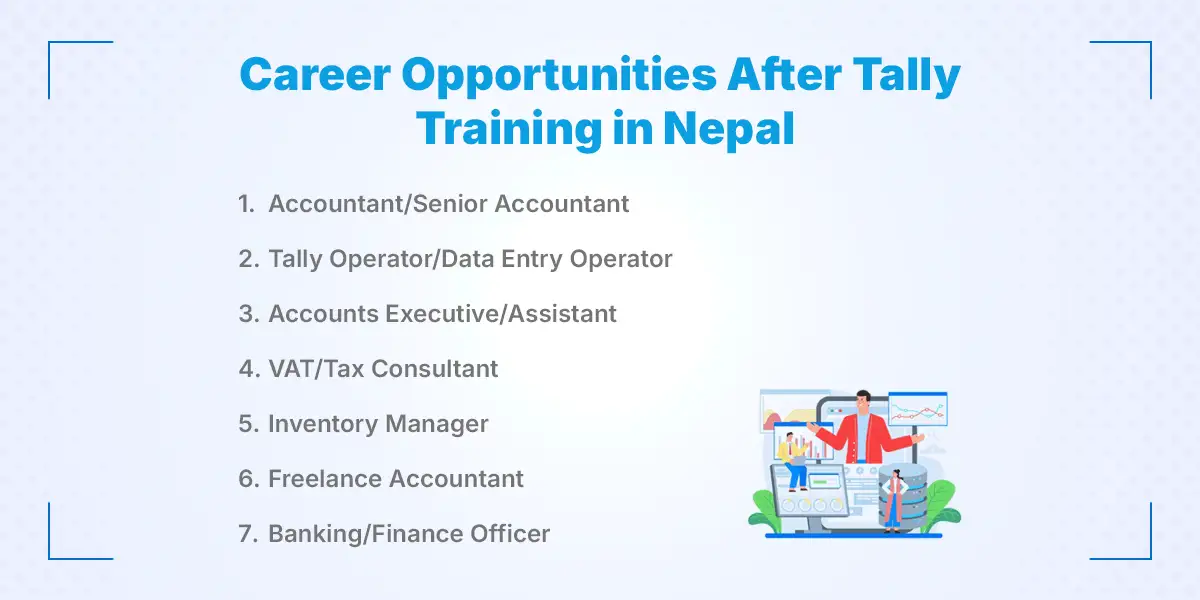
1. Accountant / Senior Accountant
Accountants handle daily accounts, reports, and financial records. Tally helps them record entries correctly and prepare balance sheets. Senior accountants also review work and manage compliance. Experience and strong basics help in career growth. This role offers long-term stability.
2. Tally Operator / Data Entry Operator
This role focuses on entering bills, vouchers, and transactions in Tally. It is suitable for fresh learners and beginners. Accuracy and speed matter the most here. Many small offices hire Tally operators. It is a good starting point in accounting.
3. Accounts Executive / Assistant
Accounts executives support senior accountants in their daily work. They manage invoices, payments, and basic reports. Tally makes their work faster and more organized. This role helps build real office experience. It is common in private companies.
4. VAT / Tax Consultant
Tax consultants help businesses manage VAT and tax records. Tally is used to track taxable sales and purchases. Basic tax knowledge is important for this role. Many consultants work with multiple clients. This job has good demand.
5. Inventory Manager
Inventory managers track stock and product movement. Tally helps monitor purchases, sales, and stock levels. This role is common in trading and manufacturing firms. Accurate records reduce losses. It supports smooth business operations.
6. Freelance Accountant
Freelance accountants work independently for small businesses. They use Tally to manage accounts and reports. Many handle monthly accounting work for clients. This offers flexible working options. Income grows with experience.
7. Banking / Finance Officer
Tally skills support roles in banks and finance offices. It helps in understanding accounts and reports. Many finance roles prefer software knowledge. This improves job readiness. It supports long-term career growth.
Where to Get the Best Tally Training in Nepal?
You can get the best Tally training in Nepal at Kumari Job’s accounting training, where software skills are taught with real accounting knowledge and job-focused practice.
Choosing the right institute matters more than just learning Tally software. Many training centers teach only buttons and entries, but real jobs need a practical accounting understanding. The best Tally training combines accounting basics, real office tasks, and hands-on practice. This helps learners become job-ready, not just course-certified.
Kumari Job’s training focuses on how Tally is actually used in Nepali companies. The training is designed for students, job seekers, and working professionals who want clear skills that employers value. Classes are practical, simple, and aligned with real business needs.
What makes a good Tally training institute stand out:
- Trainers with real accounting and industry experience
- Practical classes instead of theory-heavy sessions
- Coverage of VAT, payroll, and real business cases
- Updated syllabus based on current market demand
- Support for career guidance and job readiness
Accounting-focused institutions always give better results because Tally works best with strong basics. When learners understand why entries are made, software becomes easier and more useful. This also reduces mistakes at work.
At Kumari Job’s training, learners get exposure to real accounting workflows, not just demo data. This builds confidence to work in offices, firms, and businesses. For anyone serious about building an accounting career in Nepal, choosing the right training institute makes all the difference.
How to Choose the Right Tally Training Institute?
To choose the right Tally training institute, look for one that focuses on practical accounting training rather than theory-based software classes. Choosing the right institute decides how effective your Tally learning will be in real jobs. Many students complete training but still feel unsure at work. This usually happens when courses focus only on software steps. A good institute prepares you for real accounting tasks used in offices.
1. Trainer Experience and Syllabus
The trainer should have real accounting or office experience. Teaching only how to use software is not enough. The syllabus must include accounting basics with Tally Prime. It should clearly cover VAT, payroll, and reports. Avoid rushed or outdated courses. Good trainers explain concepts in simple language. This helps you understand the logic behind entries.
2. Practical vs Theory Based Training
Practical training matters more than long theory sessions. You should practice real sales, purchase, and expense entries. Good institutes use examples from Nepali businesses. Regular practice builds confidence. Theory alone feels easy, but fails in jobs. Ask how much hands-on practice is provided.
3. Certification and Job Support
Certificates add value only when skills are strong. Choose institutes that offer job guidance along with training. Interview tips and CV support are helpful. Some institutes assist with internships. This support improves job chances. Always ask about job help clearly.
4. Reviews and Success Stories
Reviews show the real quality of training. Look for genuine student feedback. Success stories show career growth after training. Check Google and social media reviews. Real experiences matter more than ads.
Is Tally Training Enough to Get an Accounting Job?
To get an accounting job in Nepal, Tally training alone is usually not enough. Tally training helps you understand how accounting work is done using software, but most employers look for more than just software knowledge. In many offices, accountants are expected to understand accounting rules, handle taxes, prepare reports, and solve daily problems. Without basic accounting understanding, Tally becomes limited to simple data entry work.
For entry-level roles like Tally operator or accounts assistant, Tally training can help you get started. However, for long-term growth and better salary roles, companies prefer candidates who understand accounting concepts along with software skills. This is why many learners feel stuck even after completing Tally training.
What employers actually look for in accounting jobs:
- Clear understanding of accounting basics
- Ability to handle real business transactions
- Knowledge of VAT and tax rules
- Confidence in preparing financial reports
- Practical experience, not just certificates
Tally is a tool, not the full accounting process. It helps record and manage data, but decision-making and accuracy come from accounting knowledge. When you know why an entry is made, using Tally becomes easier and more meaningful.
If your goal is a stable accounting career with growth opportunities, combining Tally with accounting fundamentals is the smarter choice. You can take job-oriented accounting training to improve skills, increase job chances, and move beyond basic software roles.
Conclusion
Tally training in Nepal is a valuable starting point for anyone aiming to enter accounting or finance roles. It equips learners with practical software skills, helping manage daily accounts, generate reports, and stay compliant with VAT and tax requirements. However, Tally alone is rarely enough to secure long-term career growth or higher-paying roles. Combining Tally skills with strong accounting fundamentals, taxation knowledge, and real-world practice makes candidates job-ready and competitive in the market.
By choosing the right institute, practicing consistently, and learning both software and accounting principles, learners can turn Tally training into a meaningful career foundation. For serious career growth, job-oriented accounting training alongside Tally is the smartest path in Nepal.
Frequently Asked Questions
Submit your comments

Get Our App On



What is the Public Relations Officer Salary in Nepal
VIEW DETAILS
What Is the Salary of a Ticketing Officer in Nepal?
VIEW DETAILS
What Is the Salary of a Travel Consultant in Nepal?
VIEW DETAILS
How to Become an Auditor in Nepal
VIEW DETAILS


Loading Comments...