




Every business in Nepal faces financial challenges such as unpaid invoices, messy accounts, and confusing expenses. This can cause stress and uncertainty about the company’s health. This is where proper bookkeeping solves these problems. It’s not just about recording numbers; it helps business owners track finances, make smart decisions, and stay compliant with tax regulations.
In this guide, you will learn what bookkeeping really is, why it is essential for every business, and the key skills and training needed to become proficient. By following this guide, you can manage accounts more effectively, reduce errors, and even explore career opportunities in bookkeeping and accounting in Nepal.
In this blog
What is Bookkeeping in Accounting?
Bookkeeping is the systematic and organized management of a company's financial transactions. It lays a base of operational financial system of a business, making sure that all the incomes, expenses, purchases, and sales are properly recorded. The businesses can get mixed up financially, misunderstand their reporting, and also find it difficult to monitor their financial performance without doing the necessary bookkeeping.
While bookkeeping is concerned with the recording of transactions, accounting goes an extra mile. These financial records can be analyzed, interpreted, and summarized to enable the making of strategic business decisions, which is known as accounting. Stated differently, bookkeeping gives the raw data and accounting converts the same into information that can be used to plan, budget, and grow. Correct bookkeeping is required as any small mistakes may result in inaccurate financial inferences in business decision-making and payment of tax.
The major elements of bookkeeping are:
- Recording Transactions: All the sales, purchases, payments, and receipts are recorded in a ledger or accounting package
- Organizing Financial Data: The transactions are classified into accounts such as revenue, expenses, assets, and liabilities so that they can be easily tracked.
- Maintaining Accuracy: Precision is essential to avoid discrepancies that may impact reports and compliance.
- Tracking Payments and Receivables: Invoices and payments will be tracked to ensure that there is cash flow.
- Supporting Tax and Legal Compliance: The right records assist businesses in filing taxes properly and also in satisfying regulatory demands.
Through proper bookkeeping, the businesses will be able to track the financial performance, early detection of mistakes or fraud early, and make decisions. It also guarantees easier auditing, funding, and overall management of the company's finances and is therefore an inseparable part of a successful company.
Want to Become Job-Ready in Accounting?
Enroll in our Job-Oriented Accounting Training in Nepal and gain practical skills that employers actively seek.
Importance of Bookkeeping in Accounting
Bookkeeping does not only entail record keeping. It assists businesses to know their money, plan ahead, and avoid trouble with taxes. Good bookkeeping enables the owners to make wise decisions and prevent expensive errors. It also results in making the running of the business a lot easier and less stressing.
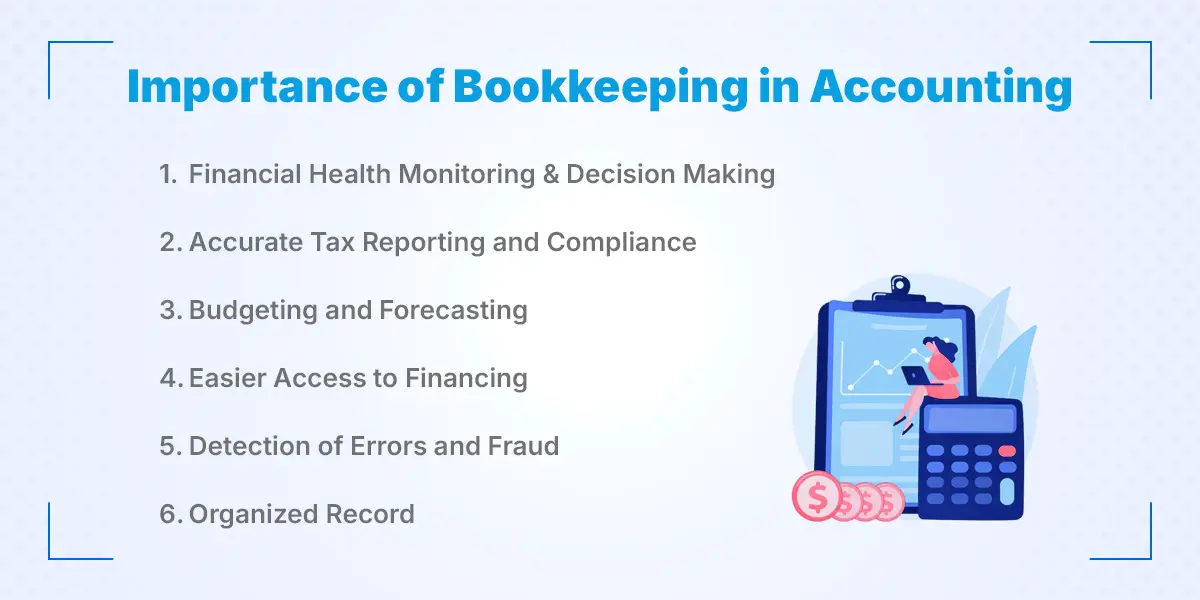
1. Financial Health Monitoring & Decision Making
Bookkeeping will aid you in the visualization of the flow of money in and out of your company. Under good records, you will be able to check whether your business is making a loss or a profit. The information is used to make decisions such as where to spend, where to save, or when to invest. It provides a clear image of the financial health of your business. You can also identify trends, such as slow and busy months. This knowledge will help you to plan better and not be surprised.
2. Accurate Tax Reporting and Compliance
Maintaining accurate books helps one to pay the appropriate amount of taxes. You will be able to determine the precise amount you earned and spent. Properly recorded books prevent tax errors. It also helps you to avoid fines or legal problems. You will be able to make tax reports in a hurry and stress-free. Bookkeeping also makes you do things by the rules of the government.
3. Budgeting and Forecasting
Bookkeeping reflects the utilization of money in your business. You can also prepare a budget using this for the next month or year. It can give you preparation regarding expenditures and savings. It is possible to forecast future revenues and expenses. This would reduce the chances of going broke. It also directs you to invest in the areas of growth.
4. Easier Access to Financing
Banks and investors desire to have transparent financial bookkeeping. Bookkeeping is good bookkeeping that ensures easy acquisition of loans or funding. It demonstrates that your business is reliable and well-organized. Lenders are able to verify your income and expenses within a short period. This enhances your probability of approval.
5. Detection of Errors and Fraud
Bookkeeping assists in identifying errors in time. In case it does not add up, you can correct it in a short period of time. It also assists in identifying any fraudulent money usage. Fraud can be minimized by checking your business on a regular basis.
6. Organized Records
All the financial data is located in a single place. Invoices, bills, and receipts can be easily located as and when required. Systematized documentation saves time and stress. They simplify and streamline the operation of a business.
Key Bookkeeping Skills You Need
To be a good bookkeeper, you need to have more than knowledge of numbers. Some of the skills assist in entering transactions appropriately and maintaining financial data in order. The skills can also simplify the process of comprehending the finances of a business and aid decision-making. When you master such abilities, you will be able to handle accounts and become a successful bookkeeper.
1. Understanding Financial Statements
You must know how to read and interpret financial statements such as the income statements and balance sheets. These statements demonstrate the amount of money a business earns, spends, has, and owes. Being familiar with them makes you monitor the performance of the business. You can know whether the business is profitable or not. It also assists in making the correct reports to the managers or owners. Even amateurs may begin by knowing the fundamentals of such statements. This skill will, in the long run, be very helpful in decision-making.
2. Knowledge of Accounting Software
Most companies manage accounts using software such as Tally, QuickBooks, or Excel. It is easier to know how to use these tools to make bookkeeping easier and quicker. It only takes a few clicks to record transactions, generate reports, and keep track of money. The errors in learning software are also minimized, as opposed to all the work being done manually. A lot of Training facilities in Nepal provide such programs. Working in software means a better chance of being hired.
3. Accuracy and Attention to Detail
Bookkeeping requires careful attention to every number. Even small mistakes can cause big problems later. You need to check your work and make sure all entries are correct. Paying attention helps prevent errors and fraud. Accuracy builds trust with employers and clients. Practicing regularly improves this skill over time.
4. Organizational and Time Management Skills
You need to keep records organized so they are easy to find. Filing invoices, receipts, and reports properly saves time. Managing time well helps you complete tasks without stress. Being organized also makes audits and tax filing easier. These skills help you handle multiple accounts efficiently.
5. Basic Understanding of Tax Rules and Compliance
Bookkeepers should know simple tax rules and government regulations. This ensures businesses pay the right amount of taxes. It also helps avoid fines or legal problems. Understanding taxes makes bookkeeping more useful for business decisions. You don’t need to be an expert, just know the basics. This knowledge grows with practice and training.
Which is the Best Accounting Training Center in Nepal?
Kumari Job Accounting Training is one of the best options in Nepal if you want to build a strong career in bookkeeping and accounting. The institute lays emphasis on practical learning and gives the students a chance to learn about bookkeeping at both basic and advanced levels. It is created to suit either amateurs or professionals who are professionals and need to enhance their ability to handle financial documents properly.
Kumari Job accounting training is unique in the sense that it lays stress on practical application. Students not only have theory but also have hands-on experience with accounting software, financial statements, and the bookkeeping cycles. This will make sure that the learners are equipped to deal with real business accounts immediately after completing the course.
Key benefits of enrolling at Kumari Job Accounting Training:
- Practical Training: Students are given real bookkeeping examples to train confidence and accuracy.
- Software Exposure: Be familiar with the popular software applications such as Tally and QuickBooks, which are very common in Nepal.
- Certification: The course provides you with a certifiable certificate, which makes you more employable.
- Career Growth: The trained students may be easily employed as bookkeepers, accounting assistants, or junior accountants.
- Skill Development: Pays attention to accuracy, organization, and interpretation of financial statements.
- Business Support: It can also be of benefit to the business owners who can learn about bookkeeping to keep their own books in a better way.
The students have the confidence to handle real financial records in addition to the knowledge with professional training provided by Kumari Job accounting training. The institute also provides the learner with a strong platform for long-term growth, as they are prepared to take up the career opportunities in the field of bookkeeping and accounting. You may wish to begin a career, freelance, or handle your business finance; this training center is a handy and trustworthy option.
How to Learn Bookkeeping in Nepal?
To learn bookkeeping in Nepal, start with the basics, take proper training, practice software, follow the bookkeeping cycle, and gain hands-on experience with certification. These steps give you a clear path to becoming skilled and confident in managing financial records. Following them carefully helps you build a strong foundation for both career growth and business management.
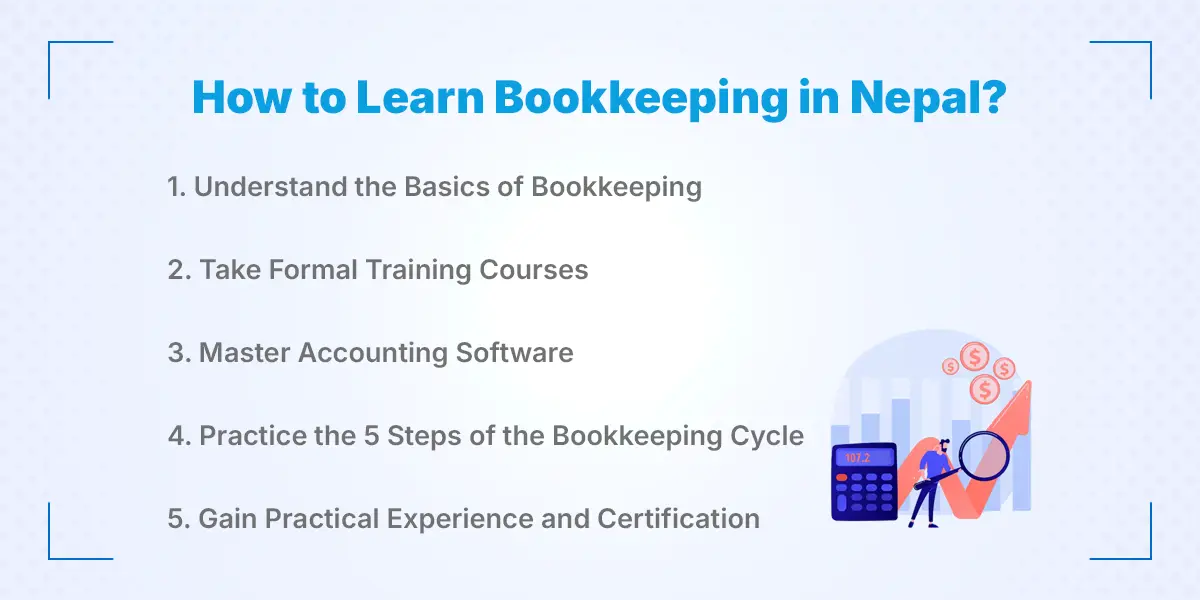
1. Understand the Basics of Bookkeeping
Begin with understanding what bookkeeping is and why it is important to businesses. Understand terms such as assets, liabilities, income, and expenses. Get to know how to make entries in journals and ledgers. At first, pay attention to easy examples, so as not to get confused. The knowledge of the basics will enable you to manage the accounts without errors. It also prepares you to have a higher level of training in the future. Any small business owner can use the same by mastering these basics.
2. Take Formal Training Courses
Get professional training in bookkeeping provided by training institutes such as Kumari Job. Formal courses are lessons and practical assignments. The trainers will help step by step and respond to questions. Real-life examples of financial records are also taught in courses. By taking a course, you are sure that you can manage accounts in a business. You also receive a reputable qualification which can be used in employment.
3. Master Accounting Software
Become familiar with such popular tools as Tally, QuickBooks, or Excel for bookkeeping. It is easier and quicker to record, track, and report through software. Training in recording transactions and creating reports on a regular basis. Software knowledge cuts errors and wastage of time. It also trains you for the actual workplace demands. Speed and accuracy are enhanced with frequent use.
4. Practice the 5 Steps of the Bookkeeping Cycle
The bookkeeping cycle includes identifying transactions, recording them, posting to ledgers, preparing trial balances, and making financial statements. Practice each step carefully with examples. This is to make sure that all the financial information is full and fair. The routine of keeping books in order develops a routine of good bookkeeping. It also assists you in the quick identification of mistakes. It takes professional bookkeeping to have mastery of the cycle.
5. Gain Practical Experience and Certification
Use your expertise to assist small companies or undertake internships. Practical education exposes one to life challenges that cannot be found in books. When a recognized institute certifies you, it indicates to employers that you are a skilled person. Practicum with certification enhances career opportunities. You get self-confidence to handle the accounts on your own. It also equips you with the future development in accounting and finance.
Career Opportunities After Bookkeeping Training
The completion of bookkeeping training in Nepal can provide numerous career opportunities. The skills acquired are very helpful whether you are planning to work with a company, handle accounts on behalf of small businesses, or even become a freelance worker. The demand in bookkeeping is explained by the fact that all business organizations require proper accounts of financial information, and qualified specialists are appreciated due to their skills in controlling accounts.
After training, you can start in entry-level roles such as:
- Junior Accountant: Process daily financial documentation and assist the seniors in reporting.
- Bookkeeper: Record transactions, control invoices, and maintain the accounts.
- Accounting Assistant: Assists the accounting teams with data entry, reconciliations, and financial documentation.
Opportunities outside the traditional jobs are also available. Working as a bookkeeper enables you to work with small companies that might not have a full-time accounting department. One of the services you can provide is account management, financial statements preparation, or assisting in filing taxes. This provides flexibility and opportunity to earn on his own.
Salary and Growth Potential
In Nepal, entry-level bookkeepers and accounting assistants earn a reasonable starting salary, which can grow significantly with experience and certifications. With consistent learning and skill improvement, professionals can move into higher roles such as senior accountant, finance officer, or accounting manager.
Long-Term Career Path
Bookkeeping provides a strong foundation for long-term careers in accounting. With experience, you can specialize in areas like auditing, taxation, or financial analysis. This training also prepares you for managerial positions in larger companies or the opportunity to start your own accounting or bookkeeping service.
Overall, bookkeeping training not only opens immediate job opportunities but also sets the stage for a stable, growing, and rewarding career in Nepal’s financial sector.
Conclusion
Bookkeeping is the backbone of every successful business in Nepal. It ensures that financial transactions are recorded accurately, helping owners make smart decisions, plan budgets, and stay compliant with taxes. Learning bookkeeping opens doors to valuable career opportunities, whether as a junior accountant, bookkeeper, or freelance professional.
Professional training, like that offered by Kumari Job Accounting Training, equips you with practical skills, software knowledge, and certification to handle real-world accounts confidently. By mastering bookkeeping, you not only manage finances better but also build a strong foundation for long-term growth in accounting and finance. For anyone looking to strengthen their business or start a rewarding career, bookkeeping is an essential skill to invest in today.
Ready to go beyond basic bookkeeping? Join an advance accounting course to build strong skills in financial reporting, taxation, and accounting software.
Frequently Asked Questions
Submit your comments

Get Our App On



What is the Public Relations Officer Salary in Nepal
VIEW DETAILS
What Is the Salary of a Ticketing Officer in Nepal?
VIEW DETAILS
What Is the Salary of a Travel Consultant in Nepal?
VIEW DETAILS
How to Become an Auditor in Nepal
VIEW DETAILS


Loading Comments...