




Choosing the right career after +2 can feel stressful, especially in Nepal, where jobs are competitive and skilled roles are limited. Although Nepal’s labour force is over 16.8 million workers, formal skilled employment remains a challenge, and many young graduates still struggle to find stable roles in the job market. Engineers are increasingly seen as valuable because infrastructure, technology, and industry projects continue to expand despite overall employment gaps.
A Bachelor of Engineering (BE) in Nepal is a four-year professional degree that prepares students for careers in civil, mechanical, electrical, software, and other engineering disciplines. Today, engineers are among the most demanded professionals in the country’s job market, appearing alongside IT and healthcare roles in the list of top career opportunities for 2026. In this article, you will learn what a BE degree is, why engineering remains a strong career choice in Nepal, and how it can help you secure long-term job prospects and salary growth.
In this blog
What is a Bachelor of Engineering (BE)?
A Bachelor of Engineering (BE) is a four-year undergraduate degree that trains students in engineering science, math, design, and practical problem-solving skills needed for technical careers. It prepares graduates to work as professional engineers in sectors like infrastructure, energy, manufacturing, IT, and construction. BE degrees are typically structured over eight semesters and include practical projects, labs, and internships.
Duration and Eligibility in Nepal
- Duration: 4 years (8 semesters). This is the standard format for most BE programs in Nepal.
- Eligibility: Students usually must complete +2 (or equivalent) science education with a minimum pass grade and gain admission through an engineering entrance exam or qualifying criteria set by universities.
Top engineering institutions like Pulchowk Campus (Institute of Engineering, Tribhuvan University) admit students based on competitive entrance exams, with thousands of applicants vying for limited seats each year.
Difference Between BE and Other Technical Degrees
- BE vs. B.Sc. CSIT / IT Degrees: BE programs focus on core engineering disciplines (civil, mechanical, electrical, etc.) with strong emphasis on math, physics, and practical engineering design. In contrast, degrees like B.Sc. CSIT or BIT focuses on software, computing, and information systems rather than traditional engineering fundamentals.
- BE is typically more technical and hardware-oriented, while IT degrees emphasize software applications and programming.
- BE often leads to professional engineering roles regulated by bodies like the Nepal Engineering Council, whereas IT degrees may lead to computing and technology jobs not requiring engineering licensure.
Popular Engineering Fields in Nepal
Engineering in Nepal offers multiple specializations based on infrastructure growth, IT expansion, and industrial development. Choosing the right field depends on market demand, salary potential, and long-term career goals.
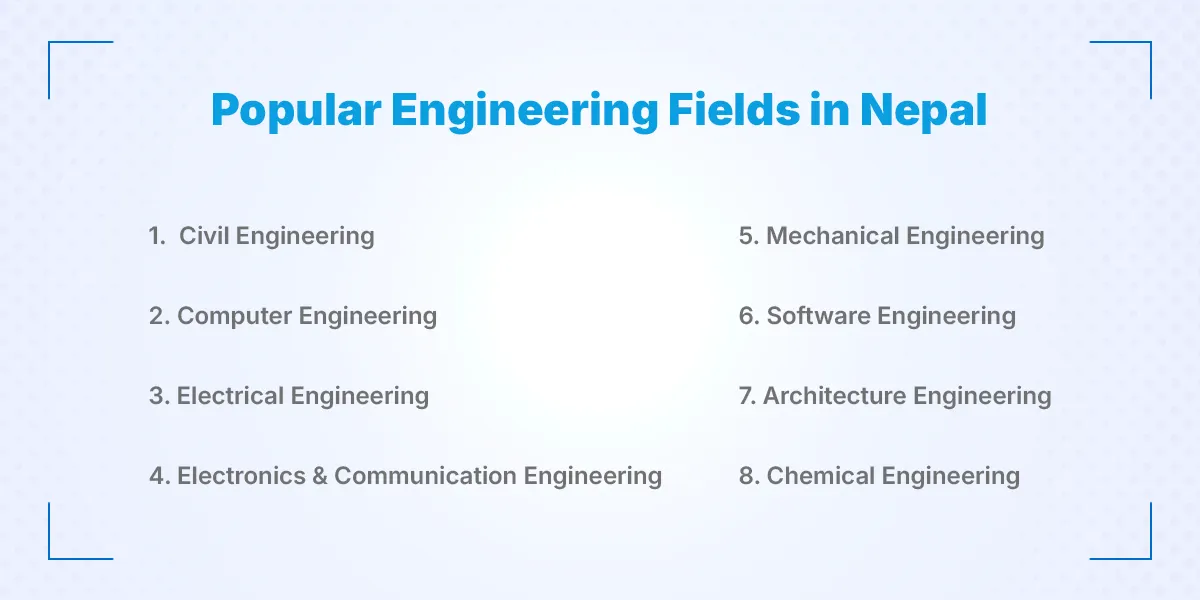
1. Civil Engineering
Civil Engineering is one of the most demanded engineering fields in Nepal due to continuous infrastructure development. The country is investing in roads, bridges, hydropower projects, airports, and urban housing. Civil engineers work as site engineers, project managers, structural designers, and consultants. Government departments and private construction companies regularly hire civil graduates. This field offers strong opportunities in both Nepal and abroad.
2. Computer Engineering
Computer Engineering focuses on software development, hardware systems, and network technologies. With Nepal’s growing IT sector and digital transformation, demand for computer engineers is increasing steadily. Graduates work as software developers, system engineers, cybersecurity specialists, and network administrators. IT outsourcing and freelancing also create global earning opportunities. This field has strong salary growth potential compared to many traditional sectors.
3. Electrical Engineering
Electrical Engineering deals with power generation, transmission, and electrical systems. Nepal’s hydropower expansion has increased the need for electrical engineers in energy projects. They work in power plants, substations, manufacturing industries, and telecom companies. Government agencies and energy authorities frequently recruit electrical engineers. The field offers stable long-term career prospects due to continuous energy demand.
4. Electronics & Communication Engineering
Electronics and Communication Engineering focuses on communication systems, signal processing, and electronic devices. Telecom companies, internet service providers, and broadcasting sectors hire graduates in this field. With increasing internet penetration and mobile usage in Nepal, the communication infrastructure is expanding rapidly. Engineers in this field also work in hardware design and embedded systems. It is a strong option for students interested in technology and networking systems.
5. Mechanical Engineering
Mechanical Engineering is a core engineering discipline that deals with machines, manufacturing systems, and industrial equipment. Industries such as manufacturing, automobile workshops, and hydropower projects require mechanical engineers. Graduates work in maintenance, production, quality control, and industrial design roles. Although industrial growth in Nepal is moderate, skilled mechanical engineers remain in demand. Many also find opportunities abroad due to transferable technical skills.
6. Software Engineering
Software Engineering focuses entirely on software design, development, and system architecture. With the rapid growth of Nepal’s IT outsourcing and startup ecosystem, this field is expanding quickly. Software engineers work in web development, mobile app development, AI systems, and cloud technologies. Remote work opportunities allow professionals to earn international salaries while living in Nepal. This specialization offers high growth and flexibility.
7. Architecture Engineering
Architecture and Engineering combines engineering principles with building design and urban planning. Nepal’s urban expansion and real estate growth have increased demand for architects and design engineers. Professionals work on residential, commercial, and smart city projects. This field requires creativity along with technical precision. Licensed architects can build successful private consulting careers over time.
8. Chemical Engineering
Chemical Engineering focuses on industrial processes that convert raw materials into useful products such as fuels, chemicals, cement, food products, and pharmaceuticals. In Nepal, chemical engineers work in industries like cement manufacturing, breweries, food processing, paint production, and emerging pharmaceutical companies. They are responsible for process optimization, quality control, safety management, and production efficiency. Although this field is smaller compared to civil or computer engineering, it offers stable opportunities in manufacturing and industrial sectors. Skilled chemical engineers can also explore international career options due to globally transferable expertise.
Bachelor of Engineering Scope in Nepal
The scope of a Bachelor of Engineering in Nepal is expanding due to infrastructure development, digital transformation, energy projects, and industrial growth. Engineers are needed in both government and private sectors as the country modernizes its economy and builds long-term development projects.
1. Infrastructure Development Growth
Infrastructure development in Nepal has significantly increased demand for civil, electrical, and mechanical engineers. Road expansion, bridge construction, urban housing, airports, and smart city projects require skilled technical professionals. Government budgets consistently allocate a large portion to infrastructure and capital expenditure. Large-scale projects create employment opportunities for site engineers, project managers, and consultants. As urbanization continues, engineering roles in construction and planning will remain strong.
2. IT and Digital Transformation
Nepal’s IT sector is growing rapidly due to outsourcing, startups, and digital services. Many companies now rely on software systems, cybersecurity, cloud computing, and automation tools. Computer and software engineers are in high demand in private companies and international outsourcing firms. Remote work opportunities also allow engineers to work for global clients from Nepal. Digital transformation across banking, education, and healthcare further strengthens engineering demand.
3. Hydropower and Energy Sector Expansion
Nepal has strong hydropower potential, and energy production projects continue to expand nationwide. This growth is creating increasing demand for jobs in hydropower, especially for electrical and mechanical engineers. Engineers are required for power plant design, transmission systems, grid management, and maintenance operations. The government aims to increase electricity production and export surplus energy in the coming years. As new hydropower and renewable energy projects develop, stable engineering jobs continue to grow, ensuring long-term demand for skilled technical professionals.
4. Manufacturing and Industrial Growth
Although Nepal’s manufacturing sector is still developing, industries such as cement, food processing, pharmaceuticals, and consumer goods are expanding. Mechanical and chemical engineers play important roles in production systems, plant management, and quality control. Industrial growth requires skilled engineers to improve efficiency and safety standards. As Nepal promotes local production and industrialization, technical roles will increase gradually. Engineers with practical skills have better employment prospects.
5. Government and Private Sector Demand
Engineering graduates have opportunities in both public and private sectors. Government roles are available through Public Service Commission exams in departments such as roads, irrigation, and energy. Municipalities and provincial offices also recruit engineers for development projects. In the private sector, construction firms, IT companies, banks, telecom providers, and manufacturing industries actively hire engineers. This balanced demand across sectors strengthens the overall scope of engineering in Nepal.
Career Opportunities After a Bachelor of Engineering in Nepal
A Bachelor of Engineering degree opens doors to technical, managerial, and research-based careers across multiple industries in Nepal. Graduates can work in construction, IT, manufacturing, energy, government offices, and private companies, depending on their specialization.
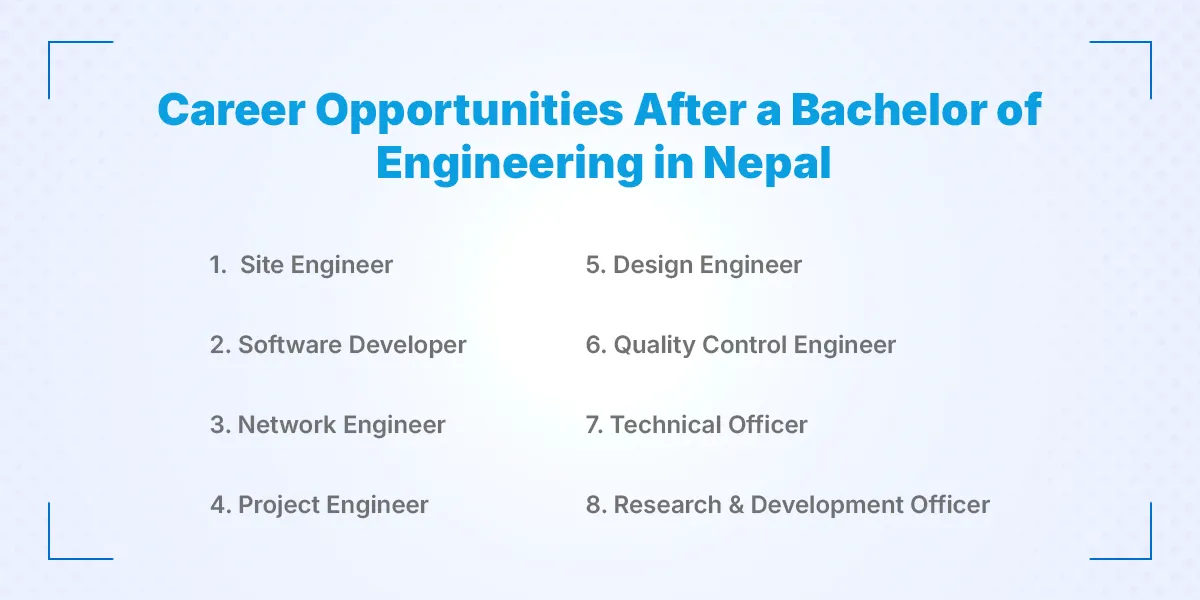
1. Site Engineer
A Site Engineer manages daily construction activities and ensures projects follow technical drawings and safety standards. Civil engineering graduates commonly work in road, bridge, housing, and hydropower projects. They coordinate with contractors, supervisors, and project managers on-site. The role requires strong practical knowledge and problem-solving skills. Site engineers are in steady demand due to ongoing infrastructure development.
2. Software Developer
A Software Developer designs, builds, and maintains applications, websites, and software systems. Computer and software engineering graduates often work in IT companies, startups, and outsourcing firms. They specialize in web development, mobile apps, cloud systems, or AI solutions. The demand for software developers is growing due to digital transformation in banking, education, and e-commerce. Remote work opportunities also allow them to earn from international clients.
3. Network Engineer
A Network Engineer manages communication systems, servers, and network security within organizations. Electronics and computer engineers often pursue this role. They work in telecom companies, banks, corporate offices, and IT service providers. Responsibilities include maintaining network performance and protecting data systems. With increasing internet usage in Nepal, network engineers remain essential for digital infrastructure.
4. Project Engineer
A Project Engineer oversees engineering projects from planning to completion. They coordinate technical teams, manage timelines, and monitor budgets. Civil, mechanical, and electrical engineers often move into this role after gaining experience. Strong leadership and communication skills are important for success. Project engineers play a key role in large infrastructure and industrial projects.
5. Design Engineer
A Design Engineer creates technical drawings, system designs, and engineering models using software tools like AutoCAD or SolidWorks. Mechanical, electrical, and civil engineers commonly work in this position. They ensure products or structures meet safety and efficiency standards. This role requires creativity combined with technical accuracy. Design engineers are needed in manufacturing, construction, and product development sectors.
6. Quality Control Engineer
A Quality Control Engineer ensures products, materials, and systems meet required standards and specifications. Manufacturing industries, construction companies, and production plants hire professionals for this role. They conduct inspections, testing, and compliance verification. Attention to detail and analytical skills are essential. Quality control helps companies maintain performance and reduce operational risks.
7. Technical Officer
A Technical Officer works in government departments, hydropower projects, municipalities, or private companies to supervise technical operations. This role often involves inspection, reporting, and field monitoring. Engineers who pass Public Service Commission exams frequently secure these positions. It offers stable employment with structured career growth. Technical officers support development projects at local and national levels.
8. Research & Development Officer
A Research & Development (R&D) Officer focuses on innovation, testing, and improving products or systems. Engineers in manufacturing, IT, and energy sectors may enter R&D roles. They analyze data, experiment with new technologies, and propose technical improvements. This position requires strong analytical thinking and continuous learning. R&D careers are suitable for engineers interested in innovation and long-term technical growth.
Government Engineering Jobs in Nepal
Government engineering jobs in Nepal offer stable employment, structured career growth, and long-term benefits through federal, provincial, and local institutions. These government jobs in Nepal are mainly filled through competitive exams and technical recruitment processes, making them highly sought-after career options for engineering graduates.
1. Public Service Commission (Lok Sewa Aayog) Opportunities
Public Service Commission (Lok Sewa Aayog) conducts competitive exams to recruit engineers for various government positions across Nepal. Engineering graduates can apply for roles such as Engineer, Sub-Engineer, and Technical Officer under federal and provincial services. Selection is based on written exams, interviews, and merit ranking. These positions provide job security, government benefits, and clear promotion pathways. Many engineering graduates prepare specifically for Lok Sewa to secure long-term career stability.
2. Engineering Positions in Ministries and Departments
Different ministries and government departments regularly hire engineers for development and technical supervision roles. Common departments include the Ministry of Physical Infrastructure and Transport, the Ministry of Energy, Water Resources and Irrigation, and the Department of Urban Development. Engineers work on project planning, technical evaluation, supervision, and reporting. These roles contribute directly to national development projects. Government engineering positions often provide structured salary scales and retirement benefits.
3. Hydropower and Road Department Jobs
Nepal’s hydropower and road sectors create continuous demand for civil, electrical, and mechanical engineers. The Department of Roads, the Department of Electricity Development, and Nepal Electricity Authority recruit engineers for design, maintenance, and project execution. Engineers supervise construction, manage infrastructure upgrades, and ensure compliance with technical standards. Large hydropower and highway projects require long-term technical staffing. These roles are critical for national energy and transport expansion.
4. Municipal and Provincial Engineering Jobs
Local governments and provincial offices also recruit engineers to support regional development projects. Municipalities hire civil and environmental engineers for road construction, drainage systems, building permits, and urban planning. Provincial ministries require technical officers for infrastructure and public service delivery. These roles allow engineers to work closely with community development initiatives. As federalism strengthens in Nepal, engineering demand at local levels continues to grow.
Private Sector Engineering Jobs in Nepal
Private sector engineering jobs in Nepal offer faster career growth, performance-based salaries, and diverse industry exposure compared to government roles. Engineers in the private sector work in construction, IT, finance, manufacturing, and telecom industries, depending on their specialization.
1. Construction Companies
Construction companies are among the largest employers of civil engineers in Nepal. They hire site engineers, project engineers, quantity surveyors, and design consultants. Engineers supervise building projects, road construction, bridges, and hydropower infrastructure. Private construction firms often provide faster promotion based on performance. Large contractors working on national projects regularly recruit engineering graduates.
2. IT Companies
IT companies actively hire computer, software, and electronics engineers. Roles include software developer, system analyst, cybersecurity specialist, and DevOps engineer. Nepal’s IT outsourcing and startup ecosystem is expanding steadily. Many engineers work remotely for international clients while living in Nepal. This sector offers higher earning potential compared to many traditional industries.
3. Banks and Financial Institutions
Banks and financial institutions hire engineers mainly for IT, cybersecurity, system management, and digital banking infrastructure. Computer and network engineers manage core banking systems and data security. Some financial institutions also hire civil engineers for branch infrastructure and technical supervision. Digital transformation in the banking sector has increased technical hiring. Engineers in this field work in structured corporate environments.
4. Manufacturing Industries
Manufacturing industries such as cement, food processing, pharmaceuticals, and consumer goods require mechanical and chemical engineers. Engineers manage production systems, plant maintenance, quality control, and industrial automation. Private factories offer hands-on technical experience. Industrial growth in Nepal is gradually increasing the demand for skilled engineers. Experienced professionals can move into plant management roles over time.
5. Telecom Companies
Telecom companies hire electronics, electrical, and network engineers to manage communication infrastructure. Engineers maintain mobile towers, fiber networks, and data transmission systems. Internet penetration and digital services expansion have strengthened demand in this sector. Telecom engineers work in system maintenance, network optimization, and technical operations. This field offers stable corporate career opportunities.
Where to Get Engineering Jobs in Nepal?
You can get engineering jobs in Nepal through online job portals like Kumari Job, company career pages, LinkedIn, recruitment agencies, Lok Sewa vacancy notices, internships, and professional networking platforms. Using multiple job search channels increases your chances of securing interviews faster.
Below are the most effective ways to find engineering jobs in Nepal:
1. Online Job Portals in Nepal
Online job portals are one of the fastest ways to find engineering vacancies. Platforms like Kumari Job regularly publish engineering openings across civil, IT, electrical, and mechanical sectors. You can filter jobs by experience level, location, and industry. Many employers directly shortlist candidates from these portals. Keeping your profile updated increases visibility to recruiters.
2. Company Career Pages
Many large construction firms, IT companies, telecom providers, and banks publish vacancies on their official websites. Checking career pages helps you apply directly without third-party competition. Some companies only post jobs internally on their website. Regular monitoring improves your chances of early application. Direct applications can sometimes speed up the hiring process.
3. LinkedIn Job Search
LinkedIn has become a powerful platform for engineering job searches in Nepal. Companies post vacancies, and recruiters actively search for qualified candidates. Creating a strong LinkedIn profile with skills and projects increases credibility. Networking with HR professionals and engineering managers can lead to referral opportunities. Engaging with industry posts also improves visibility.
4. Engineering Consultancies
Engineering consultancies hire graduates for design, supervision, and technical support roles. Civil and mechanical engineers often find opportunities in consulting firms. These firms work on government and private development projects. Experience in consultancy builds strong technical foundations. Many engineers begin their careers through consulting projects.
5. Recruitment Agencies
Recruitment agencies connect engineering graduates with private companies across industries. Agencies like Kumari Job assist with bulk hiring and specialized technical recruitment. They match candidates based on skill level and industry demand. Registering with trusted recruitment firms increases access to hidden job opportunities. Agencies often speed up interview scheduling.
6. Lok Sewa Vacancy Notices
For government engineering jobs, monitoring the Public Service Commission (Lok Sewa Aayog) notices is essential. Vacancies are announced officially for engineer and sub-engineer positions. Candidates must prepare for competitive exams and interviews. Government roles offer job security and long-term benefits. Regularly checking vacancy notices helps avoid missing deadlines.
7. Internship Programs Leading to Full-Time Jobs
Many companies hire interns and later convert them into full-time employees. Internships provide practical experience and industry exposure. Civil, IT, and mechanical firms frequently recruit fresh graduates through internship programs. Strong performance during internships increases permanent job chances. This pathway is ideal for fresh engineering graduates.
8. Networking and Professional Associations
Professional networking plays a major role in engineering careers. Joining engineering associations and attending industry events increases job awareness. Connecting with seniors, professors, and industry professionals can lead to referrals. Many job opportunities are shared through informal networks. Active networking improves long-term career growth.
Salary of Engineers in Nepal
The average salary of engineers in Nepal ranges from NPR 20,000 to NPR 200,000+ per month, depending on experience level, specialization, industry, and job role. Entry-level engineers earn lower starting salaries, while experienced professionals in IT, hydropower, and senior management roles earn significantly higher packages.
1. Entry-Level Salary Range (0–2 Years)
Fresh engineering graduates in Nepal typically earn between NPR 20,000 and NPR 45,000 per month. Civil and mechanical engineers often start around NPR 20,000–30,000 in construction or site roles. IT and software engineers may start slightly higher, around NPR 30,000–40,000 per month, depending on technical skills. Internship experience and software knowledge strongly affect starting pay. Salaries are generally higher in Kathmandu compared to other cities.
2. Mid-Level Salary Range (2–5 Years)
Engineers with 2–5 years of experience usually earn between NPR 45,000 and NPR 90,000 per month. At this stage, professionals handle independent projects and team responsibilities. Software engineers, cybersecurity professionals, and experienced electrical engineers often reach the upper end of this range. Civil engineers managing projects or supervising sites also see salary growth. Performance and specialization play a major role in salary progression.
3. Senior-Level Salary Range (5+ Years)
Senior engineers in Nepal can earn NPR 80,000 to NPR 200,000+ per month, especially in IT, large hydropower projects, and corporate leadership roles. Software architects and senior developers may earn NPR 150,000 or more, depending on the company and expertise. Project managers and consulting engineers in infrastructure projects also earn competitive salaries. Leadership, certification, and technical specialization significantly increase earning potential.
4. Salary Differences by Field (Civil vs IT vs Electrical, etc.)
Engineering salary varies by industry demand and skill scarcity:
- Software/Computer Engineering: Highest earning potential, especially in outsourcing and remote work.
- Civil Engineering: Stable demand due to infrastructure projects, but moderate salary growth initially.
- Electrical Engineering: Strong opportunities in the hydropower and energy sectors.
- Mechanical Engineering: Competitive salaries in manufacturing and industrial roles.
IT-related engineering fields generally offer faster salary growth compared to traditional sectors.
Skills Required to Get Engineering Jobs in Nepal
To get engineering jobs in Nepal, you need strong technical knowledge, practical software skills, communication ability, project management understanding, and real-world experience through internships. Employers prefer engineers who can apply theory to practical problems and work efficiently in teams.
1. Technical Skills (Field-Specific)
Technical skills are the foundation of every engineering career. Civil engineers must understand structural design, surveying, and construction methods. Computer engineers need programming, system design, and problem-solving skills. Electrical and mechanical engineers must know circuit systems, machinery, and industrial processes. Strong subject knowledge increases job confidence and interview performance.
2. Software Knowledge (AutoCAD, Python, etc.)
Software proficiency significantly increases employability in Nepal’s job market. Civil engineers are expected to know tools like AutoCAD, ETABS, or SAP. Software and computer engineers must know programming languages such as Python, Java, or JavaScript. Mechanical engineers often use SolidWorks or other design tools. Practical software skills help employers see immediate value in candidates.
3. Communication Skills
Communication skills are essential for engineers working in teams and dealing with clients. Engineers must explain technical ideas clearly to non-technical stakeholders. Site engineers need strong coordination skills with contractors and workers. IT engineers must communicate with project managers and clients effectively. Good communication improves leadership and promotion opportunities.
4. Project Management Skills
Basic project management knowledge helps engineers handle deadlines, budgets, and teamwork. Understanding planning, scheduling, and risk management improves efficiency. Engineers working on construction or IT projects often coordinate multiple tasks simultaneously. Skills in documentation and reporting are also important. Engineers with management abilities grow faster into senior roles.
5. Internship Experience Importance
Internship experience greatly improves job opportunities for fresh graduates. Many employers in Nepal prefer candidates who have hands-on site or project exposure. Internships help students understand industry standards and practical challenges. Strong performance during internships often leads to full-time job offers. Practical experience reduces the skill gap between education and industry expectations.
Higher Study Options After BE in Nepal
After completing a Bachelor of Engineering in Nepal, graduates can pursue advanced education, international studies, professional certifications, or obtain a professional engineering license to improve career prospects and salary growth. Higher qualifications increase specialization, credibility, and long-term earning potential.
1. Master’s Degree in Nepal
Pursuing a Master’s degree (M.E. or M.Sc.) in Nepal allows engineers to specialize in areas such as structural engineering, hydropower, data science, or power systems. Universities like Tribhuvan University, Kathmandu University, and Pokhara University offer postgraduate engineering programs. A Master’s degree improves chances of promotion, teaching careers, and research roles. It also increases eligibility for higher-level government positions. Many engineers choose this path to gain technical depth without leaving the country.
2. Studying Abroad
Studying abroad is a popular option for engineers seeking global exposure and advanced research facilities. Many graduates choose to study abroad in countries like Australia, the USA, Canada, Germany, and the UK to access better laboratories, innovation ecosystems, and global job markets. International degrees often improve career prospects and earning potential. Graduates can gain work experience overseas or return to Nepal with stronger qualifications. However, proper financial planning and entrance requirements must be carefully considered before deciding to study abroad.
3. Specialized Certifications
Professional certifications help engineers upgrade skills without committing to full academic degrees. IT engineers often pursue certifications in cloud computing, cybersecurity, data science, or DevOps. Civil and mechanical engineers may complete project management, safety, or structural design certifications. Short-term certifications increase employability and salary potential. Employers value practical certifications that align with industry needs.
4. Professional License (NEC Registration)
Nepal Engineering Council (NEC) registration is mandatory for engineers who want to practice professionally in Nepal. Without NEC licensing, engineers cannot legally sign technical documents or approve engineering projects. Registration requires academic verification and examination (if applicable). NEC certification improves credibility and eligibility for government projects. It is an essential step for engineers planning long-term careers in Nepal.
Challenges in an Engineering Career in Nepal
Engineering offers strong career potential, but graduates in Nepal also face several practical challenges. Understanding these issues helps students prepare better and build competitive skills early.
1. High Competition
High competition makes it difficult for fresh engineering graduates to secure quality jobs immediately after graduation. Every year, thousands of students graduate from engineering colleges across Nepal. Government positions are limited and require competitive Lok Sewa exams. In the private sector, companies often prefer candidates with experience. Without strong skills or internships, many graduates struggle during the initial job search phase.
2. Skill Gap
The skill gap between academic learning and industry expectations is a major challenge in Nepal. Many students focus heavily on theory but lack hands-on technical exposure. Employers expect practical knowledge of software tools, site work, coding frameworks, or industrial systems. Engineers who do not upgrade skills beyond the syllabus often face employment difficulties. Continuous learning and certifications are essential to bridge this gap.
3. Limited Research Opportunities
Limited research infrastructure restricts innovation and advanced engineering development in Nepal. Research funding, laboratory facilities, and industrial collaboration are still developing. Many engineers interested in R&D must pursue higher education abroad. Local industries focus more on implementation than innovation. This limits opportunities for engineers who want research-focused careers.
4. Migration Trend
The migration trend affects both opportunities and workforce stability in Nepal. Many skilled engineers move abroad for higher salaries and better career growth. This creates talent shortages in certain sectors within the country. However, it also increases competition among those who stay. Engineers must carefully evaluate whether to build a career locally or explore international opportunities.
Future of Engineering in Nepal
The future of engineering in Nepal looks promising due to urban development, renewable energy expansion, IT growth, and large-scale infrastructure modernization. Engineers will play a central role in shaping Nepal’s economic and technological progress over the next decade.
1. Smart City Projects
Smart city development is gradually becoming part of Nepal’s urban planning strategy. Major cities are focusing on digital governance, smart traffic systems, sustainable housing, and modern public infrastructure. Civil, electrical, and IT engineers are required to design and manage integrated systems. Urban population growth is increasing pressure for organized city planning. This creates long-term demand for skilled engineering professionals.
2. Renewable Energy Growth
Renewable energy, especially hydropower and solar energy, is expanding rapidly in Nepal. The country has strong hydropower potential, and new energy projects continue to be developed. Electrical and mechanical engineers are essential for plant design, grid systems, and maintenance operations. The government aims to increase electricity production and export surplus energy. Renewable energy investment will continue to create stable engineering jobs.
3. IT Outsourcing Expansion
Nepal’s IT outsourcing industry is growing due to global demand for software development and digital services. Many Nepali engineers now work remotely for international companies. Software engineering, cybersecurity, AI, and cloud computing roles are increasing each year. Startups and tech companies are expanding in Kathmandu and other cities. IT engineering is expected to offer some of the highest salary growth in the coming years.
4. Infrastructure Modernization
Infrastructure modernization remains a national priority in Nepal. Road upgrades, tunnel construction, airports, bridges, and industrial zones require long-term engineering expertise. Government and private sector investments continue to support these projects. Civil, mechanical, and electrical engineers will be needed for execution and supervision. Modern infrastructure development ensures steady career opportunities for future engineering graduates.
Conclusion
A Bachelor of Engineering in Nepal offers strong career opportunities across infrastructure, IT, energy, manufacturing, and government sectors. With growing investment in hydropower, digital services, and urban development, the demand for skilled engineers remains steady and future-focused.
However, success in engineering depends on continuous skill development. Technical expertise, software knowledge, practical exposure, and communication skills play a major role in securing better jobs and higher salaries. Graduates who upgrade their skills and gain real-world experience through internships and certifications have stronger career growth potential.
Engineering is still a powerful career choice in Nepal, but smart planning is essential. Choose the right specialization, build practical skills, and stay updated with industry trends to stay competitive.
If you are looking for more job options in IT, civil, electrical, or other engineering sectors, explore verified vacancies and career opportunities through Kumari Job to find roles that match your skills and experience.
Frequently Asked Questions
Submit your comments

Get Our App On



What is the Public Relations Officer Salary in Nepal
VIEW DETAILS
What Is the Salary of a Ticketing Officer in Nepal?
VIEW DETAILS
What Is the Salary of a Travel Consultant in Nepal?
VIEW DETAILS
How to Become an Auditor in Nepal
VIEW DETAILS


Loading Comments...