



Most HR freshers in Nepal feel confident with theory but struggle when they face real hiring tasks like writing job descriptions, screening CVs, and conducting structured interviews. They often hesitate when asked to shortlist candidates or manage the hiring process independently. At the same time, companies from startups to established corporate offices are under pressure to hire the right talent quickly and efficiently. This gap between classroom knowledge and practical hiring skills creates stress for job seekers and costly hiring mistakes for employers.
According to recent labor data, Nepal’s youth unemployment rate (ages 15–24) is around 20%, and many employers report skill mismatch as a major hiring challenge. This shows that having practical, job-ready recruitment skills is more important than ever in Nepal’s competitive job market. In this blog, you will learn what recruitment training in Nepal includes, the practical modules covered, the skills you gain, and how it can help you build a strong career in HR.
In this blog
What is Recruitment Training?
Recruitment training teaches you how to attract, screen, interview, and select the right candidates for a company in a structured and professional way. Unlike theoretical HR, which focuses on concepts and policies, recruitment training focuses on practical hiring tasks. It teaches you how to write job descriptions, source candidates, screen CVs, conduct structured interviews, and manage the selection process. Instead of only understanding definitions, you learn how to handle real recruitment situations inside companies.
Companies prefer trained recruiters because hiring mistakes cost time and money. Skilled recruiters reduce wrong hiring decisions, improve candidate experience, and follow a structured process. In Nepal, recruitment skills are in high demand as startups and corporate offices grow and competition for qualified employees increases, making professional hiring more important than ever.
Why Recruitment Skills Are in High Demand in Nepal
Recruitment skills are in high demand in Nepal because businesses are expanding and competition for qualified talent is becoming stronger. Startups, IT companies, banks, and corporate offices are growing in major cities like Kathmandu, Lalitpur, and Pokhara. As more businesses enter the market, the demand for skilled employees increases. Companies now compete to attract the best candidates instead of simply filling vacancies.
At the same time, organizations are focusing more on quality hiring. They want structured recruitment processes to reduce hiring mistakes, improve employee performance, and ensure long-term retention. This shift has increased the need for trained recruiters who understand professional screening, interviewing, and selection methods.
What You Will Learn in Recruitment Training in Nepal?
Recruitment training in Nepal teaches you the complete step-by-step hiring process, from understanding job requirements to onboarding selected candidates professionally. This training focuses on practical recruitment tasks used by real companies. You learn how to identify hiring needs, attract the right candidates, evaluate them properly, and complete the selection process without confusion. The goal is to make you confident enough to manage recruitment independently.
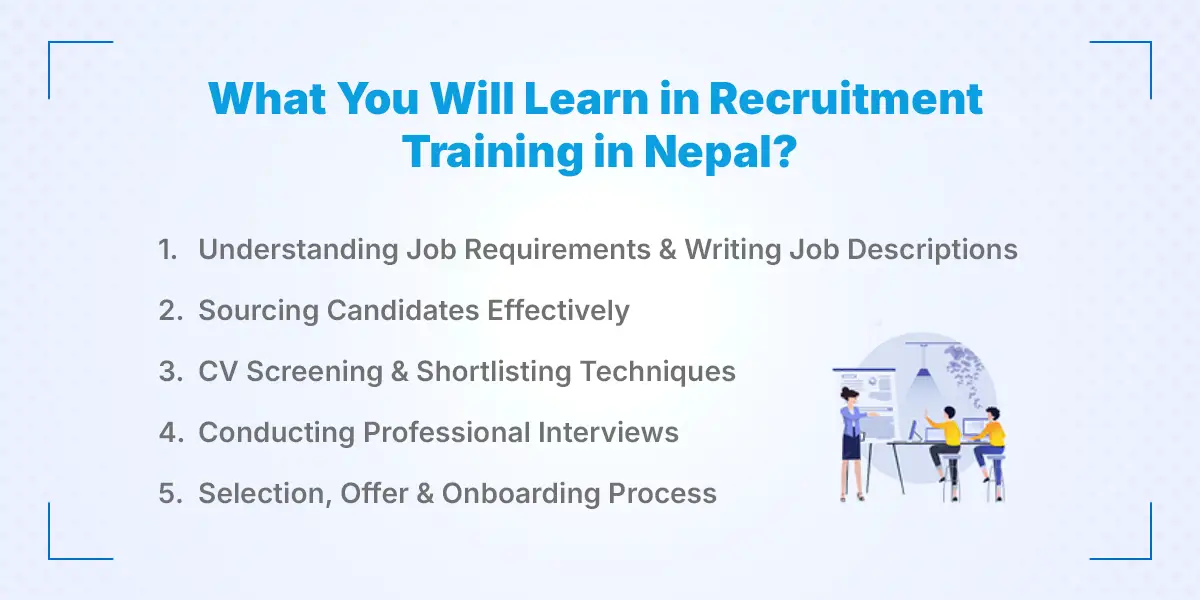
1. Understanding Job Requirements & Writing Job Descriptions
You first learn how to understand what the company actually needs before posting a job. This includes identifying skills, experience level, salary range, and reporting structure. You practice writing clear and professional job descriptions that attract the right applicants. A well-written job post reduces irrelevant applications and saves screening time. Companies that define roles clearly experience fewer hiring mistakes.
2. Sourcing Candidates Effectively
You learn how to find candidates using multiple channels instead of waiting for applications. This includes job portals, LinkedIn, referrals, and internal databases. Effective sourcing increases the quality and quantity of applicants. You understand how to target passive candidates who are not actively applying. Strong sourcing skills help companies fill positions faster.
3. CV Screening & Shortlisting Techniques
Recruitment training teaches you how to filter CVs based on skills, experience, and relevance. You learn how to identify red flags and spot strong profiles quickly. Structured screening reduces bias and improves hiring quality. You practice shortlisting candidates using clear evaluation criteria. This ensures only qualified applicants move to the interview stage.
4. Conducting Professional Interviews
You learn how to prepare interview questions based on job requirements. The training covers structured and behavioral interview techniques. You practice evaluating answers using scoring methods instead of personal opinions. This improves fairness and consistency in hiring. Professional interviews help companies select candidates who truly match the role.
5. Selection, Offer & Onboarding Process
You understand how to compare shortlisted candidates objectively before making a final decision. The training explains how to prepare offer letters and communicate salary details clearly. You also learn basic onboarding steps to ensure a smooth joining. Proper onboarding improves employee retention and engagement. A structured final process completes professional recruitment.
Practical Skills You Gain After Recruitment Training
Recruitment training helps you develop practical hiring skills that make you confident and job-ready in real HR environments. After completing recruitment training in Nepal, you do not just understand recruitment in theory; you can actually perform the tasks independently. These skills reduce errors, improve hiring quality, and increase your professional value in the job market.
- Write clear and effective job posts that attract the right candidates.
- Screen CVs confidently using structured evaluation methods.
- Conduct professional and structured interviews.
- Reduce wrong hiring decisions through proper assessment.
- Communicate clearly and professionally with candidates.
- Manage the complete recruitment process independently.
These practical skills are what separate a trained recruiter from a fresher who only knows HR concepts.
Who Should Join Recruitment Training in Nepal?
Recruitment training in Nepal is suitable for HR freshers, BBA/MBA students, career switchers, admin staff moving to HR, business owners handling hiring, and junior HR officers seeking promotion. This course is designed for anyone who wants practical hiring skills instead of only theoretical HR knowledge. It focuses on real recruitment tasks used inside companies, making it useful for both beginners and working professionals who want career growth.
1. HR Freshers
HR freshers often struggle with real hiring responsibilities. Recruitment training helps them learn CV screening, interviewing, and shortlisting in a practical way. It builds confidence before entering the job market. This reduces dependency on senior HR staff. It also improves chances of securing entry-level HR roles.
2. BBA/MBA Students
BBA and MBA students planning a career in HR benefit from early practical exposure. Recruitment training adds hands-on experience to their academic degree. Employers prefer candidates who understand structured hiring processes. It strengthens their CV before graduation. It also prepares them for internships and HR assistant positions.
3. Career Switchers
Professionals from other industries who want to enter HR need foundational recruitment skills. This training provides a clear understanding of hiring processes. It reduces confusion during a career transition. Structured knowledge improves employability. It also builds confidence when applying for HR roles.
4. Admin Staff Moving to HR
Admin staff often assist in recruitment but lack formal training. Recruitment training helps them understand screening, interviews, and selection steps properly. It increases internal growth opportunities. Companies value staff who can handle recruitment independently. This makes career progression easier.
5. Business Owners Handling Hiring
Small and medium business owners often manage hiring themselves. Recruitment training helps them avoid costly hiring mistakes. It teaches structured evaluation instead of informal decision-making. Better hiring improves team performance. It also supports long-term business stability.
6. Junior HR Officers Wanting Promotion
Junior HR officers who want career growth must strengthen their recruitment skills. Advanced hiring knowledge increases professional value. It prepares them for roles like Talent Acquisition Executive. Structured recruitment skills improve leadership potential. This supports faster promotion within organizations.
Career Opportunities After Recruitment Training
After completing recruitment training in Nepal, you can apply for entry-level and mid-level hiring roles in companies across different industries. Recruitment skills are required in IT companies, banks, manufacturing firms, hospitality businesses, consultancies, and corporate offices. Practical training increases your chances of getting selected because employers prefer candidates who understand real hiring processes.
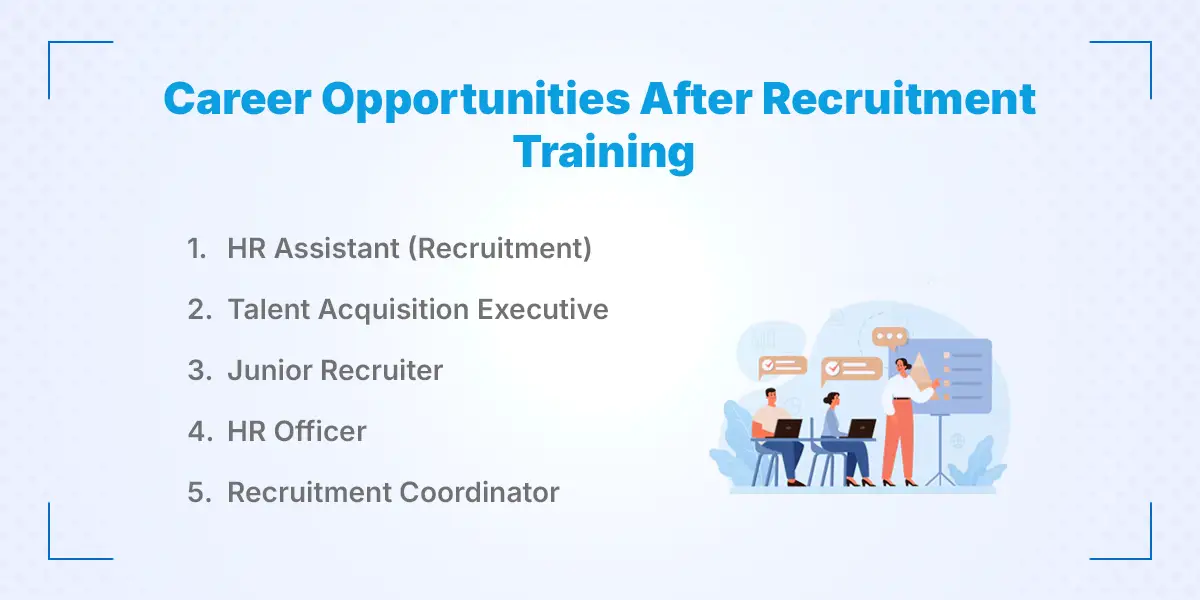
1. HR Assistant (Recruitment)
An HR Assistant (Recruitment) supports the hiring process from job posting to interview coordination. This role involves screening CVs, scheduling interviews, and maintaining candidate records. It is usually an entry-level position suitable for freshers. Recruitment training prepares you to handle these tasks independently. It also builds the foundation for future HR growth.
2. Talent Acquisition Executive
A Talent Acquisition Executive manages sourcing, interviewing, and selecting candidates for different departments. This role requires strong communication and structured evaluation skills. You may work closely with department heads to understand hiring needs. Recruitment training helps you understand sourcing strategies and interview techniques. This role offers strong career growth in corporate HR departments.
3. Junior Recruiter
A Junior Recruiter focuses mainly on sourcing and shortlisting candidates. You will post jobs, search databases, and communicate with applicants. This role is common in recruitment agencies and HR consultancies. Practical recruitment training helps you manage multiple vacancies efficiently. It also improves your candidate handling skills.
4. HR Officer
An HR Officer may handle recruitment along with other HR responsibilities. This role includes screening, interviewing, onboarding, and sometimes basic HR documentation. Companies prefer HR Officers who understand structured recruitment processes. Recruitment training strengthens your hiring expertise. It also increases your chances of promotion to senior HR roles.
5. Recruitment Coordinator
A Recruitment Coordinator manages interview scheduling, communication, and hiring documentation. This role requires organization and professional communication skills. You act as a link between candidates and hiring managers. Recruitment training teaches you how to maintain structured hiring workflows. It prepares you to manage the recruitment process smoothly and professionally.
Recruitment Training vs Complete HR Training – What’s Better?
Recruitment training focuses mainly on hiring skills such as sourcing candidates, screening CVs, interviewing, and selecting the right talent. Complete HR training covers all core HR functions, including hiring, plus areas like payroll, labor law, performance management, compensation & benefits, employee relations, compliance, and HR strategy.
| Comparison Point | Recruitment Training | Complete HR Training |
|---|---|---|
| Primary Focus | Only the recruitment and selection process | Full HR functions, including recruitment |
| Key Skills Covered | Sourcing, CV screening, interviews, and onboarding | Recruitment plus payroll, labor law, performance management, compliance |
| Career Scope | Talent Acquisition, Recruiter roles | HR Officer, HR Manager, and HR Generalist roles |
| Depth of Learning | Specialized in the hiring process | Comprehensive HR knowledge across departments |
| Best For | Those who want only hiring skills | Those who want long term HR career growth |
| Future Growth | Growth within the recruitment field | Wider promotion and leadership opportunities |
Recruitment training is ideal if your goal is to become a recruiter or talent acquisition specialist quickly. Complete HR training is better if you want to understand the full HR cycle, including employee lifecycle management, payroll systems, labor compliance, performance appraisal systems, and HR strategy. At Kumari Job, the Complete HR Training Program covers practical recruitment modules along with payroll basics, labor law understanding, performance management systems, documentation processes, and compliance practices. This ensures you gain both hiring expertise and complete HR knowledge for long-term career growth.
Why Choose a Kumari Job for Recruitment Training in Nepal?
Kumari Job provides practical, job-focused recruitment training designed to make you confident and industry-ready from day one. Our training is not limited to theory. We focus on real hiring processes used by companies in Nepal so that you can handle recruitment tasks independently after completing the course.
- Practical and job-ready training focused on real hiring workflows
- Real hiring case studies based on actual recruitment scenarios
- Interview practice sessions to build confidence and evaluation skills
- Hands-on CV screening exercises using structured criteria
- Professional templates provided for job descriptions, evaluation sheets, and offer letters
- Career guidance support to help you prepare for HR job opportunities
At Kumari Job, the goal is simple: to make you capable of managing recruitment professionally and confidently in any organization.
Conclusion
Recruitment is the foundation of HR and plays a critical role in building strong organizations. Companies need skilled hiring professionals who can identify, evaluate, and select the right talent efficiently. With proper recruitment training, you can confidently manage the entire hiring process and reduce costly mistakes.
If you are serious about building a career in HR or strengthening your hiring skills, consider joining the practical recruitment training program at Kumari Job. The right training today can open the door to long-term success in your HR career.
Frequently Asked Questions
Submit your comments

Get Our App On


What is the Public Relations Officer Salary in Nepal
VIEW DETAILS
What Is the Salary of a Ticketing Officer in Nepal?
VIEW DETAILS
What Is the Salary of a Travel Consultant in Nepal?
VIEW DETAILS
How to Become an Auditor in Nepal
VIEW DETAILS


Loading Comments...