




Looking for an HR course that actually leads to a job? As companies in Nepal focus more on structured hiring, compliance, and people management, the demand for skilled HR professionals is rising fast. Many graduates and working professionals are now turning to HR as a long-term career option. However, with so many short-term trainings available, choosing the right course has become confusing. The best HR course should build real skills, not just provide certificates.
In this blog, we will help you understand the best HR course in Kathmandu and what makes it valuable for your career. We will explain what an HR course includes, why it is important, how to choose the right one, who should take it, and the benefits it offers. This guide is designed to help you make a confident and informed decision before enrolling.
In this blog
What Is an HR Course?
An HR course is a professional training program that teaches the core skills needed to manage people, workplace policies, and organisational processes. It focuses on practical human resource management rather than only theory. An HR course prepares learners to handle recruitment, employee relations, payroll, and compliance tasks. It is designed for fresh graduates, career switchers, and professionals aiming to work in HR roles.
What Do You Learn in an HR Course?
You learn the practical HR skills required to manage the full employee lifecycle in an organisation. The course focuses on real workplace scenarios and job-oriented HR responsibilities. It helps learners understand how HR functions support business growth.
Key learning areas usually include:
- Recruitment and selection process
- Payroll management and salary structures
- Labour laws and HR compliance in Nepal
- Performance management systems
- Employee engagement and retention strategies
- HR documentation and reporting
- Workplace ethics and professional communication
Why Is an HR Course Important?
An HR course is important because it builds job-ready skills that employers in Nepal actively look for. Organisations today need trained HR professionals who understand people management, labour laws, and workplace compliance. An HR course bridges the gap between academic knowledge and practical workplace requirements. It helps individuals enter the HR field with confidence and clarity. For long-term growth, HR training also supports career stability and advancement.
How HR Skills Support Career Growth in Nepal?
HR skills support career growth by opening opportunities across multiple industries in Nepal. Trained HR professionals are valued for their ability to manage people and processes effectively. These skills remain relevant even as organisations grow and evolve.
Key ways HR skills help career growth include:
- Access to entry-level and mid-level HR job roles
- Career progression from HR assistant to HR officer or manager
- Opportunities in corporate, NGO, and service sectors
- Strong understanding of workplace laws and compliance
- Improved communication and leadership abilities
- Long-term job security in growing organisations
Best HR Course in Kathmandu
Kumari Job offers the best HR course in Kathmandu because its training is designed around real industry needs and employer expectations. The course focuses on building practical HR skills that are directly applicable in the Nepali workplace. Students gain hands-on exposure to core HR functions rather than only theoretical knowledge. This approach helps learners become job-ready and confident from the start of their HR careers.
What Makes Kumari Job’s HR Course the Best?
Kumari Job’s HR course stands out due to its industry-focused HR training curriculum that aligns with the needs of Nepali employers. The course content is regularly updated to reflect current HR practices, labour laws, and recruitment trends in Nepal. Learners are exposed to real HR tools, templates, and case scenarios that help them understand how HR works in actual organisations. Trainers bring practical experience from HR roles across corporate and NGO sectors, making classroom learning highly relevant. Students also learn how to handle key HR responsibilities such as talent acquisition, performance management, and compliance through advance hr training in Nepal.
Practical and job-oriented learning is another core strength of Kumari Job’s HR training. The program includes hands-on assignments, group discussions, mock interviews, and HR simulation exercises that reinforce key skills. Students gain confidence in drafting job descriptions, screening resumes, conducting interviews, and managing HR data with industry-standard tools. This practical exposure greatly enhances employability and helps learners transition smoothly into HR roles. With focused career support and real-world training, Kumari Job prepares students for success in Kathmandu’s competitive HR job market.
How to Choose the Best HR Course in Kathmandu?
To choose the best HR course in Kathmandu, you must focus on practical learning, trainer credibility, certification value, and how well the course matches current HR job market needs. With many training options available, the right course should help you gain job-ready skills rather than just theoretical knowledge. A good HR course prepares you for real workplace challenges, Nepali labour laws, and modern HR practices. It should also support your career growth through guidance, exposure, and placement assistance. Making the right choice early can save time and directly impact your employability and long-term hr strategy.
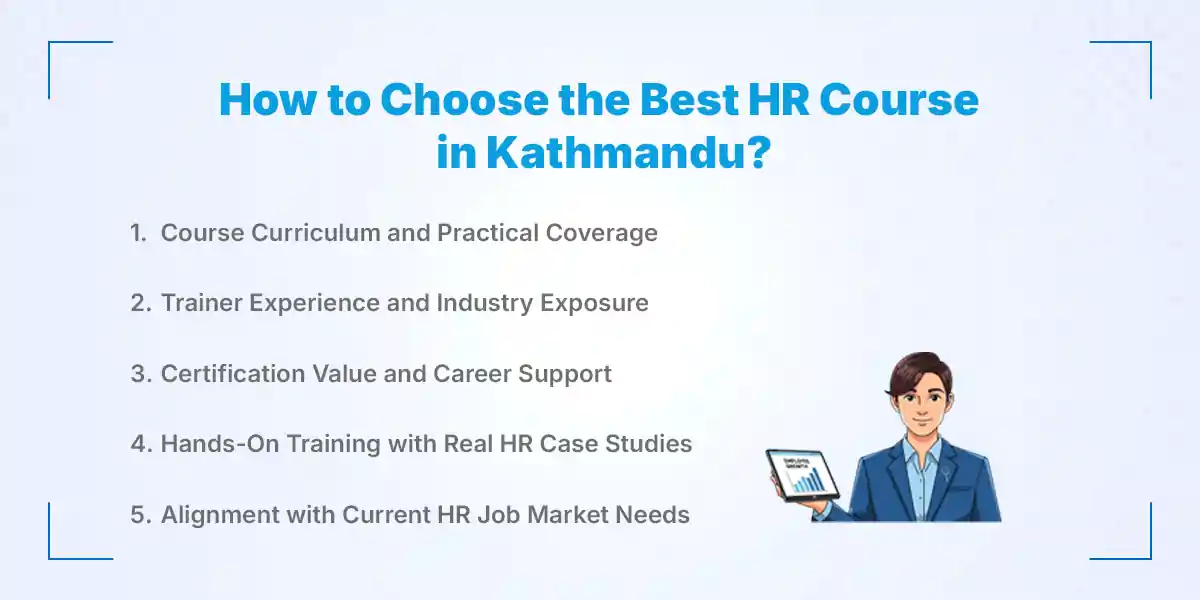
1. Course Curriculum and Practical Coverage
The course curriculum should directly cover core HR functions such as recruitment, payroll, labour law, performance management, and employee relations. A strong HR course balances theory with practical application so learners understand how HR actually works in organisations. Practical coverage helps you confidently handle HR tasks from day one. It also ensures that learning stays relevant to real company needs. This is especially important for freshers entering the HR field or those tasked with conducting an hr audit.
2. Trainer Experience and Industry Exposure
Trainer experience plays a key role in the quality of HR training you receive. Trainers with real HR industry exposure can share practical insights, case examples, and common workplace challenges. Their guidance helps bridge the gap between classroom learning and real HR jobs. Experienced trainers also mentor students on career paths and HR best practices. This adds long-term value beyond the course duration.
3. Certification Value and Career Support
A recognised certification adds credibility to your HR profile in the job market. Employers often prefer candidates who hold certifications from trusted training providers. Along with certification, career support, such as interview preparation and job guidance,e is equally important. This support helps learners transition smoothly into HR roles. It also boosts confidence during job applications and interviews.
4. Hands-On Training with Real HR Case Studies
Hands-on training allows learners to work on real HR scenarios, documents, and decision-making situations. Case studies help you understand how HR problems are solved in actual organisations. This type of learning improves critical thinking and problem-solving skills. It also prepares you for handling workplace situations professionally. Practical exposure makes your HR knowledge more effective and usable.
5. Alignment with Current HR Job Market Needs
The best HR course should align with what employers in Kathmandu are currently looking for. This includes updated HR tools, compliance knowledge, and people management skills. Courses designed around market demand increase your chances of employment. They also help you stay relevant as HR practices evolve. Market-aligned training ensures long-term career stability in HR.
Who Should Take an HR Course in Kathmandu?
An HR course in Kathmandu is ideal for anyone who wants to build, grow, or formalise a career in human resources. It is suitable for both beginners and experienced professionals who want practical HR skills. With organisations in Nepal becoming more structured, trained HR professionals are in high demand. An HR course helps learners understand people management, labour laws, and workplace practices. It also opens doors to stable career opportunities across industries.
1. Fresh Graduates and Entry-Level Job Seekers
Fresh graduates and entry-level job seekers can greatly benefit from an HR course as it provides job-ready skills. Many graduates lack practical exposure, and HR training helps bridge that gap. The course introduces real HR tasks such as recruitment, documentation, and employee coordination. It also improves communication and professional confidence. This makes it easier to enter the job market with a clear career direction.
2. Professionals Switching Careers to HR
Professionals from other fields can use an HR course to smoothly transition into human resources. The training helps them understand core HR functions and workplace responsibilities. It builds a strong foundation in HR processes and compliance. Career switchers also gain clarity on HR roles and expectations. This reduces the risk of confusion when entering a new profession.
3. HR Executives Looking for Skill Enhancement
HR executives can take an HR course to upgrade their existing skills and stay updated. The course helps refine knowledge in labour law, performance management, and employee engagement. It also introduces modern HR tools and best practices. Skill enhancement leads to better decision-making and career growth. This is useful for professionals aiming for senior HR roles.
4. Entrepreneurs and Business Owners in Nepal
Entrepreneurs and business owners can take an HR course to manage their workforce effectively. Understanding HR helps them handle hiring, compliance, and employee relations properly. It reduces legal risks related to labour laws. The course also supports building a positive workplace culture. This leads to better productivity and long-term business growth.
Benefits of Taking an HR Course in Kathmandu
Taking an HR course in Kathmandu helps you gain practical skills, improve employability, and build a strong career in human resources. It prepares you to handle real workplace responsibilities with confidence. As Nepali organisations become more structured, trained HR professionals are increasingly valued. An HR course also helps you understand people management and legal compliance. Overall, it gives you a clear advantage in the competitive job market by providing all the benefits of hr training in Nepal.
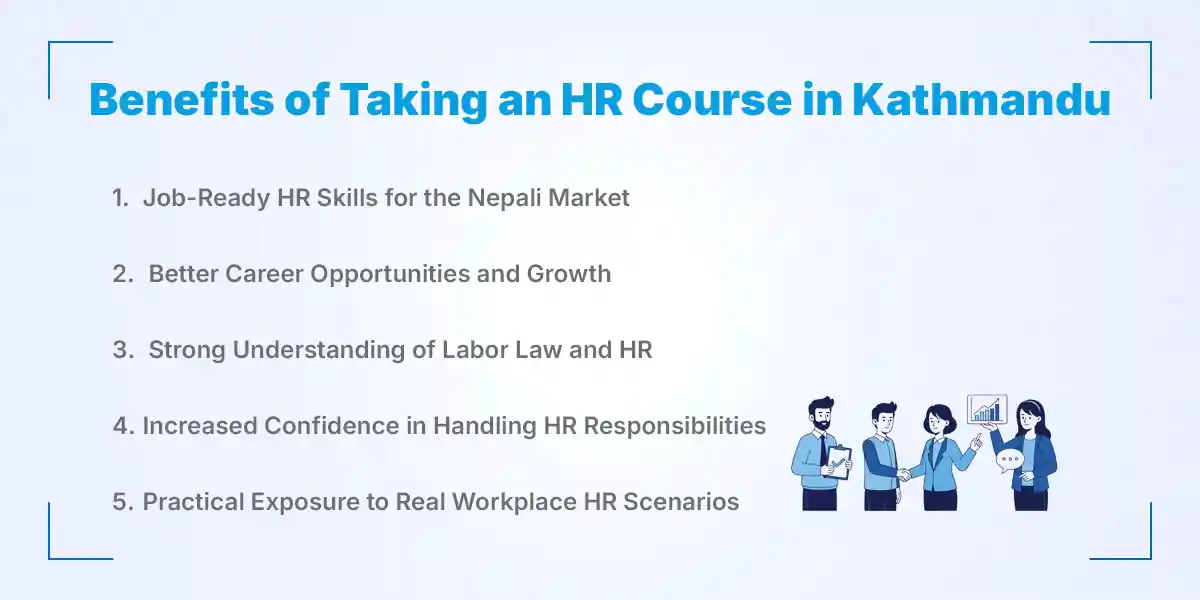
1. Job-Ready HR Skills for the Nepali Market
An HR course equips you with skills that are directly useful in Nepali organisations. You learn recruitment, payroll basics, attendance handling, and employee coordination. These skills match what employers look for in junior and mid-level HR roles. Practical training makes it easier to start work without confusion. This reduces the learning curve after getting hired. It also helps you adapt quickly to different workplace environments.
2. Better Career Opportunities and Growth
Completing an HR course opens doors to a wider range of job opportunities across various industries. It helps you qualify for roles such as HR assistant, HR officer, and recruiter. With experience, career growth becomes faster and more structured. Employers prefer candidates who are trained for long-term roles. This leads to better job stability and promotions. Over time, it can result in higher responsibilities and better salary prospects.
3. Strong Understanding of Labour Law and HR
HR training helps you clearly understand Nepali labour laws and workplace rules. You learn about employee rights, employer duties, and legal compliance. This knowledge reduces the risk of workplace conflicts. It also improves decision-making in HR situations. Legal understanding is essential for responsible HR practice. It ensures that HR actions remain fair and compliant with established hr policies.
4. Increased Confidence in Handling HR Responsibilities
An HR course builds confidence by teaching you how to manage real HR tasks. You learn how to communicate with employees and management professionally. Practical exposure reduces fear of making mistakes. Confidence helps you perform better in interviews and at work. This is important for long-term career success. Confident HR professionals handle challenges more effectively.
5. Practical Exposure to Real Workplace HR Scenarios
Practical learning exposes you to real HR documents and situations. You work on case studies, reports, and HR processes. This helps you understand how HR decisions are made. Real scenarios prepare you for daily HR challenges. It makes your learning more effective and applicable. Practical exposure bridges the gap between training and real work.
Scope of HR Course in Kathmandu
The scope of an HR course in Kathmandu is strong due to the growing number of organised businesses and professional workplaces. Companies are increasingly focusing on structured HR systems and skilled people management. Trained HR professionals are needed to handle recruitment, compliance, and employee relations. An HR course helps learners meet these market demands. This makes HR a stable and long-term career option in Kathmandu.
1. HR Job Opportunities in the Corporate Sector
Corporate organisations in Kathmandu require trained HR professionals to manage their workforce efficiently. HR roles are essential for recruitment, performance management, and employee engagement. As companies grow, the need for structured HR systems increases. Trained HR staff help improve productivity and workplace culture. This creates consistent job opportunities across industries. Corporate HR roles also offer clear career growth paths.
2. Demand for HR Professionals in NGOs and INGOs
NGOs and INGOs in Nepal rely on HR professionals to manage diverse teams and donor compliance. These organisations require strong HR policies and proper employee documentation. Trained HR professionals help maintain transparency and fairness. HR roles in NGOs also involve coordination with international standards. This creates a steady demand for skilled HR professionals. Such roles often offer meaningful work environments.
3. Growth of Recruitment and Payroll Roles
Recruitment and payroll roles are growing rapidly in Kathmandu’s job market. Organisations need skilled professionals to handle hiring processes and salary management. An HR course prepares learners for these specialised roles. Accurate payroll and efficient recruitment are critical for business operations. This creates a continuous demand for trained HR professionals. These roles also offer opportunities for specialisation.
Is an HR Course Really Worth Taking in Kathmandu?
Yes, an HR course is definitely worth taking in Kathmandu because it provides practical skills that match current job market needs. As organisations in Nepal become more structured, the demand for trained HR professionals continues to grow. An HR course helps you understand recruitment, labour law, and employee management in real workplaces. It also improves your chances of getting hired and advancing in your career. With proper training, you gain confidence to handle HR responsibilities effectively. Overall, an HR course offers strong career value and long-term growth opportunities in Kathmandu.
Conclusion
Choosing the right HR course in Kathmandu can play a crucial role in shaping your professional future. With growing demand for skilled HR professionals across corporate sectors, NGOs, and service industries, proper HR training has become more important than ever. A well-structured HR course equips you with practical knowledge, labour law understanding, and people management skills that employers value. It also helps build confidence and prepares you for real workplace challenges in Nepal’s evolving job market.
If you are looking to start or grow your HR career, investing in the right training can make a real difference. Explore more training in Nepal from Kumari Job.
Frequently Asked Questions
Submit your comments

Get Our App On



What is the Public Relations Officer Salary in Nepal
VIEW DETAILS
What Is the Salary of a Ticketing Officer in Nepal?
VIEW DETAILS
What Is the Salary of a Travel Consultant in Nepal?
VIEW DETAILS
How to Become an Auditor in Nepal
VIEW DETAILS


Loading Comments...