




Have you ever wondered how top companies attract and hire the best talent in a competitive market? Finding skilled employees who fit both the role and the company culture is increasingly challenging. Talent acquisition is not just recruitment, it focuses on long-term strategies to bring the right people on board efficiently. Companies that master this process gain a significant advantage in building high-performing teams and staying ahead in their industries.
In this blog, talent acquisition meaning, process, and best software are explored in detail. We will cover the stages of talent acquisition, strategies to attract top candidates, essential tools and software for HR teams, and tips to streamline hiring. Whether you are an HR professional or a business leader, this guide provides actionable insights to improve your hiring outcomes.
In this blog
What Is Talent Acquisition?
Talent acquisition is a strategic approach to identifying, attracting, and hiring skilled professionals who align with an organization’s long-term goals. Unlike simple recruitment, it focuses on building a talent pipeline, employer branding, and aligning hiring with business objectives. This process involves proactive planning, sourcing, and engaging candidates to ensure the organization consistently has access to the right talent. Effective talent acquisition helps companies reduce turnover, increase employee satisfaction, and maintain a competitive advantage in the market.
Difference Between Recruitment and Talent Acquisition
Recruitment is the process of filling immediate job openings, often reactive and short-term, while talent acquisition is proactive and strategic. Talent acquisition focuses on long-term workforce planning, employer branding, and building a talent pipeline for future roles. While traditional recruitment services usually end once a position is filled, talent acquisition involves ongoing relationship management with candidates, performance tracking, and aligning hires with organizational growth. While recruitment emphasizes quantity and speed, talent acquisition emphasizes quality, culture fit, and overall contribution to business objectives.
Hire Faster & Better with Experts
Talent Acquisition vs Recruitment
Talent acquisition and recruitment are often used interchangeably, but they serve different purposes. Talent acquisition focuses on long-term hiring strategies, workforce planning, and building a strong talent pipeline. Recruitment, on the other hand, is short-term, reactive, and primarily aimed at filling immediate job vacancies. When comparing a vacancy announcement vs recruitment, the former is a specific tool used to notify the public of an opening, while the latter encompasses the entire process of sourcing and hiring. While recruitment emphasizes speed and quantity, talent acquisition prioritizes quality, culture fit, and alignment with organizational goals. Employer branding and strategic planning are also central to talent acquisition, making it a broader, ongoing process.
| Feature/Aspect | Talent Acquisition | Recruitment |
|---|---|---|
| Purpose | Long-term hiring strategy | Short-term hiring for immediate needs |
| Focus | Quality, culture fit, strategic alignment | Filling open positions quickly |
| Approach | Proactive, continuous, workforce planning | Reactive, vacancy-driven |
| Employer Branding | Strong focus on promoting company as employer | Minimal focus |
| Candidate Relationship | Builds talent pipelines and engagement | Interaction usually ends after hiring |
| Tools & Technology | Uses HR software, ATS, recruitment analytics | Job boards, basic ATS, resumes |
| Outcome | Long-term organizational growth and retention | Immediate vacancy filled |
Talent Acquisition Process
The talent acquisition process is a structured approach that organizations use to attract, evaluate, hire, and retain top talent. It goes beyond filling open positions by focusing on long-term workforce planning, employer branding, and creating pipelines of high-quality candidates. Companies that follow a clear process can hire efficiently, reduce turnover, and ensure new hires align with organizational culture and goals. The process also emphasizes candidate experience, helping organizations maintain a positive reputation in competitive job markets.
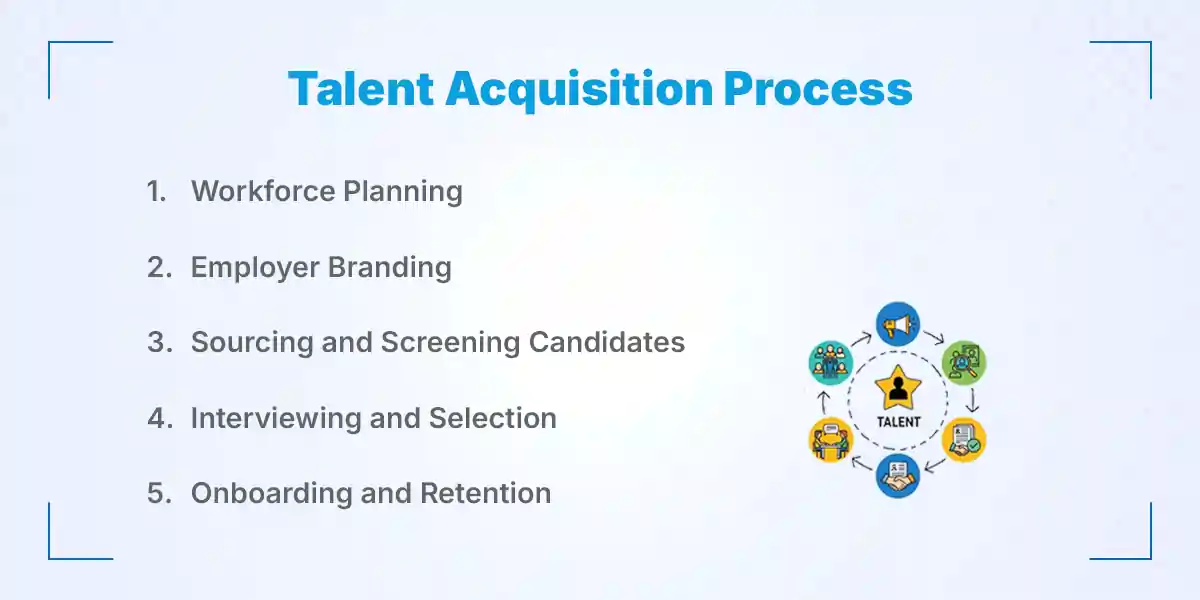
1. Workforce Planning
Workforce planning involves analyzing current and future staffing needs based on business goals. It includes identifying skill gaps, forecasting talent requirements, and creating hiring strategies to meet organizational objectives. Effective planning ensures companies proactively source candidates rather than reacting to vacancies. It also helps align recruitment budgets, timelines, and internal resources for efficient hiring.
2. Employer Branding
Employer branding is promoting a company as a desirable place to work. It involves sharing company culture, values, and employee experiences to attract top talent. Strong branding increases candidate interest and engagement while reducing hiring time. It also positions the company as an industry leader and helps retain existing employees by showcasing growth opportunities and a positive work environment.
3. Sourcing and Screening Candidates
Sourcing and screening involve finding potential candidates through job portals, social media, referrals, and professional networks. Screening evaluates resumes, portfolios, and qualifications to shortlist the most suitable applicants. Effective sourcing ensures a diverse talent pool, while proper screening reduces time spent on unqualified candidates. This step also includes pre-interview assessments and skill tests to ensure quality selection.
Ready to Simplify Your HR Operations?
Ler our specialists handle recruitment, payroll, and people-related processes with an expert's insight.
4. Interviewing and Selection
Interviewing and selection involve assessing candidates’ skills, experience, and cultural fit through structured interviews, practical tests, and behavioral evaluations. HR and hiring managers collaborate to make objective decisions based on predefined criteria. Clear communication and timely feedback enhance candidate experience, and final selection focuses on long-term fit rather than just immediate needs.
5. Onboarding and Retention
Onboarding introduces new hires to company policies, culture, and job responsibilities, ensuring a smooth transition. Retention strategies focus on employee engagement, training, and career development. Effective onboarding reduces turnover, accelerates productivity, and strengthens organizational loyalty. Continuous support and feedback help retain high-performing employees and build a strong talent pipeline for future roles.
Role of a Talent Acquisition Company
A talent acquisition company helps businesses find, attract, and hire the right talent efficiently. They act as experts in sourcing candidates, managing recruitment processes, and building talent pipelines. Outsourcing to these companies saves time, reduces hiring costs, and ensures access to a wider pool of qualified candidates. Companies can focus on core operations while recruitment experts handle strategic and operational hiring tasks.
What Do Talent Acquisition Companies Do?
Ans: Talent acquisition companies identify, attract, and screen candidates for client organizations. They manage the full hiring cycle, including posting job ads, sourcing candidates through multiple channels, screening resumes, conducting initial interviews, and shortlisting qualified applicants. They also provide market insights, salary benchmarking, and candidate recommendations to ensure strategic hires. By handling recruitment operations, they help companies save time and hire top-quality talent efficiently.
What Are the Benefits of Outsourcing Talent Acquisition?
Outsourcing talent acquisition reduces the burden on internal HR teams and speeds up hiring. Companies gain access to specialized recruitment expertise, advanced sourcing tools, and a larger candidate network. Outsourcing ensures better candidate quality, improved employer branding, and data-driven hiring decisions. It also allows businesses to focus on core functions, maintain flexibility during peak hiring periods, and reduce long-term recruitment costs while retaining high-performing talent.
Outsource Your HR Workload Today!
Which Is the Best Talent Acquisition Company in Nepal?
Kumari Job is the best talent acquisition company in Nepal because it provides end-to-end recruitment solutions tailored to business needs. With years of expertise, a wide candidate network, and modern hiring tools, it ensures companies find skilled professionals efficiently. Their approach combines strategic workforce planning, employer branding support, and technology-driven sourcing, making the hiring process faster and more accurate.
Kumari Job also prioritizes quality, reliability, and transparency, helping businesses reduce recruitment costs while improving candidate experience. Their deep understanding of local industries and global hiring trends allows them to serve both startups and large organizations effectively.
Why Do Businesses Choose Professional TA Companies?
Businesses choose professional talent acquisition companies to save time and reduce hiring costs. Experts manage the entire recruitment cycle, from sourcing and screening to interviewing and onboarding. They provide access to a larger talent pool, use advanced tools for efficient hiring, and offer market insights for better decisions. Professional TA companies also improve employer branding and ensure compliance with local labor regulations, making hiring strategic, consistent, and stress-free.
Features of Talent Acquisition Software
Talent acquisition software simplifies and streamlines hiring processes for companies. It helps track applicants, manage candidate relationships, automate repetitive tasks, and generate data-driven insights. By integrating with job portals and other HR tools, this software improves recruitment efficiency, reduces manual errors, and ensures better candidate experiences. Businesses can monitor hiring performance, optimize workflows, and make strategic decisions using advanced analytics. Overall, talent acquisition software enhances productivity and supports scalable hiring.
1. Applicant Tracking System (ATS)
An ATS organizes and tracks candidates throughout the hiring process. It stores resumes, monitors application status, schedules interviews, and manages communication with applicants. ATS ensures no candidate is overlooked and streamlines collaboration among HR teams. Many systems also provide automated notifications, ranking tools, and resume parsing to save time. This feature is crucial for managing high volumes of applications efficiently and keeping the hiring pipeline organized.
2. Candidate Relationship Management (CRM)
CRM software in talent acquisition maintains relationships with potential candidates. It allows recruiters to build talent pools, send personalized messages, track candidate engagement, and nurture relationships over time. CRM helps maintain communication with passive candidates and supports long-term hiring strategies. By keeping detailed profiles and interaction history, companies can quickly identify suitable candidates for future openings.
3. Automation and AI Screening
Automation and AI screening speed up candidate shortlisting. AI algorithms analyze resumes, match skills to job requirements, and prioritize top candidates. Automation handles repetitive tasks like interview scheduling, follow-ups, and notifications. This reduces human bias, saves time, and improves hiring quality. Companies can focus on strategic recruitment activities while routine tasks are efficiently managed by AI-driven tools.
4. Analytics and Reporting
Analytics and reporting provide insights into recruitment performance. Software tracks metrics like time-to-hire, candidate source, cost-per-hire, and offer acceptance rates. HR teams can identify bottlenecks, optimize workflows, and improve decision-making. Reporting dashboards offer real-time visibility into hiring processes, enabling data-driven adjustments and strategic workforce planning.
5. Integration with Job Portals
Integration with job portals allows seamless job posting across multiple platforms. Candidate applications from portals are automatically captured in the system, reducing manual entry. This ensures faster visibility, wider reach, and easier applicant management. Integration also supports syncing with social media platforms, enhancing employer branding, and attracting more qualified candidates.
Benefits of Using Talent Acquisition Software
Talent acquisition software brings multiple advantages for businesses of all sizes. It speeds up recruitment, ensures better candidate management, and improves overall hiring efficiency. By automating repetitive tasks and centralizing data, HR teams can focus on strategic initiatives. The software also enhances communication, provides actionable insights, and creates a consistent experience for candidates. Overall, companies can attract, hire, and retain talent more effectively while optimizing costs and time spent on recruitment.

1. Faster Hiring Process
Talent acquisition software streamlines recruitment workflows, reducing time-to-hire. Automated resume screening, interview scheduling, and candidate tracking speed up each hiring stage. Teams can quickly shortlist qualified candidates, avoiding delays caused by manual processes. The software also allows multiple recruiters to work simultaneously, ensuring a smooth and efficient process from application to onboarding.
2. Improved Candidate Experience
Software provides seamless communication and timely updates to candidates. Automated emails, interview notifications, and easy application tracking create a professional and engaging experience. Candidates can view status updates, submit documents digitally, and receive feedback promptly. A positive experience increases the likelihood of accepting offers and boosts employer branding.
3. Data-Driven Recruitment Decisions
Talent acquisition software generates insights from analytics, helping HR teams make informed hiring decisions. Metrics like time-to-hire, source effectiveness, and candidate engagement highlight areas for improvement. Data-driven strategies ensure better alignment with company goals, reduce hiring biases, and improve overall recruitment quality.
4. Better Collaboration Across HR Teams
The software centralizes candidate information, allowing HR teams to collaborate efficiently. Multiple users can access profiles, share notes, and track hiring progress in real-time. This reduces miscommunication, prevents duplicate efforts, and ensures a coordinated approach. Cross-functional teams can participate in the hiring process seamlessly, from sourcing to final selection.
Let Experts Handle Your Hiring!
How to Choose the Right Talent Acquisition Software?
You can choose the right talent acquisition software by evaluating your company’s hiring requirements, team size, and recruitment goals. It’s important to consider usability, customization options, cost-effectiveness, and whether the software aligns with local or global recruitment standards. Selecting the right platform ensures streamlined hiring processes, improved candidate experience, and better HR collaboration. A well-chosen system also grows with your company, reducing the need for frequent changes and minimizing disruptions in recruitment workflows.
1. Business Size and Hiring Needs
Software should match your company's size and recruitment volume. Large enterprises may need advanced features like multi-department workflows, analytics dashboards, and compliance tracking. Small to mid-sized businesses may prioritize simplicity, core hiring functions, and ease of integration. Understanding hiring frequency, team collaboration needs, and role complexity helps select a system that suits daily operations.
2. Ease of Use and Customization
A user-friendly interface ensures smooth adoption across HR teams. Customizable workflows, templates, and dashboards allow the software to adapt to your processes. Easy navigation reduces errors, saves training time, and increases productivity. Custom features such as branded application forms, automated notifications, and reporting dashboards improve efficiency and candidate experience.
3. Cost and Scalability
Evaluate pricing based on features, number of users, and company size. Scalable software grows with your organization, supporting higher recruitment volumes over time. Avoid platforms with hidden costs for upgrades or extra modules. Investing in scalable solutions ensures long-term efficiency without frequent system changes or interruptions in hiring workflows.
4. Local vs Global Software Options
Local software may provide region-specific compliance, Nepali language support, and integration with local job portals. Global solutions often offer advanced features, cloud storage, and broader analytics. Choosing between local and global options depends on your company’s operational scope, recruitment standards, and preference for international best practices versus localized ease of use.
Conclusion
Choosing the right talent acquisition software is crucial for modern businesses to streamline hiring, improve candidate experience, and make data-driven decisions. By considering company size, hiring needs, ease of use, cost, and whether a local or global solution fits best, organizations can optimize recruitment processes and reduce administrative burdens.
Investing in the right platform not only speeds up hiring but also strengthens collaboration across HR teams and ensures long-term scalability. A carefully selected software empowers recruiters, enhances employer branding, and helps companies attract and retain top talent efficiently in a competitive market.
Frequently Asked Questions
Submit your comments

Get Our App On



What is the Public Relations Officer Salary in Nepal
VIEW DETAILS
What Is the Salary of a Ticketing Officer in Nepal?
VIEW DETAILS
What Is the Salary of a Travel Consultant in Nepal?
VIEW DETAILS
How to Become an Auditor in Nepal
VIEW DETAILS


Loading Comments...