




Labor law in Nepal provides the legal framework that governs employment relationships, ensuring fair treatment for employees while outlining the responsibilities of employers and HR professionals. It covers essential areas such as wages, working hours, leave, social security, workplace safety, and termination procedures. By following these laws, businesses can maintain a compliant, safe, and transparent work environment while protecting employees’ rights.
For employers and HR teams, understanding labor law is crucial to minimizing legal risks, avoiding penalties, and handling workforce management effectively. Proper knowledge helps HR professionals design compliant policies, manage payroll and benefits, and resolve disputes fairly. Whether managing permanent, contract, part-time, or outsourced employees, a clear understanding of labor regulations is essential for fostering trust, efficiency, and long-term organizational success in Nepal.
In this blog
What is Labor Law in Nepal?
Labor law in Nepal is a set of rules and regulations that govern employment relationships, ensuring fair treatment for employees while outlining the responsibilities of employers and HR professionals. It provides the legal framework for workplaces, covering areas such as wages, working hours, leave, social security, and workplace safety.
The purpose of labor law is to protect employees from exploitation, maintain safe and healthy working conditions, and ensure fair compensation. At the same time, it guides employers in managing their workforce responsibly and staying compliant with legal standards. All companies, employers, and HR departments operating in Nepal must comply with these laws. Even outsourced or third-party employees are subject to certain provisions, making understanding labor law essential for anyone involved in workforce management.
Why Is Labor Law Important in Nepal?
Labor law is important in Nepal because it provides legal protection for both employers and employees, ensuring that workplaces operate fairly and safely. For employees, it guarantees rights such as fair wages, leave, and a safe working environment. For employers, it establishes clear rules for managing staff and avoiding disputes.
Non-compliance with labor laws can result in serious consequences, including fines, legal penalties, employee grievances, and damage to a company’s reputation. Ignoring labor regulations can also lead to prolonged disputes, decreased employee trust, and operational challenges.
HR teams must have a clear understanding of labor laws to implement them effectively within the organization. Proper knowledge allows HR professionals to design compliant policies, handle payroll and benefits correctly, and address workplace issues legally. This not only minimizes legal risks but also strengthens the organization’s credibility and employee satisfaction.
Major Labor Laws in Nepal
Nepal’s labor law framework is made up of several key acts and rules that together govern employment relationships, workplace rights, and HR compliance responsibilities. These laws have been updated in recent years to protect workers, clarify employer obligations, and align Nepal’s labor standards with constitutional and international norms.
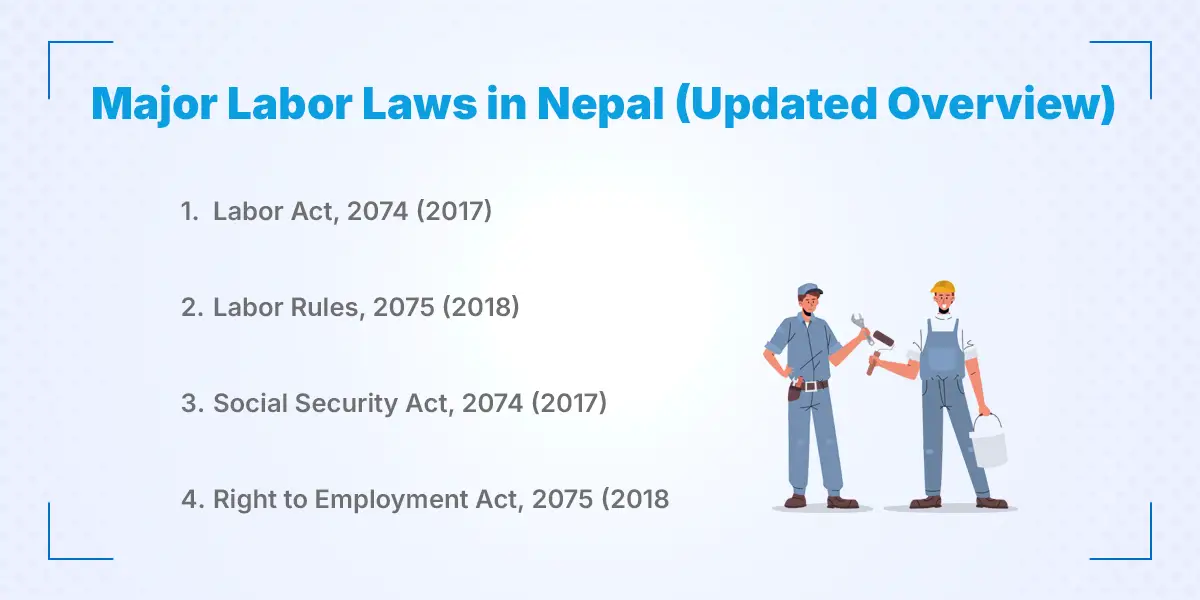
1. Labor Act, 2074 (2017)
The Labor Act, 2074 (2017) is the core legislation governing labor and employment in Nepal, repealing the older Labor Act 2048 and modernizing the legal framework for labor relations. It defines employers’ and employees’ rights, sets standards for working hours, wages, leave, workplace safety, and dispute resolution, and prohibits forced labor, discrimination, and child labor. The Act also provides detailed classifications of employment types and requires formal employment agreements. It applies to all enterprises regardless of size or profit motive.
2. Labor Rules, 2075 (2018)
To implement the Labor Act effectively, the Labor Rules, 2075 (2018) were introduced. These rules offer procedural guidance on many aspects of the Labor Act, including employment contracts, work permits for foreign nationals, and administrative processes for compliance. They detail how employers should implement statutory obligations such as written agreements and work permit requirements. The rules also clarify eligibility and documentation procedures for various labor protections under the Act.
3. Social Security Act, 2074 (2017)
The Contribution-Based Social Security Act, 2074 (2017) establishes the legal basis for Nepal’s Social Security Fund (SSF), a mandatory contributory system that provides financial protection and benefits to employees. Employers and employees both make regular contributions to fund schemes such as medical and maternity protection, accident and disability coverage, and old age security. The Act ensures that formal sector workers receive social welfare benefits, and it defines registration, contribution rates, and eligibility for benefits.
4. Right to Employment Act, 2075 (2018)
The Right to Employment Act, 2075 (2018), focuses on promoting employment opportunities and protecting citizens’ access to work. It establishes a legal right to employment for Nepali citizens and requires the government at national and local levels to facilitate job opportunities, create employment service centers, and prioritize vulnerable groups such as women, Dalits, and economically disadvantaged populations. The Act aims to reduce unemployment by organizing employment services and support programs.
Together, these major laws provide a comprehensive regulatory ecosystem for employment and HR compliance in Nepal. Employers and HR professionals must understand each of these laws to ensure full compliance, protect employee rights, and minimize legal risk in their organizations.
Confused About HR Policies and Compliance?
Get expert HR guidance to manage people, policies, and paperwork the right way.
Employment Types Recognized Under the Nepal Labor Law
Nepal's labor law recognizes different types of employment to regulate workers’ rights and employers’ responsibilities. Understanding these categories helps HR professionals and business owners remain compliant while offering fair treatment to all employees.
1. Permanent Employment
Permanent employees are hired for an indefinite period with no predetermined end date. They receive full benefits, including annual leave, social security contributions, and other statutory entitlements. Employers must follow formal hiring procedures, maintain records, and comply with termination rules. Permanent employment ensures job stability and security, making it the most common type of employment in Nepal. Proper documentation is essential to avoid disputes and ensure legal compliance.
2. Contract Employment
Contract employees are hired for a specific duration or project as defined in a written agreement. Their rights and benefits depend on the contract terms as well as applicable labor laws. Contracts must clearly specify duration, remuneration, and conditions for termination. This employment type is often used for seasonal work, project-based roles, or specialized assignments. HR teams must regularly review contracts to ensure compliance with labor regulations.
3. Casual Employment
Casual employees work on a temporary or irregular basis, often hired daily or for short-term tasks. They have limited benefits compared to permanent employees, but employers must still comply with minimum wage, workplace safety, and social security obligations. Casual employment is common for handling workload peaks or short-term operational needs. Proper record-keeping of attendance and payments is crucial to avoid legal issues.
4. Part-Time Employment
Part-time employees work fewer hours than full-time staff, with schedules agreed upon in advance. They receive proportional benefits based on hours worked, including leave and social security contributions. Part-time work is ideal for flexible roles or additional support staff. HR must track hours accurately and ensure compliance with wage and labor regulations. Clear agreements prevent misunderstandings and legal risks.
5. Outsourced and Third-Party Employees
Outsourced employees are hired through external agencies or third-party providers. Although they perform work for the company, their legal employment relationship is with the agency. Labor laws regarding safety, fair treatment, and compliance still apply. Companies often use outsourcing to access skilled labor efficiently while reducing administrative burden. Learn more about HR Outsourcing Services in Nepal
Working Hours, Leave, and Overtime Rules in Nepal
Nepal’s labor law sets specific standards for working hours, rest periods, leave entitlements, and overtime compensation to protect employee rights while giving employers a framework for compliant workforce management. Understanding these rules helps HR teams maintain legal compliance and minimize disputes.
1. Daily and Weekly Working Hours
Under the Labour Act 2074 (2017), the maximum regular working hours are 8 hours per day and 48 hours per week for adult employees. Employers must ensure that employees do not exceed these limits in their regular schedule. There is flexibility in how hours are arranged; for example, a 5‑day workweek can still comply as long as total weekly hours do not exceed 48.
In addition to regular hours, workers are entitled to a rest break (at least 30 minutes) after 5 continuous hours of work, and employers should structure work so these breaks are meaningful.
2. Public Holidays and Weekly Rest
Employees are entitled to one weekly rest day, typically Sunday or another agreed day, to support work‑life balance. Employers must also observe the government-declared public holidays, generally 13 days annually (with an extra day for women on International Women’s Day).
If an employee works on a weekly rest day or public holiday, employers must either provide paid overtime at the legal rate or grant replacement leave within a legally prescribed period (often 21 days).
3. Annual, Sick, Maternity, and Casual Leave
Nepal’s labor law provides multiple leave categories:
- Annual/Home Leave: Employees earn 1 day of annual leave for every 20 days worked (often totaling around 18–21 days annually) and can carry over a portion of unused leave up to limits set by the Act.
- Sick Leave: Fully paid sick leave of up to 12 days per year is guaranteed on a proportional basis.
- Maternity Leave: Female workers receive up to 14 weeks of maternity leave, of which 60 days are paid.
- Paternity Leave: New fathers are entitled to 15 days of paid leave.
- Casual/Mourning Leave: The law provides provisions like mourning leave (typically paid) for certain personal events.
These leave benefits must be tracked accurately, and many can be encashed at the end of employment if unused.
4. Overtime Calculation and Payment Rules
Work that exceeds the standard working hours (beyond 8 hours per day or 48 hours per week) is considered overtime. Employers may require or request overtime only when necessary, and this should be reasonable and documented.
Overtime limits are set at a maximum of 4 hours per day and 24 hours per week. Employers must pay overtime at 1.5 times the employee’s normal hourly rate, or provide equivalent compensatory paid leave.
Accurate attendance and overtime records are essential to ensure proper calculation and legal compliance. Employers must also respect employee consent and ensure that overtime policies are reflected in contracts and company policy documents.
Salary, Payroll, and Minimum Wage Provisions
Understanding salary, payroll, and minimum wage rules is essential for employers and HR professionals in Nepal to ensure compliance with the Labour Act and protect employee rights. These provisions govern how much workers must be paid, how payroll should be managed, and what deductions are legally allowed.
1. Minimum Wage Structure in Nepal
Nepal’s government periodically updates the minimum wage to reflect economic conditions. Under the Labour Act 2074 (2017), the Minimum Remuneration Fixation Committee reviews and sets minimum wages at least every two years. The most recent Minimum Remuneration Notice (2082/2025 A.D.) sets the monthly minimum wage at NPR 19,550 for most employees (including basic wage and dearness allowance), with corresponding daily and hourly rates (approx. NPR 754 daily and NPR 101 hourly). Employers cannot lawfully pay less than these prescribed amounts, even for part‑time, contractual, or casual workers.
2. Salary Payment Timeline and Methods
The Labour Act requires that wages be paid in a timely and regular manner. Employers may set payment periods (weekly, fortnightly, or monthly), but the interval between payments must not exceed one month. For workers employed for less than one month, payments must be made within three days after work is completed, and casual workers should be paid immediately after work ends. Employers must pay salaries on a working day and should ideally use transparent methods such as bank transfer or documented pay slips.
3. Payroll Records and Documentation
HR and payroll teams must keep accurate payroll records for all employees showing detailed salary components (basic wage, allowances, overtime, etc.), statutory contributions, and deductions. These records help employers demonstrate compliance during government inspections and resolve employee disputes. Nepalese labour law also requires clear pay slips that show how wages are calculated and what amounts were deducted.
Simplify Payroll Management with HR Support!
4. Legal Wage Deductions
Not all deductions are allowed under the law. Permitted deductions include income tax (as per tax law), SSF contributions, provident fund (where applicable), and other legally authorized items like employee‑taken advances. Employers must not make unauthorized deductions from wages, and any deduction must be transparent and explained to the employee. This prevents disputes and ensures compliance with statutory requirements.
By complying with these salary, payroll, and minimum wage provisions, companies in Nepal protect both employees and themselves from legal issues, foster trust, and maintain a transparent and fair workplace environment.
Social Security Fund (SSF) and Tax Compliance
In Nepal, all employers are legally required to register their employees with the Social Security Fund (SSF) under the Contribution-Based Social Security Act, 2074 (2017). Both employers and employees contribute to the fund, which provides benefits such as a pension, medical care, maternity leave, disability allowance, and employment injury coverage. The current contribution ratio is 10% from the employer and 10% from the employee of the monthly salary, though exact percentages may vary based on employee categories and salary levels. Timely registration and contribution are mandatory for all formal sector workers, including permanent, contract, and part-time employees.
Non-compliance or late contributions can lead to penalties, fines, and legal action, in addition to potential damage to a company’s reputation. Common mistakes companies make include failing to register employees, miscalculating contributions, delaying payments, and not keeping proper records of deductions and payments. HR professionals must stay updated on SSF rules and ensure accurate payroll integration to maintain compliance and protect employees’ social security rights.
Employee Termination, Resignation, and Disciplinary Action
In Nepal, employee termination must follow legal procedures defined under the Labour Act, 2074. Employers can terminate employees for justified reasons such as misconduct, poor performance, redundancy, or the closure of the company. Termination must be documented with clear reasons, and disciplinary actions should follow a formal process to ensure fairness and avoid disputes. Arbitrary dismissal without legal grounds can lead to penalties and compensation claims.
The law also specifies notice period requirements. Typically, employers must provide at least one month’s notice or equivalent salary in lieu of notice for permanent employees. Contract employees should follow the notice period defined in their agreements. Similarly, employees wishing to resign must submit notice according to the terms of their employment contract.
HR departments must maintain a proper grievance handling process to resolve workplace disputes before they escalate. When an employee leaves, whether voluntarily or through termination, the employer must conduct a final settlement, including salary, leave encashment, overtime, and other benefits owed. Ensuring accurate and timely settlements protects companies from legal action and builds trust with employees.
Common Labor Law Mistakes Companies Make in Nepal
Even experienced companies often make errors in labor law compliance, which can lead to penalties, disputes, and reputational damage. Understanding common mistakes helps HR teams prevent legal issues and maintain proper workforce management.
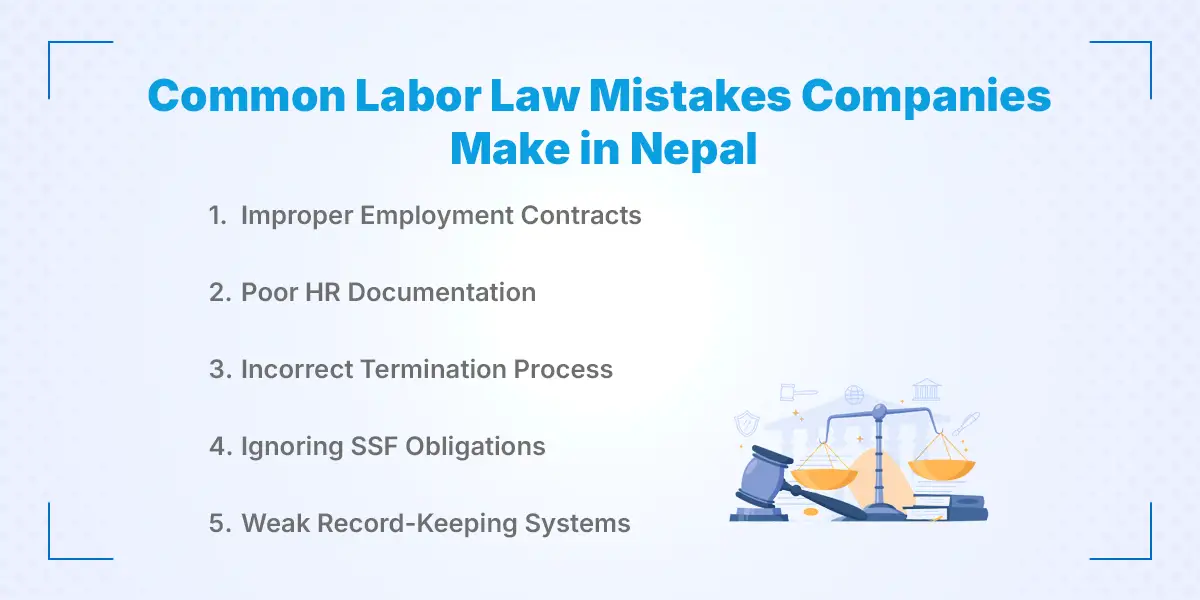
1. Improper Employment Contracts
Many companies fail to draft employment contracts that comply with the Nepal labor law. Missing details such as job role, salary, working hours, leave entitlements, and termination clauses can create legal loopholes. Properly written contracts protect both employees and employers, ensuring clarity and minimizing disputes.
2. Poor HR Documentation
HR departments sometimes neglect proper documentation of attendance, leave, payroll, and employee records. Inadequate records make it difficult to resolve disputes, calculate benefits, or prove compliance during government inspections. Maintaining organized HR files is essential for legal protection.
Get Professional HR Support Today!
3. Incorrect Termination Process
Companies often terminate employees without following legal procedures, failing to provide proper notice or final settlement. This can result in employee grievances, legal penalties, or forced reinstatement. HR teams must adhere strictly to labor law guidelines for disciplinary actions and termination.
4. Ignoring SSF Obligations
Some businesses delay SSF registration or contributions, miscalculate amounts, or skip reporting entirely. Non-compliance exposes companies to fines, penalties, and loss of credibility. Regular monitoring of SSF contributions ensures employees receive social security benefits and protects the company from legal risks.
5. Weak Record-Keeping Systems
Inadequate record-keeping for payroll, leave, overtime, and HR policies is a frequent mistake. Weak systems increase errors in payments, benefits, and compliance reporting. Implementing structured HR management and payroll systems reduces mistakes, improves transparency, and ensures legal adherence.
Why HR Professionals Must Understand Labor Law in Nepal
HR professionals who clearly understand labor law gain a significant career advantage, as they can manage employee relations effectively and ensure organizational compliance. Knowledge of the law helps HR teams reduce legal and compliance risks, preventing costly fines, penalties, or disputes.
Understanding labor regulations also helps in building trust within organizations, as employees feel their rights are protected and policies are applied fairly. By mastering labor law, HR professionals contribute to a transparent, efficient, and legally compliant workplace, enhancing both their reputation and the organization’s credibility.
How HR Training Helps You Master Labor Law Compliance
Effective HR training provides practical applications of labor law, equipping HR professionals to handle real-world situations confidently. Through real-world case studies, participants learn how to manage payroll, leave, overtime, and other compliance requirements accurately.
Kumari Job’s HR Training in Nepal also covers payroll management, compliance handling, and HR policy drafting, ensuring that HR teams can implement company policies in line with labor regulations. Such training prepares HR officers to avoid mistakes, maintain proper documentation, and create a fair and legally compliant workplace.
Conclusion
Labor law compliance in Nepal is essential for protecting both employees and businesses. Adhering to legal requirements ensures fair treatment, prevents disputes, and safeguards companies from penalties or reputational damage.
Correct HR practices, including proper employment contracts, accurate payroll, leave management, and SSF compliance, create a transparent and efficient work environment. Businesses that implement these practices not only reduce legal risks but also build trust with their workforce.
Investing in HR training and consulting support, such as the programs offered by Kumari Job, equips HR teams with the knowledge and tools to manage labor law effectively, ensuring long-term compliance and organizational success.
Frequently Asked Questions
Submit your comments

Get Our App On



What is the Public Relations Officer Salary in Nepal
VIEW DETAILS
What Is the Salary of a Ticketing Officer in Nepal?
VIEW DETAILS
What Is the Salary of a Travel Consultant in Nepal?
VIEW DETAILS
How to Become an Auditor in Nepal
VIEW DETAILS


Loading Comments...