




Every rupee you earn feels like a reward for your hard work. But before it reaches your hands, a small share goes to the government. This is how the country funds roads, schools, hospitals, and many other services you use every day.
This share is called salary tax, and it applies to most people who earn in Nepal. The idea is simple, but the rules, rates, and exemptions can be tricky to follow. Many workers aren’t sure how much they should pay or whether they can reduce it legally.
In this blog, we’ll walk you through everything about salary tax in Nepal for 2025. From what it means to how it’s calculated, we’ll make it easy and clear.
In this blog
What is Salary Tax in Nepal?
Salary tax is the amount of money that the government receives from your salary. It is used to pay for public facilities like roads, schools, and hospitals. If you earn money from working, part of it goes to the government as tax. Typically, your employer deducts it from your pay before he pays you. It means you don't have to provide the tax yourself. It is deducted on a monthly basis. The amount deducted is based on your income. The more you make, the higher the tax rate is, and the less you make, the lower the tax rate. Salary tax cannot be avoided legally.
In Nepal, salary tax is controlled by the Income Tax Act. This law explains how much tax to pay and who needs to pay it. It also tells what types of income are taxed. There are different tax rates, so people who earn more pay more tax. Some things, like insurance payments or retirement fund contributions, can lower the amount of tax you owe. The law is fair because it treats everyone in the same income group equally. Employers must follow these rules when they take taxes from their workers' pay. This system helps the government collect money in an organized way. Without laws like this, tax collection would be chaotic and unfair.
Anyone who earns a salary in Nepal will have to pay salary tax. This includes full-time employees of corporations, part-time employees, and government employees. Even freelancers and self-employed people pay tax, though the rules may be slightly different for them. However, you may not have to pay if your income is below the minimum amount taxable. The minimum taxable income fluctuates over time, as per the government's policies and budget. Even non-residents who earn in Nepal have to pay tax on the income they earn in Nepal, especially those aiming for a good salary in Nepal.
Salary Tax Rates in Nepal (Updated for 2025)
In Nepal, how much tax you pay depends on your annual income. The government has set different tax rates for single individuals and married couples. Here's how it works:
1. For Single Individuals
- First NPR 500,000: Taxed at 1%, totaling NPR 5,000.
- Next NPR 200,000 (i.e., from NPR 500,001 to NPR 700,000): Taxed at 10%, totaling NPR 20,000.
- Next NPR 300,000 (i.e., from NPR 700,001 to NPR 1,000,000): Taxed at 20%, totaling NPR 60,000.
- Next NPR 1,000,000 (i.e., from NPR 1,000,001 to NPR 2,000,000): Taxed at 30%, totaling NPR 300,000.
- Next NPR 3,000,000 (i.e., from NPR 2,000,001 to NPR 5,000,000): Taxed at 36%, totaling NPR 1,080,000.
- Above NPR 5,000,000: Taxed at 39%.
2. For Married Couples
- First NPR 600,000: Taxed at 1%, totaling NPR 6,000.
- Next NPR 200,000 (i.e., from NPR 600,001 to NPR 800,000): Taxed at 10%, totaling NPR 20,000.
- Next NPR 300,000 (i.e., from NPR 800,001 to NPR 1,100,000): Taxed at 20%, totaling NPR 60,000.
- Next NPR 900,000 (i.e., from NPR 1,100,001 to NPR 2,000,000): Taxed at 30%, totaling NPR 270,000.
- Next NPR 3,000,000 (i.e., from NPR 2,000,001 to NPR 5,000,000): Taxed at 36%, totaling NPR 1,080,000.
| - Above NPR 5,000,000: Taxed at 39%.
This structure allows married couples to benefit from a higher tax-free threshold, meaning they can earn more before paying higher tax rates.
Salary Tax Rates in Nepal (2082)
| Annual Income (Single NPR) | Annual Income (Married NPR) | Tax Rate |
|---|---|---|
| Up to 500,000 | Up to 600,000 | 1% |
| 500,001 to 700,000 | 600,001 to 800,000 | 10% |
| 700,001 to 1,000,000 | 800,001 to 1,100,000 | 20% |
| 1,000,001 to 2,000,000 | 1,100,001 to 2,000,000 | 30% |
| 2,000,001 to 5,000,000 | 2,000,001 to 5,000,000 | 36% |
| Above 5,000,000 | Above 5,000,000 | 39% |
Understanding these rates and deductions can help you manage your finances better and ensure you're paying the correct amount of tax. If you need assistance calculating your specific tax liability or exploring further deductions, feel free to ask!
Salary Tax for Different Employment Types
In Nepal, the salary tax policy is a bit different depending on whether you are freelancing or full-time. Being aware of both makes you pay the right amount and avoid issues. Here is a quick overview:
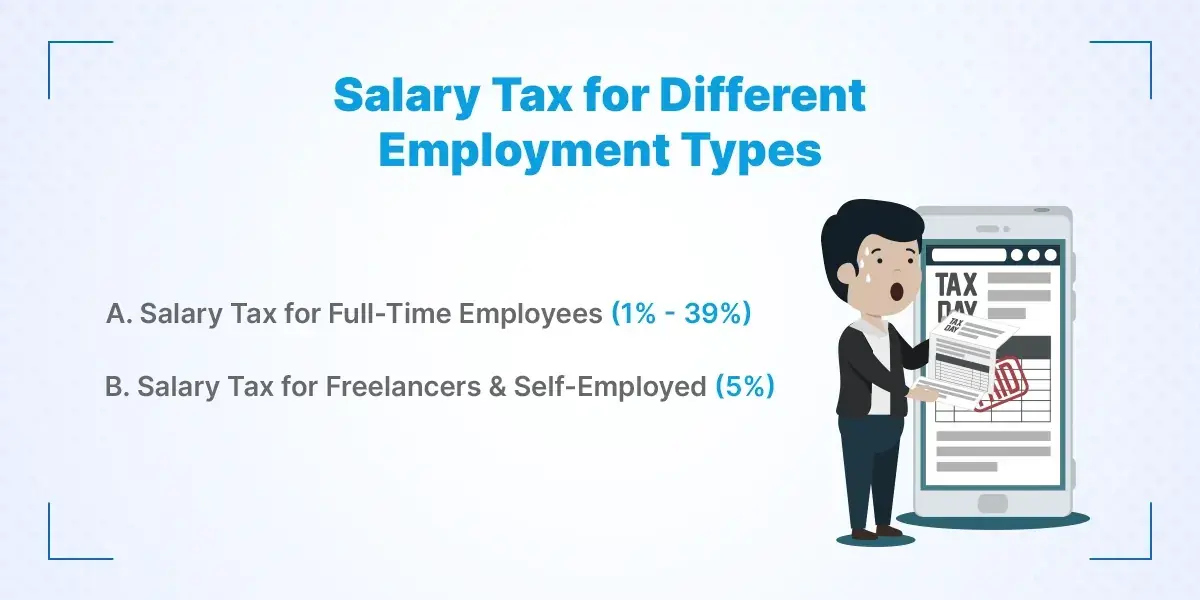
1. Full-Time Employees Salary Tax (1% - 39%)
Permanent employees pay tax on their yearly income. The tax is 1% for low-income people and 39% for rich people. Your employer will automatically deduct this tax from your monthly pay. Your employer will also help you with your tax return. This makes it easy and automatic to pay tax. You can still make deductions like insurance or payments into a pension fund. If you receive some extra income, you will have to report it yourself.
2. Freelancers & Self-Employed Salary Tax (5%)
Freelancers and self-employed persons pay a flat rate of 5% on their income. It is simple and does not change with income levels. They, however, need to compute and pay their tax themselves. They need to be cautious to keep proper records of expenses and revenue. Occasionally, they need to pay tax in advance. When their income crosses a specified amount, they will also need to register for VAT. Freelancers need to be well-organized so as not to be charged fines.
How to Calculate Salary Tax in Nepal?
To calculate salary tax in Nepal, first find your total taxable annual income, then apply the tax rates based on your income slab, subtract any deductions, and finally divide by 12 for monthly tax.
Step-by-Step Calculation Guide
1. Calculate Your Total Annual Income: Add up all your earnings from salary, bonuses, allowances, and any other taxable income for the year.
2. Identify Your Tax Slab: Look at the income tax slabs for your status (single or married) to find your tax rate based on your total annual income.
3. Calculate Tax for Each Slab: If your income falls into multiple slabs, calculate tax separately for each portion. For example, if you earn NPR 900,000 as a single individual:
- First NPR 500,000 taxed at 1%
- Next NPR 200,000 taxed at 10%
- Remaining NPR 200,000 taxed at 20%
4. Apply Deductions and Exemptions: Subtract eligible deductions like retirement fund contributions, life insurance premiums, and medical insurance payments. These reduce your taxable income.
5. Calculate Final Tax Payable: After deductions, recalculate tax if needed. This is your annual tax.
6. Find Monthly Tax: Divide your annual tax by 12 for the monthly tax amount deducted from your salary.
Calculating these tax slabs manually for every employee is time-consuming and error-prone. If you want to learn how to automate these tax calculations and run flawless payroll, you can take the professional HR Training in Nepal and grow your skills.
Examples
1. Full-Time Employee
If you earn NPR 900,000 yearly and contribute NPR 50,000 to a retirement fund, deduct that from your income first. So, taxable income = 900,000 - 50,000 = 850,000. Then calculate tax on 850,000 using slabs. Here is how you do it:
If you are single:
- Taxable income: 850,000
- 1% for first 500,000: 5000
- 10% for another 200,000: 20,000
- 20% for the remaining 150,000: 30,000
- Total yearly payable tax amount: 55,000
If you are married:
- Taxable income: 850,000
- 1% for first 600,000: 6000
- 10% for another 200,000: 20,000
- 20% for the remaining 50,000: 10,000
- Total yearly payable tax amount: 36,000
2. Part-Time Worker
If your part-time income is NPR 400,000 a year, the tax rate is 1%. So, tax = NPR 400,000 x 1% = NPR 4,000 yearly.
3. Freelancer
Freelancers must also add freelance earnings. If you earn NPR 700,000 from freelancing and have no deductions, calculate tax slab-wise on the whole amount. Also, freelancers might need to pay advance tax and consider GST if applicable.
Salary Tax Deductions and Exemptions
When you pay salary tax in Nepal, you are not required to pay tax on your entire income. The government has the facility to deduct some parts of your income from the tax. Deductions and exemptions lower the part of the income on which you are required to pay tax, and you can save money.
These are the common deductions and exemptions that you must know:
1. Retirement Fund Contributions
If you pay into a retirement fund such as the Provident Fund or Employee Retirement Fund, the amount that you pay is deducted from your taxable income. However, the government sets an upper limit on the maximum amount you can deduct. Usually, you can deduct one-third of your gross income or NPR 500,000 per year, whichever is smaller. This encourages people to save for the future while benefiting from tax relief now.
2. Insurance Premiums
You can even add premiums you pay on life insurance and health insurance to your deductions. So, if you pay an insurance company money to protect you or your family, the payment decreases your taxable income. You can deduct up to NPR 40,000 a year on life insurance. On health insurance, you can deduct up to NPR 20,000 a year.
3. Medical Expenses
Some medical costs can be offset as a deductible if they meet the requirements of the government. For example, when you pay for medical care on your own or for your family members, some of the costs might be deducted from your income tax. There are normally terms and conditions involved, so it would be better to keep bills and receipts to prove these expenditures in case of a tax audit.
4. Investment Reliefs
Investing in specific government-approved schemes or industries can reduce your tax payable. For example, purchasing shares, bonds, or government projects of infrastructure construction might qualify for tax relief. The government prefers investing in sectors supporting the country's economy, so it provides relief to the taxpayers by allowing deductions for such investments. The rules and limits can vary, so check the latest procedures each year.
Salary Tax Filing and Payment Process
Filing and paying your salary tax correctly is important to avoid fines and keep your finances in order. Whether you’re an employee or a freelancer, knowing the steps to file tax on time helps you stay stress-free and legal. Here’s a simple guide to help you understand the process, deadlines, and what to watch out for.
1. Monthly Tax Deduction
For many employees, tax is automatically deducted from your monthly salary by your employer. This makes it easier to pay tax gradually throughout the year. If tax isn’t deducted regularly, you need to calculate and pay it yourself.
2. Annual Tax Return Filing
Every year, you must file your income tax return with the Inland Revenue Department (IRD). The fiscal year runs from July 16 to July 15, and the deadline to file your tax return is November 15 after the fiscal year ends.
3. Reporting All Income
You should report your total income from all sources — salary, freelance work, bonuses, or any other earnings. This ensures your taxable income is accurate and complete.
4. Claiming Deductions and Exemptions
Don’t forget to include any deductions or exemptions you qualify for, such as contributions to retirement funds, insurance payments, or medical expenses. These reduce your taxable income and help lower your tax bill.
5. Paying Taxes or Claiming Refunds
If the tax deducted from your salary during the year is less than what you owe, you must pay the difference when filing. If you paid more tax than required, you can ask for a refund from the tax office.
6. Keep Your Records Safe
Keep all your financial documents, such as salary slips, tax certificates, receipts for deductions, and income proofs. The tax department may request these during audits or verification.
7. Deadlines and Penalties
Filing your tax return on or before November 15 is crucial. Missing the deadline or delaying payment can lead to penalties, fines, or interest charges, so timely filing saves you money and trouble.
Common Mistakes in Salary Tax Filing
Filing your salary tax can be difficult. Many people make simple mistakes, which can lead to problems later. You can avoid these issues by learning about common errors and filing your taxes correctly.
1. Ignoring Multiple Income Sources
Sometimes people earn income from multiple sources, like an additional job, freelancing, or investments. They only report the main income. This is a mistake since all the income sources have to be reported. In case you miss one, the tax department can interrogate you or fine you. Always add up all your incomes before filing taxes. It's better to be transparent and clear to avoid trouble.
2. Misreporting Freelance Income
Freelancers often forget some of their income from freelancing or mix business and personal money. This can lead to a miscalculation of tax. It is always better to maintain records properly and report real income. Not reporting correctly will incur a penalty or extra taxes later on. Keep invoices and receipts to demonstrate your income.
3. Missing Deductions
The majority of taxpayers are forgetting to claim deductions like retirement fund, insurance, or medical bills. These exemptions lower your tax burden and save you money. You pay more tax than you should if you fail to claim it. Always check what you qualify for before filing. Savings add up to a lot in the long run.
Conclusion
Understanding salary tax in Nepal is a must for everyone who receives an income, whether they are a full-timer, part-timer, or even a freelancer. Paying the right amount of tax helps the country prosper and also keeps you away from penalties and legal issues. Understanding how to calculate your tax, which slabs you belong to, and what deductions you can claim empowers you with the ability to keep your finances in control. On-time and accurate payment of your tax is just as important as knowing the rates.
Staying organized and knowing the latest tax rules can help lower your taxes legally and prevent mistakes on your tax return. In the end, understanding salary tax brings peace of mind and helps you to be financially responsible.
Want to manage your income better? Learn about the minimum salary in Nepal and how it affects your tax calculations so you can plan your finances wisely.
Frequently Asked Questions
Submit your comments

Get Our App On



What is the Public Relations Officer Salary in Nepal
VIEW DETAILS
What Is the Salary of a Ticketing Officer in Nepal?
VIEW DETAILS
What Is the Salary of a Travel Consultant in Nepal?
VIEW DETAILS
How to Become an Auditor in Nepal
VIEW DETAILS


Loading Comments...