



Did you know that more than 95,000 people serve in the Nepal Army, and thousands of young Nepalis dream of joining each year? It’s not just about wearing the uniform or showing patriotism, salary and benefits matter too.
Many families wonder how much a Nepal Army soldier earns, what officers get, and how it compares to other government jobs. Understanding this helps young people plan their careers and financial future better.
In this article, we will explain the Nepal Army salary by rank, the allowances and benefits, the pension system, and why the army remains one of the most respected and secure career choices in Nepal.
In this blog
What is the Average Army Salary in Nepal?
The monthly salary of Nepal Army personnel generally ranges from NPR 26,000 for a new recruit to around NPR 77,600 for the Chief of Army Staff (COAS). The Nepal Army offers a well-structured salary system that grows with experience and promotions. Even at the entry level, soldiers earn a stable and respectable income that can support their basic needs. As personnel rise through the ranks, their salaries increase significantly, and higher-ranking officers enjoy better pay along with additional allowances.
Compared to other government jobs in Nepal, the army salary is competitive. Civil service positions may start with similar or slightly lower pay, but army personnel also receive housing, healthcare, rations, field, and risk allowances. These perks make the army not just a job, but a secure career with financial stability, benefits for families, and recognition in society.
Joining the Nepal Army is therefore appealing not only for those who want to serve their country but also for those looking for steady growth, strong job security, and long-term rewards.
Nepal Army Salary by Position/Rank
The Nepal Army has a clear pay system that offers higher pay for experience, responsibility, and rank. Salaries start from the entry-level position of सिपाही (Private) and increase steadily as you move up the hierarchy. The pay scale ensures that every soldier receives a stable income while also motivating them to advance in their career, reflecting the average salary in Nepal.
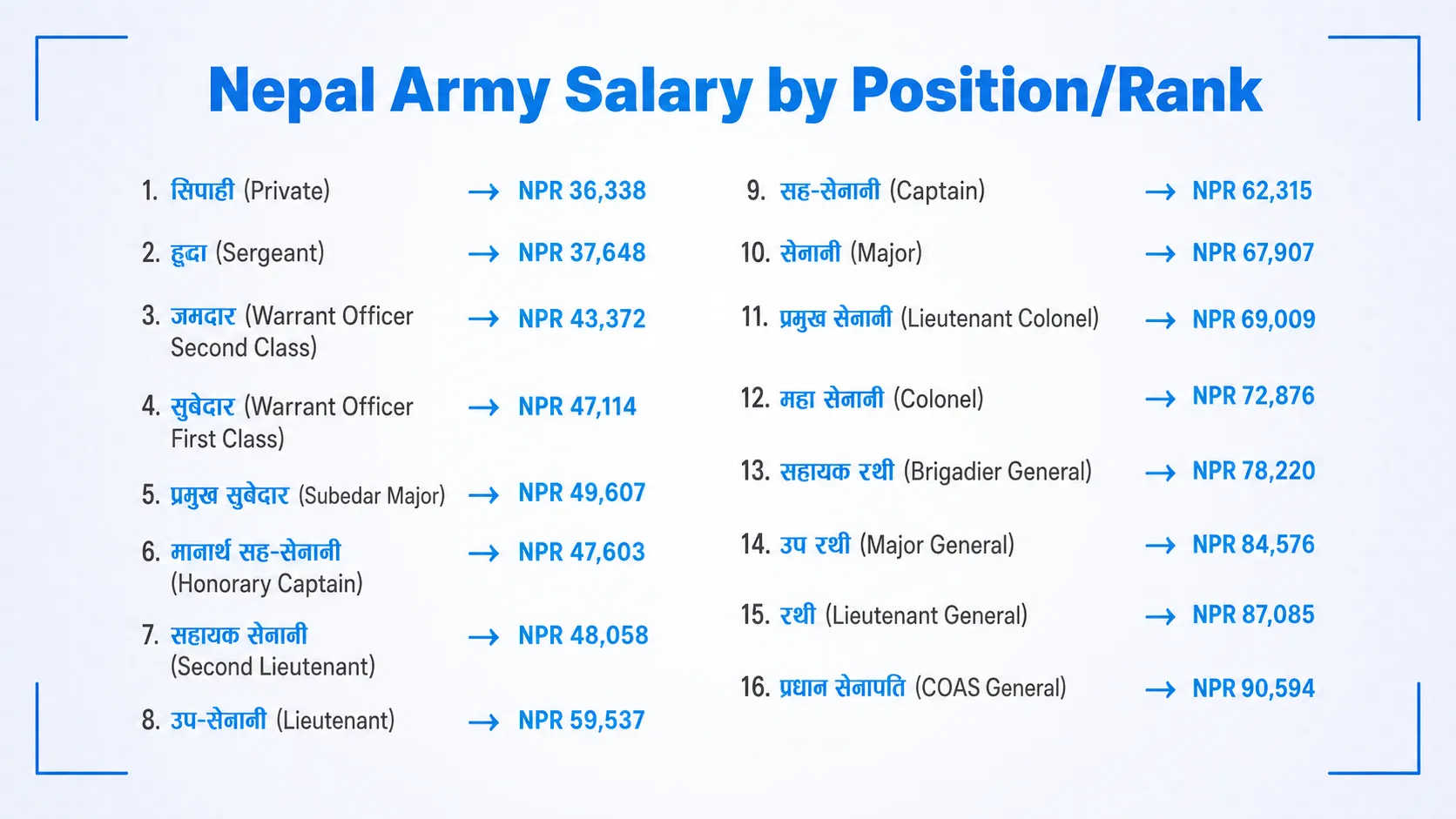
At the bottom of the scale, a Recruit earns around NPR 27,172 per month, which is enough to cover basic living expenses and provides a secure start for young recruits. As soldiers gain experience and take on more responsibility, their salary grows. For example, a Private (सिपाही) earns NPR 36,338, and a Sergeant (हुद्दा) earns slightly more at NPR 37,648, while higher non-commissioned ranks such as Warrant Officer Second Class (जमदार) receive NPR 43,372.
Commissioned officers start at a higher pay scale due to their leadership roles and responsibilities. A Second Lieutenant (सहायक सेनानी) earns NPR 48,058, and a Lieutenant (उप-सेनानी) earns NPR 59,537. As officers climb further, positions like Captain (सह-सेनानी) and Major (सेनानी) offer NPR 62,315 and NPR 67,907, respectively.
Senior ranks see a significant jump in salary. Lieutenant Colonels (प्रमुख सेनानी) earn NPR 69,009, and Colonels (महा सेनानी) take home NPR 72,876. The generals and top leadership receive the highest salaries and also come with greater responsibilities. For example, a Brigadier General (सहायक रथी) earns NPR 78,220, a Major General (उप रथी) earns NPR 84,576, a Lieutenant General (रथी) earns NPR 87,085, and the Chief of Army Staff (प्रधान सेनापति) receives NPR 90,594 per month.
This structure and the new government salary scale 2083/84 not only provides financial stability but also motivates you to perform well, take leadership roles, and serve the country diligently. Along with base salary, officers and soldiers also enjoy various allowances, including housing, field allowance, risk allowance, healthcare, and rations, which significantly enhance their overall compensation.
The system is designed to recognize both experience and rank, ensuring fairness and transparency. For families of army personnel, this means a secure income, steady growth, and a clear career path from entry-level positions to top leadership roles.
Here’s a quick summary table of the Nepal Army salary by rank:
| Rank of Nepal Army | Starting Salary | Grade | Grade Rate | Final Salary |
|---|---|---|---|---|
| Recruit (रिक्रूट) | NPR 27,172 | — | — | NPR 27,172 |
| Non-Combatant (नन् कम्बाटेण्ट) | NPR 27,172 | 10 | NPR 906 | NPR 36,232 |
| Private (सिपाही) | NPR 28,690 | 8 | NPR 956 | NPR 36,338 |
| Lance Corporal (प्यूठ) | NPR 29,297 | 8 | NPR 977 | NPR 37,113 |
| Corporal (अमलदार) | NPR 30,373 | 7 | NPR 1,012 | NPR 37,457 |
| Sergeant (हुद्दागण, हुद्दा) | NPR 31,372 | 6 | NPR 1,046 | NPR 37,648 |
| Warrant Officer Second Class (जमदार) | NPR 36,142 | 6 | NPR 1,205 | NPR 43,372 |
| Warrant Officer First Class (सुवेदार) | NPR 38,203 | 7 | NPR 1,273 | NPR 47,114 |
| Subedar Major (प्रमुख सुबेदार) | NPR 45,098 | 3 | NPR 1,503 | NPR 49,607 |
| Honourable Lieutenant (मानार्थ उप-सेनानी) | NPR 46,628 | — | — | NPR 46,628 |
| Honourable Captain (मानार्थ सह-सेनानी) | NPR 47,603 | — | — | NPR 47,603 |
| Officer Cadet (अधिकृत क्याडेट) | NPR 47,960 | — | — | NPR 47,960 |
| Second Lieutenant (सहायक सेनानी) | NPR 48,058 | — | — | NPR 48,058 |
| Lieutenant (उप-सेनानी) | NPR 49,613 | 6 | NPR 1,654 | NPR 59,537 |
| Captain (सह-सेनानी) | NPR 51,929 | 6 | NPR 1,731 | NPR 62,315 |
| Major (सेनानी) | NPR 53,611 | 8 | NPR 1,787 | NPR 67,907 |
| Lieutenant Colonel (प्रमुख सेनानी) | NPR 57,507 | 6 | NPR 1,917 | NPR 69,009 |
| Colonel (महा सेनानी) | NPR 62,466 | 5 | NPR 2,082 | NPR 72,876 |
| Brigadier General (सहायक रथी) | NPR 67,045 | 5 | NPR 2,235 | NPR 78,220 |
| Major General (उप रथी) | NPR 79,290 | 2 | NPR 2,643 | NPR 84,576 |
| Lieutenant General (रथी) | NPR 81,643 | 2 | NPR 2,721 | NPR 87,085 |
| COAS General (प्रधान सेनापति) | NPR 84,932 | 2 | NPR 2,831 | NPR 90,594 |
Allowances and Benefits in the Nepal Army
Salary are not the only thing that make the Nepal Army a secure job. Soldiers and officers also receive many benefits that make their lives easier and more comfortable. These extra perks help cover daily needs and reduce financial pressure on their families. From food and clothes to housing and medical care, the army provides strong support to its people. Let’s look at these allowances and benefits in detail.
1. Uniform, Ration, Housing, and Healthcare
Every soldier in the Nepal Army receives a proper uniform without having to pay for it. This ensures all members look disciplined and professional. They also get a ration allowance, which means their food expenses are partly or fully covered by the army. Housing facilities are another big benefit—many soldiers are provided with quarters to live in, reducing the need to rent or buy homes. For those stationed away from family, this support is a huge relief. Healthcare is also included, and army personnel, along with their families, can receive free or discounted medical treatment in army hospitals. These facilities make army life more stable and reduce extra costs for families. It is one of the main reasons people trust the army as a long-term career.
2. Field Allowance
Not all jobs in the army are the same. Some soldiers are posted in normal areas, while others are sent to remote or difficult places. To support those working in harder conditions, the Nepal Army provides a field allowance. This is an extra payment on top of the basic salary. The amount can vary depending on where the soldier is posted. For example, someone serving in hilly or border areas may get a higher allowance than someone posted in the city. This system motivates soldiers to take on tough duties without worrying too much about money. It also makes the pay scale more fair.
3. Risk Allowance
Army life is not always safe. Soldiers often face risks that normal government employees never experience. To recognize this, the Nepal Army offers a risk allowance. This allowance is given to those working in dangerous zones, training with weapons, or taking part in risky operations. It adds financial support for those putting their lives on the line. For soldiers, it is not just about money, it shows that the country values their bravery. Families also feel more secure knowing there is extra income for dangerous postings. This allowance is an important part of overall army benefits.
4. Travel Benefits
Army personnel are often required to move from one place to another, sometimes within Nepal and sometimes abroad for training or peacekeeping missions. To make this easier, the Nepal Army provides travel benefits. This may include free or discounted transportation, allowances for tickets, or daily expenses during travel. Soldiers do not have to worry about the cost of moving frequently, which is common in army life. For international missions, the travel benefits are even better and often include allowances in foreign currency. These perks make army service more exciting while also removing the burden of extra costs. Travel support is one of the most attractive benefits of this career.
Nepal Army Pension System
One of the biggest reasons why there are so many people who join the Nepal Army is the pension system. A pension is the money you continue to receive every month even after retirement. For soldiers and officers, this is a benefit since it gives them lifelong financial security. While most private job earnings come to an end upon retirement, the Nepal Army ensures its members are well taken care of even after they can no longer work.
1. Retirement Age and Pension Rules
The retirement age for the Nepal Army is different based on rank. Lower ranks like sipahi retire early, while higher ranks (officers) retire late. For example, the army staff retire in their 40s or 50s, while senior officers get to stay up to their late 50s. They get a pension every month after retirement.
The pension is not random. It is calculated based on the person's past salary and the duration for which they served in the army. That means the longer you serve, the higher your pension will be. This is why the majority of army officials try to stay as long as they can before retirement.
2. Monthly Pension Benefits
Once they retire, every officer and soldier receives a fixed amount of money each month. This monthly pension works just like a salary, but usually a little lower than during active duty. For example, if a military officer received approximately NPR 50,000 during retirement, then their pension will be a percentage of this amount specified by law.
This pension is quite helpful. It provides retired officers with an opportunity to cover their expenses for daily living, such as food, shelter, medical care, and the needs of their families, without having to depend on other people. The pension amount directly comes to their bank accounts, so it's easy and reliable.
For a majority of retired military officers, this pension is a means of survival. It enables them to live with dignity and not be a burden to their families. It also motivates freshers to think about their future, rather than their present salaries.
3. Benefits for Families
The pension plan of the Nepal Army also looks after dependents. If an army member passes away, then their spouse or children might receive a family pension. This means that the financial support does not terminate despite the death of the soldier.
This benefit is especially important for the families of the soldiers who engage in risky situations. Many parents and spouses feel secure knowing that, in case something happens, the family will still receive money every month. For widows and children, this pension is the primary source of income. It helps them with the payment of education, food, and everyday expenses.
4. Why the Pension System Matters?
The pension program is the strongest pillar of a Nepal Army career. It assures long-term economic security. To many people, it is the biggest motivation to work in the army, even bigger than the monthly salary. Although pensions are provided within civil service employment in Nepal, the army pension is respected for its reliability and family benefits.
This system shows that the army thinks about its people not only when they are on duty but even post-retirement. It gives them the security for a lifetime, and it is this reason that the Nepal Army becomes a trustworthy career choice for thousands of Nepali youth.
How does Nepal Army Salary Compare with Police and Civil Service?
When it comes to government jobs in Nepal, three sectors are always in demand: the Nepal Army, the Nepal Police, and the Civil Service. All three offer job security, regular income, and pensions after retirement. But many people often wonder—how do their salaries and facilities compare? Let’s break it down in simple words.
1. Similarities
The biggest similarity is that all three sectors follow a government pay scale. This means their salaries are fixed by the government and increase whenever there is a salary hike for public employees. So, if the government announces a rise in basic salary, it applies to the army, police, and civil service together.
Another similarity is the pension system. Just like army personnel, police officers, and civil servants also get a monthly pension after retirement. This ensures financial stability even after leaving the job. Family pensions are also available in case of death.
Healthcare, uniforms (for the army and police), and other welfare benefits are common features. All three jobs also provide respect in society and a sense of stability for families.
2. Differences
The main difference lies in the nature of work and the allowances. Army and police jobs are physically demanding and often risky. Because of this, they receive extra benefits like risk allowance, field allowance, and ration support. For example, army personnel working in remote or dangerous areas get higher field allowances compared to civil servants who mostly work in offices.
Civil service jobs, on the other hand, usually involve administrative tasks. While they may not get risk or field allowances, they do enjoy a better work-life balance. Civil servants also have less physical risk compared to soldiers or police.
In terms of salary, the base pay of the army and police is quite similar, and often slightly higher than that of the civil service at entry levels, because of the tough nature of their duties. A sipahi in the army earns around NPR 28,000, which is close to what a police constable makes. Civil servants at the entry level may start with slightly less, but their growth path is steady and predictable.
Why do Youth Choose the Nepal Army as a Career?
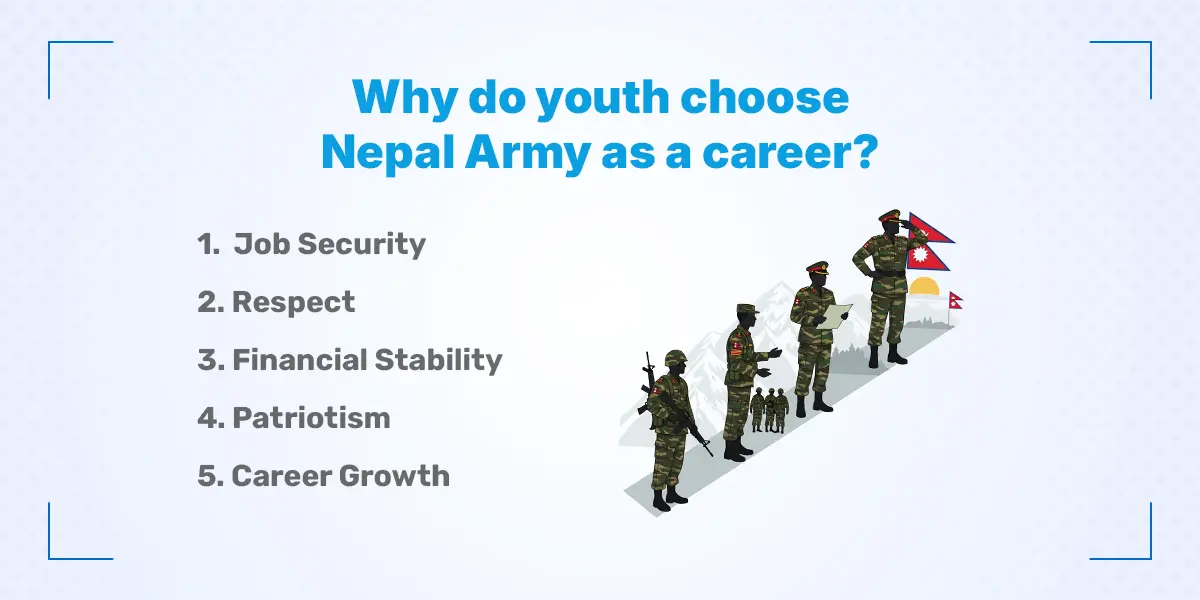
Youth in Nepal choose the Nepal Army because it offers job security, respect, steady income, and the chance to serve the country. For many young people in Nepal, the army is more than just a job. It is seen as a safe career with many benefits, both financial and social. Wearing the army uniform gives pride and respect in the community. Families also feel secure knowing their children have a stable salary and future. Let’s look at the main reasons why the army continues to attract so many youth.
1. Job Security
One of the biggest reasons is job security. Once you join the Nepal Army, you don’t have to worry about losing your job suddenly. Government jobs are safe compared to private jobs, where companies can close or reduce staff anytime. Army jobs come with fixed rules and retirement plans, which makes life predictable. Parents also prefer their children to work in a secure job, and the army gives exactly that. For many, this security is more valuable than a higher-paying but unstable private job.
2. Respect
Being part of the Nepal Army brings great respect in society. Soldiers are seen as protectors of the nation, and people naturally admire them. Wearing the uniform is a symbol of pride, not just for the soldier but for the whole family. In villages and towns, an army person is often treated with special honor. This social respect is something not every job can give. For many youth, this recognition is as important as the salary itself.
3. Financial Stability
The Nepal Army provides a regular salary, allowances, and a pension after retirement. This means financial stability is guaranteed. Even entry-level soldiers earn enough to cover basic needs, and the benefits like rations, housing, and healthcare reduce extra costs. Families don’t have to worry much about day-to-day expenses because the army provides strong Support. Compared to many private jobs in Nepal, army salaries are more reliable. Over time, with promotions and allowances, the income grows steadily. This makes the Nepal Army a financially safe career choice.
4. Patriotism
Another big reason youth choose the army is patriotism. Many young people dream of serving their country and protecting its borders. For them, the army is not just a job but a duty and an honor. Joining the Nepal Army allows them to contribute to national peace and security. Some are also inspired by family members who served in the army before. The sense of pride in serving the motherland is something money alone cannot buy. Patriotism makes the army career special.
5. Career Growth
The Nepal Army also offers clear opportunities for career growth. Soldiers can rise through the ranks with time, training, and dedication. A sipahi can move up to higher posts if they perform well and stay disciplined. The promotion system is fair and gives everyone a chance to grow. Training programs also help soldiers gain new skills. This path of steady growth keeps youth motivated to stay in the army for the long term. Unlike some jobs that stay the same for years, the army offers both growth and variety in one’s career.
Conclusion
The Nepal Army is more than just a workplace. It is a respected institution that gives security, respect, and a steady income to its people. From sipahi to generals, the salary grows with rank, and the extra allowances make life easier for soldiers and their families. The strong pension system adds long-term stability, while the pride of serving the nation makes this career truly special. Of course, army life has challenges, but for many Nepali youth, the rewards are worth it.
If you are looking for government jobs in Nepal, the Nepal Army is one of the best options to consider. It offers not only financial stability but also honor and career growth. A uniform life may be tough, but it is also meaningful and full of opportunities.
Looking to build a strong and honorable career? Join the Nepal Army by applying for the latest army vacancy and serve the nation with pride.
Frequently Asked Questions
Submit your comments

Get Our App On



What is the Public Relations Officer Salary in Nepal
VIEW DETAILS
What Is the Salary of a Ticketing Officer in Nepal?
VIEW DETAILS
What Is the Salary of a Travel Consultant in Nepal?
VIEW DETAILS
How to Become an Auditor in Nepal
VIEW DETAILS


Loading Comments...