




Struggling to understand how much a Junior Assistant earns in Nepal? Many fresh graduates and entry-level workers find themselves confused by inconsistent salary reports, unclear pay scales, and hidden benefits. This uncertainty makes career planning difficult and adds stress when choosing the right job. Limited knowledge about the role’s responsibilities and growth potential often leaves candidates hesitant to apply, slowing their progress in the professional world.
In this blog, we’ll explore junior assistant salary in Nepal, covering average pay, factors that affect earnings, and salary variations across industries. You’ll also learn the required skills, steps to become a junior assistant, and tips to grow your career efficiently. Additionally, we’ll guide you on where to find suitable job openings and how to maximise your chances of selection. By the end, you’ll have a clear roadmap to start or advance your journey as a Junior Assistant in Nepal.
In this blog
Who is a Junior Assistant & What do they do?
A Junior Assistant is an entry-level employee who provides support in administrative and clerical tasks within an organisation. They often work under supervision, assisting senior staff in managing records, documents, and day-to-day office operations. Junior Assistants can be found in government offices, private companies, banks, educational institutions, and NGOs. The role acts as a foundation for career growth in administration or office management.
What Do Junior Assistants Do?
- Maintain and organise files, records, and office documents.
- Handle data entry and update databases accurately.
- Assist in preparing reports, memos, and official correspondence.
- Support senior staff with scheduling meetings and appointments.
- Respond to phone calls, emails, and visitor inquiries professionally.
- Perform basic bookkeeping or clerical tasks as required.
- Ensure smooth workflow by coordinating with different departments.
Average Salary of a Junior Assistant in Nepal
The average salary of a Junior Assistant generally ranges between NPR 25,000 and NPR 35,000 per month, depending on the organisation and industry. Entry-level positions, particularly in banking, may start around NPR 22,000 to NPR 30,000, with increments offered after confirmation or as experience grows. Salaries in private companies, NGOs, or educational institutions can vary slightly, but most follow a similar structure for entry-level administrative roles, and the average salary in Nepal can increase with experience and additional skills. Additional benefits such as allowances, performance bonuses, or training opportunities may further boost overall compensation.
Salary of Junior Assistant by Industry
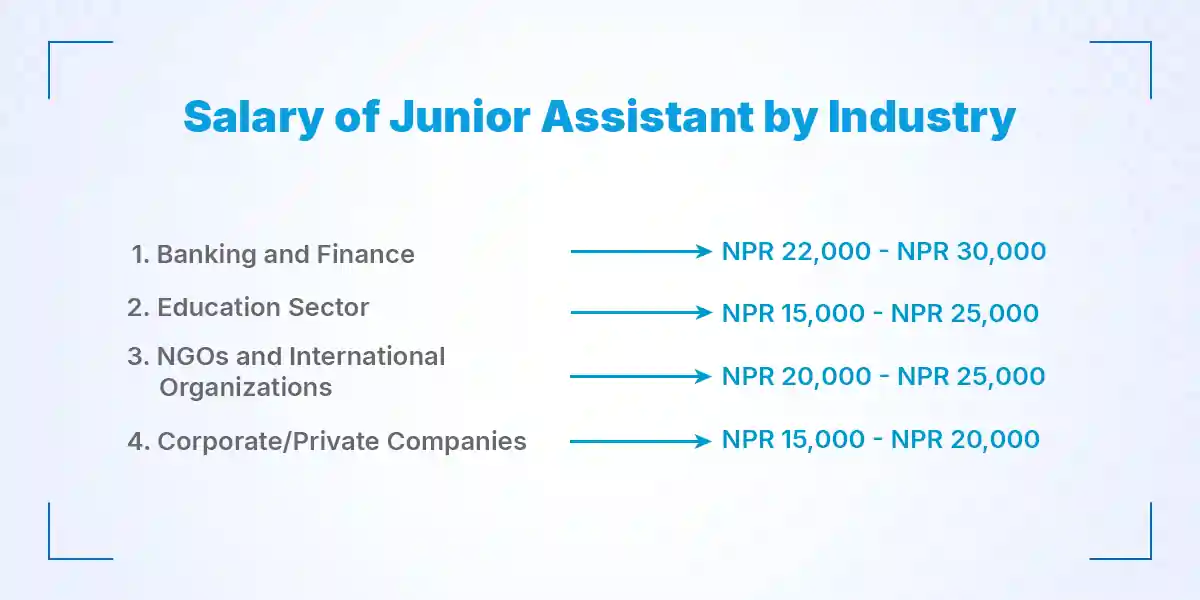
Salaries for Junior Assistants in Nepal vary depending on the industry, organisation type, and location. Banking and finance generally provide higher pay due to structured salary packages and additional benefits. Education, NGOs, and corporate companies offer moderate compensation but can include allowances or perks. Experience, skills, and role responsibilities influence earnings, so understanding industry-specific pay helps candidates choose positions that align with their career goals.
1. Banking and Finance
Junior Assistants in banks earn between NPR 22,000 and NPR 30,000 per month at the entry level. Pay often rises after confirmation or with accumulated experience. Banks provide structured benefits such as performance bonuses, health coverage, and professional training. Employees handle data entry, record management, customer correspondence, and support for clerical and administrative tasks. The banking sector remains attractive due to job stability and clear promotion pathways.
2. Education Sector
In schools, colleges, and universities, Junior Assistants typically receive NPR 15,000 to NPR 25,000 per month. Private institutions may offer higher salaries than public ones, depending on the workload and institutional resources. Responsibilities include maintaining student records, managing office files, preparing reports, assisting faculty, and coordinating day-to-day office operations. Educational organisations may also provide training opportunities to enhance administrative skills and help those looking to get teacher jobs.
3. NGOs and International Organisations
Junior Assistants working for NGO/INGO jobs in Nepal generally earn around NPR 20,000 to NPR 25,000 monthly. Some organisations include additional benefits like health insurance, project incentives, or travel allowances. Tasks include documentation, report preparation, office coordination, assisting project teams, and communication management. Positions often demand adaptability, punctuality, and familiarity with both local and international office procedures.
4. Corporate/Private Companies
Corporate and private companies generally offer salaries between NPR 15,000 and NPR 20,000 for entry-level Junior Assistants. Pay varies based on company size, location, and business sector. Responsibilities include data entry, office administration, scheduling, basic bookkeeping, and coordination between departments. Companies may provide occasional performance incentives or allowances, and promotions are often based on demonstrated efficiency and skill development.
Factors Affecting Junior Assistant Salary
The salary of a Junior Assistant in Nepal depends on multiple factors that influence overall compensation. Education level, professional experience, and tenure can significantly impact monthly earnings. The organisation’s location and type also play a role, as urban centres and reputed institutions tend to offer higher pay. Additional skills or certifications may increase salary potential. Understanding these factors helps candidates set realistic expectations and plan career growth effectively, especially when considering the minimum salary in Nepal.
1. Education and Qualifications
Higher educational qualifications generally lead to better pay. Candidates with specialised diplomas, degrees in administration, finance, or IT may start with higher salaries than those with basic education. Formal training in computer applications, office management, or accounting can also influence offers, especially in banks and corporate sectors. Employers prefer candidates whose education aligns with the responsibilities of the role, making this a key factor in compensation.
2. Experience and Tenure
Experience directly affects salary increments and promotions. Junior Assistants with prior work in administrative roles, data management, or clerical support often receive higher starting pay in entry-level roles. Tenure within an organisation can lead to incremental raises, benefits, and eligibility for supervisory responsibilities. Consistent performance over time strengthens negotiation power for higher compensation.
3. Location and Organisation Type
Salaries vary based on city, region, and type of organisation. Urban offices in Kathmandu or Pokhara usually offer higher pay compared to rural areas due to the cost of living and business scale. Private banks, multinational corporations, and international NGOs often pay more than local private companies or small institutions. Organisation reputation and size influence the structure and additional benefits available, helping candidates explore jobs by city.
4. Additional Skills and Certifications
Possessing extra skills can improve earning potential. Proficiency in MS Office, data management software, or specialised accounting programs is highly valued. Certifications in administrative management, bookkeeping, or communication enhance credibility. Employers reward candidates who can perform diverse tasks efficiently, making certifications a practical advantage for higher pay.
Skills Required to Become a Junior Assistant
To succeed as a Junior Assistant, candidates need a combination of technical and soft skills. Technical abilities ensure tasks are performed accurately and efficiently, while soft skills help manage communication and teamwork. Strong skills improve performance, career growth, and chances of a higher salary. Organisations look for candidates who can handle office operations independently while supporting senior staff effectively.
1. Technical Skills
Technical skills involve practical knowledge of office tools and processes. They enable smooth handling of data, documentation, and reporting tasks.
- Proficiency in MS Office (Word, Excel, PowerPoint) for document preparation and data management.
- Knowledge of basic bookkeeping or accounting software for financial tasks.
- Ability to manage digital and physical filing systems accurately.
- Data entry and database management skills to maintain organisational records efficiently.
- Familiarity with office equipment such as printers, scanners, and email systems.
2. Soft Skills
Soft skills are essential for communication, teamwork, and time management. They ensure professional behaviour and workplace efficiency.
- Effective verbal and written communication for coordinating with colleagues and clients.
- Time management to prioritise tasks and meet deadlines consistently.
- Teamwork and collaboration for smooth coordination across departments.
- Problem-solving ability to handle minor issues independently.
- Attention to detail for accuracy in documentation and reporting.
How to Become a Junior Assistant in Nepal?
To become a Junior Assistant in Nepal, candidates must fulfil educational criteria, develop relevant skills, apply through proper channels, and prepare effectively for interviews. Entry-level positions require a combination of academic knowledge and practical abilities to handle administrative responsibilities efficiently. Following the correct steps improves chances of selection and sets a foundation for career growth in various sectors.

1. Educational Requirements
Meeting educational qualifications is the first step. Most organisations require a minimum of a +2 (Intermediate) certificate or equivalent. A bachelor’s degree in administration, commerce, finance, or IT skills provides a competitive advantage. Certain institutions may prefer candidates with specialised diplomas or certifications related to office management, data handling, or accounting, which can strengthen the application.
2. Develop Skills
Candidates should focus on building both technical and soft skills to perform office tasks efficiently. Proficiency in MS Office applications, data entry, and basic bookkeeping is highly valued. Communication, time management, and organisational skills are essential for smooth workflow and professional interactions. Additional certifications in administrative or clerical management enhance credibility and improve overall employability.
3. Apply Through Job Portals
Candidates can apply through job portals like Kumari Job, company websites which regularly post openings for Junior Assistants. Maintaining an updated resume, tracking deadlines, and submitting applications on time improve the chances of selection. Networking and referrals can further enhance visibility among recruiters and strengthen application prospects.
4. Prepare For the Interview
Interview preparation is key to demonstrating readiness for the role. Researching the organisation, understanding job responsibilities, and anticipating common questions help build confidence. Candidates should emphasise relevant qualifications, skills, and experience while presenting themselves professionally. Clear communication and punctuality are important to leave a positive impression on interviewers, making interview preparation essential for success.
Where to Find Junior Assistant Jobs in Nepal?
You can find Junior Assistant jobs in Nepal on job portals like Kumari Job, LinkedIn, company career pages, and through walk-in interviews or local advertisements. Each source offers different types of opportunities based on organisation size and hiring process. Using multiple channels increases job visibility and improves selection chances. Regular checking and timely applications remain essential for success.
1. Job Portals
Kumari Job stands as one of the most reliable job portals for Junior Assistant vacancies in Nepal. Such platforms publish openings from banks, corporate offices, NGOs, and educational institutions. Candidates can filter roles by location, experience level, or organisation type. Maintaining a complete profile and updated resume improves recruiter reach and response rate.
2. LinkedIn
LinkedIn provides access to professional job listings and recruiter networks. Many organisations post Junior Assistant vacancies directly on company pages or through HR profiles. Active engagement, profile optimisation, and keyword usage improve visibility. Direct communication with recruiters can lead to faster interview calls.
3. Company Career Pages
Many organisations announce vacancies on official career pages before sharing publicly. Regular monitoring of company websites helps candidates apply early. Career pages usually include detailed job descriptions, eligibility criteria, and clear application steps. Direct applications show initiative and interest in the role.
4. Walk-in Interviews and Local Advertisements
Small offices and institutions continue to use walk-in interviews and local notices. Newspapers, notice boards, and community postings often list such opportunities. Visiting offices with printed resumes may result in immediate screening. This method suits candidates seeking quick entry into junior administrative positions.
Career Growth for Junior Assistants
Career growth for Junior Assistants starts with skill expansion and consistent performance. Entry-level staff gain exposure to administrative systems, documentation flow, and coordination practices. Strong accuracy, reliability, and communication often lead to role confirmation and incremental salary increases. Many organisations evaluate performance annually, creating clear progression opportunities within administrative teams.
With experience, Junior Assistants can advance into positions such as Senior Assistant, Administrative Officer, or Office Supervisor. Additional training in accounting, human resources, or information systems supports faster advancement. Banks, NGOs, and corporate offices often provide internal training and promotion pathways. Long-term growth depends on skill upgrades, role ownership, and demonstrated efficiency in daily operations.
Conclusion
Understanding junior assistant salaries in Nepal helps job seekers plan careers with clear expectations. Salary levels vary by industry, education, experience, and organisation type. Banking and finance roles usually offer higher starting pay, while education, NGOs, and corporate companies provide steady but moderate income. Beyond salary, Junior Assistant roles build strong administrative experience, exposure to office systems, and professional discipline, which adds long-term career value.
Junior Assistant positions also provide clear growth opportunities through skill development and performance. With experience and training in office management, accounting tools, or communication, professionals can move into senior assistant or administrative roles. Using platforms like Kumari Job, LinkedIn, and company career pages improves access to reliable openings. With focused preparation and consistent effort, this role can serve as a strong foundation for career growth in Nepal.
Frequently Asked Questions
Submit your comments

Get Our App On



What is the Public Relations Officer Salary in Nepal
VIEW DETAILS
What Is the Salary of a Ticketing Officer in Nepal?
VIEW DETAILS
What Is the Salary of a Travel Consultant in Nepal?
VIEW DETAILS
How to Become an Auditor in Nepal
VIEW DETAILS


Loading Comments...