




Choosing the wrong career can cost you years of effort, low pay, and constant stress — which is why understanding the world’s highest-paying jobs is more important than ever. Strong salaries influence study choices, skill development, and long-term direction. High responsibility and rare expertise push earnings upward across tech, healthcare, finance, and energy sectors, where organisations reward people who can handle complex tasks with accuracy.
Global talent shortages increase demand, and industries like software, medicine, and international markets continue to raise pay scales. These roles reach six-figure ranges due to intense training and decisions that impact public health, company growth, or national resources. In this blog, you’ll discover which careers dominate global income charts in 2026 and why they pay so well.
In this blog
How to Get High-Paying Jobs?
To get high paying jobs, candidates must build strong abilities that match current market needs. Focused learning helps people grow faster in fields that reward skill, speed, and accuracy. Practical exposure improves confidence, while global networking opens better opportunities. Consistent progress keeps careers stable through changing demands.
- Build rare, in-demand skills that solve real problems.
- Choose sectors with strong global salary growth.
- Gain practical experience through internships or project work.
- Earn certifications to strengthen technical capability.
- Improve communication, leadership, and problem-solving strength.
- Connect with professionals through global platforms for better access to roles.
What are the Top 10 Highest-Paying Jobs in the World?
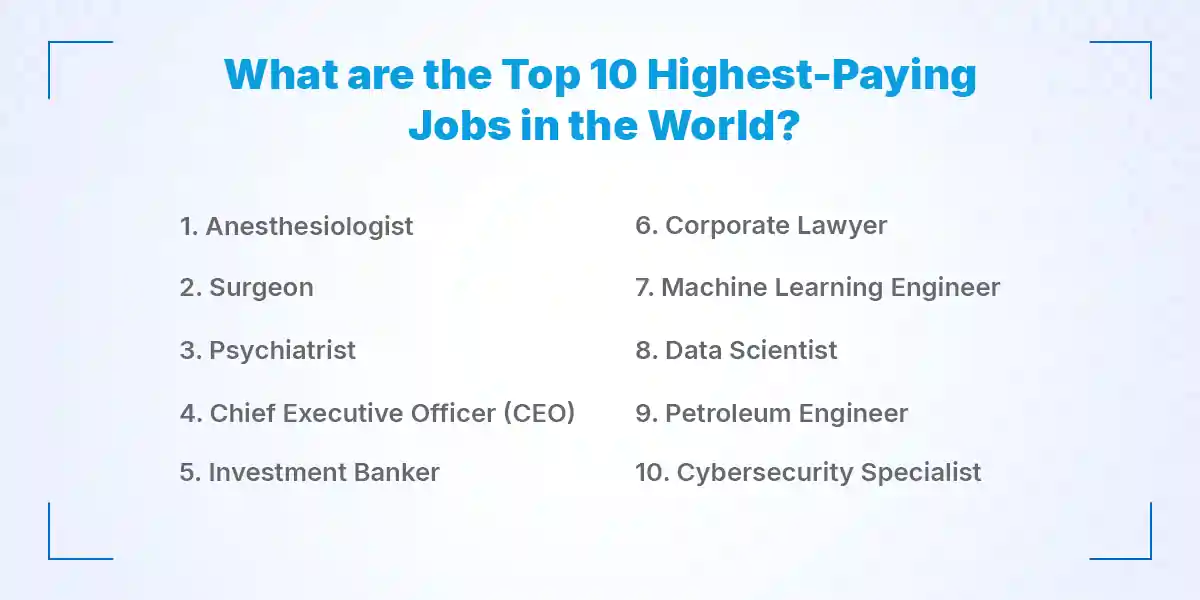
Top 10 highest-paying jobs in the world include roles such as anesthesiologist, surgeon, psychiatrist, CEO, investment banker, corporate lawyer, machine learning engineer, data scientist, petroleum engineer, and cybersecurity specialist. These positions demand precision, rare knowledge, and constant decision-making. Long training, high pressure, and advanced technical skill push income upward across global markets. Each career influences public health, business growth, energy output, or digital safety, creating a direct path toward strong financial rewards. The sections below explain how each role functions and why salaries remain high year after year.
1. Anesthesiologist
Salary ranges from USD 250,000 to USD 450,000 yearly. Anesthesiologists manage patient comfort during surgeries and supervise vital responses throughout each procedure. Their work requires steady focus, deep medical insight, and quick action during emergencies, which makes the salary of anesthesiologists a key point of interest for many learners. Scarcity of experts pushes wages higher across many countries, especially regions with rising surgical demand.
2. Surgeon
Salary ranges from USD 300,000 to USD 600,000 yearly. Surgeons treat injuries, diseases, and complex internal issues through advanced procedures. Their day includes planning operations, guiding medical teams, and monitoring recovery, which makes neurosurgeon's salary a major point of interest due to the complexity of these procedures. High stakes, long training, and life-impacting decisions keep compensation at the top of global charts.
3. Psychiatrist
Salary ranges from USD 180,000 to USD 320,000 yearly. Psychiatrists diagnose and treat mental health conditions that affect emotions, behavior, and daily functioning. Rising awareness has increased demand for specialists who offer therapy, medication plans, and crisis support. Shortages in many regions further boost earnings for skilled professionals.
4. Chief Executive Officer (CEO)
Salary ranges from USD 200,000 to USD 1,000,000+ yearly. CEOs guide company direction, manage large teams, and make strategic choices that influence revenue and long-term stability. Strong leadership, clear vision, and fast decision-making shape success, which is why the salary of CEO often attracts significant attention. Competitive industries pay high to secure individuals with proven records.
5. Investment Banker
Salary ranges from USD 150,000 to USD 400,000 yearly. Investment bankers handle mergers, financial planning, and large capital deals. Their role requires analytical judgment, strong modeling skills, and the ability to manage high-pressure negotiations. Global financial hubs reward consistent performers with bonus-heavy packages.
6. Corporate Lawyer
Salary ranges from USD 130,000 to USD 300,000 yearly. Corporate lawyers manage contracts, compliance, and legal risk for companies. They safeguard major transactions and negotiate agreements that influence business outcomes, which makes the salary of lawyer an important factor for many considering this field. High pay reflects the need for accuracy, strong interpretation skills, and quick handling of complex issues.
7. Machine Learning Engineer
Salary ranges from USD 120,000 to USD 250,000 yearly. Machine learning engineers build predictive models and automated systems used by tech, finance, and healthcare groups. Their work powers smart applications and improves decision-making across many sectors. Rapid AI growth increases demand and salary potential.
8. Data Scientist
Salary of a Data Scientist ranges from USD 110,000 to USD 220,000 yearly. Data scientists analyze large datasets, uncover trends, and guide company strategies. With strong skills in coding, statistics, and problem-solving, they turn raw data into meaningful insights. Their high salary reflects the value of data-driven decisions and the significant impact they have on business growth.
9. Petroleum Engineer
Salary ranges from USD 100,000 to USD 220,000 yearly. Petroleum engineers plan extraction systems that support global energy needs. Their work blends field knowledge with technical design to boost production safely. Energy demand, remote work sites, and limited specialists raise compensation levels.
10. Cybersecurity Specialist
Salary ranges from USD 90,000 to USD 180,000 yearly. Cybersecurity specialists protect networks, servers, and digital assets from threats. Increasing attacks push companies to strengthen digital defenses, creating strong pay for skilled analysts and expanding the scope of cybersecurity across many industries. Their role supports business safety, reliability, and customer trust.
Which Country Pays the Highest Salary in the World?
The countries that pay the highest salaries in the world are Switzerland, the United States, Luxembourg, Singapore, and Australia. These nations offer exceptional pay because their economies depend heavily on advanced industries and highly skilled professionals. Strong demand in healthcare, technology, finance, and energy pushes salaries upward as companies compete for top talent. Stable markets, innovation-focused industries, and talent shortages make these countries global leaders in high-paying careers.
1. United States
The United States leads salary charts for medical specialists, tech engineers, data experts, and executive roles. Strong hospitals, global tech giants, and major financial hubs push wages upward. Workers gain access to advanced research tools and fast-growing industries.
2. Switzerland
Switzerland offers high earnings for surgeons, psychiatrists, finance experts, and legal specialists. A powerful banking sector and structured healthcare framework support premium compensation. Limited workforce supply makes these roles even more valuable.
3. Australia
Australia pays strongly for petroleum engineers, anesthesiologists, cybersecurity workers, and tech roles. Strong energy output, mining operations, and digital expansion increase demand for skilled talent. Clear pathways for skilled migration help professionals secure well-paying jobs.
4. Canada
Canada rewards healthcare specialists, machine learning engineers, data scientists, and legal professionals with competitive packages. Workforce shortages push salaries higher across many cities. Stable living conditions and reliable job security attract global workers.
5. United Arab Emirates (UAE)
The UAE offers strong pay for executives, investment bankers, cybersecurity analysts, and engineers. Rapid development, energy production, and expanding corporate sectors create high-income opportunities. Tax-free earnings further increase overall compensation.
Global Trends in Highest-Paying Jobs
Global hiring now favors skill strength over formal labels because companies want people who deliver results with speed and accuracy. Tech fields show strong movement as AI specialists, security analysts, and data experts gain priority across major markets. Healthcare roles also stay at the top due to rising demand for advanced treatment, aging populations, and limited specialist supply. Finance and energy groups remain competitive because these sectors influence national growth, resource stability, and complex capital systems.
Biotech growth creates new high-income positions as research teams work on vaccines, genetic tools, and advanced diagnostics. Companies invest in workers who understand laboratory processes, data modeling, and clinical systems because these abilities support breakthroughs with global impact. Energy firms also increase pay as skilled engineers manage extraction sites, safety plans, and production targets. These shifts show how specialized fields continue to produce strong salaries for people who build rare capabilities.
What Skills Are Needed for High paying jobs?
High-paying jobs require a mix of technical skills, critical thinking, communication ability, and strong problem-solving under pressure. These roles often involve complex tasks where accuracy and fast decision-making directly affect results. Professionals must handle responsibility confidently, whether in hospitals, tech firms, finance teams, or engineering environments. Employers prioritise people who can think clearly, adapt quickly, and deliver consistent performance in demanding situations.
1. Healthcare Professions (Anesthesiologist, Surgeon, Psychiatrist)
Healthcare careers require precision during critical moments, along with a strong focus that supports quick action in high-stress settings. Specialists must read patient responses accurately and decide treatment paths without delay. Emotional control helps them stay calm during emergencies, while clear communication keeps teams aligned. Deep medical knowledge guides every step from diagnosis to recovery.
2. Tech Roles (Data Science, ML Engineer, Cybersecurity)
Tech workers use coding skills in Python, R, or SQL to build models and systems that manage large datasets. Machine learning engineers test algorithms that improve predictions and automate tasks. Data scientists study patterns that guide company planning, while cybersecurity analysts review risks to protect networks. These roles rely on logical thinking, accuracy, and an understanding of digital structures.
3. Finance & Law (Investment Banker, Corporate Lawyer)
Financial modeling helps bankers study markets, value companies, and manage large transactions. Negotiation strength allows them to close deals that support growth. Lawyers need clear interpretation skills, deep knowledge of regulations, and strategies that reduce risk for clients. Both careers reward individuals who maintain discipline, clarity, and decision speed.
4. Leadership (CEO)
CEOs make top-level choices that influence growth, hiring, budgets, and brand direction. Strong people management allows leaders to guide teams and solve issues early. Planning skills help them set targets that match changing markets. Crisis control is essential because unexpected events require calm direction.
5. Engineering (Petroleum Engineer)
Petroleum engineers apply math and physics to design systems that extract resources safely and efficiently. Knowledge of energy structures supports decisions in fields, plants, and offshore setups. Field operations require hands-on problem-solving because conditions shift rapidly. Safety management protects workers, equipment, and production targets.
Where Can You Learn These Skills?
You can learn these skills in educational institutes and training institutes like Kumari Job, along with online platforms, field programs, and professional courses that build practical ability. Many high-paying careers start with structured study, guided practice, and industry exposure. Each path below explains where learners can gain the knowledge needed to grow in these roles.
1. Healthcare Fields
Medical roles begin in accredited medical schools where students study human anatomy, disease patterns, and treatment methods through theory and labs. Residency programs place learners inside hospitals where they treat patients under supervision, gaining confidence with procedures and emergency responses. Specialized fellowships offer a deeper focus in anesthesia, surgery, psychiatry, and other advanced sectors. These stages shape the discipline and accuracy required in high-pressure medical environments.
2. Tech Fields
Tech learners can build strong foundations through online platforms such as Coursera, Udemy, MITx, or Google courses that explain coding, data systems, AI models, and security basics. Bootcamps like DataCamp, Le Wagon, or Springboard provide fast-paced, project-driven learning that prepares learners for hiring tests. University degrees add academic grounding, though many professionals advance faster by practicing real tasks, competing in hackathons, and building portfolio projects. These routes help learners master modern tools used by global tech teams.
3. Finance & Law
Finance careers grow through certifications like CFA or ACCA that teach investment analysis, financial reporting, and market study. These programs guide learners through complex scenarios used in banks and consulting firms. Law careers start with LLB or JD degrees, where students learn case interpretation, contract handling, and regulatory systems. Corporate training programs help individuals practice negotiation, compliance work, and documentation review needed in business environments.
4. Leadership & Management
Leadership skills are formed through MBA programs or targeted management courses that teach planning, team direction, and organizational behaviour. Executive programs by Harvard or Wharton Online help learners strengthen strategic thinking, decision-making speed, and leadership style. Startup roles and real-world management tasks push learners to handle pressure, guide teams, and resolve conflicts. These experiences shape practical leaders capable of running companies or major departments.
5. Engineering
Engineering knowledge begins in petroleum or mechanical engineering degrees, where learners study physics, material science, energy systems, and operational methods. Field training programs place individuals on drilling sites or production units where they learn how to solve issues in real conditions. Industry certifications like API or SPE help engineers follow international standards and stay updated with evolving technology. These pathways build the technical strength needed for roles in the energy and industrial sectors.
Are Professional Degrees Required for High Paying jobs?
Yes, many high-paying jobs require professional degrees, but several modern careers now accept skill-based learning instead of traditional university pathways. Some fields like medicine, law, and engineering demand structured degrees because of strict regulations and high responsibility. Meanwhile, careers in tech, digital marketing, design, and data often allow entry through skill-focused training, bootcamps, or institutes like Kumari Job. Ultimately, the path depends on how much technical depth, certification, and industry oversight the role requires.
1. Mandatory Degree Careers
Medical and legal roles require long, structured study with strict licensing rules. Anesthesiologists, surgeons, and psychiatrists complete medical school, followed by residency programs that last three to seven years, depending on specialization. Corporate lawyers earn an LLB or JD, then pass bar exams before work begins. Petroleum engineers complete a four-year engineering degree, then join field programs that prepare them for energy sites and technical systems.
2. Degree Preferred but Not Mandatory
Many high-income fields accept learners who study through online platforms and training institutes like Kumari Job. Investment bankers benefit from finance degrees, yet strong modeling skills and certifications also help new learners enter. CEOs often grow through experience, early leadership roles, and decision-focused training. Data scientists, machine learning engineers, and cybersecurity specialists build careers through coding practice, bootcamps, and real project work. Skill strength often carries more weight than formal labels.
3. Careers Where Skills Can Replace Degrees
- Cybersecurity roles grow through certifications such as CEH, CompTIA, or CISSP.
- Data science hiring shifts toward portfolios that show coding, analysis, and project results.
- Machine learning roles reward strong coding, clean model building, and problem-solving.
- CEO positions favor experience, team leadership, and strategic results over academic titles.
How Will AI Affect These High-Paying Jobs?
AI will affect these jobs by automating routine tasks, improving decision accuracy, and raising the need for workers who understand digital tools. Finance teams already use AI for fast analysis and documentation reviews. Surgical units rely on smart systems that support diagnosis and assist during treatment. Data roles shift toward managing automation instead of performing repetitive steps. Tech and cybersecurity fields grow as AI expands digital systems, while leadership and healthcare remain the least replaceable due to human judgment and patient needs.
How to Leverage AI to Excel in Your Specific Job?
You can leverage AI to complete tasks faster, improve work quality, and stay competitive in fields that change quickly. Using AI tools helps workers save time, handle large datasets, and make decisions with greater clarity. These habits support long-term growth and prepare professionals for future demands across every major industry.
- Use AI systems for research, documentation, or quick information checks.
- Apply AI platforms to analyze financial models or legal cases.
- Train small models to support predictions in data or machine learning tasks.
- Strengthen cybersecurity skills with AI-driven threat monitoring tools.
- Explore AI dashboards that help leaders plan goals and track team progress.
- Use medical AI tools to support diagnosis, imaging review, or patient tracking.
- Improve engineering tasks using AI for simulations, testing, or workflow checks.
Conclusion
High-income careers open doors for people who focus on their strengths, build steady skills, and commit to long-term growth. Choosing roles that match natural ability creates better results, faster progress, and stronger confidence. Combining technical skill, certifications, and practical experience helps workers stay relevant in competitive markets. Tech and healthcare continue to lead salary charts because these sectors depend on accuracy, discipline, and rare expertise. Continuous learning supports career stability, especially as industries shift toward digital tools and global collaboration.
You can learn job-oriented skills through structured training that prepares you for real work environments. Visit Kumari Job to start programs that help you build strong abilities and move toward high-paying roles.
Frequently Asked Questions
Submit your comments

Get Our App On



What is the Public Relations Officer Salary in Nepal
VIEW DETAILS
What Is the Salary of a Ticketing Officer in Nepal?
VIEW DETAILS
What Is the Salary of a Travel Consultant in Nepal?
VIEW DETAILS
How to Become an Auditor in Nepal
VIEW DETAILS


Loading Comments...