




Ever thought about how much bank managers in Nepal earn these days? It's 2026, and the jobs in the banking sector are growing very fast. With more branches, services, and customers, a bank manager's role is more essential than ever. Bank jobs have always been considered secure and well-paying. But what about the bank manager's salary in Nepal? Is it as high as everybody dreams?
In this blog, we’ll break it all down for you. From average monthly salary to real examples from top banks, we’ll cover everything. You’ll also learn what affects their pay, what skills are needed, and what extra benefits they get. Let’s get started and see if becoming a bank manager in Nepal is really worth it in 2026.
In this blog
What is the Average Bank Manager Salary in Nepal in 2026?
The average bank manager salary in Nepal is NPR 70,000 to NPR 180,000 per month in 2026, which reflects the average salary in Nepal for senior banking roles. It can be higher in big banks and lower in small banks, depending on the individual’s experience. Some top managers receive more than NPR 200,000 along with bonuses and allowances.
1. Typical Salary Range: Junior to Senior Bank Managers
Not everyone working in a bank manager's job makes the same amount. Some have just started as a manager, and some have been working for years. If you are a new manager or newly promoted, you can start at around NPR 70,000 to NPR 90,000 a month. That's the general starting point in the majority of banks. After some years of work, the pay normally increases. Mid-level bank managers normally earn between NPR 100,000 and NPR 130,000 a month.
Senior managers, with 5+ years of experience, can get NPR 150,000 to NPR 180,000 or more. Their pay depends on the size of the bank and the position they hold. Some banks include performance pay, bonuses, and even profit-sharing. This increases the compensation even more. Even small banks are now offering increased salaries to compete with competitors. So the difference between big and small banks is slowly disappearing. But yes, in the top private banks, you usually earn more than in small development or cooperative banks.
2. Differences by Bank Type (Commercial vs. Development vs. Microfinance)
All types of banks do not pay equally. Let us talk about it simply. Commercial banks pay the highest salaries to the managers. Their managers can earn above NPR 200,000 a month, as long as they are handling big branches. Development banks pay lower. Their managerial salary is around NPR 100,000 to NPR 130,000.
Microfinance banks give the lowest range. A manager there might earn NPR 70,000 to NPR 100,000 per month. Why? The big banks have more customers, more services, and larger targets. So, they offer greater pay to balance the workload and responsibility. However, the majority start in small banks, then move to big ones. It's the tradition. Whether commercial or development, any type has some benefits, such as bonuses, insurance, and leave. Thus, even when the pay is not equal, the job may still be rewarding.
Factors That Affect Bank Manager Salaries in Nepal
Bank manager salaries are not the same everywhere. Two people doing the exact same work can have different salaries. Why? Because a number of small things can change the amount a bank manager is paid. Let us consider the most common factors that change the salary of a bank manager in Nepal.
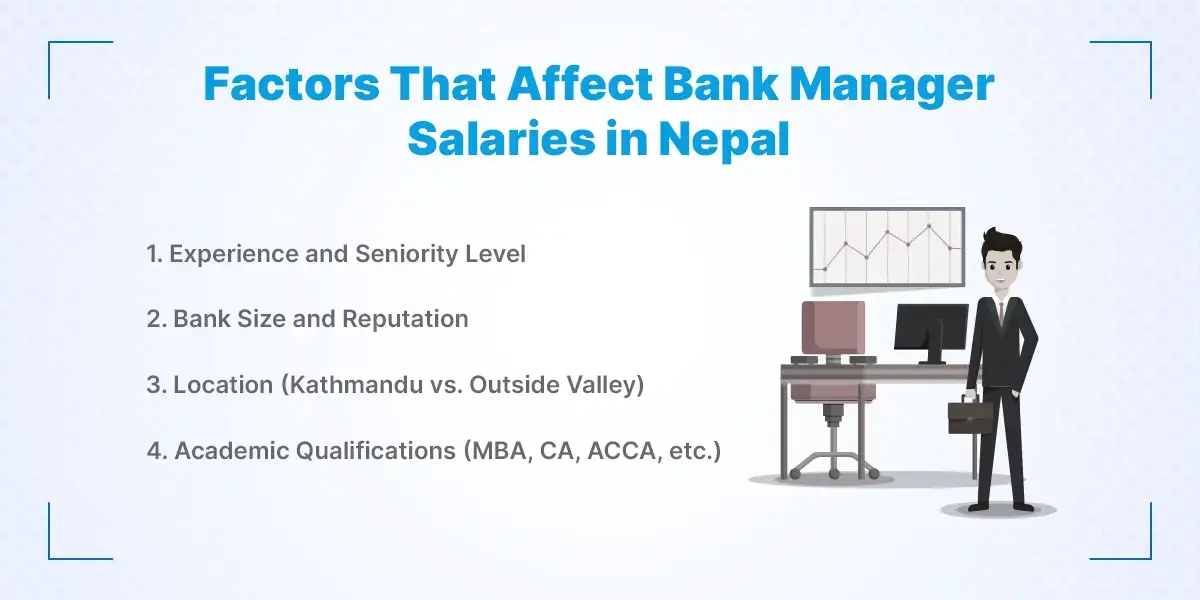
1. Experience and Seniority Level
Experience really matters in banking. The more you work, the more you earn. A person who has just become a manager may receive a lower salary initially. But a person who has been in and around banks for 10 years will receive much more. Senior managers tend to do more important tasks. They have bigger teams and make bigger decisions. So, banks depend on them more and pay them higher salaries. Thus, seniority leads to a higher salary and better perks. Even the same title varies in meaning based on experience. A 2-year experienced branch manager is different from a 10-year experienced one. Salaries go up over the years with performance and promotions.
2. Bank Size and Reputation
Bigger banks pay more. They have more clients, bigger branches, and offer more services. Older established banks like Nabil, Global IME, Kumari, or NIC Asia tend to pay more than smaller regional or cooperative banks. These larger banks also have better bonus schemes and other perks. Their brand name adds to your stature. Smaller banks may not offer as much pay, but they offer you chances to learn. You can move on to larger banks later if you perform. So being employed by a top bank boosts your career and salary.
3. Location (Kathmandu vs. Outside Valley)
Where you work also has an impact. Managers working in Kathmandu get paid more than those who work outside the valley. Why? Because the cost of living is higher in Kathmandu. Banks in the city also have more transactions and larger clients. This generates more work pressure, but with higher pay. A lower number of customers and lower targets in rural areas result in bank managers' salaries being relatively modest. Nonetheless, some banks provide extra benefits to their employees deployed outside the valley, like travel or house allowance.
4. Academic Qualifications (MBA, CA, ACCA, etc.)
Education plays an important role in banking. The more degrees you have, the more likely you are to be paid better. MBA, CA, or ACCA-qualified managers tend to be paid more. These degrees show that you have a good understanding of management and finance. Some banks even require these for higher-level jobs. You can be a manager with a bachelor's degree alone. But with advanced studies, you can be promoted faster. You may even be selected for special training programs and assignments. More education equals more respect, responsibility, and yes, more pay.
Salaries of Bank Managers Compared to Other Banking Roles
Bank managers do not work alone. There are many other important jobs in a bank. Their salaries are different from each other. For example, assistant managers usually earn less than bank managers. They help the managers and learn the job. Their salary is often about 60% to 80% of what a bank manager makes. Loan officers focus on giving loans to customers. Their pay is usually lower than that of bank managers but can grow with experience.
Branch managers and bank managers sometimes mean the same thing, but in some banks, branch managers might earn a bit less if the bank manager's role is higher up. In banks, salaries go up as you move up the job ladder. You start in smaller roles and can get promoted to assistant manager, then bank manager, and then higher executive roles. This growth depends on your work, skills, and how long you stay in the bank.
Salary Comparison Table of Banking Roles
| Job Role | Average Monthly Salary (NPR) |
|---|---|
| Loan Officer | 40,000 – 70,000 |
| Assistant Manager | 50,000 – 90,000 |
| Bank Manager | 70,000 – 180,000 |
| Senior Bank Manager/Executive | 150,000 – 250,000+ |
Skills Needed to Become a Bank Manager in Nepal
Being a bank manager is not just about wearing a suit and sitting behind an office. It's a big job with a lot of responsibilities. That is why banks look for certain skills when appointing or promoting someone to this role. If you are looking to become a bank manager in Nepal, the following are the most important skills that you need to acquire.
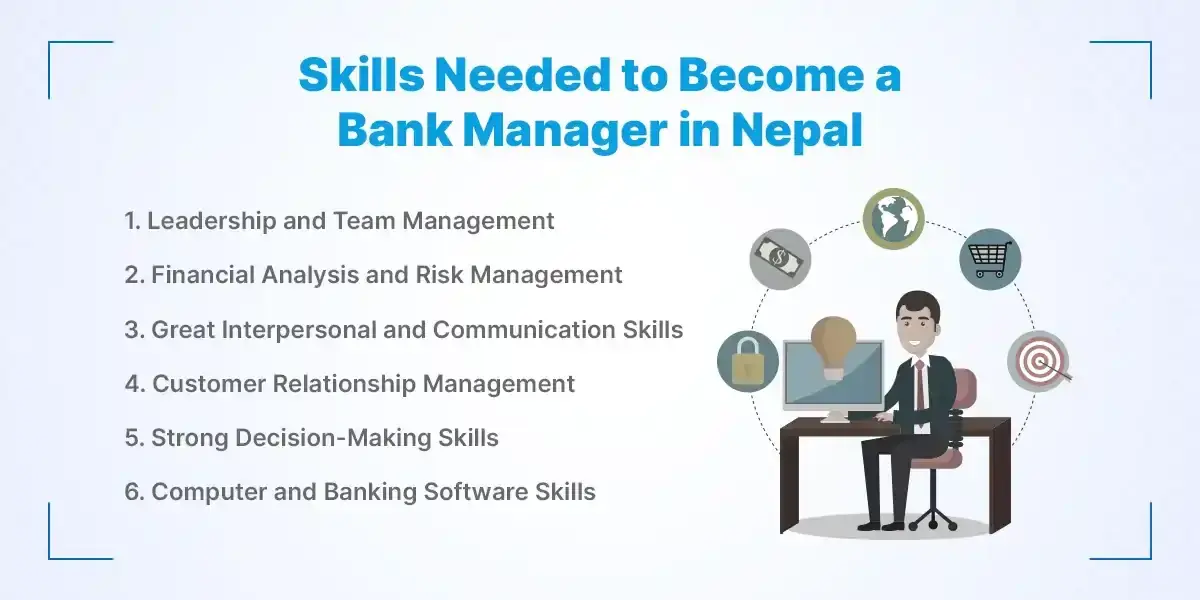
1. Leadership and Team Management
Bank managers have a team of workers. They need to lead the team every day. Good leadership means doing your best and helping others do well, too. It also means solving problems quickly when they happen. Managers must give out tasks and make sure the branch runs smoothly. They also hire new workers and keep order. Without good leadership, the team can lose focus or become slow. So, leadership is very important.
2. Financial Analysis and Risk Management
A bank manager should be highly proficient in numbers. They study reports, profits, and losses. They also check if the bank is making smart choices or not. If there is a risk involved, they must identify it beforehand and solve it. For example, if the loan seems risky, they must take action accordingly. They also make the branch fraud-free or error-free. Awareness in finance makes them good decision-makers. And thus, the bank remains strong.
3. Great Interpersonal and Communication Skills
Bank managers interact with a lot of people on a daily basis. They speak to employees, customers, and top officials. So, they must be good at speaking and listening. A clear message doesn't puzzle. Sometimes, they need to sort out customer concerns in a composed way. They must also convey regulations or news to their employees. Communication leads to trust. And trust helps the bank expand.
4. Customer Relationship Management
Customers are the backbone of any bank. A bank manager must know how to make them satisfied. They need to greet customers warmly and listen to what they want. If a customer complains, they must deal with it right away. Managers also make sure staff offer good service. Happy customers come back and bring some friends with them. Therefore, developing a friendly relationship with customers is very important to success.
5. Strong Decision-Making Skills
There are numerous decisions that bank managers need to make daily. They need to make decisions quickly but intelligently. That may be about loans, staff, or clients. A wrong decision causes problems. So, they need to think right and make decisions courageously. But, in doing so, they need to be just and cautious. Decent decision-making keeps the branch running smoothly. And that makes the whole bank run smoothly.
6. Computer and Banking Software Skills
Nowadays, banks utilize a huge amount of software and systems. A bank manager should be well-known to them. They should know how to run core banking systems, check statements, and alter data. In case of a defect, they should know how to fix it or report it. Even loan approvals or checking balances happen on a computer. So, being technologically equipped is not a choice anymore. Managers who are aware of tech save time and reduce errors.
How Much Do Bank Managers at Top Banks in Nepal Make?
Some banks in Nepal are bigger and more well-known than others. These top banks usually pay better and give more benefits. Many people dream of working in these banks because of the salary, perks, and career growth. Let’s look at some real examples from the top banks in Nepal.
1. Real Salary Examples from Leading Banks
Bank managers at top commercial banks usually earn more than those in smaller or local banks. For example, in Nabil Bank, a branch manager or similar-level manager can earn between NPR 150,000 and NPR 220,000 per month. This depends on branch size and experience. At Global IME Bank, managers often earn around NPR 140,000 to NPR 200,000. Bigger branches may offer even more.
NIC Asia Bank also offers salaries in the range of NPR 130,000 to NPR 190,000 for experienced managers. In Prabhu Bank, salaries are a bit similar, usually NPR 120,000 to NPR 180,000, depending on role and location. Even in government-owned banks like Rastriya Banijya Bank (RBB), senior managers can earn NPR 110,000 to NPR 170,000 per month, along with other government benefits. These amounts are base salaries and can increase with bonuses and other perks.
2. Perks, Bonuses, and Allowances Offered
Top banks also offer many extra benefits besides salary. Managers usually get yearly bonuses, which depend on performance and bank profits. These bonuses can be equal to one or more months’ salary. There are also travel and fuel allowances, especially if the manager needs to visit other branches or attend meetings. Banks often provide medical insurance, gratuity, and retirement plans. Some banks even give housing support or vehicle loans at low interest rates.
Mobile bills and internet charges may also be covered by the bank. In short, these perks make the total package much higher than just the monthly pay. So, while the base salary is already good, these extras make working in top banks even more attractive.
Perks and Allowances for Bank Managers in Nepal
Bank managers don’t just earn a salary. They also get many extra benefits from the bank. These perks make the job more rewarding and help managers stay motivated. Some benefits are the same in most banks, while others depend on the bank’s size and policy. Let’s look at the most common perks and allowances given to bank managers in Nepal.
1. Vehicle, Insurance, Housing, and Retirement Benefits
Many banks provide a vehicle or give a fuel allowance to their managers. If not a car, some banks cover monthly travel costs. Health insurance is another big benefit. Banks usually cover the manager, and sometimes even their family. Some managers get support for housing, too. This could be a housing loan with low interest or a fixed allowance. For retirement, there’s usually a provident fund and gratuity. These help managers plan for their future.
2. Annual Bonuses and Performance-Based Incentives
Almost every bank gives a bonus at the end of the year. This is usually based on the bank’s profit and the manager’s performance. If the manager meets targets, the bonus can be equal to one or two months’ salary. Some banks also give small monthly incentives based on performance. Managers may get extra rewards for bringing in big clients or meeting loan goals. These bonuses encourage better results. It's one of the reasons why banking jobs are seen as high-paying in the long run.
Conclusion
So, is the bank manager's salary in Nepal in 2026 good enough? Yes, it is. The pay is strong, and the added benefits make it even better. While not everyone earns the same, experienced managers at good banks can enjoy a very comfortable income. The more skills and experience you have, the more your salary grows over time. If you're aiming for a stable career with solid pay, the role of a bank manager is one of the better options in Nepal’s job market today.
Looking for a job right now? Check out the latest jobs in Nepal and take your next step toward a better future. Your opportunity might be just one click away!
Frequently Asked Questions
Submit your comments

Get Our App On



What is the Public Relations Officer Salary in Nepal
VIEW DETAILS
What Is the Salary of a Ticketing Officer in Nepal?
VIEW DETAILS
What Is the Salary of a Travel Consultant in Nepal?
VIEW DETAILS
How to Become an Auditor in Nepal
VIEW DETAILS


Loading Comments...