




Have you ever thought about how companies make smart choices and grow faster? It’s usually because of business analysts. In Nepal, more banks, IT firms, and startups are turning to data-driven insights to improve their operations. Because of this, the need for skilled business analysts is growing faster than ever.
In this guide, you’ll learn everything you need to start your journey as a business analyst in Nepal, from what they actually do, what skills you’ll need, and how much you can earn, to step-by-step tips on landing your first job. Let’s make your career path clear and achievable, one step at a time.
In this blog
What Does a Business Analyst Do?
A business analyst helps companies understand problems and find better ways to work. They act as a bridge between management, customers, and technical teams. Their main goal is to study how a company operates, collect useful data, and suggest improvements that save time and money.
A big part of their job is about understanding what the business needs and turning those needs into clear plans that teams can follow. They look at reports, talk to people from different departments, and figure out what changes can make the company more efficient.
Here are some of the main things a business analyst does:
- Gather requirements: Talk with clients or managers to understand what problems need solving.
- Analyze data: Look at numbers, reports, and trends to find out what’s working and what’s not.
- Improve business processes: Suggest better systems, tools, or steps that can make tasks faster or easier.
- Work with teams: Communicate between developers, management, and clients to make sure everyone is on the same page.
- Prepare reports: Share insights and solutions in a simple way that decision-makers can use.
In Nepal, business analysts are now in high demand across many sectors like banking, IT companies, telecom, NGOs, and growing startups. Every organization that deals with data or wants to improve its operations can benefit from a skilled business analyst.
A typical day might include meeting with a project manager in the morning, analyzing customer data in the afternoon, and preparing a short report before the day ends. It’s a mix of people work and data work, understanding business problems, finding insights, and helping companies make smarter decisions.
Qualifications Required to Become a Business Analyst in Nepal
Becoming a business analyst doesn’t always need a fancy degree, but the right education and skills make a big difference. Most employers look for candidates who understand both business and technology. If you can read data, think logically, and explain ideas clearly, you already have a good start. Let’s look at what qualifications and skills help you stand out in Nepal’s job market.
1. Educational Background
A bachelor’s degree is the first step. Most business analysts in Nepal come from fields like Business Administration (BBA), Information Technology (BIT), Management, or Economics. These courses teach you how businesses work and how to use data for better decisions. Even if your background is different, you can still switch careers by taking short courses in business analysis or data analytics.
2. Postgraduate Studies
Having a Master of Business Administration (MBA) or a Master’s in Data Analytics can give you an edge. These programs help you understand complex business problems and teach you leadership, finance, and data-driven decision-making. While not required, a postgraduate degree often opens doors to higher-level or specialized roles.
3. Analytical and Communication Skills
Strong analytical skills help you make sense of data and find useful insights. But that’s only half of the job. You also need good communication skills to explain your findings in a simple way to managers, clients, or technical teams. Many great analysts fail not because they lack data skills, but because they can’t explain their ideas clearly.
What Skills are Needed to Get a Business Analyst Job?
To become a business analyst, you need both technical skills, like Excel, SQL, and Power BI, and soft skills like communication and problem-solving. Being a business analyst is about more than just numbers. You need to understand data, spot patterns, and explain what they mean in simple words. The right skills help you turn information into smart business decisions. Let’s look at both the technical and soft skills that matter most.

1. Technical Skills
These are the tools and techniques that help you collect, organize, and study data.
- Excel: The most basic yet powerful tool. You’ll use it to make reports, charts, and simple dashboards.
- SQL: This helps you pull data directly from databases. Knowing how to write simple SQL queries can save a lot of time.
- Power BI: A tool for turning data into visual reports and dashboards. Many Nepali companies use Power BI to track performance.
- Tableau: Another great tool for data visualization. It helps you turn raw data into clear, colorful insights.
- Google Analytics: Perfect for analyzing website traffic and user behavior. This is especially useful if you’re working in digital marketing or IT companies.
Learning these tools doesn’t mean becoming an expert right away. Start with Excel and SQL, then slowly move to Power BI or Tableau as you gain confidence.
2. Soft Skills
Technical tools help you find answers, but soft skills help you share them effectively.
- Communication: You must explain your ideas clearly to both technical and non-technical people.
- Problem-Solving: You’ll face different business challenges every day, so thinking logically and creatively is key.
- Teamwork: Analysts often work with managers, developers, and clients. Working well in a team makes projects smoother.
- Critical Thinking: Don’t just accept data as it is. Question it, compare it, and look for what it really means.
In short, a great business analyst knows how to use data tools and how to talk about data in a simple, meaningful way. Balance both, and you’ll be ready for success in any company.
How to Get a Business Analyst Job in Nepal?
To get a business analyst job in Nepal, get a relevant degree or short-term training, learn data tools, gain experience through internships, build a strong CV, network online, and prepare well for interviews. The role is in high demand, and with the right mix of education, skills, and confidence, you can land a great job even as a beginner. Let’s go through each step clearly.
Step 1: Gain a Relevant Degree or Training
Most business analysts begin with a bachelor’s degree in Business Administration, IT, Management, or Economics. But if you have already graduated in another field, don’t worry. You can take short-term courses in business analysis, data analytics, or project management. These help you understand business processes, data handling, and reporting, the basics of the job.
Step 2: Learn the Right Tools
Technical tools make your work easier and more accurate. Start by mastering Excel for data organization and reports. Then move on to SQL for database queries. Learn tools like Power BI and Tableau to make dashboards and visualize data. These are the tools that most Nepali companies use daily.
Step 3: Build a Strong CV with Projects
Your CV should show that you can analyze and solve problems. Include college projects, case studies, or small data analysis tasks you’ve done. Even personal or training-based projects count if they show your skills. Make sure your CV looks clean, clear, and highlights both your technical and communication strengths.
Step 4: Get Real Experience through Internships
Internships are a great way to learn how businesses work. Many banks, IT firms, and startups in Nepal offer internships for business analysis or data roles. Even if it’s unpaid, the experience helps you understand real data problems and teamwork.
Step 5: Network with Professionals
Building connections helps you find hidden job opportunities. Use LinkedIn to connect with Nepali business analysts and recruiters. You can also check local job platforms like Kumari Job, Merojob, and Growth Sellers for openings. Attend webinars or workshops to meet people in the same field.
Step 6: Prepare for Interviews
Prepare for your interview beforehand. Review common case studies and business problems. Practice explaining how you’d solve them. Interviewers often check your thinking process, not just your answers. Be ready to talk about your projects, the tools you used, and how you helped make decisions.
What is the Average Business Analyst Salary in Nepal?
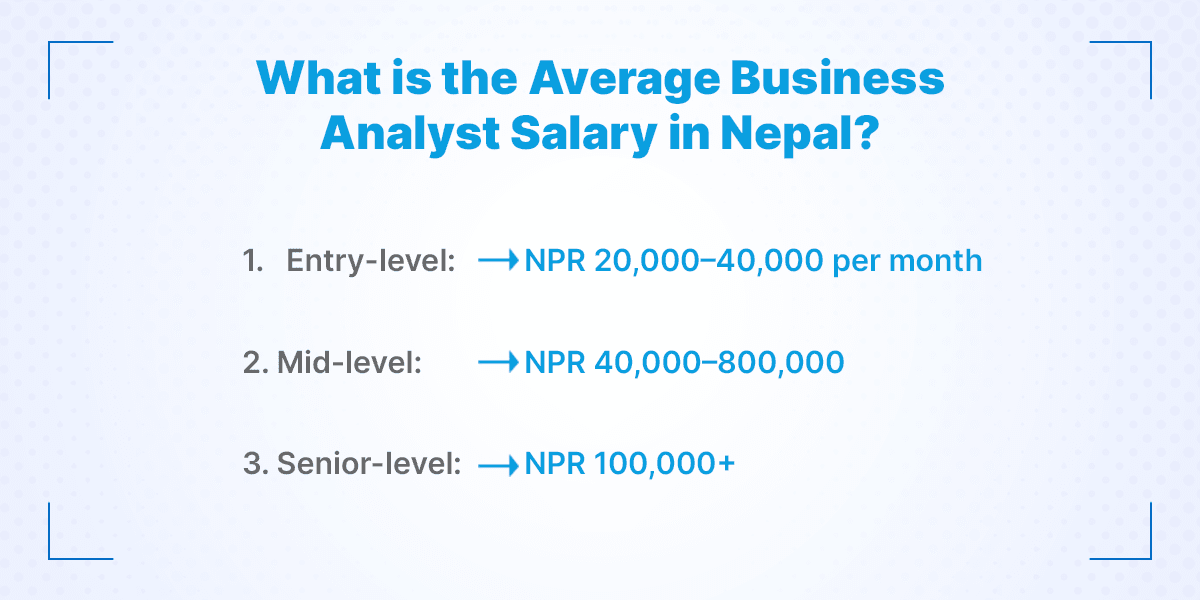
The average salary of a business analyst in Nepal ranges from NPR 20,000 for entry-level to NPR 100,000+ for senior-level positions. Business analysts in Nepal are becoming increasingly important as more companies rely on data to make decisions. Salaries vary depending on experience, skills, and the company’s size. Understanding the pay structure can help you plan your career and set realistic expectations.
1. Entry-Level Business Analyst Salary
For fresh graduates or beginners, the typical salary is around NPR 20,000 to 40,000 per month. At this stage, companies focus more on your potential, willingness to learn, and basic knowledge of tools like Excel, SQL, or Power BI. Entry-level analysts often work under supervision and assist in data collection, reporting, and minor analysis tasks.
2. Mid-Level Business Analyst Salary
After a few years of experience, mid-level analysts can earn between NPR 40,000 and 80,000 per month, depending on the company and their expertise. At this level, you are expected to handle projects independently, create dashboards, analyze complex data, and provide recommendations. Companies also value certifications and hands-on experience, which can push salaries toward the higher range.
3. Senior-Level Business Analyst Salary
Senior business analysts, with several years of experience and strong technical and soft skills, can earn NPR 100,000+ per month. They often manage teams, lead important projects, and guide decision-making at a strategic level. Senior analysts may also mentor juniors, design business processes, and work closely with top management.
What Certifications Help You Get Hired Faster?
Certifications like ECBA, CBAP, Google Data Analytics, and Microsoft Power BI/SQL can help you get hired faster as a business analyst in Nepal. Having the right certifications shows employers that you have the skills and knowledge needed for the job. They not only increase your credibility but also often lead to better salary offers. In a competitive job market, certifications can set you apart from other candidates.
- IIBA Entry Certificate in Business Analysis (ECBA): It validates your understanding of business analysis fundamentals. Completing this certification shows employers that you are serious about starting a career in business analysis.
- CBAP (Certified Business Analysis Professional): It demonstrates advanced knowledge and skills in business analysis. Holding a CBAP can help you land higher-level roles and negotiate better salaries in Nepal.
- Google Data Analytics Certificate: It teaches you how to clean, analyze, and visualize data using real-world examples. Employers value it because it shows practical, hands-on ability to work with data.
- Microsoft Power BI and SQL Certifications: Power BI and SQL are widely used in Nepali companies for reporting and database management. Certified skills make you more efficient and increase your chances of getting hired quickly.
Career Growth and Future Scope of Business Analysts in Nepal
The demand for business analysts in Nepal is growing rapidly. Companies are moving toward digitalization and data-driven decision-making, which means skilled analysts are becoming essential. As organizations rely more on data, the career opportunities for business analysts are expanding not only within Nepal but also globally.
Here are some common career paths and opportunities for business analysts:
- Senior Analyst: After gaining experience, you can move to senior analyst roles, handling bigger projects and mentoring juniors.
- Business Consultant: With expertise, you can advise multiple companies on improving processes and making data-based decisions.
- Product Manager: Analysts with a good understanding of business and customer needs can shift to product management roles.
- Data Scientist: If you develop advanced data and technical skills, you can transition to data science roles focusing on predictive analytics and AI.
Global and Remote Opportunities
Business analysis skills are highly transferable. Many global companies hire remote business analysts or freelancers for short-term projects. Platforms like Upwork or Fiverr provide opportunities to work with international clients, giving exposure to global business practices. This can significantly improve your experience, skill set, and earnings.
Common Challenges for New Business Analysts in Nepal
Starting a career as a business analyst in Nepal can be exciting, but beginners often face several challenges. Many struggle to gain practical experience or fully understand how businesses operate. The good news is that most of these challenges can be overcome with learning, practice, and guidance.
1. Lack of Hands-On Project Experience
One of the biggest challenges for new analysts is limited real-world experience. While you may know the theory, applying it to actual business problems is different. Many companies prefer candidates who have worked on projects, even small ones. Internships, volunteering, or personal projects can help bridge this gap. Practicing case studies or simulations also improves your confidence. Building a portfolio of projects shows employers that you can handle real tasks. Over time, this experience makes job applications much stronger.
2. Limited Exposure to Business Processes
Beginners often have little understanding of how companies function beyond theory. They may not know how departments interact, how decisions are made, or what challenges businesses face. This can make it hard to provide useful insights. Learning through internships or observing experienced professionals helps. Reading case studies or business reports also improves knowledge. Asking questions and shadowing senior analysts can provide practical exposure. With time, this knowledge becomes a strong advantage in interviews and daily work.
3. Overcoming Skill Gaps Through Online Training and Mentorship
Many new analysts discover they lack certain technical or soft skills needed for the job. Tools like SQL, Power BI, or Excel might seem difficult at first. Online courses, tutorials, and certifications can fill these gaps. Mentorship from experienced professionals is also invaluable. A mentor can guide you on career steps, tools to learn, and ways to approach projects. Combining training with mentorship accelerates learning and prepares you for real job challenges. Overcoming these gaps makes you a more confident and capable analyst.
Conclusion
Becoming a business analyst in Nepal is a rewarding career path with growing demand across banking, IT, telecom, startups, and NGOs. By focusing on the right education, skills, and certifications, you can stand out in a competitive job market. Start with a relevant degree or short-term training in Nepal. Learn essential tools like Excel, SQL, Power BI, and Tableau, and gain real-world experience through internships or projects.
Networking and preparing well for interviews further increase your chances of success. Continuous learning, improving both technical and soft skills, and earning certifications can boost your credibility and salary. With dedication and the right approach, you can build a successful and long-lasting career as a business analyst in Nepal.
Frequently Asked Questions
Submit your comments

Get Our App On



What is the Public Relations Officer Salary in Nepal
VIEW DETAILS
What Is the Salary of a Ticketing Officer in Nepal?
VIEW DETAILS
What Is the Salary of a Travel Consultant in Nepal?
VIEW DETAILS
How to Become an Auditor in Nepal
VIEW DETAILS


Loading Comments...