




Mental health problems are no longer a hidden issue in Nepal. More students, parents, schools, hospitals, and organizations are now paying attention to stress, anxiety, depression, counseling, learning behavior, and emotional well-being, which is increasing the need for trained psychology professionals. Nepal’s 2020 National Mental Health Survey found that 10% of adults had experienced a mental disorder in their lifetime, while 5.2% of adolescents had a mental disorder, showing why this field is becoming more important across the country.
That is why the scope of psychology in Nepal is growing beyond theory and classrooms. Today, psychology is creating real career opportunities in hospitals, schools, NGOs, rehabilitation centers, community programs, and private counseling practices, while national and international organizations are also investing more in mental health support and youth wellbeing in Nepal. In this blog, you will learn about the scope of psychology in Nepal, career options, job opportunities, salary, qualifications, and practical tips to find psychology jobs and build a career in this field.
In this blog
What is Psychology, and Why is it Becoming Important in Nepal?
Psychology is the study of how people think, feel, behave, and respond to different situations. In simple words, it helps us understand human behavior, emotions, learning, stress, relationships, and mental health. It is useful not only for treating mental health problems but also for improving education, communication, and daily life.
Psychology is becoming more important in Nepal because awareness of mental health and emotional well-being is growing. More people, schools, hospitals, NGOs, and communities now understand the need for counseling, behavior support, and psychosocial care. Nepal’s National Mental Health Survey found that 10% of adults and 5.2% of adolescents had experienced a mental disorder in their lifetime, which shows why trained psychology professionals are increasingly needed.
This growing awareness is also creating real job demand and career growth. Psychology graduates can work in schools, hospitals, rehabilitation centers, NGOs, workplaces, and community programs where support for behavior, learning, stress, and mental health is needed. As Nepal continues to expand mental health services and support systems, the scope of psychology is becoming stronger as a career field.
What is the Scope of Psychology in Nepal?
The scope of psychology in Nepal is growing as more institutions need support in mental health, behavior, learning, counseling, and psychosocial care. What was once seen as a limited field is now gaining attention in both the public and private sectors, especially as Nepal expands mental health services and community support systems. WHO’s Nepal work and recent investment reports show increasing focus on integrating mental health and psychosocial support into broader health and social systems.
This growth is creating opportunities in counseling, clinical support, teaching, social work, human resources, child development, and rehabilitation. Psychology knowledge is now useful in schools, NGOs, hospitals, rehabilitation centers, and even some workplace and corporate settings, where people need help with emotional well-being, behavior, trauma, communication, and performance. Recent Nepal job listings also show demand for roles such as psychosocial counsellor, training counselor, and program roles that prefer psychology backgrounds.
The field is still developing in Nepal, and that is actually a strong advantage for students and professionals who want long-term growth. Because the system is still expanding, there is more room to build a career through specialization, training, field experience, and private practice over time. In simple words, the scope of psychology in Nepal is not only good today, but also promising for the future.
Why Choose Psychology as a Career in Nepal?
Psychology is a good career choice in Nepal for students who want meaningful work, flexible career paths, and growing opportunities in people-focused fields. It is a people-centered profession where your work can make a real difference. Psychology professionals can help individuals, families, students, and communities deal with stress, emotional problems, behavior issues, learning challenges, and personal development.
Another reason to choose psychology is that it does not limit you to one fixed job. You can build a career in counseling, teaching, social work, child development, rehabilitation, HR, NGOs, hospitals, and community support. It is also becoming more relevant in modern workplaces where communication, mental well-being, and problem-solving matter more than before.
Psychology is a strong option for students who are interested in human behavior, communication, emotions, and helping others solve real-life problems. If you want a career that is practical, impactful, and has room to grow in Nepal, psychology can be a smart choice.
Where Can Psychology Graduates Work in Nepal?
Psychology graduates in Nepal can work in hospitals, schools, NGOs, rehabilitation centers, child support settings, community programs, corporate offices, research institutions, private counseling centers, and government-related social service organizations. This makes psychology a flexible career field with opportunities in both direct support and professional office-based roles. The exact job path depends on your qualifications, skills, training, and area of interest.
1. Hospitals and Mental Health Centers
Psychology graduates can work in hospitals and mental health centers by supporting patients with emotional, behavioral, and psychological problems. Their role may include counseling support, case coordination, mental health screening, and psychosocial care. In some settings, they work under psychiatrists, psychologists, or clinical teams. This is a strong option for those interested in mental health services and clinical environments.
2. Schools and Colleges
Schools and colleges need psychology graduates to support students with learning, behavior, stress, and emotional challenges. They may work in student counseling, academic guidance, behavioral support, or child development roles. These jobs are suitable for those who enjoy working with young people and education systems. The demand can grow as more institutions focus on student well-being and counseling services.
3. NGOs and INGOs
Many NGOs and INGOs hire psychology graduates for community-based support, child protection, mental health, and psychosocial programs. These roles often involve working with vulnerable groups, conducting awareness programs, and helping with emotional support services. Psychology graduates may also support training, case management, and field coordination. This area offers meaningful work and strong exposure to social impact projects.
4. Rehabilitation Centers
Rehabilitation centers offer opportunities for psychology graduates to support people recovering from addiction, trauma, disability, or behavioral issues. Their work may include counseling support, motivation building, emotional care, and rehabilitation planning. These roles require patience, empathy, and strong communication skills. It is a good field for those who want to help people rebuild their lives.
5. Child Care and Special Education Centers
Psychology graduates can work in child care and special education centers by helping children with developmental, emotional, or behavioral needs. They may support assessments, parent guidance, behavior improvement plans, and learning support activities. This field is important for those interested in child psychology and inclusive education. It also creates space for long-term specialization.
6. Community Health Programs
Community health programs need psychology graduates for awareness, counseling, mental health support, and outreach work. They often work with local communities to address stress, trauma, family issues, and emotional well-being. These roles can include field visits, workshops, and community-based intervention programs. It is a practical area for graduates who want to work directly with people at the grassroots level.
7. Corporate Offices and HR Departments
Psychology graduates can also work in corporate offices, especially in human resources, employee wellbeing, training, and communication-related roles. Their understanding of behavior, motivation, and interpersonal skills is useful in recruitment, team management, and workplace support. This is a good path for those who want a more professional office setting. It also shows that psychology is useful beyond the health and counseling fields.
8. Research Institutions
Research institutions offer psychology graduates opportunities in data collection, behavioral studies, surveys, and academic projects. They may assist in research on mental health, education, social behavior, or development issues. These roles are useful for graduates who enjoy analysis, writing, and evidence-based work. Research experience can also help in higher studies and specialized careers.
9. Private Counseling Centers
Private counseling centers are a growing option for psychology graduates who want to work in one-on-one or family support settings. They may help clients with stress, anxiety, relationship issues, academic pressure, and emotional challenges. Some graduates begin in junior roles and grow through training and supervised experience. This field can also lead to private practice in the future.
10. Government-Related Social Service Organizations
Government-related social service organizations may hire psychology graduates in child welfare, community support, rehabilitation, social protection, and public health programs. These roles focus on improving wellbeing at the population level and supporting people in difficult situations. The work may involve coordination, counseling, awareness, and service delivery. It is a good option for those who want stable and socially meaningful career opportunities.
What Qualifications are Needed to Study Psychology in Nepal?
To study psychology in Nepal, students usually start after +2, then continue with a bachelor’s degree, and often a master’s degree for better specialization and career growth. Your qualifications affect the type of job you can get, but practical skills and field exposure are also very important. In psychology, education and real experience must grow together.
1. +2 Level Background
Students can choose psychology after completing their +2 level, especially if they are interested in human behavior, communication, and mental health. There is no strict rule that only one stream can study psychology, but academic requirements may vary by college or university. A good interest in social science, education, or health-related subjects can be helpful. This is the first step to entering the field.
2. Bachelor’s Degree Options
A bachelor’s degree in psychology is the main academic path for students who want to build a career in this field. Some colleges may offer psychology as a major subject, while others may include it under social science or education programs. This level helps students understand basic psychological theories, behavior, development, and research concepts. It creates the foundation for future jobs and higher studies.
3. Master’s Degree for Specialization
A master’s degree in psychology is important for students who want deeper knowledge and better career opportunities. It helps in specialization areas such as counseling, clinical support, child psychology, or research. In many cases, higher qualifications improve access to more responsible and skilled roles. For long-term career growth, a master’s degree is often a strong advantage.
4. Training and Certification Courses
Short-term training and certification courses can help psychology students build practical skills beyond academic study. These may include counseling skills, psychosocial support, child protection, mental health awareness, and communication training. Such courses are useful for making your profile stronger and more job-ready. They can also help you enter field-based roles more confidently.
5. Internships and Practical Experience
Internships and practical experience are very important in psychology because this field depends heavily on real-world understanding and human interaction. Students learn a lot by observing professionals, joining community programs, working in schools, or supporting mental health and social service projects. Practical exposure improves confidence, communication, and problem-solving ability. It also increases your chances of getting better job opportunities after graduation.
What Skills are Needed for Psychology Jobs in Nepal?
Psychology jobs in Nepal need strong communication, empathy, observation, problem-solving, and professional ethics because the work involves understanding people and supporting them carefully. Academic knowledge is important, but employers also value practical soft skills that help you work with different individuals, age groups, and communities. The better your people skills, the stronger your career growth in psychology can be.
1. Communication Skills
Good communication is important because psychology professionals need to speak clearly and build trust with others. You may need to explain problems, give guidance, ask the right questions, and support people in a simple way. Strong verbal and written communication also helps in schools, NGOs, hospitals, and workplaces. This skill is useful in almost every psychology-related job.
2. Active Listening
Active listening means paying full attention to what someone is saying without interrupting or judging too quickly. It helps psychology professionals understand emotions, concerns, and hidden issues more clearly. People often need someone who listens with care and focus. This skill is especially important in counseling, support work, and community programs.
3. Empathy and Patience
Empathy helps you understand another person’s feelings and situation in a respectful way. Patience is equally important because people may take time to open up, change behavior, or recover from stress and emotional problems. In psychology-related work, quick judgment can harm trust. That is why empathy and patience are core skills in this field.
4. Observation and Analytical Thinking
Psychology professionals must observe behavior, emotions, and patterns carefully. Small details in speech, reactions, or daily habits can help in understanding a person’s condition or challenge. Analytical thinking helps you connect those details and understand the bigger picture. This skill is useful in assessment, support planning, and behavior-related work.
5. Problem-Solving
Many psychology jobs involve helping people manage emotional, behavioral, educational, or social problems. Good problem-solving helps you identify the issue, understand possible causes, and find practical ways to support improvement. This does not always mean giving direct answers. Sometimes it means guiding people toward better decisions and healthier actions.
6. Emotional Intelligence
Emotional intelligence means understanding your own emotions and handling the emotions of others in a balanced way. In psychology jobs, this skill helps professionals stay calm, respectful, and supportive even in difficult situations. It also improves relationship building and conflict handling. This is very important when working with students, families, patients, or vulnerable groups.
7. Confidentiality and Ethics
Confidentiality and ethics are essential because psychology professionals often deal with personal, emotional, and sensitive information. People must feel safe when sharing their problems or experiences. Respecting privacy and professional boundaries helps build trust and protect clients. Without ethics, it is difficult to work responsibly in this field.
8. Report Writing and Documentation
Psychology-related roles often require writing reports, case notes, observations, and progress records. Clear documentation helps track cases, share updates with teams, and maintain professional standards. This skill is especially useful in NGOs, schools, hospitals, and rehabilitation centers. Good writing also supports research and administrative work.
9. Counseling and Interpersonal Skills
Counseling and interpersonal skills help professionals connect with people in a supportive and respectful way. These skills include trust building, asking thoughtful questions, guiding conversations, and responding with care. Even if the job is not fully clinical, interpersonal ability is still necessary. It improves the quality of support and workplace effectiveness.
10. Ability to Work With Different Age Groups and Communities
Psychology graduates in Nepal may work with children, teenagers, adults, families, elderly people, or vulnerable communities. This means they need flexibility and cultural understanding to handle different backgrounds and needs. The way you support a school child is different from the way you support an adult or a community group. Being adaptable makes you more effective and employable in psychology jobs.
What are the Top Psychology-Related Jobs in Nepal?
The top psychology-related jobs in Nepal include roles in counseling, schools, NGOs, mental health projects, HR, research, and academic institutions. These jobs show that psychology is not limited to one career path. In Nepal, many openings are more commonly advertised under psychosocial support, counseling, education, HR, and field program roles rather than only under the title “psychologist.”
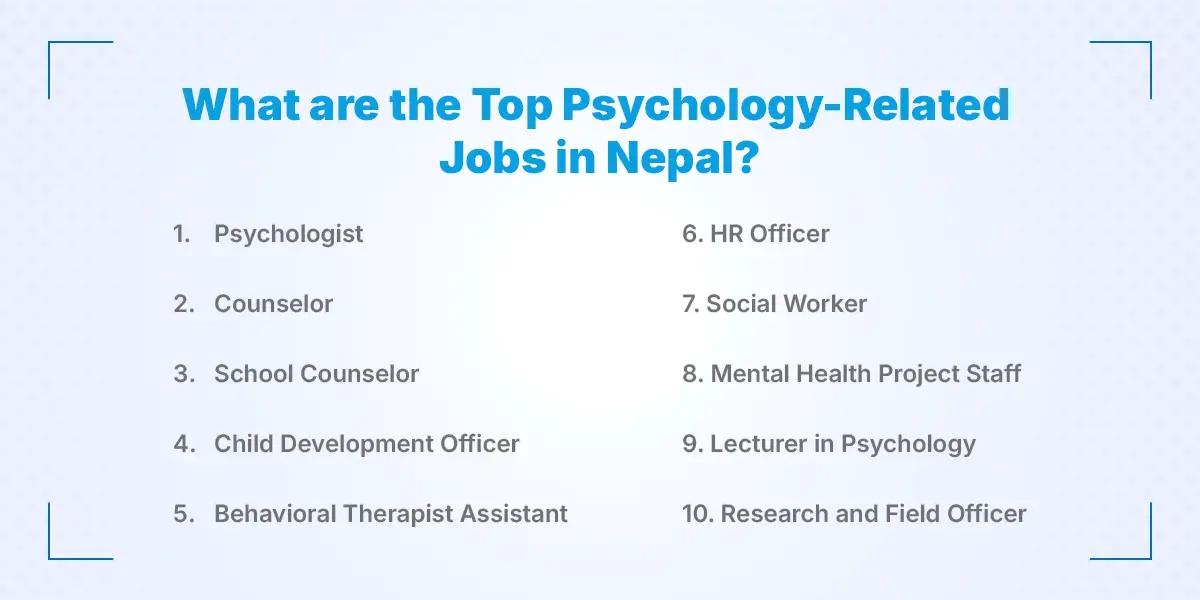
1. Psychologist
A psychologist works on understanding behavior, emotions, and mental health challenges in a professional setting. In Nepal, this role may be found in hospitals, mental health centers, rehabilitation services, or private practice. The title is more specialized, so higher education and practical training are usually important. This is a strong path for those who want long-term growth in assessment, therapy, and mental health support.
2. Counselor
A counselor helps people manage stress, emotional problems, trauma, family issues, and personal challenges. This is one of the most visible psychology-related job paths in Nepal, especially in NGOs, community programs, and support centers. Recent Nepal job listings show active demand for counsellor and psychosocial counsellor roles. These jobs often value psychology plus practical counseling training.
3. School Counselor
A school counselor supports students with academic stress, emotional well-being, behavior issues, and personal development. This role is becoming more important as schools pay more attention to student mental health and guidance services. Psychology graduates with strong communication and child-focused skills can fit well in this area. It is a good option for those who want to work in an education setting.
4. Child Development Officer
A child development officer works with children’s emotional, social, and behavioral growth in schools, NGOs, and child-focused programs. The job may involve parent support, child wellbeing activities, case follow-up, and development planning. Psychology is useful here because it helps professionals understand childhood behavior and learning needs. This role is suitable for those interested in child psychology and community impact.
5. Behavioral Therapist Assistant
A behavioral therapist assistant supports children or individuals with developmental, emotional, or behavioral challenges. The work may include helping with therapy plans, observing behavior, assisting specialists, and supporting families. This role can be found in therapy centers, special education settings, and rehabilitation programs. It is a practical path for those who want hands-on experience in behavior support.
6. HR Officer
An HR officer manages people-related work such as recruitment, communication, employee support, and workplace coordination. Psychology graduates can do well in HR because they understand behavior, motivation, conflict, and interpersonal communication. This is one of the best non-clinical career options for psychology students in Nepal. It is especially suitable for those who prefer office-based professional roles.
7. Social Worker
A social worker helps individuals, families, and communities deal with social, emotional, and practical challenges. Psychology knowledge is helpful in understanding trauma, family problems, community needs, and vulnerable groups. In Nepal, this role is common in NGOs, rehabilitation settings, and social service organizations. It is a meaningful career for people who want direct community-level impact.
8. Mental Health Project Staff
Mental health project staff work in NGO and INGO programs focused on psychosocial support, awareness, training, referrals, and community wellbeing. These jobs are growing in Nepal, and listings often ask for psychology, social work, or counseling backgrounds along with field experience. Recent vacancies show roles linked to GBV response, child and adolescent mental health, and community psychosocial support. This is a strong path for graduates who want field-based work with social impact.
9. Lecturer in Psychology
A lecturer in psychology teaches psychology subjects at colleges or universities and may also guide research and academic activities. This job is better suited for candidates with higher qualifications, such as a master’s degree or beyond. It is a good option for those who enjoy teaching, writing, and academic work. Over time, this path can also lead to research and institutional leadership roles.
10. Research and Field Officer
A research and field officer works on surveys, case documentation, project monitoring, behavioral studies, and data collection. Psychology graduates are useful in these roles because they understand human behavior, interviewing, observation, and reporting. These jobs are common in NGOs, development projects, and research institutions. It is a solid option for those who like analysis, fieldwork, and evidence-based work.
How to Get Psychology Jobs in Nepal?
To get psychology jobs in Nepal, you need the right education, practical experience, a strong CV, and consistent job searching through relevant institutions and platforms. Most employers look for candidates who not only understand psychology theory but can also apply it in real settings. Starting small and building experience step by step is often the best way to enter this field.
1. Complete a Relevant Degree in Psychology
A relevant degree in psychology is the first step to entering this field in Nepal. A bachelor’s degree helps you build the foundation, while a master’s degree can improve your career options and specialization. Employers usually prefer candidates with academic knowledge related to behavior, counseling, mental health, or research. Your qualification gives you the base to apply for both entry-level and advanced roles.
2. Join Internships, Training, or Field Placements
Internships, training programs, and field placements help you move beyond theory and understand how psychology works in real life. You can gain exposure in schools, NGOs, hospitals, counseling centers, or community programs. This practical learning helps you build confidence and understand workplace expectations. It also makes your profile stronger when applying for jobs.
3. Build Practical Counseling or Research Experience
Psychology employers often value practical experience because this field depends heavily on communication, observation, and problem-solving. You can build experience by volunteering, assisting in projects, joining field research, or supporting counseling-related work. Even small experiences can help you develop relevant skills. Over time, this makes you more job-ready and competitive.
4. Prepare a Strong CV Focused on Psychology Skills
Your CV should clearly show your psychology-related skills, training, academic background, and practical experience. Highlight areas such as communication, empathy, report writing, counseling support, research, and fieldwork. Keep the CV simple, relevant, and focused on the job you are applying for. A well-structured CV increases your chances of getting shortlisted.
5. Search on Job Portals and Company Career Pages
You should regularly check job portals, NGO vacancy pages, hospital websites, school career pages, and company websites for psychology-related openings. In Nepal, some jobs may not always use the exact title “psychology job,” so search with related terms like counselor, psychosocial support, child development, HR, or research assistant. A wider search approach helps you find more opportunities. Applying early and consistently also matters.
6. Network with Institutions, Colleges, NGOs, and Hospitals
Networking can help you discover opportunities that are not always widely advertised. Stay connected with teachers, training centers, hospitals, NGOs, rehabilitation centers, and college departments related to psychology. These connections may guide you toward internships, workshops, job openings, or referrals. In a growing field like psychology, professional relationships can be very useful.
7. Apply for Entry-Level Roles to Gain Experience
Do not wait only for high-level or perfect job titles in the beginning. Entry-level roles in counseling support, project assistance, education support, HR, research, or community programs can help you gain valuable experience. These jobs build your practical skills and improve your future opportunities. Starting small is often the smartest way to grow in psychology.
8. Keep Improving Through Workshops and Certifications
Psychology is a field where learning should continue even after your degree. Workshops, short courses, and certification programs can help you improve your counseling skills, communication, child support knowledge, research ability, or mental health understanding. These extra qualifications make your profile more professional and job-ready. Continuous learning also helps you grow faster in your career.
Where to Find Psychology Jobs in Nepal?
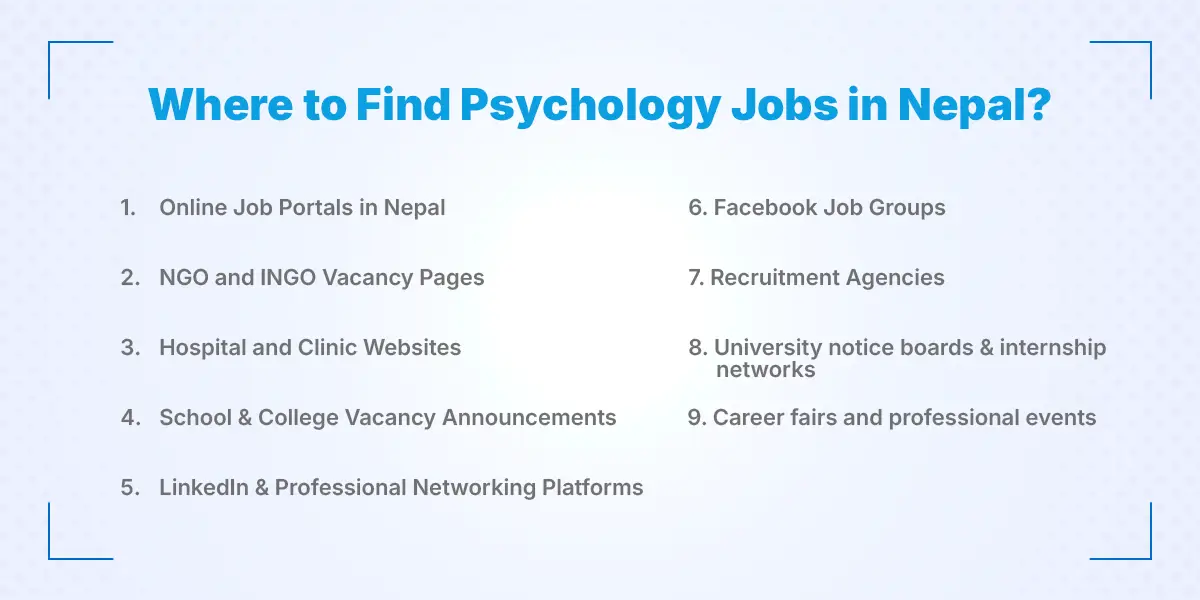
You can find psychology jobs in Nepal on platforms like Kumari Job, online job portals, NGO and INGO vacancy pages, hospital websites, school career pages, LinkedIn, Facebook job groups, recruitment agencies, and university networks. Psychology-related jobs are often posted under different titles, so it is important to search using related terms such as counselor, psychosocial support, school counselor, HR officer, research assistant, and child development roles. Using multiple sources gives you a better chance of finding the right opportunity.
1. Online Job Portals in Nepal
Online job portals are one of the easiest ways to search for psychology-related jobs in Nepal. Websites like Kumari Job and other job portals often post openings in counseling, HR, social work, education, and NGO sectors. You should search with different keywords because psychology jobs may not always be listed under the exact word “psychology.” Regular checking can help you find new vacancies early.
2. NGO and INGO Vacancy Pages
Many psychology-related jobs in Nepal are posted on NGO and INGO vacancy pages. These organizations often hire for roles in mental health, psychosocial support, child protection, community development, and rehabilitation. If you are interested in field-based or social impact work, this is a very important source. Visiting official vacancy pages directly can help you find relevant openings.
3. Hospital and Clinic Websites
Hospitals, mental health centers, and clinics may post jobs for counseling support, mental health assistance, and related positions on their official websites. These roles are useful for psychology graduates who want to work in healthcare settings. Some openings may also appear on hospital social media pages or notice boards. Checking these sources regularly can be helpful.
4. School and College Vacancy Announcements
Schools and colleges may announce openings for school counselors, psychology teachers, student support staff, or child development roles. These jobs are ideal for graduates who want to work in education and student wellbeing. Some institutions post vacancies on their websites, while others share them through notices or social media. This is a good area to monitor if you prefer academic environments.
5. LinkedIn and Professional Networking Platforms
LinkedIn is becoming more useful for finding professional jobs in Nepal, including HR, research, education, and mental health-related roles. It also helps you connect with recruiters, institutions, and professionals working in related fields. A good LinkedIn profile can improve your visibility and credibility. Networking there can sometimes lead to opportunities beyond direct job posts.
6. Facebook Job Groups
Facebook job groups can also help you find psychology-related vacancies in Nepal. Many employers, recruiters, schools, and organizations share urgent openings in these groups. This is especially useful for entry-level, field-based, or locally advertised jobs. You should still verify each post carefully before applying.
7. Recruitment Agencies
Recruitment agencies can help connect job seekers with employers in different sectors, including education, healthcare, NGOs, and corporate offices. Some psychology graduates may find roles through agencies that recruit for HR, training, counseling support, or community-based work. Registering with trusted agencies can increase your chances of hearing about suitable openings. It is a useful option for wider job access.
8. University Notice Boards and Internship Networks
Colleges and universities often share internship and job opportunities through notice boards, departments, teachers, and student networks. These sources are valuable for fresh graduates who are just starting out. Sometimes the best early opportunities come through academic connections rather than public job posts. Staying active in your college network can be a smart move.
9. Career Fairs and Professional Events
Career fairs, workshops, seminars, and professional events can help you discover employers and institutions hiring in related fields. These events also give you a chance to build contacts and learn what employers are looking for. In a growing field like psychology, networking can open useful doors. Meeting people directly can sometimes lead to internships or entry-level jobs.
Salary of Psychology Professionals in Nepal
The salary of psychology professionals in Nepal usually ranges from around NPR 20,000 per month in entry-level roles to NPR 80,000+ per month in more experienced or specialized positions. Pay depends on your qualification, job title, sector, training, location, and years of experience. In Nepal, psychology-related salaries also vary because many jobs are advertised under related titles such as counselor, psychosocial counselor, HR officer, lecturer, or project staff rather than only “psychologist.”
1. Entry-Level Salary Range
Fresh graduates usually start in junior roles such as counseling support, psychosocial counselor, research assistant, school support, or NGO field staff. Based on recent Nepal salary guides and vacancy examples, entry-level pay is commonly around NPR 20,000 to 30,000 per month. A past Nepal vacancy also listed NPR 20,000 for a psychosocial counsellor role, which supports this as a realistic starting point in some organizations. Graduates with only a bachelor’s degree usually begin in this range unless they already have strong training or field exposure.
2. Mid-Level Salary Growth
With a few years of experience, psychology professionals can move into more independent and better-paid roles. Mid-level salaries often rise to around NPR 35,000 to 60,000 per month, especially for counselors, program staff, HR roles, and experienced school or NGO-based professionals. One current Nepal counselor salary guide places mid-level counselors at NPR 35,000 to 60,000, while common HR officer benchmarks also fall in a similar band. This is usually the stage where specialization, practical confidence, and report-writing ability begin to increase more clearly
3. Higher Earning Potential with Specialization and Experience
Professionals with a master’s degree, recognized counseling training, clinical exposure, or several years of experience can earn much more. Recent Nepal salary guides suggest that experienced counselors and senior specialists can reach around NPR 60,000 to 120,000+ per month, especially in private clinics, hospitals, international organizations, and higher-responsibility roles. Job postings also show that employers often give priority to candidates with an MA in Psychology, Counselling Psychology, or PGD counseling qualifications, which supports the idea that specialization improves earning potential. In simple terms, the more advanced your training and responsibility level, the stronger your salary growth becomes.
4. Difference Between NGO, Private, Academic, and Clinical Sectors
Salary can vary a lot by sector. NGO and INGO roles may offer structured salaries, project allowances, and benefits, but pay depends on donor funding and project level; some field counselor roles start modestly, while project-based roles can pay more. Private sector and clinic roles may pay better for experienced professionals, especially in counseling and specialized services. Academic roles such as lecturer positions often depend on institution type and qualification, while clinical and hospital-based roles can offer stronger long-term earning potential for highly trained professionals.
5. Practical Salary Summary for Nepal
A realistic working range for psychology-related careers in Nepal is:
- Entry level: NPR 20,000 to 30,000 per month
- Mid-level: NPR 35,000 to 60,000 per month
- Experienced or specialized: NPR 60,000 to 120,000+ per month
These are not fixed numbers for every job, but they give a practical market view based on current Nepal salary guides, related job benchmarks, and vacancy patterns. For most people, salary grows step by step through higher qualifications, field experience, certifications, and specialization.
Is Psychology a Good Career in Nepal?
Yes, psychology can be a good career in Nepal for students who want to help people, understand human behavior, and build a meaningful profession. It is a suitable field for those who are interested in mental health, counseling, communication, education, and social impact, rather than only chasing one fixed job title. At the same time, it is important to be realistic because success in this field often depends on higher qualifications, practical experience, and patience. If you are willing to keep learning, gain field exposure, and grow step by step, psychology can offer a valuable and rewarding career path in Nepal.
Conclusion
The scope of psychology in Nepal is growing as more schools, hospitals, NGOs, rehabilitation centers, and workplaces need support in mental health, behavior, counseling, and human development. This shows that psychology is no longer a limited field but a career path with expanding job opportunities in different sectors.
Students who choose the right degree, practical skills, training, and job search strategy can build a strong future in this field. As awareness and demand continue to rise, psychology can become a meaningful and rewarding profession for those who want both career growth and social impact.
Looking for health-related jobs or psychology-related opportunities in Nepal? Explore the latest openings on Kumari Job and find roles that match your skills and career goals.
Frequently Asked Questions
Submit your comments

Get Our App On



What is the Public Relations Officer Salary in Nepal
VIEW DETAILS
What Is the Salary of a Ticketing Officer in Nepal?
VIEW DETAILS
What Is the Salary of a Travel Consultant in Nepal?
VIEW DETAILS
How to Become an Auditor in Nepal
VIEW DETAILS


Loading Comments...