



Landing a job at the Food and Agriculture Organization (FAO) is a dream for many agriculture and development professionals in Nepal. After all, FAO works at the heart of food security, rural development, and climate resilience. The organisation has been supporting Nepal for decades through national projects, technical assistance, and partnerships with the government.
FAO Nepal vacancies are highly competitive and respected across the development sector. It is easy to get allured by such a strong reputation. However, many job seekers struggle to find verified FAO Nepal vacancy updates, understand eligibility criteria, or map the application system properly.
As a result, great opportunities are often missed.
That’s why we’ve created this guide! Here, you’ll learn where to find FAO job vacancies in Nepal, how to apply correctly, what salary to expect, and how to increase your chances of getting selected.
In this blog
What is the FAO Program in Nepal?
The Food and Agriculture Organization (FAO) program in Nepal is a development partnership that supports agriculture, food systems, and rural livelihoods across the country. Globally, FAO works to end hunger, improve nutrition, and promote sustainable farming. It provides technical support, research, and policy guidance to governments around the world. In Nepal, FAO has been working for decades to strengthen the agriculture sector and improve food security at both national and local levels.
Over the years, Nepal has partnered closely with FAO to modernize farming practices and build climate-resilient communities. Today, the program focuses on areas like sustainable agriculture, livestock development, forestry management, food safety, and disaster risk reduction. In addition, FAO supports farmers with better tools, training, and data systems. These efforts directly impact rural families and help strengthen the national economy.
FAO works in coordination with the Government of Nepal, development partners, and local communities. Because of this strong collaboration, its projects often influence national policies and long-term strategies. Being part of FAO means contributing to meaningful change that improves lives across the country. For many professionals, this is a chance to work on projects that truly matter.
What are the Types of Job Vacancies at FAO Nepal?
A wide range of opportunities with FAO Nepal varies from professional vacancies at the technical expert level and encompasses project management, field-based, and support jobs in administration. This whole suite of roles is designed to cover every part of FAO’s operation, from planning and research into field implementation up to reporting. To clearly put you in perspective as to where you may fit, let's explore what each category involves and what it really means to work with FAO:
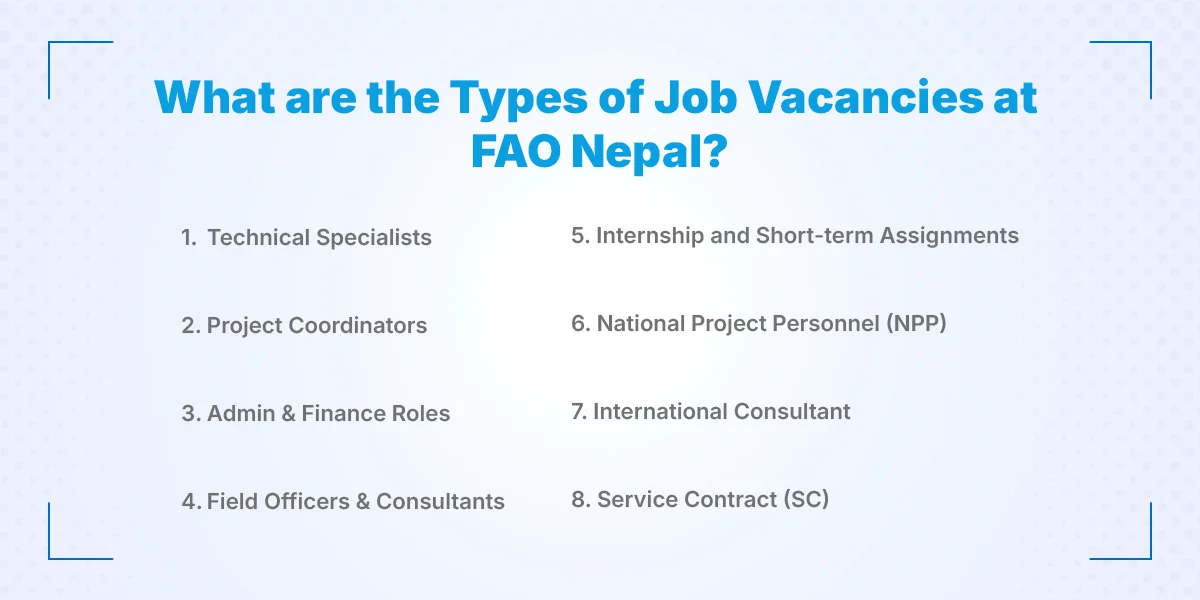
1. Technical Specialists
Technical Specialists are the backbone of FAO projects. These are professionals in agriculture, livestock, forestry, fisheries, food technology, climate change, or food safety who provide deep technical knowledge. At FAO Nepal, they design strategies, develop technical guidelines, and support government policies with evidence-based solutions.
For example, a crop specialist may help improve seed systems across provinces, while a livestock expert may design disease control frameworks. If you are someone who enjoys solving real agricultural problems with science and data, this role carries both responsibility and long-term impact.
2. Project Coordinators
Project Coordinators manage timelines, budgets, reporting requirements, and stakeholder communication. In FAO Nepal, many projects are funded by international donors, so strong coordination and accountability are essential. A coordinator ensures that technical experts, government officials, and field teams work toward one common goal. If you are organized, strategic, and comfortable leading teams, this role allows you to shape how development projects succeed on the ground.
3. Admin & Finance Roles
Admin and Finance professionals may not always be visible in the field, but their work is critical. They handle procurement processes, vendor contracts, payroll, financial tracking, and audit compliance. Since FAO follows strict UN rules and financial standards, accuracy is non-negotiable. In simple terms, finance and accounting position-holders protect the integrity of the organization. If you are detail-oriented and strong with systems and numbers, this role offers stability and strong career credibility within the UN system.
4. Field Officers & Consultants
Field Officers are closest to the community. They travel to districts, interact with farmers, monitor activities, and ensure that project plans are actually working on the ground. Their role requires practical understanding, patience, and strong communication skills. Consultants, on the other hand, are usually hired for specific expertise or short-term tasks, such as conducting an evaluation or drafting a strategy document. Both office and consultant roles are essential because FAO believes development must combine technical knowledge with real field realities.
5. Internship and Short-term Assignments
Internships at FAO Nepal are excellent entry points for students and recent graduates. Interns often assist in research, documentation, data analysis, or coordination tasks. While the role may seem supportive, the exposure is powerful! You learn how international development projects function from inside. Short-term assignments are also common, especially for project-based needs. These internship opportunities help young professionals build confidence and position themselves for larger roles later.
6. National Project Personnel (NPP)
National Project Personnel are professionals recruited locally under specific FAO-funded projects. They understand Nepal’s policies, language, and community systems, which makes them highly valuable. Most FAO Nepal vacancy announcements fall under this category because projects need strong local ownership. NPP roles often combine technical work with coordination and reporting responsibilities. If you want to contribute directly to Nepal’s agricultural transformation while working within an international framework, this path is highly rewarding.
7. International Consultant
International Consultants are experts brought in from different countries to provide specialized technical support. They may work on policy reform, advanced research, or high-level strategy development. Their global experience helps Nepal adopt international best practices. At the same time, they collaborate closely with national teams to ensure solutions fit the local context. These are usually senior-level roles and require significant expertise.
8. Service Contract (SC)
Service Contract roles support the daily functioning of FAO offices. These include positions in administration, logistics, IT, procurement support, and office operations. Although they may seem operational, they are essential for smooth project delivery. Without strong administrative and logistical support, technical teams cannot focus on implementation. For many professionals, SC roles also serve as an entry point into the wider UN system.
How to Apply for FAO Nepal Vacancy?
Applying for a FAO Nepal vacancy requires a strategic and structured approach rather than just submitting a CV online. Many applicants miss opportunities because they don’t know where to search, how to tailor their profile, or how to follow up effectively. This step-by-step guide will show you exactly how to find, apply, and position yourself for success in FAO Nepal job vacancies.
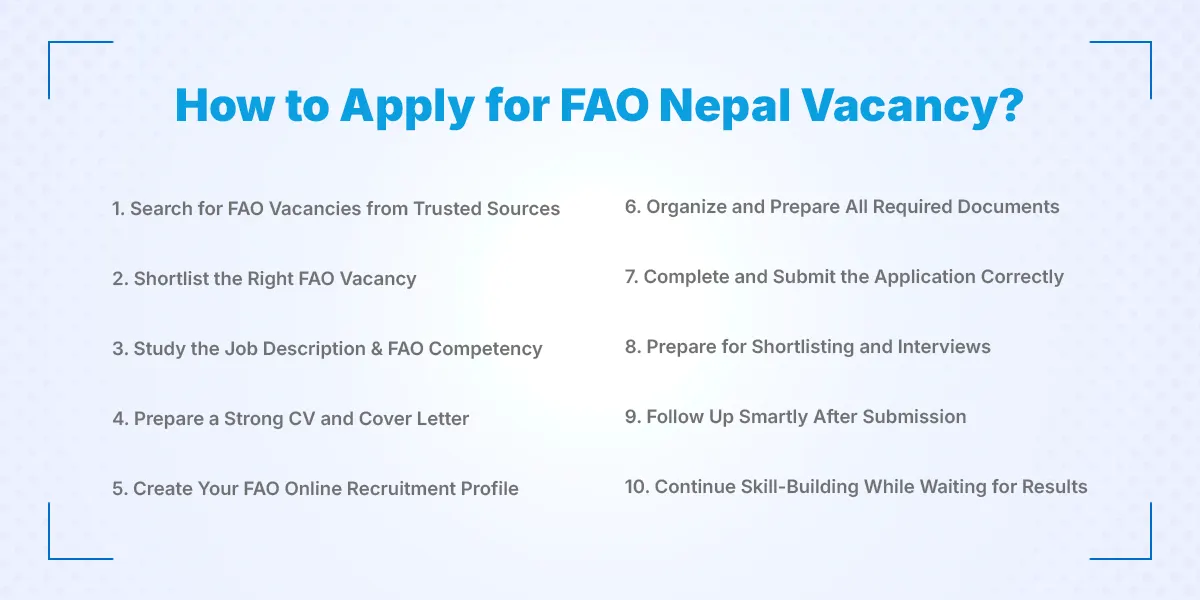
1. Search for FAO Vacancies from Trusted Sources
Start by looking for openings in the right places. The FAO official careers portal is the most reliable source, as it lists verified vacancies and provides complete job descriptions. In addition, check reputed Nepalese job portals like Kumari Job , professional networks like LinkedIn, and development sector groups or forums. Avoid relying solely on social media posts unless you can cross-check the announcement on FAO’s official site.
To ensure prompt application, set up job alerts for keywords like FAO Nepal vacancy, FAO job vacancies in Nepal, or FAO consultant Nepal to stay updated automatically.
2. Shortlist the Right FAO Vacancy
It is not every job posting where your skills and desired career will match. Firstly, study the eligibility criteria to see if you fit the job, the educational requirements, and experience. Your aim should be to apply to jobs where you meet at least 70-80% of the requirements. Just keep your list limited to 2-3 at any given time and focus on the quality of responses over quantity.
3. Study the Job Description & FAO Competency
Recruiters in the FAO use a competency-based recruitment system. This means their selection is centered around both knowledge and competencies. It is essential to read the job description carefully and understand the technical requirements, the need for projects, and specific competencies needed. While doing this, attention should be given to the core competencies of the FAO. Emphasize specific achievements from previous jobs that align with the competency areas that FAO is seeking.
4. Prepare a Strong CV and Cover Letter
Your CV is your first impression, and you should make the best of it. This means that your CV should ideally have an achievement-oriented style. For the cover letter as well, you need to indicate how your skills match the selected FAO job. Just keep everything simple, use bullet points for achievements, and avoid generic descriptions.
5. Create Your FAO Online Recruitment Profile
You see, all applications to FAO are to be submitted through their online application portal. It would be appropriate to register using a valid email ID and fill in all required information correctly. The dates and job designations provided must exactly match those in your resume. The documents, too, must be in pdf format. If you can make time, regularly save your profile details and proofread for typos, etc., before submitting.
6. Organize and Prepare All Required Documents
To apply for most FAO positions, you’ll typically need a CV, an application letter, academic certificates, experience letters, and citizenship identification (if applying for a national position). It is recommended that you prepare a folder with a title containing all your requirements.
7. Complete and Submit the Application Correctly
Make sure you fill out the mandatory fields on the online form carefully and answer the screening questions appropriately. Carefully examine each and every section before you click submit. Never submit the form on the same day; always submit it 2-3 days in advance. Consider saving the email confirming the confirmation email or the application number.
8. Prepare for Shortlisting and Interviews
In case you get shortlisted, the interview may be a competency-based interview. To prepare for this type of interview, you should know how to answer the questions using the STAR method. It is explained as Situation, Task, Action, and Result. Research the projects implemented by the FAO Nepal. Get comfortable articulating your experience and making connections to FAO’s mission and projects.
9. Follow Up Smartly After Submission
Once you have applied, keep your profile updated. FAO rarely gets back to unsuccessful applicants. Repeated emails are not recommended. However, it’s important to keep your skills and your networking relevant and active in this field. If possible, join professional groups and networking sessions related to the FAO to be aware of upcoming opportunities.
10. Continue Skill Building While Waiting for Results
Even at this point, improving your technical knowledge and management skills will enhance subsequent applications. Take short courses in M&E, data analysis, or sustainable agriculture, or get field experience. In fact, take this opportunity to enhance your CV, which can benefit you not only in the present case but also for future jobs at FAO.
Salary and Benefits at FAO Nepal Vacancies
FAO Nepal is renowned for valuing their people. It is because they offer competitive salaries and a range of attractive benefits. A career at FAO Nepal encourages meaningful impact, fair compensation, and extra perks that make your experience rewarding. Following the UN Common System, FAO makes sure all the international, national, and support-level roles are paid transparently and in a standardized manner. Ultimately, your salary and benefits will depend on your position, responsibilities, and local living costs.
1. FAO Nepal Job Categories and Salary Structure
FAO Nepal has three major categories of staff, each of which aims at customizing the position, responsibility, and level of expertise needed. International Professional and Director positions at the P and D level are part of the first category, and these positions are filled on a worldwide basis for a senior or technical position. NCDS suppliants get a net base salary and a post adjustment, which for Kathmandu is about 22.4% for the cost of living.
The second category is National Professional Officers (NO). These positions are locally recruited when they require professional qualifications, e.g., for project coordination or technical support. The salaries for staff at this grade are paid in Nepalese Rupees. The scale is local and takes into account the level of professionalism in the position.
The third category is General Service (GS), which includes administrative and supporting staff. Examples include office management, logistics, and IT services. The staff in this category are also recruited locally and are paid in NPR. Although these positions serve operational purposes, they are actually very crucial for the overall FAO projects to be carried out in a smooth manner,
This structure, hierarchy and categorization ensures fair pay and equity to all levels of staff while considering factors such as the cost of living in those places and the responsibilities associated with each position. It will also help the applicant to understand where their skills and experience can best fit into the organization, namely FAO Nepal.
2. Estimated Salary Ranges at FAO Nepal (Net Annual)
FAO Nepal salaries range from around NPR 5.8 lakhs per year for entry-level support staff (G-1) to over USD 143,000 per year for senior international professionals (P-4). Pay depends on grade level, job responsibility, and whether the role is international or national. FAO follows the UN common salary system, ensuring structured pay scales and transparent grade classifications.
Below are approximate net annual salary ranges for common roles at Food and Agriculture Organization in Nepal:
| Position Type | Grade | Estimated Net Annual Salary |
|---|---|---|
| International Professional | P-4 (Senior) | $111,347 – $143,559 |
| International Professional | P-2 (Mid-level) | $70,577 – $95,861 |
| National Officer | NO-B | ~NPR 35,38,000 (~$24,500) |
| General Service | G-7 (Top Support) | ~NPR 28,37,136 |
| General Service | G-1 (Entry Support) | ~NPR 5,82,163 |
3. Key Benefits & Allowances at FAO Nepal
Food and Agriculture Organization (FAO) offers benefits that go beyond salary, making these roles highly attractive for professionals seeking career growth and stability:
- Family Support: This includes dependency allowances for spouses and children. International staff have the opportunity for an Education Grant, covering up to 75% of education costs for children.
- Relocation (International Staff Only): Encompasses an assignment grant to cover moving expenditure and the shipment of personal effects, including rental subsidy on housing at high rates.
- Leave & Time Off: You get up to 30 days of annual leave, along with 10 paid public holidays. Maternity, paternity, and adoption leave are fully paid.
- Social Security: Involvement with the UN Joint Staff Pension Fund and co-shared health and dental insurance plans ensure security.
- Home Leave (International Only): Provision of funds for periodic home visits.
These benefits ensure not only financial stability but also work-life balance, career development, and family well-being, making FAO a very satisfying place to work.
Why Work at FAO Nepal?
Working in the FAO Nepal office will provide the chance to develop your career and contribute directly to the country's agricultural and rural development sectors. The organization provides the chance to work alongside international experts and gain exposure at the policy level. At the same time, your work will provide great credibility, giving you the chance for future growth in the sector.
1. Contribute to Food Security and Rural Development
You have to work with projects led by FAO Nepal, which aim to improve farming practices, increase food production, and support climate resilience. Your contribution to your job ensures reinforcing rural livelihoods and influences specific farmers and countries. Each project offers concrete results to support communities and countries.
2. Work with International Experts
At FAO, you are able to work with other professionals worldwide, giving you access to worldwide knowledge and work experience. Mentorship and access to worldwide best practices improve your technical and professional expertise. It also opens your opportunities in the international development community.
3. Strong Career Credibility
FAO is an organization well recognized globally, and working with the UN is seen as prestigious, which will give you brownie points on your resume. The organization is also greatly valued by potential employers in terms of experience, especially in terms of FAO projects.
4. Exposure to Policy-Level Impact
Several projects undertaken by the FAO impact national agriculture, food security, and rural development strategies. The staff involved get an opportunity to observe and add input into policy formulation and project development. This is a perfect way to look beyond working in the field.
Important Tips to Land a Job at FAO Nepal
If you are looking for a job at the Food and Agriculture Organization (FAO) in Nepal, you basically need to make sure you are a good match for the organization in terms of having some level of technical expertise in agrifood systems and meeting the core values, but your chances of getting the job are actually based on the ability you exhibit in reflecting the job requirements, while simultaneously reflecting your interest in the development of the country. Sounds tough, huh? But trust me, getting an appointment for a job position at FAO in Nepal is actually within your reach. Let's take a step-by-step guide on how you can make it:
1. Customizing Your Profile Using FAO Keywords
When filling out your profile on the online recruitment portal operated by the FAO, avoid the temptation to cut and paste your old resume. These systems, as well as the recruiters, like to see specific terms under "Professional Areas" such as "Food Security," "Climate Change," or "Project Management." Always use the drop-down boxes provided on the recruitment portal for your work history, whenever possible, as this allows the recruiters to see your background directly in relation to their strategic plan.
2. Master the STAR Method for Competency-Based Interviews
FAO Nepal prioritises competency-based interviews. This means, they want to hear your stories about how you overcame problems in the past. If you want to give a fantastic response to a question, you should use the STAR method to bring up a Situation, a Task you had to perform, an Action you took, and a Result you achieved. It is always a good idea to prepare a set of stories that you can use to respond to almost any question. This makes you versatile. For this, prepare three or four stories from your work experience beforehand. Your story must demonstrate your teamwork, communication, and problem-solving skills.
3. Highlight Your Local Context and Technical Depth
Working with the FAO in Nepal is different because it needs both international standards and grassroots sensibilities. While applying and interviewing with the FAO, try to narrate your experiences of working under the government of Nepal, many cooperatives of Nepal, or the varied population of Nepal. If you can demonstrate your familiarity with the agricultural scenario of Nepal from the Terai belt to the hill areas, it only means that not only will you be able to do the job, but you will be
4. Verify Your Academic Credentials Early
One of the not-so-well-known technicalities that tends to catch newbies off guard is the need to have "accredited" degrees. Note that FAO will only accept degrees from universities accredited by the World Higher Education Database. Before you even send your application, it is always a good idea to check and confirm if your university is accredited by this body to avoid sending your application to oblivion. This piece of homework will spare you a great number of headaches and demonstrate your diligence and professional level of understanding of processes.
Conclusion
Therefore, to conclude this article, we have managed to cover the various job categories that are available at the FAO Nepal office, the application process, and the tips on how your profile will stand out. From the competency interview to ensuring your academic documents are valid, we are dealing with the small hinges that swing the big doors.
But then again, apart from the technicalities, remember that FAO is seeking an individual whose heart beats for the farmers and people in Nepal. Well, you do have the technical qualities and the passion, and now you have the roadmap to channel these qualities effectively. Remember, every talent out there was once an individual who chose to take the first bold step towards a higher calling, and you don't want anything to keep you from having that career that truly counts. Yes, take a minute today and create your job profile on the career portal, applying for that dream role that will kick-start a journey toward a hunger-free Nepal for you.
Frequently Asked Questions
Submit your comments

Get Our App On



What is the Public Relations Officer Salary in Nepal
VIEW DETAILS
What Is the Salary of a Ticketing Officer in Nepal?
VIEW DETAILS
What Is the Salary of a Travel Consultant in Nepal?
VIEW DETAILS
How to Become an Auditor in Nepal
VIEW DETAILS


Loading Comments...