




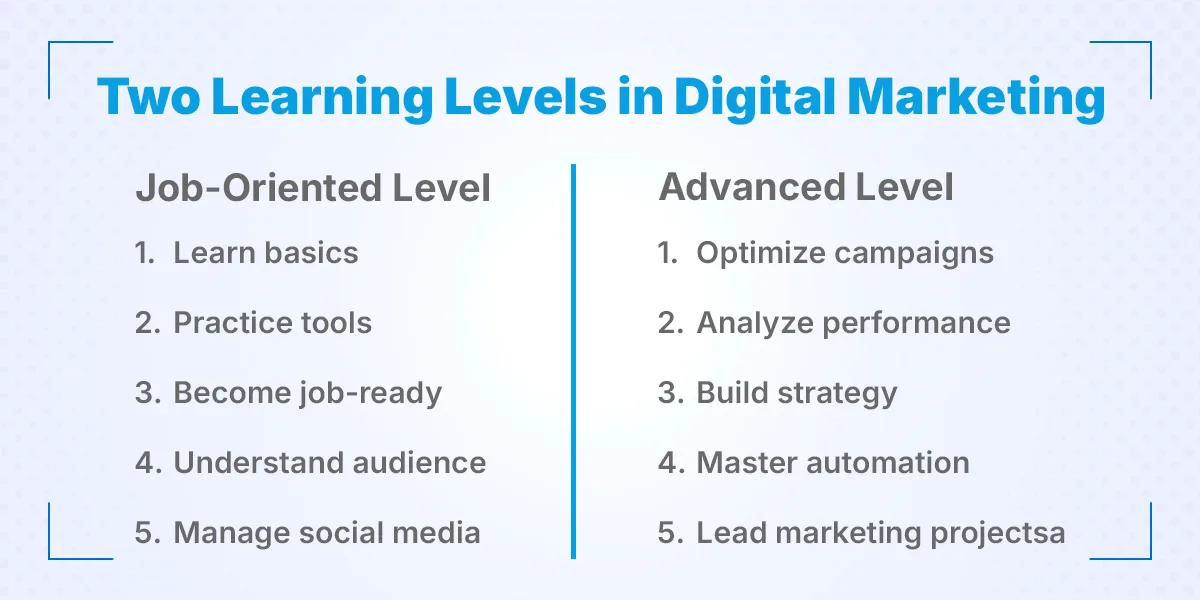
Digital marketing has become one of the most in-demand skills in today’s fast-paced business world. If you are planning to upskill your digital marketing abilities in 2026, it’s important to understand the right path for your career. There are two main levels of courses you can take: job-oriented courses for beginners, which focus on practical skills, and advanced courses for professionals, which teach strategy, analytics, and campaign optimization. Choosing the right level ensures you learn the skills that align with your knowledge and career goals.
This guide breaks down the differences between job-oriented vs advanced digital marketing course levels, the skills you’ll gain, potential career outcomes, and salary expectations in the context of Nepal. Whether you want to start from scratch with hands-on experience or enhance your existing skills for strategic roles, this guide will help you make an informed decision to choose the best training programs in Nepal. By the end, you’ll be ready to confidently step into the world of digital marketing.
In this blog
What are Job-Oriented Digital Marketing Courses in Nepal?
Job-oriented digital marketing courses are designed to give you practical skills you can use immediately in the workplace. Instead of focusing only on theory, these courses teach you how to work with real marketing tools, run campaigns, and measure results. By the end of the program, you’ll be ready to take on entry-level jobs or freelance projects with confidence.
This course is perfect if you are:
- A beginner looking to start a career in digital marketing
- A student who wants practical skills to add to your resume
- +2 or SEE-passed student trying to learn a new skill
- A professional thinking about switching to marketing
- A freelancer aiming to offer marketing services to clients
In short, if your goal is to learn fast, gain practical experience, and start working, this course fits you perfectly.
What Skills You Learn at the Job-Oriented Marketing Training
At the job-oriented level, the focus is on foundational skills that make you job-ready. The course combines theory with hands-on practice, so you don’t just learn concepts, you apply them in real-world scenarios. By the end of the program, you will be able to:
- Understand digital marketing basics such as SEO, social media, and email campaigns
- Use key tools like Google Analytics, Facebook Ads, and Canva
- Create campaigns and content that engage real audiences
- Target the right customers and measure results effectively
- Run ad campaigns on social media and Google Ads
- Analyze performance data to see what works and what doesn’t
- Collaborate with a marketing team or manage freelance projects independently
With these skills, you can confidently apply for entry-level digital marketing jobs or start freelancing for clients, giving your career a strong first step. This approach ensures you learn by doing, preparing you for real opportunities from day one. If you take this course seriously, you’ll walk away ready to start earning, growing, and exploring your career in the digital world.
Join Job-Oriented Digital Marketing Classes Today!
What are Advanced Digital Marketing Courses in Nepal?
Advanced digital marketing courses are designed for learners who already have a basic understanding of marketing and want to take their skills to the next level. These programs focus on strategy, optimization, and data-driven decision-making. You’ll learn how to run complex campaigns, measure performance deeply, and create long-term growth strategies for businesses or clients. By the end of the course, you won’t just execute marketing tasks, you’ll lead projects and make strategic marketing decisions confidently.
This course is ideal if you are:
- A digital marketer who wants to advance your skills and take on bigger responsibilities
- A freelancer looking to offer advanced marketing services to clients
- A graduate or fresher willing to upskill to gain confidence
- A business owner or manager wanting to optimize marketing efforts for better ROI
- Someone aiming for specialized roles like SEO strategist, PPC manager, or analytics expert
In short, if your goal is to move beyond basics and become a marketing expert, this course is for you.
What Skills You Learn at the Advanced Digital Marketing Classes
At the advanced level, the focus is on strategy, analysis, and optimization. You will gain the skills to plan, execute, and improve marketing campaigns that deliver measurable results. By the end of the program, you will be able to:
- Optimize campaigns for better performance across channels like Google Ads, Facebook, and LinkedIn
- Analyze marketing data to make informed decisions and improve ROI
- Build and implement strategies for social media, content, and email marketing
- Master automation tools to streamline campaigns and save time
- Run A/B tests and experiments to identify the most effective marketing tactics
- Lead marketing projects or manage a team to execute campaigns efficiently
- Measure success using KPIs and analytics reports to demonstrate real impact
With this stack of digital marketing skills, you can confidently take on advanced roles in marketing teams, manage your own campaigns, or offer high-value freelance services. This hands-on, strategy-focused approach ensures you’re making data-driven decisions that drive real results. If you take this course seriously, you’ll finish ready to command higher-level roles, manage bigger campaigns, and achieve tangible business outcomes.
Join Advanced Digital Marketing Classes Today!
Key Differences Between Job-Oriented and Advanced Digital Marketing Courses
The key difference between job-oriented and advanced digital marketing courses lies in their focus and depth of learning. Job-oriented courses teach foundational skills and practical tasks, while advanced courses emphasize strategy, analytics, and optimization for complex campaigns. Understanding these differences helps you choose the right course and sets the stage for exploring specific factors like skills, tools, and career outcomes.
1. Entry Skill Requirements
Job-oriented courses are designed for beginners, so they don’t require prior marketing knowledge. You can start even if you have no experience in digital marketing. On the other hand, advanced courses assume you already know the basics and have some hands-on experience. This means advanced learners are ready to focus on strategy, analytics, and optimization instead of learning fundamentals.
2. Depth of Curriculum and Complexity
Job-oriented courses focus on core skills and practical tasks, keeping the learning straightforward. They cover essential tools, social media, SEO, and email marketing without going too deep. Advanced courses, however, dive into complex topics like multi-channel strategy, data analytics, and marketing automation. This deeper curriculum requires careful attention and practice to fully understand how each component affects results.
3. Focus on Execution vs Strategy
In job-oriented courses, the emphasis is on executing marketing tasks efficiently. You learn how to run campaigns, create content, and manage tools step by step. Advanced courses shift the focus to strategy, decision-making, and campaign optimization, helping you plan campaigns that deliver measurable results. Essentially, one teaches you how to do it, while the other teaches you how to lead and improve it.
4. Tools, Platforms, and Technology Exposure
Beginners are introduced to essential tools like Canva, Google Analytics, and basic ad platforms to get started quickly. The exposure is practical but limited to what’s needed for daily tasks. Advanced courses go further, covering advanced analytics software, automation tools, A/B testing platforms, and multi-channel management systems. This allows learners to handle complex campaigns and analyze performance like a pro.
5. Practical Training and Real-World Application
Job-oriented courses emphasize hands-on practice with small campaigns and sample projects, giving learners confidence to take entry-level roles. You learn by doing, but the scale and complexity are limited. Advanced courses involve larger projects, real-world scenarios, and strategy planning, simulating professional marketing challenges. This approach prepares learners to handle real campaigns and make data-driven decisions that impact business outcomes.
6. Learning Curve and Time Commitment
Job-oriented courses have a gentle learning curve, allowing beginners to grasp concepts quickly and start applying them immediately. They usually require a shorter time commitment compared to advanced programs. Advanced courses demand more time, focus, and effort, as learners need to understand complex strategies, analyze data, and optimize campaigns. The investment is higher, but the skills gained open doors to senior-level roles and high-value freelance opportunities.
Comparison: Job Oriented vs Advanced Digital Marketing Courses in Nepal
| Job-Oriented Course | Advanced Course |
|---|---|
| No prior experience needed; beginner-friendly | Requires basic marketing knowledge and some hands-on experience |
| Covers fundamentals: SEO, social media, email marketing | Covers complex topics: multi-channel strategy, analytics, automation |
| Execution: run campaigns, create content | Strategy: plan campaigns, optimize performance, lead projects |
| Basic tools: Canva, Google Analytics, Facebook Ads | Advanced tools: automation, A/B testing, multi-channel management |
| Small campaigns, sample projects | Large projects, real-world scenarios, strategy planning |
| Gentle learning curve, shorter duration | Steeper learning curve, longer duration, more effort required |
How to Choose the Best Digital Marketing Course for You?
Choosing the right digital marketing course starts with understanding your current knowledge, career goals, and learning preferences. It’s important to assess where you stand, what you want to achieve, and how much time you can dedicate. These steps will guide you toward a course that matches your needs and sets you up for long-term success, leading naturally into a closer look at each factor.
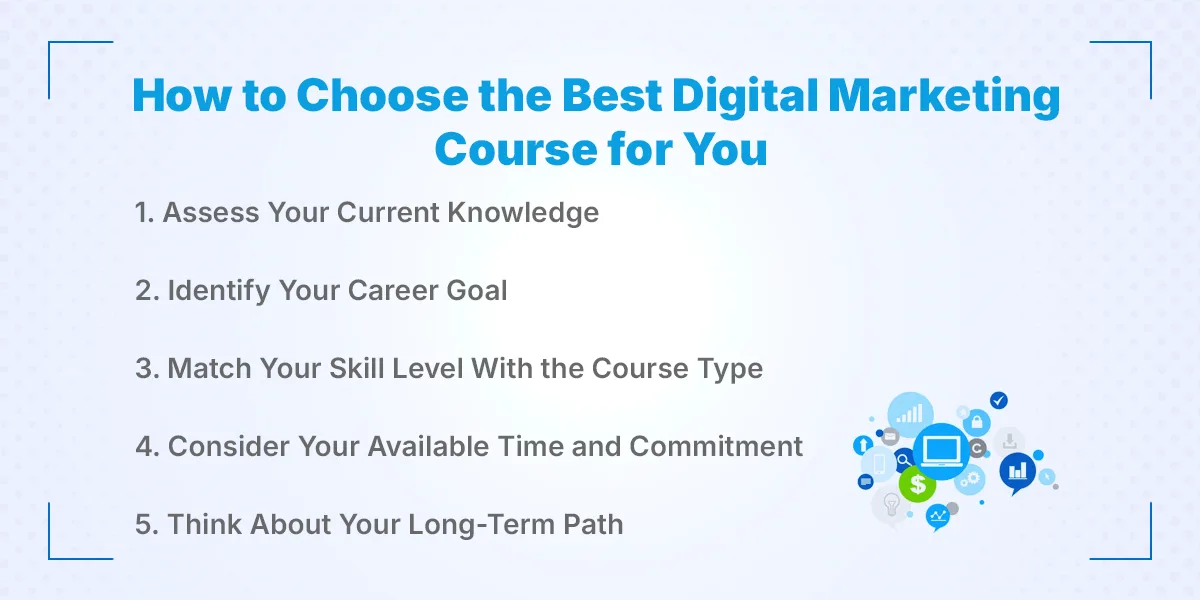
1. Assess Your Current Knowledge
Before picking a course, take a clear look at what you already know about digital marketing. If you are a complete beginner, a job-oriented course will help you learn the basics and gain hands-on experience. If you already have some experience or have completed a basic course, an advanced program can help you develop strategic and analytical skills. Knowing your starting point ensures you don’t waste time on material that’s too easy or too advanced.
2. Identify Your Career Goal
Next, think about what you want to achieve with the course. Are you aiming for an entry-level marketing role, or do you want to manage campaigns, lead teams, or start freelancing? Your career goal will determine whether you need a job-oriented or advanced course. By defining your end goal first, you can choose a program that directly builds the skills needed to reach it.
3. Match Your Skill Level With the Course Type
Once you know your knowledge and goals, match them to the right course type. Beginners should start with job-oriented courses to build practical skills step by step. Those with some experience can focus on advanced courses that teach strategy, optimization, and analytics. This ensures your learning is challenging but achievable, helping you progress without feeling overwhelmed or bored.
4. Consider Your Available Time and Commitment
Your schedule plays a major role in choosing a course. Some programs are short and intensive, perfect if you want quick results, while others are longer and more in-depth, requiring consistent effort over months. Consider how much time you can realistically dedicate each week and choose a course that fits your lifestyle. Planning this upfront prevents burnout and helps you stay consistent until completion.
5. Think About Your Long-Term Path
Finally, consider how this course fits into your long-term career journey. Will it prepare you for future promotions, freelancing opportunities, or specialized roles like SEO strategist or campaign manager? Courses that offer scalable skills and certifications can add value even years later. By thinking ahead, you ensure your investment in learning continues to pay off well beyond the course itself.
Career Outcomes After Completing Digital Marketing Course
Career outcomes after completing a digital marketing course vary based on the level you choose, with job-oriented courses preparing you for entry-level roles and advanced courses opening doors to strategic and leadership positions. Job-oriented programs focus on practical execution, while advanced courses emphasize strategy, analytics, and campaign optimization to boost career growth. Understanding these key differences helps you decide which course aligns with your goals, setting the stage for a deeper look at each pathway.
1. Common Entry-Level Roles After a Job-Oriented Course
Completing a job-oriented digital marketing course equips you with practical skills to start your career immediately. You can apply for roles such as Social Media Executive, SEO Assistant, Email Marketing Coordinator, or Content Creator. These positions allow you to gain hands-on experience, work with real campaigns, and understand how digital marketing functions in a professional environment. Starting with these roles gives you a strong foundation to grow into higher-level positions or specialize later.
2. Career Paths After an Advanced Digital Marketing Course
Advanced courses prepare you for more strategic and high-responsibility roles. You can pursue positions like Digital Marketing Manager, SEO/SEM Specialist, Marketing Analyst, or Campaign Strategist. These roles require a deeper understanding of analytics, automation, multi-channel strategy, and team collaboration. Completing an advanced course can accelerate your career growth, helping you move into leadership or specialized positions faster than with entry-level experience alone.
3. Freelancing and Independent Work Opportunities
Both job-oriented and advanced courses open doors to freelancing and independent work. Beginners can start by offering social media management, content creation, or basic ad campaigns for small clients. Advanced learners can take on larger projects, strategy planning, analytics reporting, or full-scale campaign management for businesses. Freelancing allows you to build a flexible career, earn independently, and continuously improve your skills while exploring diverse industries.
Digital Marketing Salary Expectations and Career Growth
Digital marketing salaries vary based on experience, skills, and the role you take. Entry-level positions usually offer modest pay, while advanced skills and strategic expertise can significantly increase your earning potential. Understanding these expectations helps you see how different courses can impact your career growth and long-term opportunities.
1. Starting Salary Expectations at Entry Level in Nepal
After completing a job-oriented digital marketing course in Nepal, entry-level roles usually offer a starting salary that reflects practical skills but limited experience. Typically, beginners can expect around NPR 25,000–50,000 per month for full-time positions, depending on the company and location. Freelancing opportunities in Nepal can provide additional flexible income, which varies based on projects, client budgets, and niche demand. While the starting pay may seem modest, it gives you a strong platform to gain experience and grow into higher-paying roles quickly.
2. Growth Potential With Advanced Skills in Nepal
Advanced digital marketing skills in Nepal can significantly increase your earning potential over time. Professionals with expertise in analytics, strategy, campaign optimization, and automation can move into roles like Digital Marketing Manager, SEO Specialist, or Marketing Analyst, often earning NPR 80,000–200,000+ per month, depending on the company and experience. Freelancers with advanced skills can charge higher rates for full-scale campaigns, strategic consulting, or multi-platform projects. By investing in advanced learning, you not only boost your salary but also open doors to long-term career growth, leadership roles, and specialized opportunities within Nepal and even abroad.
Conclusion
Choosing the right digital marketing course is the first step toward building a rewarding and future-ready career. Whether you start with a job-oriented course to gain practical experience or take an advanced course to master strategy and analytics, each path equips you with valuable skills that open doors to real opportunities.
Assess your current knowledge, set clear goals, and commit to learning. It is not impossible to find your dream marketing job, grow into leadership positions, or even launch your own freelance career.
Remember, digital marketing is a dynamic field. Continuous learning and hands-on practice will keep you ahead, helping you achieve both professional success and personal growth.
Frequently Asked Questions
Submit your comments

Get Our App On


What is the Public Relations Officer Salary in Nepal
VIEW DETAILS
What Is the Salary of a Ticketing Officer in Nepal?
VIEW DETAILS
What Is the Salary of a Travel Consultant in Nepal?
VIEW DETAILS
How to Become an Auditor in Nepal
VIEW DETAILS


Loading Comments...