



In August 2025, the Nepal government announced that all global social networks must officially register in Nepal or be blocked. Under the new directive, popular apps like Facebook (Meta), Instagram, X (formerly Twitter), YouTube, WhatsApp, and others must set up local offices and appoint Nepali representatives within a strict deadline.
In this blog, we will explore what the government announced, the reason behind it, which platforms are affected, why tech giants are hesitating to register, and what all this means for Nepali users and businesses.
In this blog
What Did the Nepal Government Actually Announce?
The Ministry of Communication and Information Technology (MoCIT) issued an ultimatum: within seven days (by September 3, 2025), any social media company operating in Nepal must register under Nepal’s Social Media Operation Directive 2080. Otherwise, the platforms will be blocked nationwide. The rules require each company to form a Nepalese legal entity, set up an office, and appoint a local compliance/grievance officer.
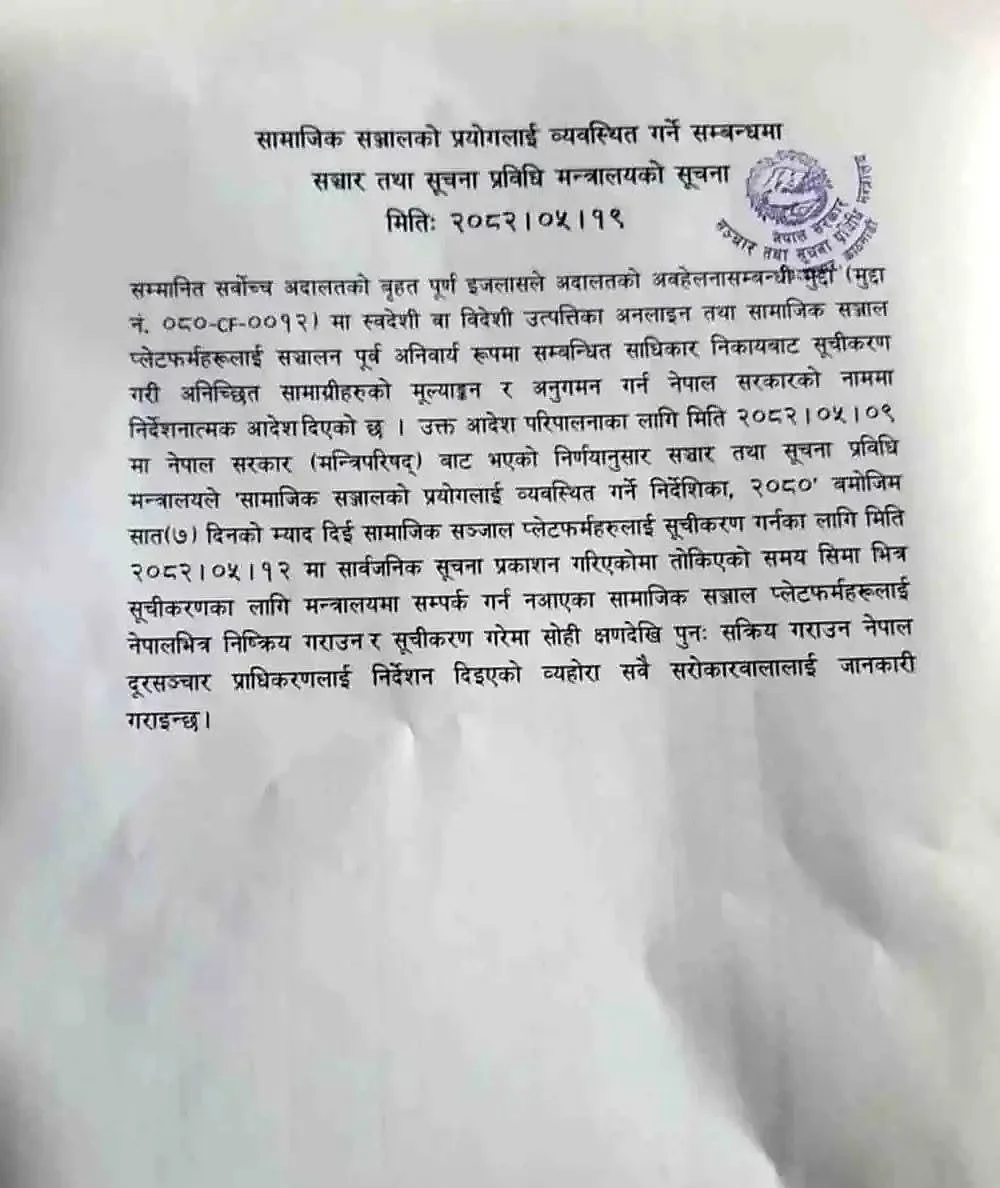
The deadline was strict as MoCIT officials warned, failure to register “will automatically lead to a shutdown” of that service in Nepal. So far (late Aug, early Sept 2025), only a few platforms have complied: TikTok’s parent ByteDance and Viber registered, and Telegram, which had been previously banned, has entered the registration process. Major players like Meta’s Facebook/Instagram and Alphabet’s YouTube have not responded. In fact, Meta publicly refused, arguing that Nepal lacks proper laws and objecting to provisions (such as mandatory content takedowns on government orders). The Nepali government now points to a recent Supreme Court order to back up its rules, essentially making the registration demand legally binding.
Why Did the Government Decide to Ban Social Media Apps?
Nepali authorities decided to ban the social media apps for several reasons, such as accountability for harmful content. Officials blame social networks for enabling fake news, hate speech, scams, and election manipulation without local oversight. For example, a Nepali research article noted that platforms bring “serious risks, including misinformation, online harassment, and foreign dominance of advertising,” all with little recourse for Nepali users. By forcing companies to register, the government aims to make them subject to Nepali law, requiring them to delete illegal posts on demand and cooperate with vinvestigators This echoes a global trend: India’s new IT Rules (2021) similarly compel large social networks to appoint local compliance officers with physical offices, and the EU’s Digital Services Act holds platforms accountable for illegal content and user safety. Nepal is following suit to assert “digital sovereignty”.
Economic motives also play a role. Nepal worries that it currently loses advertising revenue to foreign tech giants. A central bank study found that Nepali businesses spend millions on online ads each year (in foreign currency) while the platforms pay almost no taxes locally. By mandating registration, the government hopes to start taxing social media ad revenue and plugging that revenue leak. In the words of a Nepali minister, this is about reclaiming transparency and user protection over Nepal’s internet space.
Data privacy and security are related concerns. Nepal currently lacks a comprehensive consumer protection law, and experts warn that unregistered platforms are largely unaccountable for data breaches of Nepali users. For instance, a think-tank report notes that because most global apps aren’t registered, Nepali citizens have little legal recourse when their data is misused. Forcing foreign platforms to localize gives Nepal a means to enforce its own privacy rules and national security needs. This mirrors steps taken by larger economies: India’s new data protection laws and the EU’s GDPR both push data localization and stricter privacy safeguards.
Finally, Nepal points to regional examples. Neighboring countries have taken similar measures on content and compliance. During its 2023 TikTok ban, Nepal cited “social disharmony, hatred, explicit content” as reasons. Other countries like Pakistan, Myanmar, and Russia have temporarily blocked platforms, like Facebook, X, or TikTok, over political or moral concerns. These precedents show that governments often justify bans by citing public order or security. In sum, Nepal’s stated rationale is a mix of curbing harmful content, enforcing its sovereignty, securing tax revenue, and protecting user data, much as India and the EU have done with their own tech regulations.
सामाजिक सञ्जाललाई दर्ता हुन आउनुहोस् भनेर हामीले धेरै अगाडीबाट भनिरहेका थिएउ तर आउनु भएन। सुचिकरण गर्न १ पैसा पनि लाग्दैन तर उहाँहरु आउनु भएन। त्यसैले सुचिकरण नभएका सामाजिक सञ्जालहरु आजबाट नै बन्द गर्छौं।
— Information Minister Prithvi Subba Gurung
Why Haven’t Social Media Apps Registered in Nepal?
Global tech companies have largely ignored Nepal’s orders so far. Cost and market size are big factors. Opening an office, hiring staff, and complying with local rules entail expenses that companies reserve for major maintenance. Nepal’s internet population is small and has low ad revenue compared to giants like India or the US. Indeed, The Diplomat reports that YouTube’s country lead admitted “Nepal… is not a priority” for Alphabet/YouTube due to its relatively low CPM (ad rate). In other words, these companies focus on big markets first, and a Nepalese office offers little return on investment.
Legal conflicts are another reason. Meta has publicly said Nepal’s directive clashes with its global policies. Meta refused registration on the grounds that Nepal lacks proper laws and that certain demands (like deleting content on any government order) have “no legal basis,” making compliance “impossible”. Other platforms have silently shrugged and stayed off the radar. According to The Diplomat, after TikTok (with conditions) and Viber registered, no major Western platforms even engaged with Nepali authorities; Facebook, Instagram, YouTube, and X have “yet to respond” to multiple summons. In short, the tech giants may be unwilling to comply due to political exposure, legal uncertainty, and scant business incentive in a smaller economy.
Which Social Media Apps are Banned in Nepal?
The government’s directive covers virtually all major global platforms. In effect, any service that hasn’t registered could be blocked. That list explicitly includes:

Nepalis widely use each of these, and none has formally registered in Nepal. (So far, only TikTok and Viber have done so.) In short, all large U.S. and Chinese social/messaging platforms are on notice. If the law is enforced strictly, even Google services like Gmail or Search could be targeted, though officials admit banning those would disrupt state operations. But as written, the list is sweeping: any unregistered social-networking app in Nepal’s market could face a shutdown.
What Happens If Social Media Gets Banned in Nepal?
A ban on major platforms would have immediate and painful effects for Nepalis:
- Users lose access to networks: Ordinary people would suddenly be cut off from friends and communities on those apps. Popular feeds, family chats, and groups would vanish overnight, leaving users scrambling for alternatives.
- Content creators lose income: Many Nepalis earn money through their online content (ads, sponsorships, Facebook’s new monetization programs, etc.). A ban “could adversely affect” these revenue sources. Creators who built audiences on Facebook, YouTube, or TikTok would see their earnings drop to zero.
- Businesses lose advertising reach: Small shops and startups that rely on Facebook/Instagram ads to find customers would see their marketing abruptly halted. E-commerce sellers, restaurants, tourism services, and service providers would struggle to engage users. Local firms would likely rush to alternative channels (search ads, SEO, offline media), but transition takes time.
- Internet traffic patterns spike: To bypass blocks, many users will turn to VPNs or DNS workarounds. This could overload Nepal’s international bandwidth, slowing down the internet. One analyst warns that sudden VPN usage could congest networks, degrade speed, and even raise broadband costs.
- Security and privacy risks rise: Relying on free VPN apps to reach banned sites exposes users to malware or data theft. Without proper guidance, ordinary people might use unsafe VPNs, compromising their personal information.
- Democratic and social impact: Nepal’s media and civil society heavily use social media to circulate news and opinions. A study in The Diplomat notes that hundreds of Nepali news outlets and public agencies now depend on social platforms, so cutting them off “might hinder democratic values”. In past bans (like the 2023 TikTok ban), Nepalis expressed frustration that their ability to organize, share culture, and speak freely was curtailed.
In practice, officials have hinted that some services may be selectively exempted to avoid chaos (e.g., keeping Gmail or Google search alive for government use). But for regular users, a ban would mean VPNs become commonplace. Every Nepali netizen would likely scramble to find workarounds, tech-savvy users already mock potential restrictions as ineffective without VPNs. Overall, the immediate outcome would be disruption: social feeds silenced, online businesses frozen, and a surge in blackout workarounds.
How Will This Impact Businesses and Digital Marketing in Nepal?
The marketing sector would have to shift rapidly. Small businesses and advertisers would lose their cheapest and most effective channels. A telecom news analysis warns that Nepali SMEs rely on social ads to engage customers, and cutting that off leaves them “at a loss”. In response, companies would likely reallocate budgets to search-engine ads, improve their own websites, or invest in local online platforms. Digital agencies might push SEO, email marketing, and content on regional apps instead of Facebook.
Local marketing tools and offline media would see a boost. For example, tourism promoters who use Instagram and TikTok to showcase Nepal’s sights would suffer: ironically, TikTok agreed to Nepal’s conditions partly to help “promote tourism”. Without those global platforms, the tourism board and hotels would have to rely on travel websites and international partners for visibility. Similarly, political campaigns and NGOs that leverage social media would have to resort to radio, TV, or grassroots outreach.
The economic impact could be significant. The Diplomat pointed out that disrupting social media could undermine thousands of jobs, from content creators and online retailers to marketing freelancers. Businesses will spend extra to rebuild their online presence on smaller platforms or even develop their own apps. In the long run, the uncertainty might deter foreign investment in Nepal’s digital economy.
In short, a ban would force Nepali businesses to adapt quickly: replacing social media with SEO, local apps, or traditional marketing. It may also spur new domestic solutions. But experts warn that the change won’t be seamless. Many fledgling companies currently depend on social networks for growth, so the transition will be rocky. Tourism in particular, a sector that has increasingly used social media to reach youth, could see a slowdown if those channels disappear.
What Are the Alternatives for Users If Social Media is Banned?
If global platforms like Facebook, Instagram, or YouTube suddenly vanish from Nepal, people won’t just stop connecting online. They’ll search for other ways to chat, share, and stay entertained. Some apps are already well-rooted here, while others are newer players trying to fill the gap.
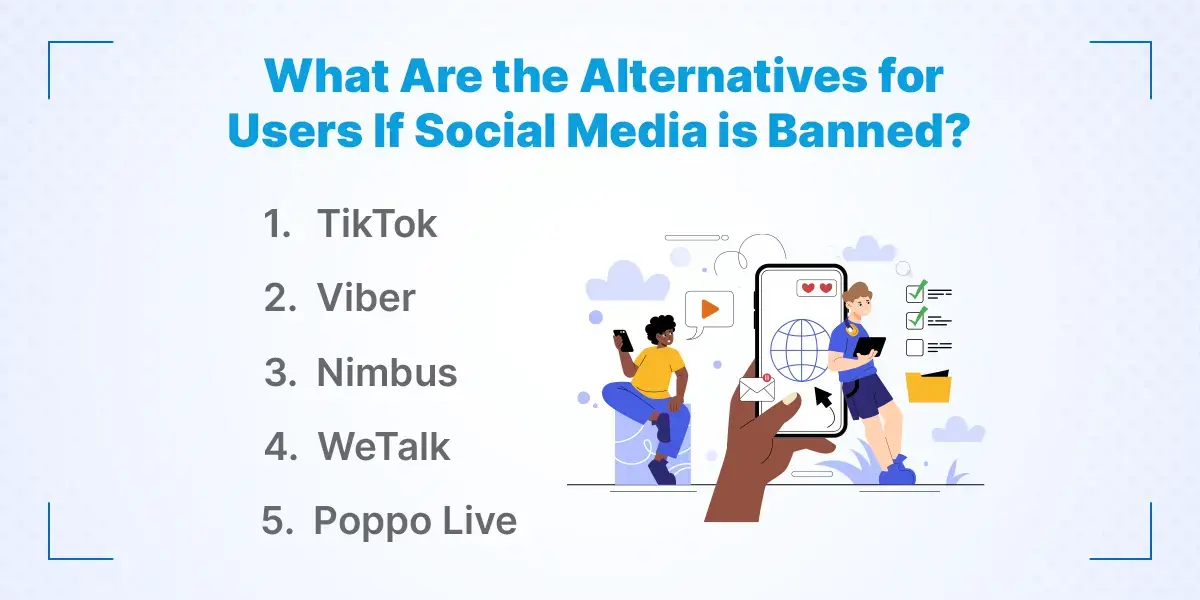
1. TikTok
Despite facing its own challenges, TikTok remains one of the most loved apps in Nepal. Its short videos, trends, and entertainment value make it a daily habit for millions. If it avoids the ban, TikTok could become the single biggest outlet for creators and audiences.
2. Viber
Viber has been a trusted app for messaging and voice calls in Nepal for years. Families, students, and even small businesses use it every day. If other platforms get blocked, Viber could grow even more as the go-to option for communication and group networks.
3. Nimbus
Nimbus is a homegrown Nepali app designed with local users in mind. It’s still building its user base, but in a scenario where foreign apps shut down, Nimbus could gain momentum quickly. Being made in Nepal, it also fits with the government’s push for local digital platforms.
4. WeTalk
Another Nepali alternative, WeTalk, focuses on messaging and calling services. It may not yet match the features of global giants, but it offers a safe and locally managed space for users. With the right updates, it could step into the spotlight if bans take hold.
5. Poppo Live
Poppo Live is growing fast as a live streaming and social app. Many Nepali creators are already experimenting with it as an alternative space to connect with fans. If global apps disappear, Poppo could turn into a hotspot for live interaction and entertainment.
Conclusion
Nepal’s social media ultimatum has put the country’s digital future at a crossroads. On one hand, if major platforms comply and register, Nepali users and businesses can carry on mostly as before (albeit with more local oversight and possibly new taxes on online ads). On the other hand, if companies refuse and get banned, Nepal will face weeks of disruption: blocked apps, scrambling for VPNs, and social-media-driven businesses losing their lifeline. The safest course for individuals and firms is to prepare for both scenarios. Businesses should begin diversifying their marketing (building websites, engaging on local platforms) and backup communication channels now.
Users may want to set up legal VPN subscriptions or learn to use new apps. In any case, Nepal’s gamble on hardline regulation marks a turning point: social media in the country can either adapt to new rules or be forced out. The coming weeks will tell which path Nepal takes, but one thing is clear: the social media landscape in Nepal is no longer the same, and everyone should stay alert to the changes.
Frequently Asked Questions
Submit your comments

Get Our App On



What is the Public Relations Officer Salary in Nepal
VIEW DETAILS
What Is the Salary of a Ticketing Officer in Nepal?
VIEW DETAILS
What Is the Salary of a Travel Consultant in Nepal?
VIEW DETAILS
How to Become an Auditor in Nepal
VIEW DETAILS


Loading Comments...