


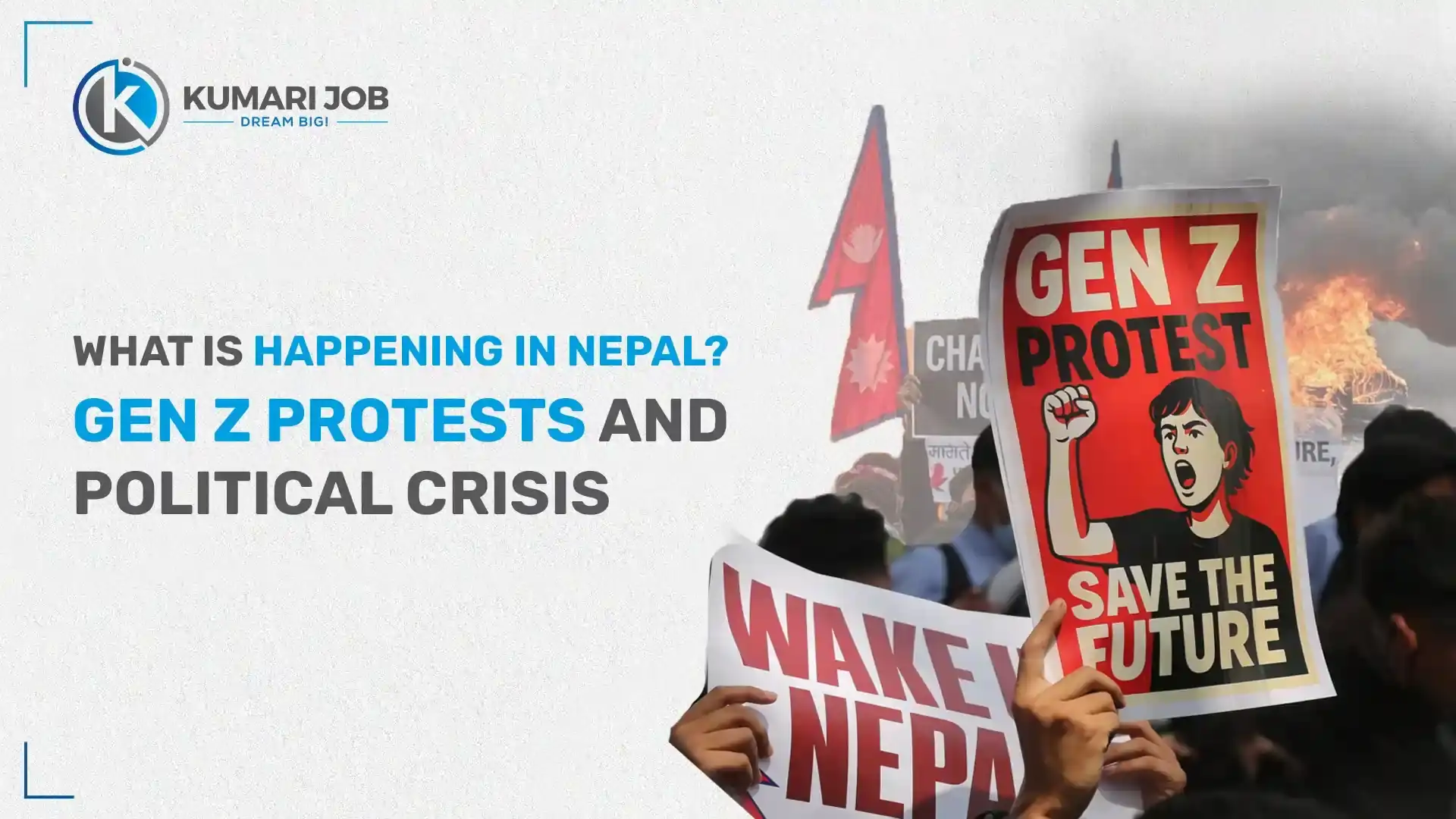

Nepal is facing one of its toughest political moments in years. People are protesting in the streets, and the country feels tense. The recent mass protests, led largely by Gen Z, have shaken the government. Prime Minister KP Sharma Oli resigned after facing huge pressure from citizens. The demonstrations are not just about anger; they are about hope. Young people are speaking up against corruption, nepotism, and poor governance.
Sadly, the protests have also turned violent, leaving more than 19 people dead and hundreds injured. Houses of politicians, Singha Durbar, and even Parliament saw fires and chaos. The international media has focused on issues like the social media ban. But for Nepali youth, the main demand is clear: a fair, corruption-free country where everyone gets real chances.
In this blog
What Triggered the Protests in Nepal?
The protests in Nepal started because young people are frustrated with corruption and unfair politics. They feel the system does not give them real opportunities. For many years, Nepali youth have been unhappy with how the government works. Corruption has grown, and powerful people often get jobs and favors for their friends and family. Ordinary citizens see this and feel left out. Young people especially feel there is no fairness. They study hard, but jobs are scarce. Many have to move abroad to find work.
Nepal’s governance problems added fuel to this frustration. Services are slow, decisions are unfair, and public resources are often wasted. The system seems to favor only a few leaders. People have tried to speak up before, but nothing has changed.
By September 2025, all this frustration boiled over. Young people took to the streets. They wanted their voices to be heard. They demanded honesty, fairness, and real change in politics.
When did the Protests Turn Violent?
The protests in Nepal turned violent on September 8, 2025, mainly in the Baneshwor area of Kathmandu. What began as a peaceful demonstration quickly escalated. Young people had been frustrated for years with corruption, nepotism, and poor governance. That day, tension between the protesters and police reached a breaking point. Security forces fired bullets to control the crowd, and tragically, 19 people lost their lives. Many more were injured. The streets were filled with chaos, fear, and anger.
Timeline of Events
- September 8, 2025 – Protests began in Maiti Ghar and moved to Baneshwor. Young people gathered to demand change, fairness, and justice. Police tried to stop the demonstrations, but clashes broke out. The violence left many injured, 19 people dead, and marked the first fatalities of the protests.
- September 9, 2025 – The protest escalated to a nationwide scale. Protesters attacked major government offices. Parliament, Singha Durbar, the Supreme Court, and the Akhityar office were burned. The homes of some politicians were also set on fire. Also, Rabi Lamicchane was set free from Nakkhu Jail. Streets across Kathmandu were chaotic. Security forces struggled to control the crowds. Hundreds more people were injured as clashes continued.
Casualties and Damage
- Over 19 deaths were reported on September 8.
- Hundreds of injuries occurred over the two days.
- Thousands of criminals ran away from prisons.
- Government offices, official buildings, and politicians’ homes suffered severe damage.
- The violence showed the deep frustration of Nepali youth and their demand for change.
While national and international media focused heavily on the social media ban during the protests, this was only part of the story. The real demand of Gen Z protesters was a corruption-free country, an end to political privilege, and fair opportunities. The violence reflected years of anger that had finally reached a breaking point. Young people wanted their voices heard, and they made it clear that this movement was about more than just online freedoms; it was about justice, fairness, and accountability in Nepal.
Why did Prime Minister KP Oli resign?
Prime Minister KP Sharma Oli resigned because of massive pressure from ongoing protests and a growing loss of trust. The streets were filled with angry young people demanding change, and the government could no longer ignore them.
The protests in early September 2025 shook Nepal’s political system. The movement, led mostly by Gen Z, was not just about small issues. It called out corruption, nepotism, and unfair politics. The intensity of the protests made it very clear that the public had lost confidence in Oli’s leadership.
Many ministers had already resigned before Oli stepped down. This included the Home Minister, among others. Their resignations showed that even inside the government, support for Oli was weakening. The political environment became unstable.
Key Reasons for Oli’s Resignation
- Mass Protests: Streets were filled with protesters. The movement grew quickly and spread across the country. It became impossible for Oli to manage the situation.
- Loss of Legitimacy: People no longer trusted Oli to lead the country fairly. His decisions were questioned, and his authority weakened.
- Resignation of Ministers: Several key ministers left the government. This created a political vacuum and made governance difficult.
- Public Pressure: The young generation, supported by wider society, demanded accountability. Their voices were loud and persistent.
Oli had tried to maintain control, but the pressure from both the public and within his party was too strong. The violence, deaths, and damage to government offices made it urgent to change leadership. His resignation was seen as a step to calm the situation and prevent further chaos.
Even after stepping down, the future of Nepal’s government remained uncertain. Questions about who would lead next and how the country could ensure fair governance were immediate concerns. The protests showed that people, especially the youth, were no longer willing to accept corruption or unfair politics. They wanted real change, and Oli’s resignation was a sign that their voices had an impact.
This moment marked a turning point in Nepal’s political history. It demonstrated the power of young people in shaping the country’s future. And it reminded leaders that public trust is essential. Without it, even a prime minister cannot continue in office.
How did the Government Respond?
The government responded to the protests with strict measures. They deployed the army, imposed curfews, and tried to control the crowds. At the same time, they faced pressure from national and international media over actions like the social media ban.
When the protests turned violent, authorities felt the need to act fast. Streets in Kathmandu and other cities were patrolled by the army and police to prevent further clashes. Curfews were announced in many areas to control movement. Despite these efforts, clashes continued in some parts, showing how strong the anger of the protesters was.
Government Measures
- Army and Police on Streets: Security forces patrolled key areas. Their presence was meant to stop violence and protect government buildings.
- Curfews: Temporary curfews were imposed to reduce chaos and restrict gatherings.
- Crackdowns: Protest hotspots were monitored closely. Authorities tried to disperse crowds when protests became violent.
- Social Media Ban: Initially, the government blocked social media platforms, claiming it would stop unrest.
- Lifting the Ban: After global criticism, the government lifted the social media ban. International media and organizations highlighted the need for free communication.
Even with these measures, the government could not fully control the protests. The army and curfews slowed the violence but did not stop the underlying anger. Young people continued to demand accountability and a corruption-free system.
The government’s response showed a mix of force and compromise. While they tried to maintain order, they also had to respond to criticism. Lifting the social media ban was a small step that recognized global concerns. However, the main message from the streets remained clear: protesters wanted real change, not just temporary controls.
Who will be Nepal’s next Prime Minister?
Everyone is asking the same question: who will lead Nepal next? After KP Sharma Oli resigned, the country entered a period of uncertainty. People are watching closely to see who will take charge and guide Nepal through this crisis.
For now, a caretaker government is in place. This means the current administration manages day-to-day tasks but does not make big political decisions. The aim is to keep the country running until a new leader is chosen.
Possible Interim Leadership
- Sushila Karki Proposal: There is a proposal to make Sushila Karki the interim Prime Minister. She is seen as a neutral figure who could guide the country temporarily. Also, popular faces like Balen also supported this.
- Debate Over Elections: Some political leaders and parties want fresh elections instead of an interim government. They believe new elections can give legitimacy to the next leader.
- Caretaker Challenges: Running a country in caretaker mode is not easy. The government can handle basic functions, but cannot implement major reforms.
Everyone is paying attention to how these discussions unfold. Young protesters and citizens want leaders who are honest and committed to reform. They hope the next Prime Minister will address corruption, nepotism, and job opportunities.
Nepal’s political future depends on these decisions. Whether through interim leadership or elections, the next Prime Minister must regain public trust and bring stability. The coming days will decide the direction of the country and whether citizens’ demands for fairness and accountability are taken seriously.
What do Gen Z Protesters Really Want?
The Gen Z protesters actually want a corruption-free country and a fair system for everyone. National and international media are covering only about the social media ban, but the main motive of the protest is not that. Gen Z protestors want a country with no corruption, nepotism, and leaders with long-term vision. They are not just angry about small issues. They are demanding real change. Let's look at what Gen Z protestors really want:
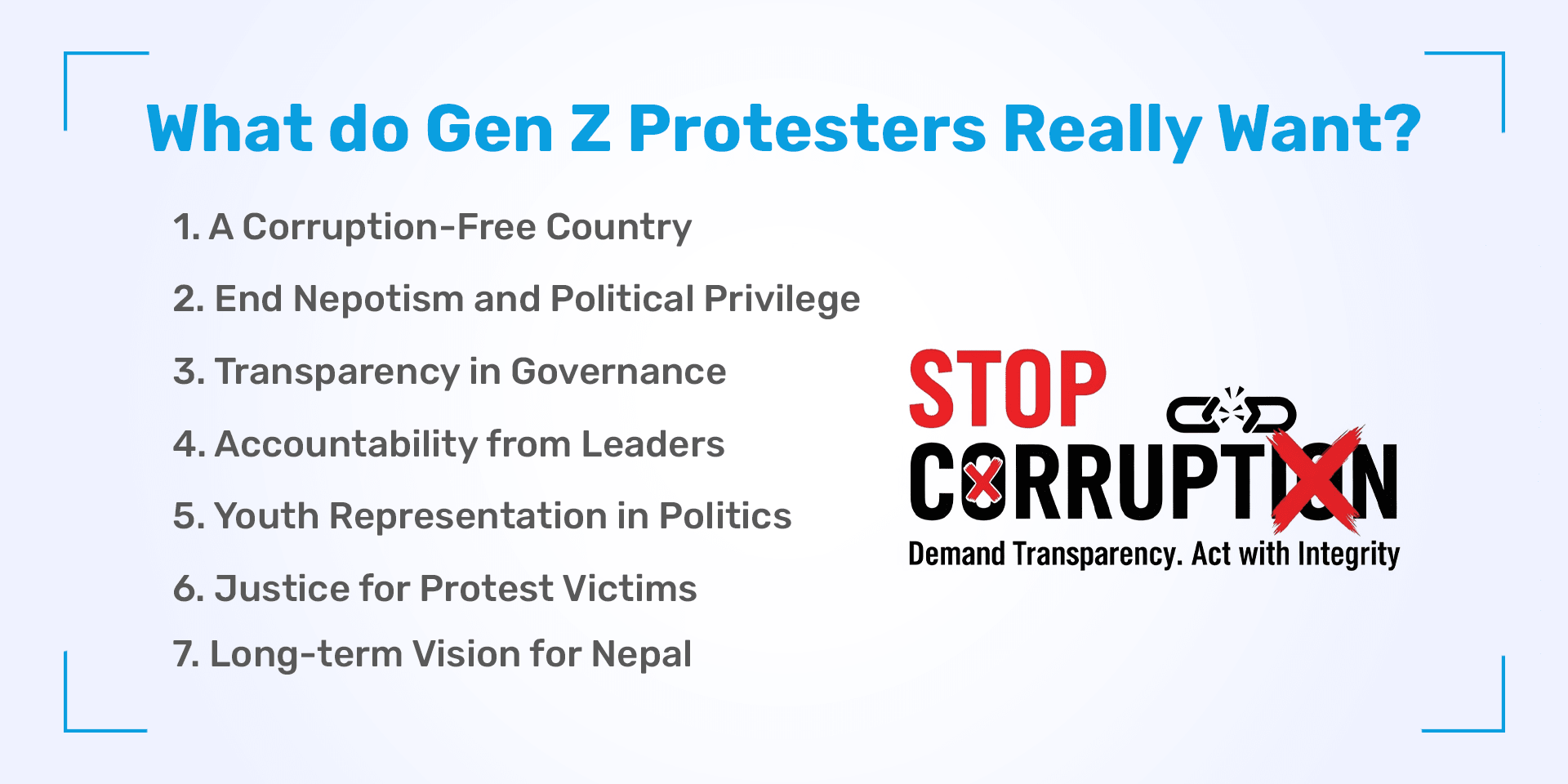
1. A Corruption-Free Country
Young people want leaders who are honest. They are tired of politicians taking money or favors for themselves. They want government work to benefit all citizens, not just a few. Corruption makes life harder for ordinary people. It blocks job opportunities and development. Gen Z is calling for strict action against corrupt officials. They want a country where the rules are fair and followed.
2. End Nepotism and Political Privilege
Protesters want an end to favoritism. Jobs and positions should go to people who deserve them, not those with connections. They are frustrated that politicians give power to friends or family. Young people want fairness in government and business. They believe everyone should have the same chance to succeed. Ending privilege is about giving regular citizens respect and opportunity.
3. Transparency in Governance
Gen Z wants clear and open decisions from leaders. People should know how money is spent and why decisions are made. Hidden deals and secret favors should stop. Transparency builds trust between citizens and government. Protesters want leaders to share information honestly. This way, everyone can see what is right and wrong.
4. Accountability from Leaders
Protesters demand that leaders face consequences for mistakes. If a politician abuses power, they should resign or be punished. No one should be above the law. Accountability is important to stop repeated corruption. Young people want a system where actions have consequences. This will make leaders careful and responsible.
5. Youth Representation in Politics
Gen Z wants a voice in decision-making. They feel old leaders do not understand youth problems. Young people want seats and roles in politics. They can bring fresh ideas and energy. Representation ensures policies are fair to all generations.
6. Justice for Protest Victims
Many people were hurt or killed during the protests. Protesters demand proper investigation and punishment for those responsible. Families deserve answers. Justice shows that the government values human life. It also builds trust in the system.
7. Long-term Vision for Nepal
Gen Z wants leaders who plan for the future. They are thinking about jobs, education, and development. They want a country that grows fairly and sustainably. This vision includes fair opportunities and social equality. Youth want a Nepal where everyone can succeed without unfair obstacles.
How could this change Nepal’s future?
The protests could change Nepal’s future in big ways. If leaders listen, the country might see real reform. But if demands are ignored, instability could continue.
Gen Z protesters have shown that young people can shape politics. Their voices are loud, organized, and persistent. This could push Nepal toward more accountable leadership and fairer policies. The future depends on whether the government responds to their demands.
Possible Impacts
- Political Reform: If leaders take action, corruption and nepotism could decrease. Transparent governance and accountability might become normal. Policies could better reflect citizens’ needs. This would strengthen democracy.
- Role of Gen Z: Young people are no longer silent. They are becoming a key part of decision-making. Their energy and ideas can bring fresh approaches to politics. Future governments may need to include more youth voices.
- Systemic Change: Meeting protesters’ demands could change the way Nepal runs completely. Jobs, education, and public services might become fairer. Ordinary citizens could have more trust in the system. This could prevent future unrest.
- Risk of Instability: If the government ignores demands, protests, and frustration could grow. Political chaos and violence might continue. Young people may feel even more disconnected from leadership.
The current movement shows that citizens, especially youth, are ready to fight for fairness. Their persistence may inspire long-term changes in governance. Nepal’s next steps, through reforms, interim leadership, or elections, will decide whether the country moves toward stability or more conflict. The future of democracy in Nepal is being shaped right now on the streets, in homes, and in the minds of young citizens demanding change.
Conclusion
Nepal is at a critical moment in its history. The protests led by Gen Z have shown that young people will no longer stay silent. They are demanding a corruption-free country, fairness in politics, and real opportunities for all. While international media focused on issues like the social media ban, the heart of the movement is about honesty, accountability, and ending political privilege.
Prime Minister Oli’s resignation shows that public pressure can bring change. But the road ahead is uncertain. How the interim government responds, whether reforms are made, and if elections are held fairly will shape Nepal’s future. The role of youth in politics is stronger than ever. Their determination could lead to real reform, a stronger democracy, and a country where fairness and opportunity matter more than connections or power.
Frequently Asked Questions
Submit your comments

Get Our App On


What is the Public Relations Officer Salary in Nepal
VIEW DETAILS
What Is the Salary of a Ticketing Officer in Nepal?
VIEW DETAILS
What Is the Salary of a Travel Consultant in Nepal?
VIEW DETAILS
How to Become an Auditor in Nepal
VIEW DETAILS


Loading Comments...