



Have you ever wondered what the SSF everyone talks about actually is? In Nepal, the Social Security Fund (SSF) is more than just a salary deduction. It’s a safety net that protects you when life gets uncertain. It helps employees with health care, maternity leave, accidents, and even retirement support. Many workers hear about it but aren’t sure how it really works or how it benefits them.
Don’t worry. It’s easier than it sounds. In this guide, we’ll break down everything about what SSF is in Nepal, how contributions are made, and why it’s important for every employee. By the end, you’ll clearly understand how SSF secures your future and supports you when you need it most.
In this blog
Understanding the Social Security Fund (SSF) System
The Social Security Fund (SSF) is a program started by the Government of Nepal to protect employees and support them during different stages of life. In simple words, it’s a national system that helps workers stay financially safe when they are sick, injured, pregnant, retired, or unable to work. Both employers and employees put a small part of the salary into this fund every month, and that money later comes back as benefits when needed.
The idea behind SSF is simple: to give every worker in Nepal a sense of security and dignity, even after their job ends or income stops. It’s one of the biggest steps Nepal has taken to build a proper social protection system for private-sector employees.
The Social Security Fund was officially introduced in 2011 under the Social Security Act, but it became active around 2018 when contribution-based programs started. The main reason for introducing SSF was to ensure that employees from private companies, not just government workers, could also enjoy long-term financial protection.
Here’s a quick look at how the SSF works under the government system:
- The Social Security Fund Office manages it under the Ministry of Labor, Employment, and Social Security.
- Employers register their companies and employees in the SSF online system.
- Every month, both the employer and the employee contribute a fixed percentage of the employee’s salary.
- The fund then provides different benefits such as medical care, maternity leave, accident coverage, and retirement plans.
- Employees can check their contributions and benefits online through the SSF portal.
In short, the SSF system runs as a shared effort between workers, employers, and the government. It helps ensure that hardworking people in Nepal don’t have to face financial struggles alone.
Objectives and Importance of SSF in Nepal
The Social Security Fund (SSF) was created with a clear goal to make sure every working person in Nepal feels protected, valued, and secure. It’s not just a fund that takes money from your salary. It’s a system that gives you peace of mind, knowing that you’ll be supported when you need help the most.
At its heart, the main goal of the SSF is to provide financial protection to workers and their families during times when income stops or health issues arise. Life is uncertain; accidents, sickness, or retirement can happen anytime. The SSF ensures that these situations don’t leave employees helpless or financially broken.
Here are the main objectives of the Social Security Fund (SSF):
- To build a strong and sustainable social protection system in Nepal.
- To protect employees from financial loss caused by illness, accidents, or job loss.
- To support workers and their families during maternity, disability, or old age.
- To encourage a culture of saving and contribution among private-sector workers.
- To promote a sense of fairness between employers and employees by sharing responsibilities.
For employees, SSF acts like a safety net. It helps cover unexpected expenses and ensures stability even after retirement. Workers don’t have to rely only on their savings or family support because the fund is already there to help them. It gives them confidence that their hard work today is building a more secure tomorrow.
For employers, SSF creates a positive work environment. It shows that the company values its staff and is committed to their well-being. This helps improve employee satisfaction, loyalty, and trust. It also keeps the business compliant with labor laws and avoids penalties.
Overall, the SSF plays a huge role in social protection and retirement security in Nepal. It reduces poverty, improves health and safety, and helps employees live with dignity even after they stop working. In simple words, it’s a small contribution that makes a big difference in every worker’s life.
Still Managing SSF By Yourself?
Avoid calculation errors, missed deadlines, and compliance stress by outsourcing payroll and SSF to experts who handle everything accurately and on time.
Advantages of SSF in Nepal
The Social Security Fund (SSF) gives employees in Nepal a strong sense of safety and trust. It’s not just about saving money; it’s about helping people when life gets difficult. From health and maternity support to retirement and family benefits, SSF covers many important needs. Let’s look at the main advantages that make SSF so valuable for employees and their families.
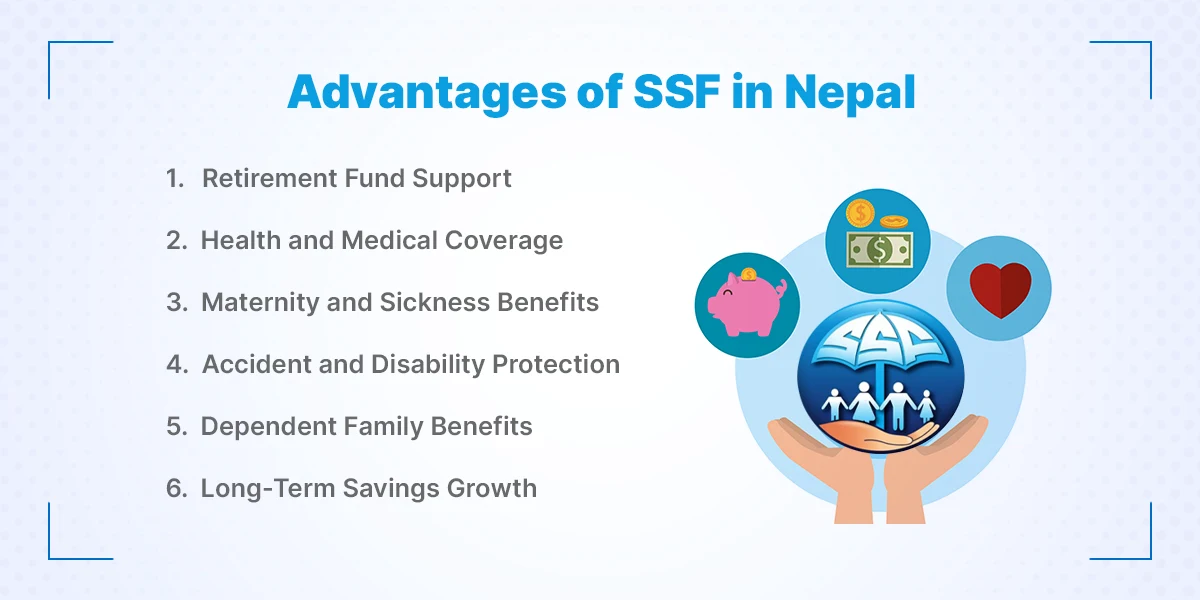
1. Retirement Fund Support
One of the biggest advantages of SSF is the retirement fund. Every month, a small part of your salary goes into the fund, and your employer adds their share too. Over time, this money grows and becomes a solid support when you retire. You don’t have to depend fully on your family or other savings. The fund gives you regular financial help after you stop working. It’s like receiving a thank-you gift for all your years of hard work. SSF helps you enjoy a peaceful and independent retirement life.
2. Health and Medical Coverage
Medical costs can come suddenly, and they’re often expensive. SSF helps employees cover hospital bills, medicine, and other treatment costs when they get sick. You don’t have to worry about paying for everything from your pocket. The medical protection scheme takes care of most of it. This benefit gives you the confidence to focus on recovery instead of expenses. It also reduces the financial pressure on your family during tough times. Health coverage through SSF means better care and less stress.
3. Maternity and Sickness Benefits
SSF supports working women during maternity leave by providing financial help. It ensures they can take proper rest without worrying about salary loss. The fund also gives benefits to any employee who cannot work for a short time due to sickness. This system shows that SSF truly cares for workers’ well-being. It gives families time to recover and maintain stability. With SSF, employees can handle health challenges without feeling financially trapped.
4. Accident and Disability Protection
Accidents can happen at any time, especially while working. SSF provides special protection in such cases. If a worker gets injured or disabled, the fund helps cover treatment costs and offers financial support during recovery. For serious disabilities, long-term aid is also available. This benefit helps employees and their families stay stable when income stops suddenly. It shows how SSF stands by workers during the hardest moments of their lives.
5. Dependent Family Benefits
SSF not only protects employees but also their families. If a worker passes away, their dependents receive financial support from the fund. This helps the family cover daily needs and continue their life with dignity. It’s a way for SSF to take care of loved ones left behind. The benefit gives peace of mind to every worker, knowing their family will not be left alone. It builds a strong sense of security and care beyond the job.
6. Long-Term Savings Growth
The money you and your employer contribute to SSF doesn’t just sit idle; it grows over time. The fund invests it safely, and the total amount increases every year. This helps build long-term savings that can be used after retirement or in times of need. It’s a steady and secure way to grow your wealth without extra effort. Even small monthly contributions can make a big difference in the future. SSF turns your earnings today into lasting financial support for tomorrow.
How Does SSF Work in Nepal?
SSF in Nepal works by collecting monthly contributions from both employers and employees, which are then used to provide benefits like health care, maternity, accident coverage, and retirement support. The Social Security Fund (SSF) is designed to protect employees in Nepal during sickness, accidents, maternity, and retirement. Both employers and employees contribute a fixed percentage of the employee’s salary every month. The fund is managed by the government, and all contributions are recorded in an online portal for easy tracking.
How SSF Contributions Are Collected:
- Employee Contribution: A small fixed percentage is automatically deducted from the employee’s monthly salary.
- Employer Contribution: The employer adds a matching or set percentage on top of the employee’s contribution.
- Payment Method: Contributions are deposited into the SSF account through the online portal or authorized bank channels.
Role of Employers and Employees:
- Employers: Responsible for registering their company and employees in the SSF system, submitting monthly contributions on time, and updating employee details.
- Employees: Ensure their personal details are correct in the portal and verify that the contributions are properly credited.
Process of Registration and Account Creation in the SSF Portal:
- Employer Registration: Employers create an account on the SSF online portal by submitting company documents and basic information.
- Employee Registration: Once the employer is registered, they register their employees under the system, providing ID and salary details.
- Account Creation: Every registered employee receives a unique SSF number (SSID) and can log in to check contributions, benefits, and account balance online.
This system ensures transparency, timely contributions, and easy access for both employers and employees to manage social security benefits efficiently. Managing the government portal and ensuring company details are correct is a major daily task for HR teams. Taking an advanced HR Training in Nepal can help you learn how to use these portals easily and avoid mistakes.
SSF Contribution Rate and Calculation
In Nepal’s Social Security Fund (SSF) scheme, contributions are based on an employee’s basic salary. The rate is:
- Employee share: 11% of the basic salary.
- Employer share: 20% of the basic salary.
- Total contribution: Combined, 31% of that basic salary is deposited each month into SSF.
That means for every eligible worker, almost a third of their basic salary (employee + employer contribution) goes into the fund every month. The idea is that this pooled money will support health, maternity, accident, disability, and retirement benefits. Even if your earnings are close to the minimum salary in Nepal, SSF contributions work the same way, providing proportional benefits to everyone.
Contribution breakdown
1. Employee contribution
Total: 11% of the employee's basic salary.
Breakdown:
- 10% to the Pension Fund
- 1% for Social Security Tax
2. Employer contribution
Total: 20% of the employee's basic salary.
Breakdown:
- 10% to the Pension Fund
- 8.33% for Gratuity
- 1.67% for Additional Contribution
SSF contributions are separate from salary tax in Nepal, but both reduce take-home pay and provide long-term financial protection.
Example of SSF Calculation
Let’s put this into a simple example: Suppose your monthly basic salary is NPR 30,000.
- Your contribution (11%): 30,000 × 11% = NPR 3,300.
- Your employer’s contribution (20%): 30,000 × 20% = NPR 6,000.
- So in one month, a total of NPR 9,300 is deposited for your SSF account.
Over time, as months turn into years, these contributions build up and fund the protections offered by SSF, letting you access benefits when you face sickness, maternity, retirement, etc.
Types of Schemes and Benefits Under SSF
The Social Security Fund (SSF) in Nepal is designed to protect employees from life’s uncertainties. It is not just about saving money for the future; it also helps in times of sickness, accidents, maternity, and retirement. The fund has different schemes to make sure employees and their families get support when they need it most.

1. Medical and Health Protection Scheme
This scheme helps employees cover medical expenses. If you get sick or need treatment at a hospital, the fund can pay for part or all of your costs. It includes doctor visits, hospital stays, and medicine expenses. You don’t have to pay for everything from your pocket. This makes it easier for employees to get proper care without financial stress. Families also benefit if an employee falls sick. The scheme encourages regular health checkups and treatment. It ensures employees stay healthy and productive at work.
2. Maternity and Sickness Protection Scheme
SSF supports working women during maternity leave. Employees receive financial help while taking time off to care for their newborn. This ensures mothers can rest and recover without worrying about losing income. The scheme also helps any employee who cannot work for a short period due to sickness. Employees can focus on recovery while the fund provides support. Families get stability during these periods. It reduces stress and helps maintain a healthy work-life balance.
3. Accident and Disability Protection Scheme
Accidents can happen at work or elsewhere. If an employee gets injured or disabled, SSF provides financial assistance. It covers medical treatment and daily expenses during recovery. In case of long-term disability, the fund continues to support the employee. This protection ensures employees and their families do not face financial hardship. It also encourages safer work environments. Employees feel more secure knowing that accidents won’t leave them helpless.
4. Old Age, Retirement, and Dependent Family Protection Scheme
This scheme ensures financial support after retirement. Employees receive a pension or lump-sum payment when they stop working. It helps maintain a comfortable lifestyle in old age. If an employee passes away, their dependents receive support from the fund. This gives families peace of mind. Regular contributions over the years build a strong retirement fund. It encourages long-term saving without extra effort. Employees can enjoy life knowing their future is secured.
Who Should Contribute to SSF in Nepal?
The Social Security Fund (SSF) in Nepal is mainly designed for employees working in private-sector organizations. Its main goal is to provide social protection, retirement support, and other benefits for employees. Not all employees in Nepal are automatically part of SSF. For example, government employees often have their own pension and social security systems, so their contributions to SSF are generally not required.
Eligibility for SSF
Employees working in registered private companies are eligible to contribute to SSF. This includes full-time staff who earn a regular salary and whose employers are registered with the SSF system. Employers are responsible for registering their employees and ensuring contributions are made each month.
Mandatory and Voluntary Contributors
- Mandatory contributors: Most full-time private-sector employees fall under this category. They must contribute a fixed percentage of their salary each month, and their employers also contribute on their behalf. This ensures employees automatically receive health, maternity, accident, and retirement benefits.
- Voluntary contributors: Some employees who do not meet the criteria for mandatory contributions, or self-employed individuals, may choose to contribute voluntarily. This gives them access to SSF benefits even if they are not formally required to participate.
Coverage for Contract and Part-Time Workers
SSF also provides coverage for contract or part-time workers if they meet certain eligibility requirements, such as earning a minimum salary or working a minimum number of hours. Employers can register these workers in the SSF system, and contributions are calculated based on their actual earnings. This ensures that even non-full-time workers can receive financial protection, health benefits, and retirement savings through SSF.
In short, SSF is primarily aimed at private-sector employees but also allows flexibility for part-time, contract, or voluntary contributors. Its inclusive design ensures that as many workers as possible can benefit from social protection and financial security in Nepal.
How to Register for SSF in Nepal?
To register for SSF in Nepal, employers first register their company online, then register employees using required documents, after which both employers and employees can log in to the portal to track contributions and check balances.
The Social Security Fund (SSF) in Nepal is designed to protect employees, but before anyone can benefit, both employers and employees must complete the registration process. Registration is simple and mostly done online through the official SSF portal. The process ensures that contributions are correctly tracked and benefits are delivered without delays.
Step-by-Step Guide for Employers and Employees
1. Employer Registration
Employers need to create an account on the SSF portal. They submit basic company information, including business registration certificate, PAN/VAT certificate, contact details, and bank account information. Once verified, the employer receives a username and password to access the portal.
2. Employee Registration
After the employer is registered, they can add employees to the system. Each employee’s details, such as full name, date of birth, citizenship or ID number, appointment letter, and salary, must be submitted. Once registered, each employee gets a unique SSF number (SSID).
3. Required Documents:
- For employers: Business registration certificate, PAN/VAT certificate, bank account details, and employee details.
- For employees: Citizenship or national ID, employment contract, recent passport-sized photo, and bank account details.
Once registered, both employers and employees can see monthly contributions on the portal. Employers deposit contributions on behalf of employees, while employees can check if their salary deductions have been correctly recorded.
How to Log In and Check SSF Balance:
Employees can log in to the SSF contributor portal using their username and SSID. Here, they can view their total contributions, monthly deposits, and accumulated benefits. The portal also provides statements that show how contributions are allocated across different schemes, such as health, maternity, accident, and retirement.
By completing registration and using the portal, employees gain control over their social security information, and employers maintain compliance with government regulations. It ensures transparency, timely contributions, and easy access to benefits for all eligible workers.
Difference Between SSF, PF, and CIT in Nepal
The three main funds in Nepal are: SSF (Social Security Fund), PF (Provident Fund), and CIT (Citizen Investment Trust). All three serve different purposes for employees and savers. While all three help people save and secure their financial future, they differ in contribution rates, benefits, and withdrawal rules. Understanding these differences helps employees decide which fund best suits their needs for long-term savings and retirement planning. Below is a clear comparison to make it easy to understand.
| Feature | SSF (Social Security Fund) | PF (Provident Fund) | CIT (Citizen Investment Trust) |
|---|---|---|---|
| Contribution | Employee 11% + Employer 20% of basic salary | Usually, Employee 10% + Employer 10% of basic salary | Voluntary contributions are decided by the individual |
| Purpose / Benefits | Health, maternity, accident, disability, retirement, and dependent family protection | Primarily retirement savings | Long-term savings and investment for individuals |
| Withdrawal Rules | Partial or full withdrawal under specific conditions: retirement, sickness, maternity, accident, or death | Generally, at retirement or resignation | Can withdraw anytime, depending on the scheme chosen |
| Long-Term Security | Offers social protection along with retirement savings | Focused mainly on retirement savings | Focused mainly on investment growth and savings |
| Who Can Contribute | Private-sector employees (mandatory), part-time or contract workers (eligible) | Private-sector employees | Any citizen, voluntary participation |
| Best For | Employees seeking both social protection and retirement benefits | Employees mainly focused on retirement savings | Individuals wanting flexible long-term savings options |
SSF Withdrawal Rules and Pension Benefits
You can only withdraw your SSF amount under certain conditions. For the pension benefit, you must have reached age 60 and contributed for at least 15 years (180 months). If you leave your job or terminate the employment before that, you may only withdraw the portion of the fund allocated for retirement benefit (gratuity) but not the pension portion. If a contributor dies before fulfilling those conditions, the accumulated amount (contributions + returns) is paid out as a lump sum to heirs or dependents.
Retirement benefits and lump‑sum options
Once you reach age 60 and have fulfilled the minimum required contributions, SSF gives you a monthly pension. The pension is calculated by taking the total amount you and your employer contributed, plus investment returns, and dividing it by a fixed number of months (recently updated from 180 to 160 months) to arrive at the monthly payout.
If you do not meet the full contribution requirement, or if you prefer, you may opt for a lump‑sum withdrawal instead of a monthly pension. The scheme also includes a “retirement benefit” (gratuity) portion that you may access earlier than the pension portion, in some cases, when you leave employment.
What happens if an employee changes jobs
When you change jobs, as long as the new employer is also covered under SSF, your SSF contributions continue. Your account and contribution history move with you. If your new job does not register you or you leave formal employment, you may still keep your SSF account active, and you may be eligible to withdraw the retirement benefit portion when you leave the job.
However, the pension portion generally stays locked until you meet the age and contribution criteria. If you stop contributing altogether and do not join another job under SSF, you may lose or delay the pension benefit, so it pays to keep your contribution record intact.
Conclusion
The Social Security Fund (SSF) in Nepal is more than just a deduction from your salary. It’s a system designed to protect employees and their families. From health and maternity support to accident protection and retirement benefits, SSF ensures financial security at every stage of life. By contributing a small percentage each month, employees and employers together build a safety net that grows over time and provides peace of mind.
Whether you’re a full-time worker, part-time employee, or on a contract, participating in SSF means you are preparing for both expected and unexpected life events. Understanding how it works and keeping track of your contributions allows you to fully benefit from the system. In short, SSF is a smart and essential step toward long-term security and stability in Nepal.
Wondering how your salary deductions are calculated in Nepal? Find out how TDS works and what it means for your monthly pay.
Frequently Asked Questions
Submit your comments

Get Our App On



What is the Public Relations Officer Salary in Nepal
VIEW DETAILS
What Is the Salary of a Ticketing Officer in Nepal?
VIEW DETAILS
What Is the Salary of a Travel Consultant in Nepal?
VIEW DETAILS
How to Become an Auditor in Nepal
VIEW DETAILS


Loading Comments...