




Every month, employees see a part of their salary go into the Social Security Fund (SSF), but most don’t really know why. Is it for health? Retirement? Or something else? This confusion leaves many unsure if they’re actually benefiting from it.
The truth is, SSF is designed to protect employees in times of need and help employers provide structured benefits easily. From medical coverage to pensions and accident support, it acts as a safety net for both sides.
In this guide, we’ll break down all SSF benefits in Nepal, explain who can claim them, how contributions work, and the step-by-step process to access these benefits. By the end, SSF will make complete sense.
In this blog
What is SSF in Nepal?
The Social Security Fund (SSF) in Nepal is a government-managed fund created to protect employees and provide financial support during difficult times. It works like a safety net, helping people with health issues, accidents, retirement, or unemployment. Every eligible employee contributes a part of their salary, and employers add their share too, making sure everyone has long-term security.
Purpose and Objectives of SSF
- Provide financial help to employees during sickness, maternity, or accidents
- Offer retirement pension and long-term savings security
- Support families of deceased or disabled employees
- Reduce financial stress and promote social welfare
- Help employers maintain a structured benefit system
Who is Required to Enroll in SSF:
- All private sector employees working in organizations with more than 10 staff members
- Both permanent and contract employees (some rules may vary)
- Employers are legally required to register their company and contribute to SSF for eligible employees.
SSF is mandatory for most private-sector employees in Nepal. It ensures that workers have access to important benefits while employers follow the law and provide a reliable benefit system.
Struggling to Manage Payroll and SSF Requirements?
Let our payroll specialists handle salary processing, SSF contributions, and complete paperwork accurately and on time.
What are the SSF Benefits?
The Social Security Fund (SSF) in Nepal provides a range of benefits to protect employees and support employers. It is designed to make sure that workers have financial security during tough times, while employers can offer a structured benefits system without extra hassle. Many employees contribute every month, but may not fully understand what they get in return. SSF ensures that this contribution is meaningful and helpful throughout their career.
Overview of Benefits Provided Under SSF
- Financial support during medical treatment or hospitalization
- Help for maternity expenses for eligible employees
- Compensation in case of accidents or disabilities
- Retirement pension to secure old age
- Support for family members if the employee passes away
- Assistance during unemployment or temporary job loss
How SSF Supports Long-Term Security
SSF is not just about immediate help. It is built for long-term protection. By pooling contributions from both employees and employers, it creates a safety net that can be relied upon throughout life. Employees know that they will have support when unexpected events happen, and employers can offer these benefits without managing complex programs individually. Over time, SSF helps employees build financial stability, reduces stress about unforeseen events, and ensures that families and dependents are also protected.
In short, SSF turns monthly contributions into a reliable plan for health, income, and retirement security. It makes life safer for employees and simpler for employers, helping both focus on work without worrying about financial risks.
Types of SSF Benefits in Nepal
SSF offers several types of benefits to make sure employees and their families are protected in different situations. These benefits cover health, accidents, retirement, family support, and unemployment. Every eligible employee contributes a small part of their salary, and employers add their share. In return, SSF provides financial help when it is needed the most.
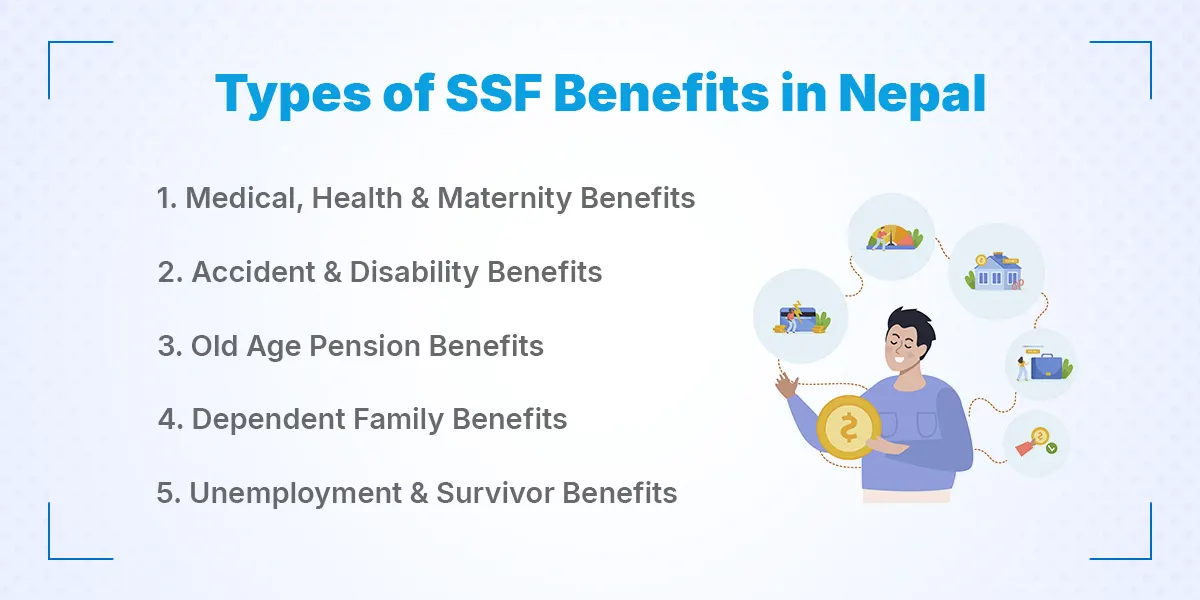
1. Medical, Health & Maternity Benefits
This benefit helps employees with medical treatment and hospital expenses. It also covers maternity costs for eligible female employees. To get this benefit, the employee must be enrolled in SSF and have contributed for a certain period. Claims can be made by submitting medical reports and receipts. Both outpatient and inpatient treatments may be covered depending on SSF rules. Employers may help employees with claim submissions. This ensures that employees can focus on recovery without worrying about money.
2. Accident & Disability Benefits
SSF provides compensation if an employee gets hurt at work or outside work. The amount depends on the severity of the injury and loss of earning capacity. Employees need to report the accident and submit relevant documents to claim the benefit. The fund also helps in case of permanent or temporary disability. Employers usually assist in filing claims to ensure faster processing. This benefit reduces financial stress caused by accidents.
3. Old Age Pension Benefits
Employees receive a monthly pension after reaching retirement age. The pension amount depends on salary and the number of years contributed. Employees must have contributed regularly to qualify. The pension provides a stable income after retirement. It helps employees live comfortably without relying solely on savings. Claims are processed after verification of contribution history.
4. Dependent Family Benefits
If an employee passes away, SSF provides financial support to their spouse and dependents. The amount depends on contribution history and salary. Dependents need to submit legal documents to prove eligibility. This ensures the family can meet daily needs and financial obligations. It reduces the economic burden on surviving family members.
5. Unemployment & Survivor Benefits
SSF gives temporary financial support if an employee loses their job. It also provides support to survivors if the employee dies unexpectedly. The benefit duration depends on contribution history and circumstances. Employees must apply with proof of unemployment or death. This helps maintain financial stability during sudden changes.
Get Help with Payroll Management
Who is Eligible for SSF Benefits?
All private sector employees in Nepal are eligible for SSF benefits if they and their employers make regular contributions. This means that anyone working in a registered private company, whether permanent or contract staff, can access SSF protection. Employers are legally responsible for enrolling their employees and ensuring contributions are paid on time, making the system fair for everyone.
1. Eligibility for Employees
Any employee working in a private company with more than 10 staff members can enroll in SSF. Both permanent and contract employees are included under the law. Employees must contribute a small portion of their monthly salary to qualify. Those who do not contribute or work in exempted sectors may not get benefits. Enrolled employees can claim medical, maternity, accident, pension, family, and unemployment benefits. Eligibility starts as soon as contributions begin. It ensures that workers have financial protection from day one.
2. Employer Obligations
Employers must register their company with SSF and enroll all eligible employees. They are responsible for deducting employee contributions from salaries. Employers must also add their share of contributions and submit the total to SSF regularly. Keeping accurate records of employees’ contributions is part of the legal requirement. Employers must help employees with claims when needed. Failing to comply can lead to penalties or legal action.
3. Contribution Requirements
Employees contribute a fixed percentage of their monthly salary to SSF. Employers contribute a larger share on behalf of their staff. The combined contributions fund all SSF benefits, from health to retirement. Timely payment of contributions is essential to maintain eligibility. Contributions are calculated based on salary slabs set by the government. Both sides must ensure accurate and consistent payments.
How SSF Contribution Works?
In the SSF system, employees contribute 11% of their basic salary to SSF, and employers contribute 20%, making a total of 31% of the basic salary deposited into the fund each month. This pooled money funds all SSF benefits and must be paid regularly to remain eligible for support.
1. Employee Contribution Percentage
Employees contribute 11% of their monthly basic salary to the Social Security Fund. This amount is usually deducted directly from the salary by the employer before payment. The employee share includes a provident fund and a small social security tax component, as defined under the Social Security Act and related rules. Contributing consistently ensures that workers stay qualified for SSF support, such as medical, pension, and other benefits. It also means employees are building long‑term financial protection with each paycheck.
2. Employer Contribution Percentage
Employers must contribute 20% of the employee’s basic salary to the SSF. This is a legal obligation for registered private sector companies. The employer share covers their part of the provident fund, gratuity, and other components that support various SSF schemes. Employers must deposit both their share and the employee’s share every month to avoid penalties. Timely contribution shows legal compliance and supports employee welfare.
3. Total Contribution Breakdown
Together, the 11% employee share and 20% employer share make a 31% total contribution to the employee’s basic salary. This combined amount goes into the SSF account monthly. Both portions together fund health, maternity, accident, old age, family, and unemployment protections. Regular contributions are essential for employees to access SSF benefits when needed. Tracking these deposits helps employees verify their eligibility.
How to Claim SSF Benefits in Nepal?
You can claim SSF benefits by submitting the correct claim form with required documents through the SSF portal or SSF office after the eligible event happens. This process applies to medical, accident, pension, family, and unemployment benefits and requires document verification. Knowing the right steps helps you avoid delays and ensures you receive your money smoothly when you need it most.
- Make Sure You Are Eligible: First, confirm that you are registered with SSF and that regular contributions are being deposited. Benefits are only available if contributions are up to date. You can check this through your HR department or the SSF portal.
- Identify the Benefit You Are Claiming: Different benefits need different forms and documents. Medical, accident, pension, or family claims are handled separately. Knowing the exact benefit helps you avoid submitting the wrong documents.
- Collect Required Documents: Gather documents such as your SSF number, citizenship ID, medical bills, reports, accident records, or retirement papers. Missing documents are the main reason for claim rejection. Always keep copies for safety.
- Fill the SSF Claim Form: Download the claim form from the official SSF website or get it from the SSF office. Fill it carefully with the correct personal and bank details. Wrong details can delay payment.
- Submit the Claim: Submit the form and documents online through the SSF portal or physically at the nearest SSF office. Some medical claims may be paid directly to listed hospitals.
- Verification by SSF: SSF checks your documents and contribution history. They may contact you if something is missing. This step usually takes a few weeks.
- Receive Payment: Once approved, the benefit amount is deposited into your bank account or paid to the service provider. You can track claim status through SSF or HR support.
Benefits of SSF for Employers
SSF is not only helpful for employees, but it also brings many advantages for employers. It gives businesses a clear and legal way to manage employee benefits. Employers can avoid confusion, future risks, and penalties by following one system. SSF helps companies build trust while staying compliant with the law.
1. Legal Compliance
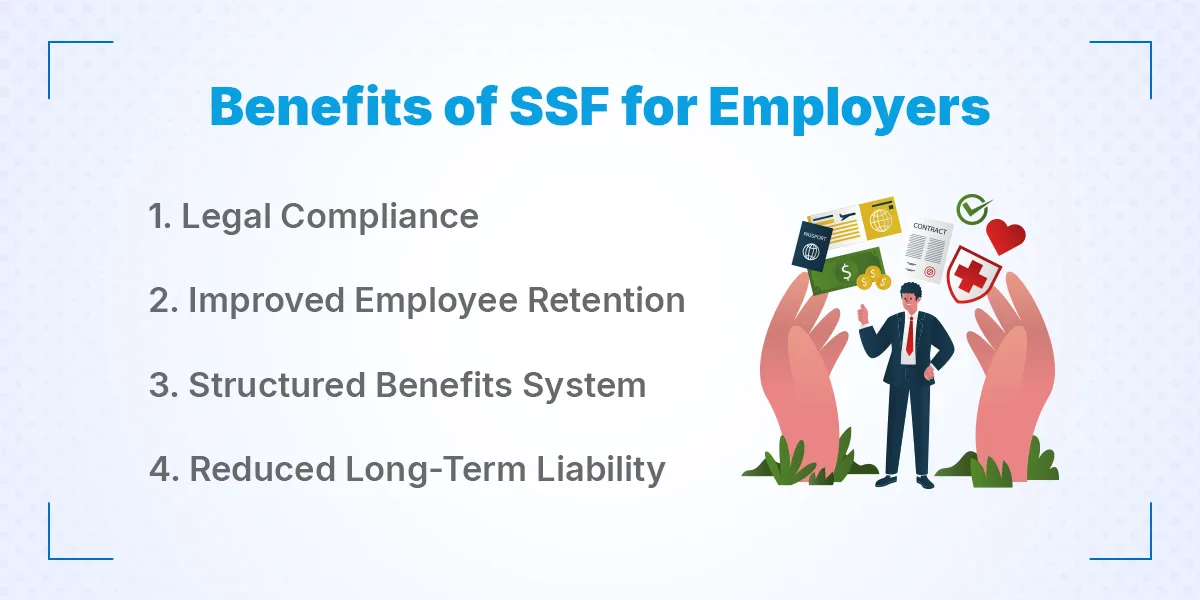
SSF helps employers follow Nepal’s labor and social security laws easily. Registering with SSF and paying contributions on time keeps the company legally safe. It reduces the risk of fines, penalties, or legal notices. Government inspections become smoother when SSF records are clear. Employers do not need to manage multiple benefit schemes separately. This saves time and reduces legal stress. Compliance also improves the company’s reputation.
2. Improved Employee Retention
Employees feel more secure when they know SSF benefits are in place. Health cover, pension, and family support increase job satisfaction. Workers are less likely to leave when benefits are stable. This reduces hiring and training costs for employers. Long-term employees also perform better at work. SSF builds trust between the employer and employee. A secure workforce is a loyal workforce.
Explore Kumari Job's Outsourcing Services
3. Structured Benefits System
SSF provides one organized system for all employee benefits. Employers do not need to create separate health or retirement plans. Contribution rules are clear and fixed. Record-keeping becomes easier through SSF reports. HR teams save time managing benefits. It brings clarity and consistency to payroll. A structured system reduces errors and confusion.
4. Reduced Long-Term Liability
SSF reduces future financial burden on employers. Pension, medical, and family support are handled by the fund. Employers do not need to pay large sums during emergencies. This protects businesses from sudden financial pressure. It also limits disputes related to employee benefits. Long-term planning becomes easier. SSF shifts risk from the employer to a secure system.
SSF vs Traditional Provident Fund
Both SSF and the traditional provident fund aim to secure an employee’s future, but they work very differently. Many employees and employers are confused about which one offers better protection. A simple comparison makes the difference clear.
| Basis | Social Security Fund (SSF) | Traditional Provident Fund (PF) |
|---|---|---|
| Legal Status | Mandatory for most private sector employers | Optional in many private companies |
| Contribution Rate | 11% employee + 20% employer (31% total) | Usually 10% employee + 10% employer |
| Coverage Scope | Health, maternity, accident, pension, family, and unemployment | Mainly retirement savings only |
| Medical Benefits | Yes, medical and hospitalization support | No medical coverage |
| Accident Protection | Yes, work and non-work related accidents | No accident coverage |
| Pension Facility | Monthly pension after retirement | Lump sum amount at retirement |
| Family Support | Yes, dependent and survivor benefits | No family protection |
| Unemployment Support | Available under certain conditions | Not available |
| Risk for Employer | Lower long-term liability | Higher responsibility during disputes |
| Employee Security | High, covers life risks | Limited, savings-focused only |
| Management | Government-managed system | Managed by the employer or the bank |
| Withdrawal Flexibility | Restricted, rule-based | Easier withdrawals |
Conclusion
SSF benefits in Nepal are not just a monthly deduction; they are a long-term protection system for both employees and employers. For employees, SSF secures health care, accident support, family safety, and a stable pension after retirement. For employers, it ensures legal compliance, reduces future risk, and creates a trusted workplace.
Unlike old systems that focus only on savings, SSF covers real-life risks that can affect income and family security. When followed correctly, SSF turns regular contributions into peace of mind. So, if you are an employee, SSF protects your future beyond your salary. And if you are an employer, SSF helps you build a responsible, lawful, and sustainable business in Nepal.
Frequently Asked Questions
Submit your comments

Get Our App On



What is the Public Relations Officer Salary in Nepal
VIEW DETAILS
What Is the Salary of a Ticketing Officer in Nepal?
VIEW DETAILS
What Is the Salary of a Travel Consultant in Nepal?
VIEW DETAILS
How to Become an Auditor in Nepal
VIEW DETAILS


Loading Comments...