




Are you looking to build a stable and rewarding career in the Nepali government? Applying for a section officer job vacancy can be a major opportunity for ambitious candidates seeking job security, growth, and prestige. These positions are highly competitive, and understanding the application process is key to increasing your chances of success.
In this blog, we will guide you step by step on how to apply for a section officer job vacancy in Nepal. You’ll learn about eligibility criteria, the selection process, salary, benefits, and practical tips to prepare for the PSC exams. By the end, you’ll have a clear roadmap to confidently apply and succeed in securing a government job in Nepal as a respected civil servant.
In this blog
Who Is a Section Officer?
Section Officer is a mid-level government officer responsible for managing and supervising administrative sections within ministries or departments. They act as a link between higher-level officials and junior staff, ensuring smooth operations. Section officers are often appointed by the Public Service Commission (PSC) and are considered gazetted employees. They play a vital role in implementing government policies, handling official correspondence, and maintaining records. Their position requires a combination of administrative skills, attention to detail, and adherence to government rules and procedures.
What Do They Do?
- Supervise and manage the daily operations of a specific section within a ministry or department.
- Prepare and review official documents, reports, and correspondence for senior officers.
- Coordinate with other departments, staff, and stakeholders to ensure smooth workflow.
- Assist in policy implementation, project monitoring, and administrative decision-making.
- Maintain records, files, and documentation according to government regulations.
- Support recruitment, training, and evaluation of junior staff in their section.
How Often Do Section Officer Vacancy Opens in Nepal?
Section officer vacancies in Nepal generally open annually, following a predictable schedule set by the Public Service Commission (Lok Sewa Aayog). Most notifications are released in the latter half of the year, usually around Mangsir (mid-December), giving candidates enough time to prepare for the upcoming exams. This annual cycle ensures a regular intake of qualified personnel into various government ministries and departments.
For example, a recent recruitment opened 298 section officer positions with an application deadline of January 7, 2025. Preliminary exams for these roles are typically held in Magh or Falgun (January/February). Candidates should monitor PSC announcements closely every year, as vacancies follow this consistent cycle, allowing aspirants to plan preparation and application strategies well in advance.
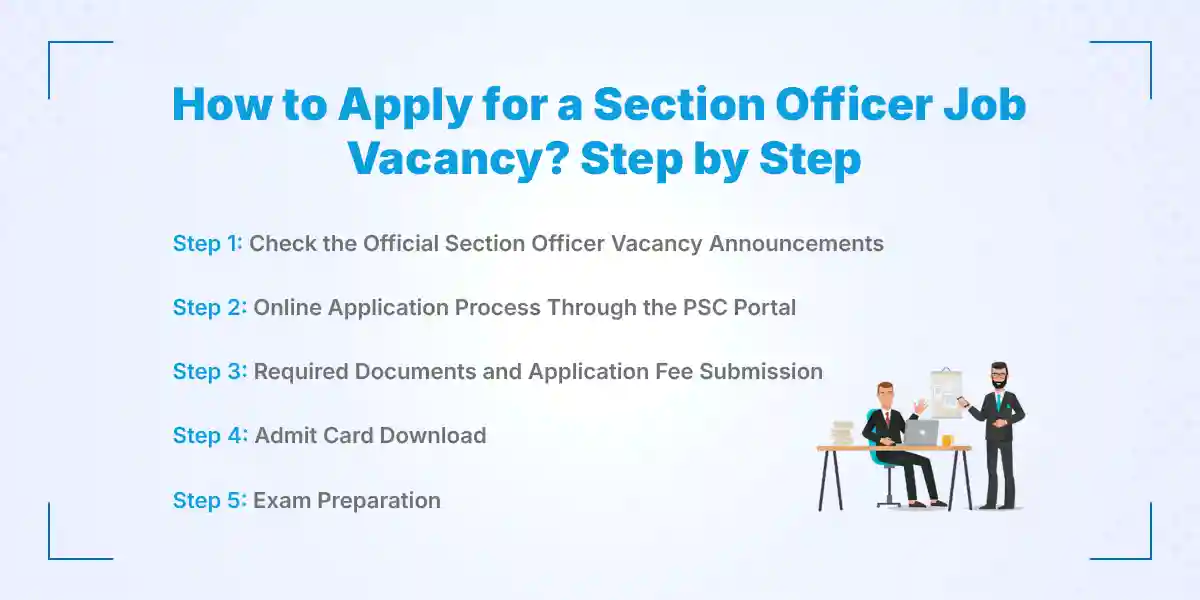
How to Apply for a Section Officer Job Vacancy? Step by Step
To apply for a section officer job vacancy in Nepal, you must carefully follow the official process set by the Public Service Commission (PSC). This involves monitoring vacancy announcements, submitting your application through the PSC portal, ensuring all required documents and fees are completed, and preparing for the exams. Following each step correctly increases your chances of selection and prevents unnecessary disqualification.
Step 1: Check the Official Section Officer Vacancy Announcements
Candidates should regularly visit the PSC official website to check for new section officer vacancies. Each announcement contains important details like the number of vacancies, eligibility criteria, application deadlines, and exam dates. Reading the notice carefully ensures you meet all requirements before applying. It is also important to note any updates or changes to the schedule published by PSC. Keeping a record of past announcements can help track trends and better plan your preparation.
Step 2: Online Application Process Through the PSC Portal
Applications must be submitted online via the PSC portal, following the instructions provided in the official notice. Candidates should fill the loksewa form by entering all personal, educational, and professional details accurately. Mistakes in the form can lead to rejection. Ensure you save a copy of the application for future reference and verification. Double-check every entry, including dates and spellings, to avoid errors that may disqualify your application.
Step 3: Required Documents and Application Fee Submission
Applicants need to gather all necessary documents, such as citizenship, academic certificates, and experience letters if applicable. After filling out the online form, pay the required application fee through the designated bank or online method. Proper submission of documents and payment is crucial to confirm eligibility. Always double-check that nothing is missing. Maintaining digital and physical copies of all documents can prevent last-minute issues.
Step 4: Admit Card Download
Once your application is accepted, the PSC publishes admit cards for eligible candidates. You must download it from the official website before the exam. The admit card contains important information like exam date, venue, and candidate details. Carry it to the examination center, as entry without it is not allowed. Check the admit card carefully for any errors and report them immediately to PSC if found.
Step 5: Exam Preparation
After confirming your application, focus on preparing for the written and interview exams. Review the syllabus, practice past questions, and use recommended books and notes. Time management, mock tests, and revision strategies are key to improving performance. Once the exams are concluded, the final step is to check Loksewa result updates on the official portal to see if you have advanced to the recommendation stage. Consistent study and regular self-assessment will boost confidence and readiness for the exams.
Eligibility Criteria for Section Officer Vacancy
The eligibility criteria for a section officer vacancy in Nepal are designed to ensure that candidates are qualified, capable, and fit for government service. These requirements include educational qualifications, age limits, nationality, experience, and adherence to inclusiveness policies. Meeting these criteria is essential before applying, as candidates who do not fulfil the requirements are automatically disqualified by the Public Service Commission (PSC). Understanding these rules clearly helps aspirants focus their preparation and improve their chances of success.
1. Educational Qualifications Required For A Section Officer
Candidates must have at least a bachelor’s degree or equivalent from a recognised university. Certain positions may require specific degrees depending on the department or ministry, such as accounting, management, or law. Higher degrees, like a master’s, may be preferred for specialised roles. Proper certification and verification of educational credentials are mandatory during the application process. Ensuring your academic records are complete and officially recognised is critical for eligibility.
2. Age Limit
Applicants must meet the age criteria set by the PSC, usually between 21 and 35 years, though some positions may have slight variations. Age relaxations may apply for candidates from reserved categories or under government regulations. Candidates should provide official proof of age, such as a citizenship certificate or birth record. Being aware of these limits prevents disqualification due to age criteria.
3. Nationality Requirements
Applicants must be Nepalese citizens to apply for a section officer vacancy. Proof of nationality is verified through a citizenship certificate issued by the government. Dual nationality holders or foreign citizens are typically not eligible. Ensuring correct and official documentation is crucial for the smooth processing of your application.
4. Experience, Inclusiveness
Some section officer positions may require prior work experience in government or related sectors. Additionally, PSC follows inclusiveness policies to ensure representation from various communities, including women, ethnic minorities, and marginalised groups. Candidates should provide experience certificates or recommendation letters if applicable. Understanding inclusiveness criteria can provide added advantages in the merit-based selection process.
5. Other Eligibility Conditions
Candidates must have a clean record, including no criminal cases or legal disputes. They should be physically and mentally fit to perform duties. Compliance with government service rules, such as not holding another government post, is mandatory. Meeting all these additional criteria ensures that candidates are fully eligible and can proceed without legal or administrative issues.
Selection Process for Section Officer Vacancy
The selection process for a section officer vacancy in Nepal is designed to identify the most qualified and capable candidates for government service. It is conducted by the Public Service Commission (PSC) and involves multiple stages, including written examinations, interviews, document verification, and medical fitness checks. Each stage evaluates different skills, knowledge, and suitability for the role. Following the process carefully increases your chances of successfully securing the position.
1. Written Examination Pattern
The written exam tests candidates on subjects relevant to government administration, general knowledge, language skills, and sector-specific topics. It usually includes objective and descriptive questions. Preparing using past papers and PSC-recommended books helps candidates understand the format. Time management during the exam is crucial to completing all sections efficiently. Scoring well in this stage is the first step toward final selection.
2. Interview & Evaluation
Candidates who pass the written exam are called for an interview to assess their communication skills, problem-solving ability, and knowledge of public administration. The panel evaluates how well candidates can handle administrative responsibilities and interact with colleagues. Performance in the interview significantly impacts the overall score, so thorough interview preparation and confidence are key. Demonstrating professionalism and a clear understanding of government procedures can improve evaluation outcomes.
3. Final Merit List
After the written exam and interview, the PSC prepares a final merit list based on combined scores. Only candidates who meet or exceed the cutoff are included. The merit list determines the ranking and order of appointment. Being aware of your position on this list helps you plan for the next steps and potential placement in government offices.
4. Medical Check-Up
Shortlisted candidates undergo a medical examination to ensure they are physically and mentally fit for the responsibilities of a section officer. Health criteria may include vision, general fitness, and absence of chronic illnesses. Passing this check is mandatory before the appointment. Failing the medical test can lead to disqualification even after clearing exams and interviews.
5. Appointment Letter
Finally, successful candidates receive the official appointment letter, which confirms their posting as a section officer in a specific department or ministry. The letter includes reporting instructions, salary details, and joining date. Candidates should carefully review the appointment terms and prepare all necessary documentation for joining government service.
Section Officer Salary in Nepal and Benefits
The salary of a section officer in Nepal makes the position highly attractive for job seekers. A newly appointed section officer (Sakha Adhikrit) starts with a solid basic salary, which increases with grade increments, promotions, and allowances. Along with financial incentives, government employees enjoy long-term career stability, additional perks, and growth opportunities. Understanding the complete salary structure helps aspirants plan their career and financial expectations effectively.
1. Basic Salary Structure Of A Section Officer
The starting basic monthly salary for a section officer is NPR 45,103, serving as the foundation of the pay structure. This is before adding any allowances or grade increments. The basic salary applies to all newly appointed section officers and provides financial stability compared to the minimum wages in Nepal. It increases gradually as the officer gains experience and progresses within the civil service.
2. Allowances, Grade Increments, And Government Benefits
On top of the basic salary, a grade rate of approximately NPR 2,137 is added, making the total monthly pay around NPR 56,287. Various allowances, such as house rent, transportation, and other official perks, further boost the take-home salary. Government benefits include retirement pensions, insurance, and leave facilities, which provide additional financial and social security. This combination of salary and benefits makes the section officer role financially rewarding.
3. Promotion System And Long-Term Career Growth
Section officers have clear career progression opportunities, such as promotions to senior positions like Under-Secretary or equivalent roles. Each promotion increases the basic salary, grade increments, and overall compensation. Over the years, officers with experience and higher ranks earn significantly more, making this a long-term, stable career. Promotions also come with enhanced responsibilities, professional recognition, and eligibility for advanced training programs within the government system.
Why Is the Section Officer Vacancy So Competitive in Nepal?
The section officer vacancy in Nepal is highly competitive because it offers long-term job security and stable employment under the government. These positions come with guaranteed salaries, allowances, and benefits that are significantly higher than many private-sector jobs. The role also provides consistent work, protection under government employment laws, and a clear career path, which makes it attractive to aspirants across the country.
In addition to financial stability, the social prestige and authority associated with being a section officer make the position desirable. Officers gain recognition in their communities and workplaces, with responsibilities that influence administrative decisions. A structured promotion ladder and retirement benefits further enhance the appeal, as employees can grow professionally while securing their long-term future. These factors combined create intense competition for every vacancy.
Exam Preparation Tips for the Section Officer Job Vacancy
Preparing for a section officer job vacancy requires a structured approach, as the PSC exams are competitive and cover multiple subjects. Candidates should focus on understanding the syllabus, practising past questions, and following a clear study plan. Consistency, time management, and regular revisions play a crucial role in improving performance and increasing the chances of success in both the written and interview stages.
1. Understanding The PSC Syllabus And Exam Format
Familiarise yourself with the PSC syllabus, which typically includes general knowledge, administrative aptitude, language skills, and sector-specific topics. Knowing the exam pattern, types of questions, and marks distribution helps you allocate time effectively. Understanding the format reduces surprises on exam day and improves confidence.
2. Recommended Books, Notes, And Study Resources
Use PSC-recommended books, guides, and notes to prepare efficiently. Supplement these with online resources, previous year question papers, and official publications. Quality study material ensures that you cover all important topics without wasting time. Keeping notes for quick revision is also helpful before exams.
3. Smart Study Plan, Mock Tests, And Revision Strategy
Create a study schedule that balances all subjects and allows enough time for practice. Solve mock tests regularly to track progress and identify weak areas. Revising key concepts multiple times improves retention and prepares you mentally for the exam. Consistent practice builds speed, accuracy, and confidence.
Common Mistakes to Avoid While Applying for a Section Officer Vacancy
Many candidates lose their chance to secure a section officer job due to simple errors during the application process. Being aware of common mistakes can save time, effort, and avoid disqualification. Careful attention to application forms, document submission, and exam preparation is essential to increase your chances of success.
1. Errors During Online Form Submission
Mistakes while filling out the online application form are one of the main reasons for rejection. Candidates often enter incorrect personal details, educational information, or contact numbers. Double-check all entries before submission to ensure accuracy. Keeping a printed or digital copy of the completed form can also help in case corrections are needed later.
2. Missing Deadlines or Incorrect Documents
Submitting the application after the deadline or providing incomplete or wrong documents can immediately disqualify you. Ensure that all required certificates, ID proof, and payment receipts are correct and uploaded properly. Tracking deadlines and keeping documents ready in advance prevents last-minute stress and errors.
3. Underestimating Exam Competition
Many aspirants assume the exam will be easy and underprepare for the PSC tests. Section officer exams are competitive, and careful preparation is required for the written and interview stages. Ignoring past question patterns, syllabus details, or mock tests can severely impact performance. Proper planning and practice are essential to stand out among candidates.
Where to Find Latest Section Officer Vacancy Updates?
You can find the latest section officer vacancy updates on the PSC official website and reliable online job portals like Kumari Job. Regularly checking these sources ensures you don’t miss any announcements, deadlines, or changes in the application process. Using verified platforms helps candidates stay informed and avoid unreliable or fake job postings.

1. Public Service Commission (PSC) Official Website
The PSC official website is the primary source for all section officer vacancies. Every notification, including eligibility criteria, exam dates, and application instructions, is published here first. Candidates should regularly check the site and subscribe to alerts if possible. This ensures you receive timely updates directly from the authority responsible for recruitment.
2. Online Job Portals
Kumari Job, a reliable online job portal, provides updates about PSC vacancies and application schedules. It often summarises official notices, making it easier for candidates to track deadlines and eligibility requirements. While using job portals, ensure the platform is trustworthy and only provides notifications from verified sources.
3. National Newspapers
Official national newspapers also publish vacancy announcements, especially for government positions. Candidates can check the classified sections or employment pages to see new openings. Newspapers act as an additional source to confirm official postings and provide access to candidates who may not regularly use the internet.
Conclusion
Applying for a section officer job vacancy in Nepal is a promising opportunity for candidates seeking a stable government career with long-term benefits. Understanding the eligibility criteria, salary structure, selection process, and proper application steps is crucial for success. Careful preparation, following official announcements, and avoiding common mistakes can significantly improve your chances of selection.
The role of a section officer offers not only financial stability but also career growth, social recognition, and professional development. By staying disciplined, focused, and informed, aspirants can confidently navigate the PSC recruitment process and achieve success in securing this prestigious government position.
Frequently Asked Questions
Submit your comments

Get Our App On



What is the Public Relations Officer Salary in Nepal
VIEW DETAILS
What Is the Salary of a Ticketing Officer in Nepal?
VIEW DETAILS
What Is the Salary of a Travel Consultant in Nepal?
VIEW DETAILS
How to Become an Auditor in Nepal
VIEW DETAILS


Loading Comments...