




Finding a good government job can be confusing and stressful, especially when you don’t know where to start or how to apply. Many people miss opportunities simply because they don’t understand the process or the rules for EPF Vacancies. If you feel lost or worried about making mistakes in your application, you are not alone.
In this guide, we will explain every step of applying for EPF Vacancies in simple words. You will learn where to find job notifications, how to fill out the application correctly, what documents are needed, and tips to improve your chances. By the end, you will feel confident and ready to apply without any stress.
In this blog
Overview of EPF (Employee Provident Fund)
The Employee Provident Fund (Karmachari Sanchaya Kosh) is a government-run savings scheme that helps workers save money during their working years and use it later in retirement or in special situations. EPF is very important for workers because it gives them a safe way to build money that they can use in the future. In Nepal, the EPF is managed under the Employees Provident Fund Act and helps many employees working in government and private jobs.
What is EPF?
EPF is like a long-term savings account that both the worker and the employer pay into every month. A small part of the employee’s salary is taken out and added to this fund, and the employer also gives money. This money stays in the fund until the employee retires or leaves the job.
Example: If Ram works in an office, every month, some money is deducted as provident fund from his salary and added to his EPF account. His company also adds money to the same account. Over the years, these amounts grow with interest so that Ram has a good amount of money when he retires.
Why EPF Matters?
EPF helps workers in several ways:
- Retirement Savings: It builds money for life after work.
- Interest Earnings: The money earns interest each year, so the total becomes bigger.
- Financial Security: Workers can use it in emergencies like medical needs, home buying, or family needs, in some cases.
Example: Ram worked for many years. When he retired, the total EPF money she saved helped him pay his rent and buy daily needs after his job ended.
Types of Vacancies at EPF
In the Employees Provident Fund (EPF) of Nepal, there are different types of job openings when new vacancies are announced. These jobs can be for people with different levels of education and skills. Some posts are for entry-level workers, and some are for people with more experience. Each post has its own work duties and responsibilities in the office. People choose the post they want and then apply according to the rules. Popular posts include Assistant Manager, Deputy Manager, Manager, Senior Assistant, Head Assistant, and Section Officer.
1. Assistant Manager
An Assistant Manager helps with many important office tasks. They support work in areas like administration, finance, law, or computers. They often prepare reports, check papers, and help senior officers. They may also communicate with other offices or people who need help. To become an Assistant Manager, a person needs a good bachelor’s degree. This job needs basic decision‑making and teamwork skills.
2. Deputy Manager
A Deputy Manager has bigger duties than an assistant. They help look after teams and make sure work is done the right way. They support the Manager in planning work and solving problems. They often guide other staff and check the work results. A person usually needs some experience and better knowledge to get this post. Good communication and leadership skills are helpful for this job.
3. Manager
A Manager leads a whole section in the EPF office. They are the main person responsible for planning and finishing the work on time. They check that all rules are followed and that staff do their duties well. They also solve problems and make decisions for the team. A Manager needs more experience and knowledge than lower posts. This role needs confidence, clear communication, and good planning skills.
4. Senior Assistant
A Senior Assistant works with office tasks and keeps important records. They prepare documents, update files, and answer questions from other staff or members. They help make sure the office work goes smoothly and correctly. They often check details carefully before final submission. A Senior Assistant needs good work habits and attention to detail. This job is good for people who like order and clear work.
5. Head Assistant
A Head Assistant is more experienced than a normal assistant. They help senior officers with their daily tasks and keep the office running well. They review papers, organize reports, and support managers when needed. They also help guide junior assistants and support them in their work. A Head Assistant needs a good understanding of office work and basic rules. They must be calm, clear in communication, and able to help others.
6. Section Officer
A Section Officer is in charge of a whole section of work in the EPF office. They make sure the work in their section goes on time and without mistakes. They guide staff, check reports, and help solve small problems. They support the Manager and Deputy Manager in planning and execution. A Section Officer needs a good understanding of tasks and office procedures. They also need good skills in organizing and coordinating work.
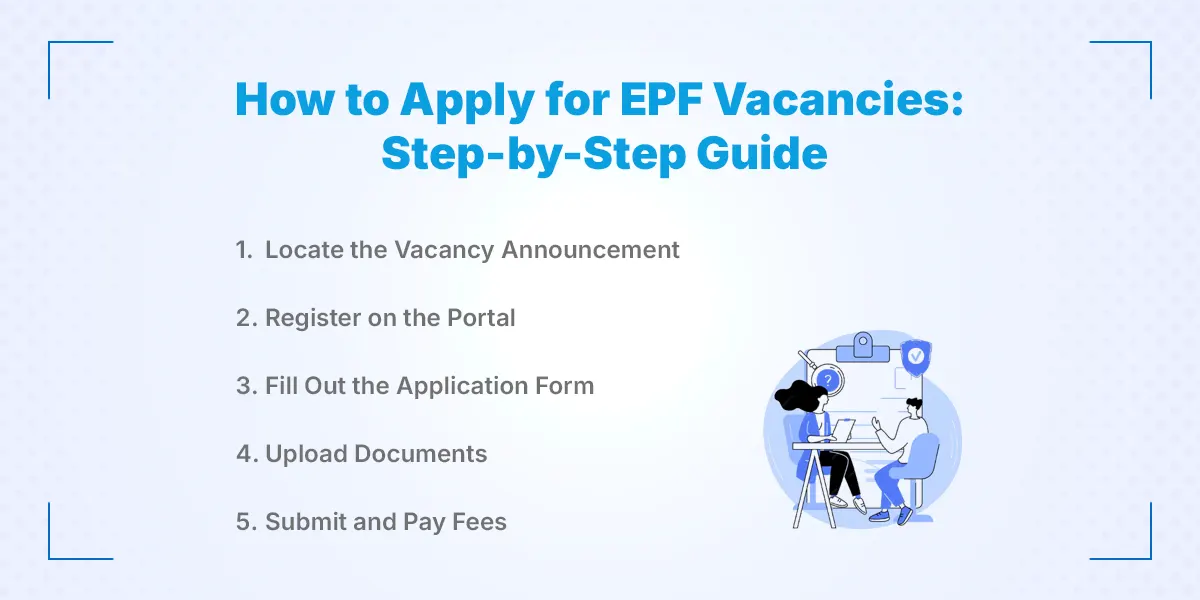
How to Apply for EPF Vacancies: Step-by-Step Guide
To apply for EPF Vacancies, first find the official vacancy notice, then register online, fill the application form, upload your documents, and finally submit with the required fees. This process helps make sure your application is complete and accepted. In this section, we explain each step in very simple and clear words, so you can follow easily from start to finish.
1. Locate the Vacancy Announcement
The first step is to find the official job notice for EPF Vacancies. You should always check the Employees Provident Fund (EPF) official website or trusted job portals. The vacancy announcement tells you the post name, number of openings, age limit, qualifications, pay scale, and last date to apply. Read the notice carefully so you know all the requirements before you start. Make sure the post you want to apply for matches your qualifications and skill level. If you miss reading the notice properly, you might make mistakes in your application. Always note down important dates from the announcement.
2. Register on the Portal
Once you know the vacancy is open, you must register online on the official application portal. Go to the EPF job registration website and create your account. You will usually need your full name, email, phone number, and a username and password. After registration, you will get a login ID to access the application form. Save your login details so you can use them again later. Registration helps EPF track your application and send updates.
3. Fill Out the Application Form
After registration, log in and open the application form for the job post you want. The form will ask for basic details like your name, address, education, work experience, and job preferences. Write all information carefully and check for spelling mistakes. Be honest and make sure everything is correct. If you give wrong information, your application may be rejected later. Take your time and double‑check each section before moving on.
4. Upload Documents
Now you need to upload scanned copies of your documents. These usually include your citizenship certificate, academic certificates, marksheets, passport-size photo, and signature. The EPF portal will tell you the exact size and format needed for each file. Make sure your scans are clear and readable before uploading. If a document is missing or unclear, the application might be rejected. Once all files are uploaded, check each one again to be sure they are correct.
5. Submit and Pay Fees
The final step is to submit your form and pay the application fee if required. After you check the form and documents, click the submit button. You may be directed to an online payment page for the fee. Use a debit card, credit card, or online banking to pay. Keep the payment receipt or screenshot as proof. Once the fee is paid and the form is submitted, you will usually get a confirmation message or email. This means your application is complete.
Eligibility Criteria for EPF Vacancies
Finding the right eligibility rules is important before you apply for EPF Vacancies. These rules tell you if you are allowed to apply or not. In this section, we explain the general eligibility points like age limit, education, experience, and special conditions in simple words. This helps you know what you must have before you start your application.
1. Age Limit
Most EPF job posts require candidates to be within a certain age range at the time of the last date of application. For lower-level posts like Assistant or Head Assistant, the age usually starts from 18 years with upper limits around 35 years. For posts like Assistant Manager or Deputy Manager, the minimum age is usually 21 years, and upper limits can be up to 35 or 45 years, depending on the post and work experience needed. Women and candidates with disabilities often get a higher age limit than general applicants for the same post. Permanent employees of EPF may not have an age limit for internal recruitment.
2. Educational Qualification
Each post has a different education requirement. For example, higher-level positions such as Assistant Manager and above typically require a Bachelor’s or Master’s degree in management, finance, IT, law, or related fields. For technical posts like IT support, you must have a degree in computer science or IT. Entry-level jobs, such as Assistant (Level 4), may require only +2 or high school completion, plus sometimes a pre‑qualification certificate from Lok Sewa Aayog. Your documents must clearly show your education level before you apply.
3. Work Experience
Some upper-level posts need work experience, too. For example, Manager and Deputy Manager posts may require several years of experience in a government or similar organization at a certain level. This means you should have worked in a related role before applying. For many lower posts, like Assistant or Senior Assistant, work experience may not be required. Always check the specific notice for the post you want before applying.
4. Other Conditions
In some cases, EPF may ask for special certificates, such as inclusive certificates, if you are applying under a quota such as Madhesi, Dalit, or Adivasi/Janajati. You must have valid documents from the local authorities to prove your category. If your degree was from a foreign university, you must attach an equivalency certificate from Tribhuvan University or a similar body to show it matches Nepali standards. If you do not have the right certificates, your application may be rejected.
How are EPF Applications Processed?
EPF applications are checked for completeness, shortlisted based on tests and interviews, and finally, selected candidates are listed for appointment. This shows the whole process in one line, so you know exactly what happens after you apply. Each step ensures that only qualified and prepared candidates move forward, making the process fair and organized. Let’s look at each part of the process in simple words so you can understand clearly.
1. Application Review Stage
After you submit your application, the EPF office first checks all forms and documents carefully. They make sure you fill every field correctly, upload all required files, and pay the fees. If something is missing or wrong, your application may not move forward. Only complete and correct applications are accepted for the next steps. This step ensures fairness and saves time for both candidates and the office.
2. Written Exam or Test
Many EPF posts require a written exam to check your knowledge and skills. The test usually includes questions about general knowledge, job-specific topics, and basic aptitude. Only candidates who pass or score well are allowed to move to the next step. This ensures that applicants understand the knowledge needed for their role. It is an important part of the selection for all mid- and higher-level posts.
3. Interview or Skill Test
Shortlisted candidates are then called for a personal interview or skill test. In this step, officials check how well you can handle job tasks and answer questions. For technical jobs, a practical test may also be done. This helps EPF see who can perform well in real work situations. Doing well in this step increases your chances of selection.
4. Final Merit List
After all exams and interviews, EPF prepares a final merit list based on scores. Candidates with the highest scores are selected first. There may also be a waiting list for backup candidates. This list decides who will be offered the job. It is published officially and shows the final result of your application.
5. Appointment Recommendation
The last step is giving the appointment letter to selected candidates. You may need to show your original documents for verification. Once everything is confirmed, EPF officially appoints you to your post. After this, you start working in your chosen position. This completes the entire application and selection process.
What are the Benefits of Working in EPF?
Working in EPF gives you job security, a good salary, and a balanced work-life with government perks. These benefits make EPF one of the most preferred places to work in Nepal. In this section, we explain each benefit clearly so you can understand why joining EPF can be a smart choice for your career and life.
1. Job Security and Growth Prospects
Working in EPF provides strong job security because it is a government organization. Once you are selected, your position is stable and protected under the law. There is less worry about sudden layoffs compared to private companies. EPF also offers opportunities for promotions and career growth. Employees can move from lower positions to higher posts based on experience and performance. Long-term employees often gain more responsibilities and recognition over time. The stable environment also allows you to focus on learning new skills without job fear.
2. Salary Structure and Allowances
EPF jobs come with a fixed and reliable salary that is paid on time every month. The salary is often higher than similar positions in smaller private offices. In addition to the base salary, employees receive allowances like travel, medical, and housing, depending on the post. Over time, promotions increase your pay and benefits. There are also regular increments based on government rules. This makes financial planning easier for employees. The clear pay structure helps employees know exactly what to expect each month.
3. Work-Life Balance and Government Job Perks
EPF provides a good work-life balance because office hours are fixed and leave policies are fair. You usually get national holidays off, plus annual leave, sick leave, and casual leave. Being a government job, EPF also provides other perks such as insurance coverage, retirement benefits, and sometimes staff welfare programs. Employees can plan their personal lives and family matters more easily than in many private companies. Overall, the job supports both your career and personal life in a balanced way.
Where to Find EPF Vacancies?
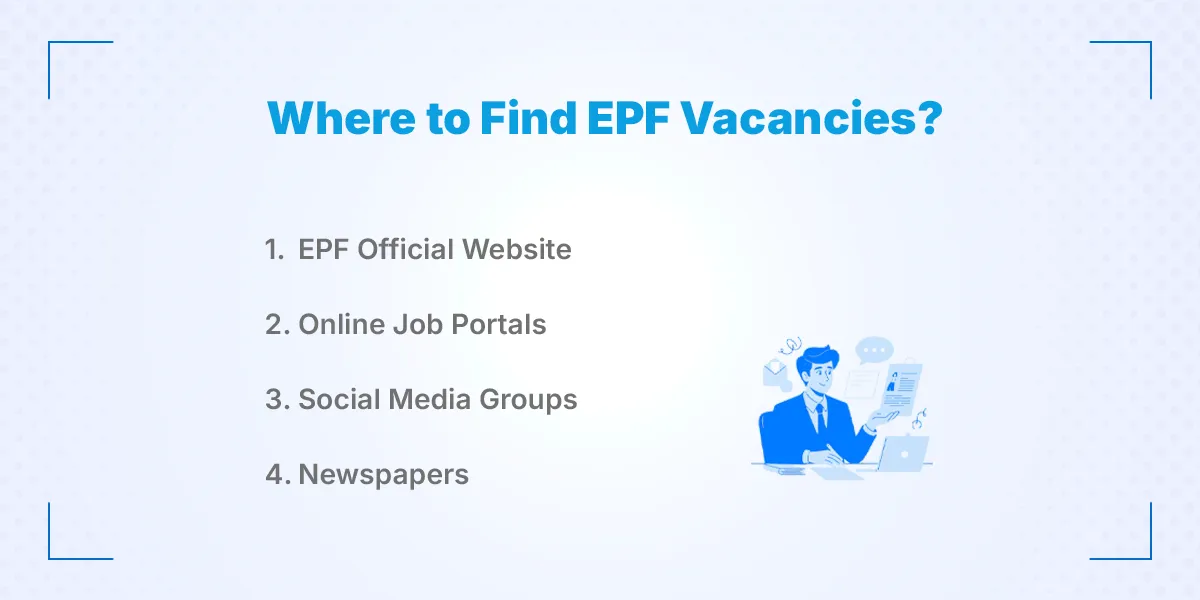
TLTR: You can find EPF Vacancies on the official website, online job portals, social media, and newspapers. Knowing where to look saves time and ensures you don’t miss any announcements. In this section, we explain each source in simple words so you can easily track EPF job openings.
1. EPF Official Website
The official EPF website is the most reliable source for job announcements. All new vacancies are first posted here with full details like eligibility, number of posts, and last date to apply. You can download the official notice and check the application instructions directly. This source ensures you get correct and updated information. You can also register or create an account if online applications are needed. Checking the website regularly is a good habit for serious job seekers. The official website prevents misinformation from other sources.
2. Online Job Portals
Many websites in Nepal share EPF job announcements for easy access. Trusted portals like Kumari Job collect vacancy notices from different government offices and display them in one place. You can search by post, location, or deadline. Some portals also allow email notifications when new jobs are published. However, always cross-check with the EPF official notice to make sure the information is correct. These portals save time because you don’t have to visit multiple sites. They are especially helpful for people who cannot check the EPF website every day.
3. Social Media Groups
Social media platforms like Facebook and LinkedIn have groups that share EPF vacancies and updates. Members of these groups often post reminders about deadlines or new job openings. You can join these groups and get notifications directly on your phone. Be careful to verify the information with the official EPF notice before applying. Social media is useful for tips and discussions about the application process. It also helps you connect with others who are applying for similar posts.
4. Newspapers
EPF job announcements are sometimes printed in national newspapers. These include papers like Gorkhapatra, Kantipur, and Annapurna Post. Newspapers are helpful for people who do not use the internet regularly. The vacancy notice in the paper contains the official details, including eligibility, post name, and deadline. Always read carefully and follow instructions from the official notice. Newspapers can also give extra details about the job process that online sources may skip.
Conclusion
Applying for EPF Vacancies is a clear and organized process if you follow the right steps. First, you need to find the official job notice and check if you meet all eligibility criteria. Then you register on the portal, fill out the application carefully, upload all required documents, and submit the form with the fees. After submission, your application goes through review, tests, and interviews before final selection.
Working in EPF gives strong job security, a good salary, career growth, and government benefits. By understanding the process, preparing your documents, and following instructions carefully, anyone can confidently apply and increase their chances of getting selected for a rewarding job in EPF.
Frequently Asked Questions
Submit your comments

Get Our App On



What is the Public Relations Officer Salary in Nepal
VIEW DETAILS
What Is the Salary of a Ticketing Officer in Nepal?
VIEW DETAILS
What Is the Salary of a Travel Consultant in Nepal?
VIEW DETAILS
How to Become an Auditor in Nepal
VIEW DETAILS


Loading Comments...