




HR careers in Nepal are continuing to grow as companies strengthen their hiring systems, payroll processes, and workplace support. Firms across banking, software, hospitality, education, aviation, manufacturing, and development projects now recruit people who can manage interviews, maintain records, guide new staff, and support daily operations. Demand rises because organisations want smoother workflows, clear policies, and fair management practices.
This guide explains the scope of HR in Nepal, how HR roles function, what abilities hiring teams expect, current salary levels, major growth areas, and steps useful for beginners starting an HR career. Each section remains simple, direct, and practical, allowing readers to see opportunities clearly and make confident choices for 2026.
In this blog
What is HR and What Do HR Professionals Do?
HR is a department or function that manages people, workplace systems, and staff processes within an organisation. HR professionals handle recruitment, training support, payroll updates, attendance monitoring, and employee relations to keep daily work organised. They screen applicants, arrange interviews, guide new hires, maintain records, solve minor conflicts, and support managers during performance reviews. These tasks help reduce confusion, improve communication, and create a steady workflow that supports company growth.
HR work also strengthens long-term progress by improving hiring quality, lowering turnover, maintaining fair policies, and supporting productive teams. Clear systems, organised documentation, and consistent communication help build a safer and more positive work culture.
HR Assistant manages scheduling, paperwork, simple communication, and initial recruitment steps. The HR Officer is responsible for managing full hiring cycles, onboarding, payroll entries, compliance checks, and employee coordination. HR Manager oversees policy planning, supervises HR staff, designs training, handles complex issues, and ensures workforce practices align with organisational goals.
Why is HR Becoming So Important in Nepal?
HR is becoming popular in Nepal because many organisations now rely on structured hiring, organised payroll systems, and clear staff support to manage growing teams more efficiently. Companies expand branches, introduce formal procedures, upgrade internal workflows, and need people who can handle recruitment, documentation, and employee coordination with accuracy and consistency. As teams grow larger and roles become more specialised, HR provides the structure needed to maintain order, reduce mistakes, and support steady performance across departments.
Demand rises due to several key changes:
- Corporate expansion: Banks, insurance groups, telecom companies, hotels, and schools open new branches and require HR teams to manage recruitment and staff placement.
- Growth of IT firms: Software companies and tech startups frequently hire, creating a strong need for HR staff who can manage interviews, onboarding, and skill-based hiring.
- Higher staffing needs in NGOs and INGOs: NGO and INGO jobs demand regular recruitment, contract management, and compliance support across multiple districts.
- Shift toward formal systems: Companies move from manual processes to HRMS platforms, payroll software, and digital attendance tools, which increases the need for trained HR professionals.
- Focus on employee support: Workplaces now value fair policies, organised documentation, health support, and performance management, all handled by HR teams.
- Need for a consistent work culture: HR helps build discipline, reduce confusion, and support positive behaviour inside offices, which improves long-term productivity.
These factors increase the value of trained HR workers who can manage people, maintain records, use digital tools, and support daily operations. As more sectors expand, HR roles gain stronger long-term prospects across Nepal.
Scope of HR in Nepal (2026 Updated)
The scope of HR in Nepal grows each year as firms expand teams, open new branches, and adopt structured people management. HR opportunities appear in almost every sector because groups now value organised hiring, clear payroll systems, and steady staff support. Entry roles, mid-level roles, and senior posts create a full career ladder that suits beginners and experienced workers.
Private companies hire large numbers of HR staff to provide recruitment services, performance tracking, salary processing, and training plans. Government offices need HR workers for record management, staff placement, and policy execution. NGOs and INGOs run projects across many districts, which creates openings for HR officers, coordinators, and managers who can handle field hiring and compliance. These varied options give job seekers a wider choice and stronger security.
Career growth remains steady because every organisation depends on HR to maintain smooth operations. People who start as assistants often move into officer roles within a short period after gaining experience. Those who continue learning HRMS tools, payroll systems, labour laws, and communication skills progress into executive or managerial roles. Many professionals also grow into training, talent acquisition, and consulting positions.
HR is considered a future-proof career in Nepal because workplaces now rely on structured systems rather than informal methods. Growing use of HR software creates demand for people with digital skills. Rising competition pushes companies to invest in employee retention, wellness, and productivity, which increases HR involvement. Since every sector needs organised workforce management, HR careers remain stable, scalable, and relevant for 2026 and beyond.
Is HR a Good Career in Nepal?
Yes, HR is a good career in Nepal because demand grows steadily across many sectors. Organisations want structured hiring, clear communication, and organised payroll systems, which increases the need for trained HR staff. The field suits beginners and experienced workers who prefer office-based roles with stable growth.
Key reasons HR is a strong career choice in Nepal:
- High demand across industries: Banks, IT companies, NGOs, INGOs, hotels, schools, hospitals, and manufacturing units hire HR staff regularly.
- Clear career path: Beginners start as interns or assistants and can grow into officer, executive, manager, or HR business partner roles with experience.
- Stable work environment: HR positions usually offer fixed working hours, structured responsibilities, and predictable monthly income.
- Skill-based progression: Growth depends on communication ability, HRMS skills, labour law knowledge, and practical recruitment experience.
- Important role in companies: HR reduces hiring mistakes, improves workplace communication, manages training, and supports staff, which makes the role essential in almost every organisation.
- Long-term career security: As companies expand branches and adopt digital HR systems, the need for skilled HR professionals continues to rise through 2026 and beyond.
HR suits people who enjoy coordination, communication, and supporting staff through daily office activities.
Types of HR Jobs Available in Nepal
HR roles in Nepal cover entry-level tasks, mid-level responsibilities, and senior decision-making. Companies recruit people for different positions based on hiring needs, payroll workload, staff size, and training requirements. Each role supports daily operations and helps maintain organised systems inside offices. The following positions show common HR jobs available across banks, tech firms, NGOs, manufacturing units, hotels, schools, and corporate groups.
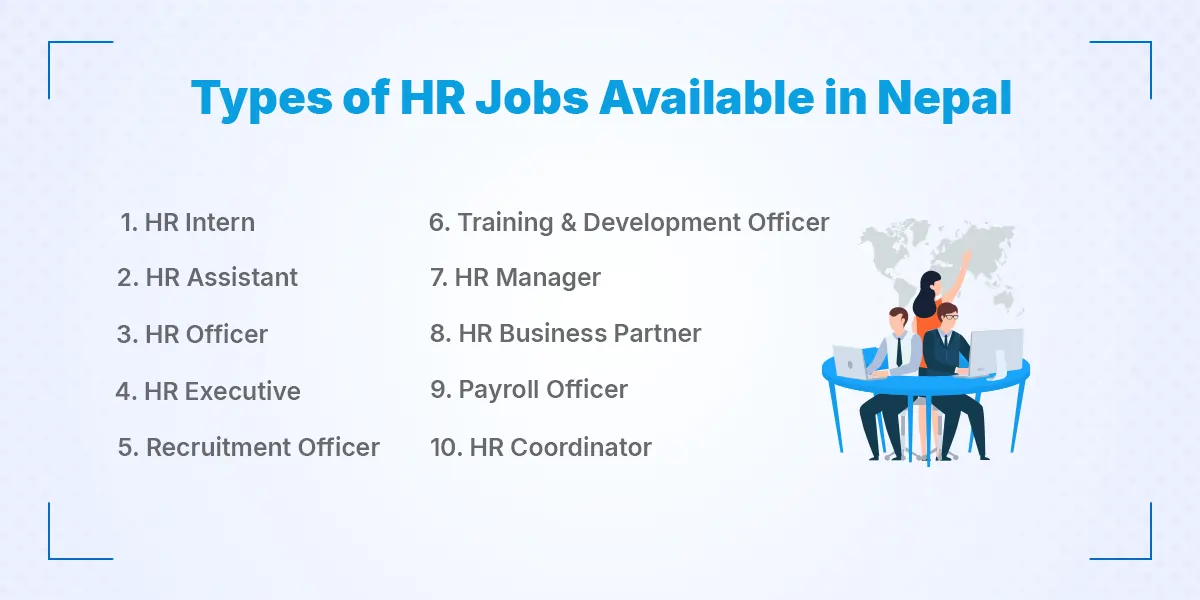
1. HR Intern
HR Intern supports basic tasks such as scheduling interviews, sorting CVs, updating records, and assisting supervisors. This role helps beginners learn recruitment steps, documentation, and workplace processes.
2. HR Assistant
HR Assistant manages clerical work, attendance updates, simple payroll entries, and communication with applicants. Assistants help ensure files stay organised and interviews run smoothly.
3. HR Officer
HR Officer handles full recruitment cycles, onboarding, salary updates, compliance checks, and staff support. Officers serve as the main link between employees and management.
4. HR Executive
HR Executive manages advanced tasks such as performance reviews, training plans, reports, and policy implementation. Executives support officers and guide assistants during key processes.
5. Recruitment Officer
The Recruitment Officer focuses on job postings, screening, interviews, selection, and joining procedures. This role suits people who enjoy speaking with applicants and managing hiring flows.
6. HR Coordinator
HR Coordinator manages communication between departments, prepares reports, maintains calendars, and ensures smooth execution of HR activities. Coordinators help align HR tasks with daily operations.
7. HR Manager
HR Manager oversees HR teams, creates policies, leads training programs, manages complex issues, and guides senior decisions. This role requires strong communication, leadership, and planning abilities.
8. HR Business Partner
HR Business Partner works directly with management to support planning, workforce strategies, and performance improvement. This role focuses on aligning employee practices with company goals.
9. Payroll Officer
The Payroll Officer handles salary processing, deductions, allowances, attendance integration, and compliance with labour rules. Accurate payroll work supports trust and smooth monthly operations.
10. Training and Development Officer
A Training and Development Officer designs learning programs, arranges skill sessions, and tracks employee progress. This role improves staff performance and helps companies build stronger teams.
What is the Average Salary of HR Professionals in Nepal?
The average salary of HR professionals in Nepal is 18,000 to 120,000 NPR per month, depending on role, experience, sector, and skills. Salaries rise when staff understand payroll systems, HRMS tools, compliance rules, documentation, and recruitment workflows. The ranges below show common earnings across different levels for 2026.
1. Entry-Level Salary Range
Entry-level roles such as interns and assistants usually earn 18,000 to 30,000 NPR monthly. Offices may offer higher pay when tasks include payroll entries, attendance handling, or recruitment support. Fresh graduates with HR training receive faster growth and slightly stronger starting figures.
2. Mid-Level Salary
Mid-level positions like HR Officer or HR Executive usually receive 30,000 to 55,000 NPR monthly. Staff at this level manage interviews, documentation, onboarding, conflict handling, and basic compliance. People with strong communication, labour law knowledge, and HRMS skills often reach the upper range quickly.
3. HR Manager Salary
HR Managers usually earn 60,000 to 120,000 NPR monthly. Larger companies, banks, hotels, and INGOs often offer higher pay for managers who guide teams, lead policy work, and handle complex employee issues. Salary rises when managers oversee multiple branches or large workforces.
4. Salary Differences Across Sectors
- Banks: Provide some of the strongest HR salaries, especially for officers and managers.
- NGOs/INGOs: Offer competitive pay because projects require constant recruitment and field coordination.
- Corporate and Manufacturing: Provide stable mid-range salaries with steady growth.
- IT Companies: Offer strong pay for HR staff who understand digital tools, payroll software, and fast-paced hiring cycles.
What are the required Skills to work as HR in Nepal?
To work as HR in Nepal, you need a mix of communication abilities, technical knowledge, and practical HR experience that support recruitment, payroll handling, staff coordination, and documentation. Employers look for people who can work with accuracy, maintain clear records, and communicate well with employees and managers. The skills below help candidates perform confidently and get HR jobs quickly.
1. Communication and Leadership Skills
HR staff speak with applicants, employees, supervisors, and management every day, so clear communication is essential. Good listening, simple explanation, and confident presentation help during interviews, orientation sessions, and training discussions. Leadership skills support teams during conflict resolution, staff motivation, and policy implementation.
2. Recruitment and Interviewing Skills
Recruitment requires understanding job needs, preparing vacancy posts, filtering applications, and selecting suitable candidates. HR professionals must identify skill gaps, ask relevant interview questions, evaluate behaviour, and choose applicants who can perform well. Strong interviewing ability reduces hiring errors and improves staff quality.
3. Payroll Processing
Payroll processing includes salary calculation, attendance checks, bonus entries, deductions, tax updates, and monthly reports. HR staff must work with accuracy because mistakes affect staff trust. Knowledge of timekeeping tools, leave tracking, and allowance structures helps maintain smooth monthly payroll cycles.
4. HR Documentation and Compliance
HR professionals maintain appointment letters, contracts, personal files, medical documents, disciplinary records, and training reports. Proper documentation ensures internal audits run smoothly and keeps sensitive information organised. Compliance skills help HR follow company rules, maintain transparency, and avoid legal issues.
5. Knowledge of the Nepal Labour Act
Understanding labour laws helps HR manage working hours, leave rights, public holidays, overtime rules, notice periods, and contract terms. This knowledge protects employees and reduces the risk of disputes. HR staff must stay updated on policy changes to ensure correct application across departments.
6. HR Software Skills (HRMS and Payroll Tools)
Modern offices use HRMS for attendance, payroll, onboarding, performance reviews, and document storage. HR staff with software skills complete tasks faster and reduce manual errors. Knowledge of digital tools also supports reporting, analysis, and smoother communication between departments.
7. Employee Relations and Performance Management
HR professionals handle staff concerns, maintain positive workplace behaviour, and support supervisors during evaluations. Strong employee relations reduce turnover, build trust, and improve teamwork. Performance management skills help guide employees through goals, feedback sessions, improvement plans, and career development activities.
What is the Future Scope of HR in Nepal?
The future scope of HR in Nepal continues to expand as organisations upgrade systems, focus on staff development, and rely on structured management practices. Companies now look for HR professionals who can combine people skills with digital knowledge. These trends create strong opportunities for new and experienced candidates across many sectors.
1. HR Digitalisation (HRMS, Automation, AI Tools)
Many firms shift from manual work to digital platforms. HRMS systems manage attendance, payroll, onboarding, and performance tracking with higher accuracy. Automation reduces repetitive work, and AI tools help screen CVs, track engagement, and analyse workforce data. This shift increases demand for HR staff who can handle technology and run processes smoothly.
2. Growing Trend of Employee Wellness and Training
Companies invest more in training programs, mental wellness support, skill development, and staff engagement. HR teams design sessions, track progress, and improve productivity through structured learning. This creates more roles in training, development, and employee support functions.
3. More Companies Are Hiring HR Teams
Firms across banking, IT, manufacturing, hospitality, and education continue to grow. Larger teams require stronger hiring systems, payroll stability, and consistent communication. As organisations expand branches and projects, the need for HR assistants, officers, executives, and managers rises each year.
4. Expansion of Outsourcing and HR Consulting Companies
Many organisations rely on external HR services for recruitment, payroll handling, compliance checks, and training. Consulting firms and outsourcing agencies now offer these services across Nepal. This expansion creates additional job openings for people who want practical HR experience, faster growth, and broader exposure.
Industries With High HR Demand in Nepal
Several sectors in Nepal continue to hire HR professionals because structured staff management supports productivity, compliance, and smooth daily operations. These industries require people who can manage recruitment, payroll, training, and employee support with consistency.
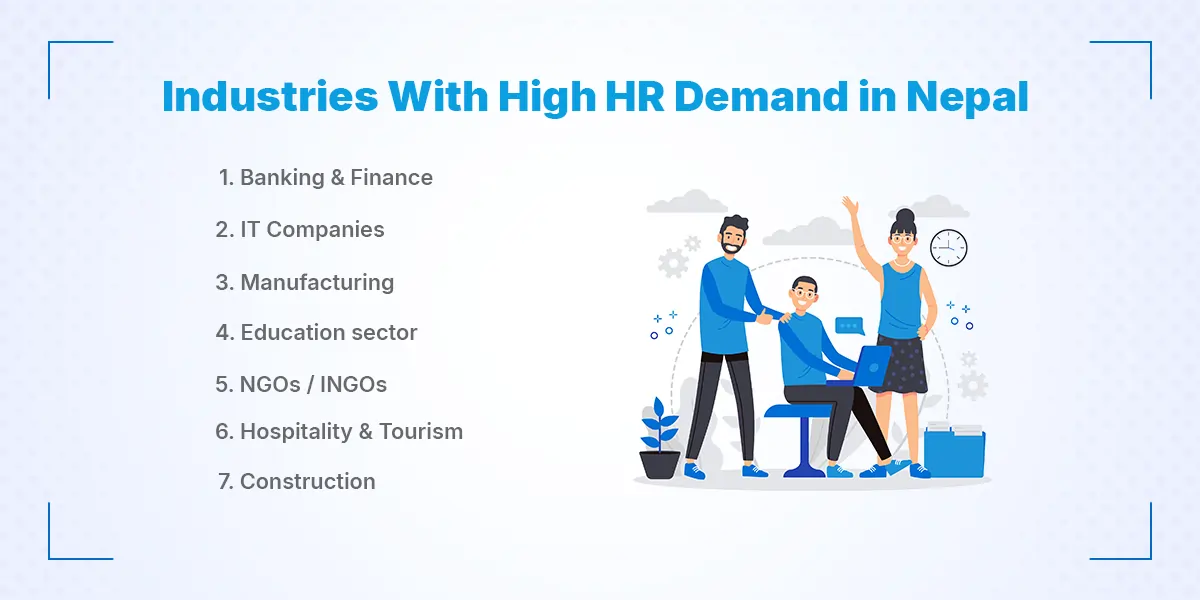
1. Banking and Finance
Banks expand branches, hire large teams, and follow strict compliance rules. HR staff manage screening, onboarding, transfers, payroll checks, and performance tracking. Demand remains high because banking roles require organised processes and steady workforce planning.
2. IT Companies
Software firms hire new talent frequently. HR teams handle fast-paced recruitment, skill-based interviews, workplace coordination, and training sessions. Growing IT startups and outsourcing companies increase demand for HR staff who can work with digital tools and structured hiring systems.
3. Manufacturing
Factories and production units employ large workforces. HR professionals manage shift planning, attendance, labour documentation, and grievance handling. This sector needs HR staff who understand labour laws and can maintain discipline and safety standards.
4. Education Sector
Schools, colleges, and training centres recruit teachers, administrative staff, and support teams. HR professionals manage hiring, contracts, payroll, and performance reviews. Growth in private education increases the need for organised HR processes.
5. NGOs and INGOs
Development projects require constant hiring for field roles, technical positions, and administrative teams. HR staff handle recruitment across multiple districts, maintain compliance, and support project requirements. INGOs often offer stronger pay and seek HR officers with strong communication skills.
6. Hospitality and Tourism
Hotels, resorts, travel groups, and airlines need HR teams for hiring, training, service-quality monitoring, and employee relations. Seasonal demand and rapid staff turnover make HR essential in this sector.
7. Construction
Construction firms manage large labour groups, contractors, and technical teams. HR staff handle attendance, safety training, contracts, and compliance with labour regulations. Growth in infrastructure projects increases HR demand for site-level coordination and workforce management.
Challenges in HR Careers in Nepal
HR jobs in Nepal offer strong growth, yet several challenges affect daily work and long-term progress. These issues appear in small firms, large companies, and project-based organisations.
1. Talent Shortage
Many companies struggle to find HR staff with practical recruitment skills, payroll knowledge, and Labour Act understanding. Beginners often lack hands-on exposure, which slows hiring and increases workload for existing teams.
2. Lack of Advanced HR Training
Training options remain limited, and many courses focus on theory rather than real tasks such as HRMS use, compliance, and performance management. This gap creates difficulty when companies expect immediate results from new HR staff.
3. Compliance Issues
HR professionals must follow Labour Act rules for leave, overtime, contracts, and disciplinary actions. Mistakes cause disputes and legal risks. Staying updated on policy changes requires regular learning and careful attention.
4. Balancing Employee Expectations
Employees seek fair pay, clear communication, growth opportunities, and supportive work environments. HR must balance these expectations while maintaining company rules, which can be challenging during conflicts or high-pressure periods.
5. Managing Digital Transformation
Many offices shift to HRMS platforms, attendance tracking tools, and automated payroll systems. HR staff must adapt quickly, learn new software, and manage both digital and manual processes during transition periods. This shift increases workload but also improves long-term efficiency.
How to Become an HR Professional in Nepal (Step-by-Step Guide)
To become an HR professional in Nepal, you can develop basic HR knowledge, gain practical training, and build experience through entry-level roles. Companies expect candidates to understand recruitment, payroll, documentation, and employee support before taking full responsibility. Learning HRMS tools, Labour Act rules, and communication skills also strengthens career growth. With steady practice and the right training, beginners can start from assistant roles and progress toward senior positions.
1. Complete +2 or Bachelor’s Degree
Any faculty suits HR roles, though management backgrounds offer a slight advantage. Formal education helps candidates understand workplace systems and communication requirements.
2. Learn HR Fundamentals
Learning basic HR processes such as interviews, onboarding, documentation, payroll support, and employee coordination prepares beginners for office tasks.
3. Join a Job-Oriented HR Training
You can join a practical, job-oriented HR training program like the HR training to build skills in payroll, recruitment, HR documentation, and HR software. This training gives beginners immediate practical confidence.
4. Do Internships to Gain Experience
Internships offer real exposure to hiring tasks, record updates, communication handling, and attendance systems. Practical experience increases job selection chances.
5. Build Skills in HRMS, Payroll Software, and Recruitment Tools
Digital systems help HR teams process tasks faster. Learning HRMS, payroll software, and communication tools improves accuracy and performance.
6. Apply for HR Assistant or HR Officer Roles
Entry roles allow beginners to handle basic tasks, learn company procedures, and support officers and managers. These positions build the foundation for long-term growth.
7. Grow into an HR Executive or HR Manager Role
With experience, strong communication, and continuous learning, professionals move into senior roles. These positions include policy planning, training design, and higher-level decisions.
Conclusion
HR offers a growing, stable career path in Nepal for students, fresh graduates, and working professionals who want office-based roles with clear structure. Companies across banking, IT, manufacturing, education, hospitality, construction, NGOs, and INGOs now rely on organised people management for smooth operations, so demand for skilled staff continues to rise. The scope of HR in Nepal keeps expanding as more organisations adopt HRMS tools, payroll systems, and formal hiring processes.
People with strong communication skills, basic labour law knowledge, and comfort with HR software can start from assistant or officer positions and move toward executive or managerial roles over time. Practical training, job-oriented courses, and internships help beginners gain confidence with real tasks like recruitment, documentation, and payroll support. With consistent learning, professional behaviour, and a focus on employee relations, anyone can build a solid, long-term HR career in Nepal for 2026 and future years.
Frequently Asked Questions
Submit your comments

Get Our App On



What is the Public Relations Officer Salary in Nepal
VIEW DETAILS
What Is the Salary of a Ticketing Officer in Nepal?
VIEW DETAILS
What Is the Salary of a Travel Consultant in Nepal?
VIEW DETAILS
How to Become an Auditor in Nepal
VIEW DETAILS


Loading Comments...