



Working at Nepal Television is not only about getting a job, but it is also about entering the studio where the stories of the nation are narrated. To several of the candidates, a Nepal Television vacancy is like a miraculous broadcast signal: you must be on time, and when it comes, you must be prepared. Being a state-owned national broadcasting company, Nepal Television has intensified the attraction of journalists, engineers, editors, administrators, and media professionals who desire stability with a spotlight. Competition may also be stiff, but when you are well prepared, your application does not need to get lost in the statistics.
In this blog, we will deconstruct all you need to know about Nepal Television vacancy, including the nature of the job vacancies that are commonly advertised by Nepal Television, the eligibility requirements and documents required, the selection procedure, and how to apply properly in a situation where a formal notice has been posted. Whether you are aiming for a communications job in Nepal or looking to enter the public service media sector, this guide will ensure that you are ready before the next opportunity opens. The next time you need a technical position, a newsroom position, or an administrative position, you'll have your pre-flight checklist ready.
In this blog
About Nepal Television
Nepal Television is Nepal’s government-owned national broadcaster, the original storyteller of the nation’s airwaves. Long before private channels multiplied like monsoon mushrooms, Nepal Television was already beaming news, culture, and cricket matches into living rooms across the country. As a public institution, it carries both responsibility and reputation, and that combination naturally makes a Nepal Television vacancy highly sought after.
The organisation operates through multiple departments, mainly News, Technical, and Administration. The News division handles reporting, editing, and content production. The Technical wing keeps cameras rolling and signals stable. Meanwhile, the Administration department ensures everything from finance to human resources runs without drama, at least off-camera.
Why Many Candidates Wait for Nepal Television Vacancy Announcements
- Government job stability that feels like a long-term contract, not a seasonal gig.
- Structured pay scale based on level and service category.
- National-level exposure in journalism, broadcasting, and engineering.
- Transparent recruitment process through formal advertisements.
- Inclusive reservation categories (Women, Madhesi, Adivasi Janajati, Dalit).
- Career growth opportunities within a respected public institution.
- The prestige of working where the country’s major stories first go on air.
Types of Job Vacancy in Nepal Television
Nepal Television does not have to just post the vacancy behind a camera or reading headlines. The broadcaster is a well-coordinated newsroom orchestra in which the journalists, engineers, editors, and administrative professionals are equally significant contributors in musical notes. Nepal Television advertises vacancies in various departments depending on the requirements of the operation, including creative, technical and managerial positions. Such roles make sure that the channel continues to produce news, entertainment and broadcasting of services to the citizens without any lapse. Being informed of these categories would make the applicants shoot their arrows in the right direction instead of shooting blindly in the job market.
1. News & Editorial Positions
The given category is the backbone of the storytelling of the broadcaster. Others, such as the Executive News Editor and Chief Producer, come under this segment and are related to planning of content, overseeing the newsroom and editorial quality. These roles rely on the professionals to determine the stories that are worthy of attention and the manner in which they will be displayed to the populace. They liaise with reporters, scriptwriters, and production departments to ensure that they are factual and report without bias. It is an area that combines leadership and creative decision making, part journalist, part general, part storyteller. Applicants normally need journalism or media studies or mass communication experience, and good editorial instincts.
2. Technical & Engineering Roles
An anonymous army of technical professionals stands behind every obvious broadcast signal. Engineer and Senior Assistant, Technical are some of the positions which are under this category. These jobs include the upkeep of broadcasting gear, transmissions, studio infrastructure and IT networks. Technical departments guarantee that live news does not stop in the middle of a sentence or disappear into the digital fog. The applicants normally are of engineering, electronics, or information technology. The job requires accuracy, troubleshooting talents, and the capacity to remain composed when technology chooses to rear up and throw his tantrums.
3. Production & Cinematography Positions
This segment has the visual beating of broadcast. The roles that are within this segment include Cameraperson, Executive Cameraperson, and Video Editor. Camerapersons visualise their narratives, whereas video editors craft rough footage into smooth and properly edited narratives which viewers actually find entertaining to watch. Executive camerapople tend to lead shoots and determine the quality of visual storytelling. All these positions combine innovativeness with technical expertise, where knowledge about cameras, lighting, editing software, and storytelling aesthetics is required. Imagine that they are visual translators who transform reality into entertaining screen experiences.
4. Administrative & Finance Positions
When the cameras and the microphones attract the eye, the administrative departments are silently ensuring that the organisation is running like a well-organised newsroom clock. Some of the positions that come under this category are Administrative Officer, Senior Administrative Officer, Accounts Officer, and Senior Assistant, Administration. These functions deal with human resources, financial management, policy coordination, and the logistics of its operations. Professionals working in administration jobs in Nepal make sure that salaries are paid, recruitment is done in a systematic way, and the departments run without difficulties. It is rather low profile than high profile, yet without it, the internal engine of a broadcaster would soon come to a halt.
5. Inclusive Category & Reserved Vacancies
Computer Recruitment policies also include Nepal Television, with the group of Women, Madhesi, Adivasi Janajati, and Dalit being reserved. Such vacancies are also meant to restore equal opportunity in employment and equal representation in national broadcasting. Applicants who are using such quotas compete in specific reservation quotas. This inclusion policy enhances social equity, besides fostering different kinds of viewpoints in the newsroom storytelling and organisational leadership. To a large extent, it assists the broadcaster in being more realistic in terms of the social mosaic of the country.
What Are the Eligibility Criteria for Nepal Television Vacancy?
The eligibility criteria for Nepal Television vacancies are structured around education, age limits, experience, and technical competence, depending on the level of the post. Since it is a government-owned broadcaster, recruitment follows formal standards rather than informal shortcuts. Higher-level positions demand stronger academic backgrounds and proven experience, while entry-level roles focus more on foundational qualifications. In short, it’s not just about passion for media; you need the paperwork to back the ambition.
1. Educational Qualifications by Level
The educational needs depend on the level of the job, but generally range from Level 5 to Level 9. The minimum level of education can be +2 or a bachelor's degree in the related courses. Officer and senior positions may require an undergraduate or graduate degree in journalism, mass communication, engineering, finance, administration, and other related fields. In technical jobs, one will usually require a degree in electronics, IT, or engineering. If you are a fresh graduate or just starting, searching for entry-level jobs in Nepal within the broadcasting sector is a smart way to gain foundational experience while meeting these initial educational requirements.
2. Age Limit Requirements
Like most government job vacancies, Nepal Television applies minimum and maximum age limits for applicants. Entry-level roles usually have a lower age threshold (often 18 years), while upper age limits may vary depending on the category and inclusion quotas. Reserved categories sometimes receive age relaxations as per government rules. It’s important to read the official notice carefully, because one year over the limit can close the door before you even knock. Age criteria are strict, and bureaucracy rarely bends.
3. Experience Requirements for Senior Posts
Senior-level positions such as Chief Producer or Executive-level roles typically require several years of relevant professional experience. Leadership roles expect candidates to have managed teams, handled projects, or supervised technical operations. Experience in broadcasting, newsroom management, engineering systems, or administrative leadership becomes crucial here. In these posts, theory alone won’t carry the day, practical exposure is the real currency. Nepal Television looks for professionals who have already weathered newsroom deadlines or technical breakdowns without losing composure.
4. Technical Certification (For Engineering & Media Roles)
In the case of engineering and technical media, it is possible to enhance an application with extra certifications. The engineers might require recognised technical licenses or accreditation by other concerned councils. Journalists, like video editors or cameraworkers, can be asked to show skills in editing programs, camera work, or broadcasting. Although not all posts require a long list of certificates, technical credibility is admittedly effective. In a profession that deals with accuracy, the skills to be taken should be quantifiable and not merely asserted as such.
How to Apply for Nepal Television Vacancy? Step-by-Step
To apply for Nepal Television vacancy, you must carefully follow the official recruitment process announced by the organisation. This isn’t the kind of job you apply for with a casual email and crossed fingers. Government recruitment works on structure, deadlines, and documentation. Missing one detail can send your application straight to the reject pile. So think of the process like following a recipe, skip an ingredient, and the result won’t taste right.
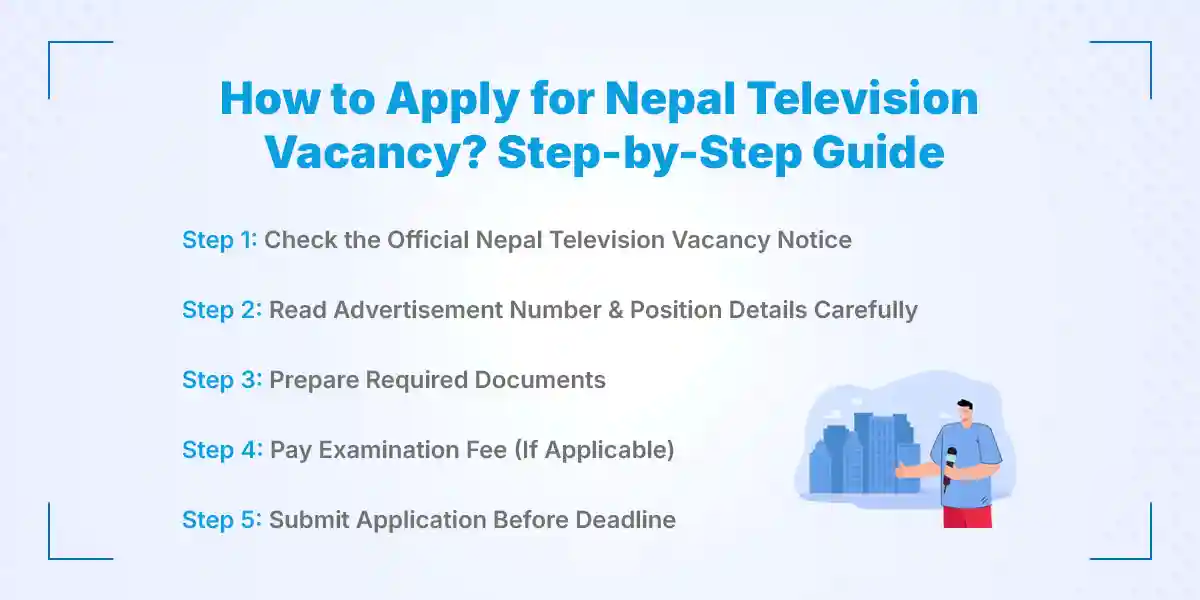
Step 1: Check the Official Nepal Television Vacancy Notice
Start by reviewing the official vacancy notice published by Nepal Television. This notice contains everything: position details, eligibility criteria, fee structure, deadlines, and advertisement numbers. Don’t rely on rumours floating around social media. Always cross-check with the official source. In recruitment season, clarity is your best friend.
Step 2: Read Advertisement Number & Position Details Carefully
Each vacancy in Nepal Television has a certain advertisement number and a level of the post. And line by line read the notice, yes, even the fine print. Consider the qualifications needed, service group, level and category required (open or inclusive). Most candidates do this in a hurry and submit their applications for positions they do not qualify for. And that is like taking the wrong bus and wishing it would take you to your destination.
Step 3: Prepare Required Documents
Gather all required documents before the deadline sneaks up on you. Typically, this includes academic certificates, a citizenship copy, experience letters (if required), and inclusion verification documents. Make sure copies are clear and properly attested if necessary. Keep both physical and digital versions ready. A well-organised file says more about your professionalism than you might think.
Step 4: Pay Examination Fee (If Applicable)
Most government job vacancies require an examination fee based on the post level. The notice will specify the amount and payment method. Ensure you pay within the deadline and keep the payment voucher or receipt safely. No receipt, no proof, and that’s a headache you don’t want. Think of the fee as your entry ticket to the competition.
Step 5: Submit Application Before Deadline
Finally, submit your application through the specified method, whether online or physical submission. Double-check every form field before submission. Deadlines in government recruitment are firm; there’s rarely a dramatic last-minute extension. Once submitted, keep a copy or confirmation for reference. After that, all you can do is prepare and wait, and perhaps resist refreshing the website every five minutes.
Documents Required for Nepal Television Job Vacancy
Applying for a Nepal Television job vacancy isn’t just about ambition; it’s about documentation. Government recruitment runs on paper trails, signatures, and verified credentials. Even the most talented applicant can be disqualified over a missing photocopy. So before you dream about newsroom debates or studio lights, make sure your document file is neat, complete, and ready for inspection. Think of it as assembling your professional identity in one carefully arranged folder.
1. Updated CV / Bio-Data
Your CV is your first introduction, your professional handshake on paper. It should clearly outline your education, experience, skills, and relevant achievements. Keep it structured and concise, not a life autobiography. For media and technical roles, highlighting specific tools, projects, or newsroom experience can make a strong impression. Updated CV can confuse reviewers, so clarity is key. Remember, recruiters scan before they study.
2. Academic Certificates & Transcripts
Nepal Television vacancy applications require verified proof of your educational qualifications. This includes certificates and mark sheets from SEE to higher education, depending on the post level. Make sure documents are properly attested if required. The qualification mentioned in the vacancy notice must exactly match your academic background. In government hiring, “almost qualified” doesn’t count.
3. Citizenship Certificate Copy
A copy of your Nepali citizenship certificate is mandatory to verify nationality and age. Ensure the copy is clear and legible, with all details visible. Any mismatch in name or date of birth between citizenship and academic documents can cause unnecessary complications. It’s a small document, but it carries big weight in official recruitment.
4. Experience Letters (If Required)
For senior or specialised positions, experience letters are crucial. These letters should clearly mention your role, duration of employment, and organisation details. Vague or informal letters may not be accepted. Nepal Television looks for relevant, documented experience, not just claims of “I’ve done similar work.” Professional verification speaks louder than self-confidence alone.
5. Inclusion Category Verification Documents
If you are applying under reserved quotas such as Women, Madhesi, Adivasi Janajati, or Dalit categories, official verification documents are required. These must be issued by authorised government bodies. Without proper certification, the application will be considered under the open category. Inclusion benefits are structured and regulated; documentation must match the claim.
Selection Process for Vacancy in Nepal Television
The selection process for vacancy in Nepal Television follows a structured, merit-based system no dramatic shortcuts, no surprise plot twists. As a government broadcaster, recruitment is designed to be transparent and competitive. From application review to final appointment, each stage filters candidates carefully. Think of it as a multi-round audition, except instead of applause, you earn your place through scores and performance. Understanding each stage helps you prepare smarter, not just harder.
1. Application Screening
The journey begins with application screening. Here, submitted forms and documents are reviewed to ensure candidates meet eligibility criteria. Educational qualifications, age limits, experience, and category claims are verified. If any required document is missing or incorrect, the application may be rejected at this stage. It’s the quiet but decisive first filter, like a gatekeeper checking tickets before anyone enters the arena.
2. Written Examination
Eligible candidates are typically called for a written examination. This test assesses subject knowledge, general awareness, and sometimes analytical or technical understanding, depending on the post. For news roles, questions may focus on current affairs and media ethics. For administrative or technical posts, the questions align with professional expertise. This stage separates preparation from mere intention, and yes, serious study pays off.
3. Practical Test (For Technical Positions)
For technical and production roles, a practical test may follow the written exam. Engineers might face troubleshooting tasks, video editors may be asked to edit footage, and camerapeople could demonstrate shooting techniques. This is where skills step out of theory and into action. In broadcasting, you can’t bluff your way through a live switchboard or editing console. Competence becomes visible very quickly.
4. Interview (HR + Technical Panel)
Shortlisted candidates are invited for an interview conducted by an HR and technical panel. The discussion often covers professional experience, problem-solving ability, communication skills, and understanding of the role. For state-owned broadcasters like NTV, it is essential to prepare for interview sessions by reviewing the specific service-related syllabus, staying updated on national current affairs, and practising the STAR (Situation, Task, Action, Result) method for behavioural questions. Senior-level candidates may also be evaluated on leadership and decision-making capacity. It’s not just about right answers; it’s about clarity, confidence, and composure. Consider it your chance to show the person behind the paperwork.
5. Final Merit List & Appointment
After all stages are completed, scores are compiled, and a final merit list is published. Selection is based on cumulative performance across exams, practical tests, and interviews. Candidates who secure top ranks receive appointment letters according to available posts. Once your name appears on that list, the long wait feels worth it. Until then, patience becomes part of the process.
Salary Structure and Benefits in Nepal Television Jobs
Working at Nepal Television comes with the stability and perks of a government job, but with the added thrill of being at the heart of national broadcasting. Salaries are structured according to official pay scales, with additional allowances for specific roles and levels. While technical experts can earn significantly more, the average salary in Nepal for entry-to-mid-level administrative staff typically aligns with the national civil service standards. Beyond the paycheck, employees benefit from career growth opportunities, skill development, and long-term job security. Think of it as a steady ship navigating dynamic media waters, safe yet full of professional currents to explore.
1. Government Pay Scale Based on Level (5-9)
Salaries in Nepal Television follow the government pay scale system, ranging from Level 5 (entry-level) to Level 9 (senior posts). Entry-level roles like Senior Assistants earn modest but steady pay, while top-level posts like Chief Producer or Executive News Editor receive higher pay reflecting responsibility. The scale is transparent and standardised, ensuring fairness and consistency. Think of it as climbing a structured ladder; each rung comes with its own reward.
2. Allowances & Benefits
Nepal Television employees receive various allowances, including house rent, travel, and operational benefits, depending on the post. Some roles also have duty-specific perks, such as field assignments or technical bonuses. Health benefits, retirement funds, and professional development opportunities may also be included. These perks add flavour to the basic pay, making the job not just a paycheck but a holistic package.
3. Career Growth in Public Broadcasting
Beyond salary, working at Nepal Television offers long-term career growth. Employees can move through levels based on experience, performance, and seniority. Skill development is encouraged through training programs and cross-department exposure. There’s also the prestige of working for the nation’s primary broadcaster, which can open doors in media, communications, or policy roles. In short, the career path is more like a climbing network than a straight ladder, full of opportunities if navigated wisely.
Why Apply for a Job Vacancy at Nepal Television?
Apply for a job vacancy at Nepal Television because it offers a unique blend of government job stability and exposure to the national media landscape. Working here isn’t just a paycheck; it’s a chance to be part of stories that shape the nation. Employees enjoy long-term growth, professional credibility, and the prestige of being in the country’s premier broadcasting house. For many, it’s the perfect mix of security and creativity, where ambition meets opportunity.
1. Government Job Stability
Nepal Television is a government-owned organisation, which means employees benefit from secure employment, regular pay, and structured career progression. Unlike private media, the risk of sudden layoffs is minimal, providing a steady professional foundation. Think of it as a safe harbour in the sometimes stormy seas of the job market. Plus, government perks and benefits further strengthen financial and job security.
2. Career in the National Media Sector
A position at Nepal Television places you at the heart of national media. Whether in news, technical, or production roles, you contribute to content that reaches millions. It’s a chance to work with cutting-edge broadcasting equipment and skilled colleagues, giving your career a front-row seat to media evolution. You also gain recognition and credibility within Nepal’s media industry.
3. Long-Term Professional Growth
Employees have clear paths for promotion, skill enhancement, and cross-department exposure. Training programs and senior-level mentorship help build expertise, preparing staff for higher responsibilities. Working here allows you to grow steadily, both in rank and capability, a career that matures like fine wine. Additionally, you can develop leadership skills and become a mentor for future colleagues.
4. Competitive Examination-Based Selection
Selection for Nepal Television vacancies is merit-based, often involving written exams, practical tests, and interviews. This ensures transparency and fairness, rewarding preparation and competence. For ambitious candidates, this is a golden opportunity to showcase talent and secure a coveted position in national media. Successfully clearing this process also boosts professional credibility and personal confidence.
Where to Find Official Nepal Television Vacancy Updates?
You can find Nepal Television vacancy updates on the official Nepal Television website and reliable online job portals like Kumari Job. These platforms act like a radar, picking up every new opening so you don’t have to endlessly refresh pages or hunt through newspapers. Staying updated through these sources ensures you never miss an opportunity in the country’s premier broadcasting house.

1. Official Nepal Television Website
The official website is the most trusted source for accurate and timely vacancy announcements. Each posting includes details like position, level, examination fee, and deadlines. Checking the site regularly keeps you ahead of the competition and ensures you get first dibs on application windows. Think of it as your direct line to the newsroom, straight from the source.
2. Online Job Portals
Portals like Kumari Job aggregate vacancies and often send email or app notifications when Nepal Television releases new openings. This makes tracking jobs much easier, especially if you’re applying for multiple roles. These portals can act like your personal assistant, ensuring you never miss an opportunity.
3. Newspapers
National newspapers also publish government job advertisements, including Nepal Television vacancies. While this method is more traditional, it remains relevant for candidates who prefer print or want an official reference. Think of it as catching the news twice, once digitally and once with a morning cup of tea.
Conclusion
Nepal Television remains one of the most sought-after workplaces in the country, offering a unique mix of government job stability, career growth, and exposure to the national media landscape. Even though there are no current vacancies, understanding the types of positions, eligibility criteria, and application process keeps you prepared for future opportunities. Being ready means you can act quickly when new openings are announced, giving you an edge over the competition. Think of it as sharpening your tools before the big project begins; preparation is half the success.
Staying updated through the official website and trusted portals like Kumari Job ensures you never miss a chance. With the right documents, preparation, and strategy, a career at Nepal Television can be rewarding, prestigious, and long-term. By following the steps outlined in this guide, aspiring candidates can confidently navigate the application process and secure a role in the nation’s premier broadcasting house.
Frequently Asked Questions
Submit your comments

Get Our App On



What is the Public Relations Officer Salary in Nepal
VIEW DETAILS
What Is the Salary of a Ticketing Officer in Nepal?
VIEW DETAILS
What Is the Salary of a Travel Consultant in Nepal?
VIEW DETAILS
How to Become an Auditor in Nepal
VIEW DETAILS


Loading Comments...