



When I talk to students starting out in digital marketing, I notice one massive misconception. Most people think SEO is just about putting keywords into a blog post. In reality, modern search optimization is much bigger than that.
Today, SEO has split into several specializations. Some experts fix backend code, others create content, and some build high-quality links.
If you want to build a career, freelance online, or get hired as an SEO specialist in Nepal, knowing just one skill is no longer enough. You need to understand how all the different types of SEO work together.
In this complete guide, I will break down the exact SEO types you need to master, why they matter in 2026, and how to start learning them step by step.
In this blog
What is SEO (Search Engine Optimization)?
SEO stands for Search Engine Optimization. Simply put, SEO means setting up your website so Google can easily read it and display it to people searching online. When your pages are well-organized and trustworthy, Google ranks them higher and brings you free, steady search traffic.
For businesses, higher rankings mean getting qualified leads without paying for ad clicks. As Nepal's digital market grows, learning SEO is one of the most reliable ways to build a high-demand career, whether you want to work with local companies or land remote freelance clients worldwide.
Why Should You Learn the Different Types of SEO?
Trying to learn SEO all at once can feel overwhelming. Breaking it down into clear categories makes the whole learning process much simpler and more structured.
Here is why knowing the different seo types helps you succeed:
- Helps you pick your ideal career path.
- Simplifies your learning step by step.
- Makes you far more hireable to agencies.
- Increases your freelance income and rates.
- Unlocks long-term growth in high-paying niches.
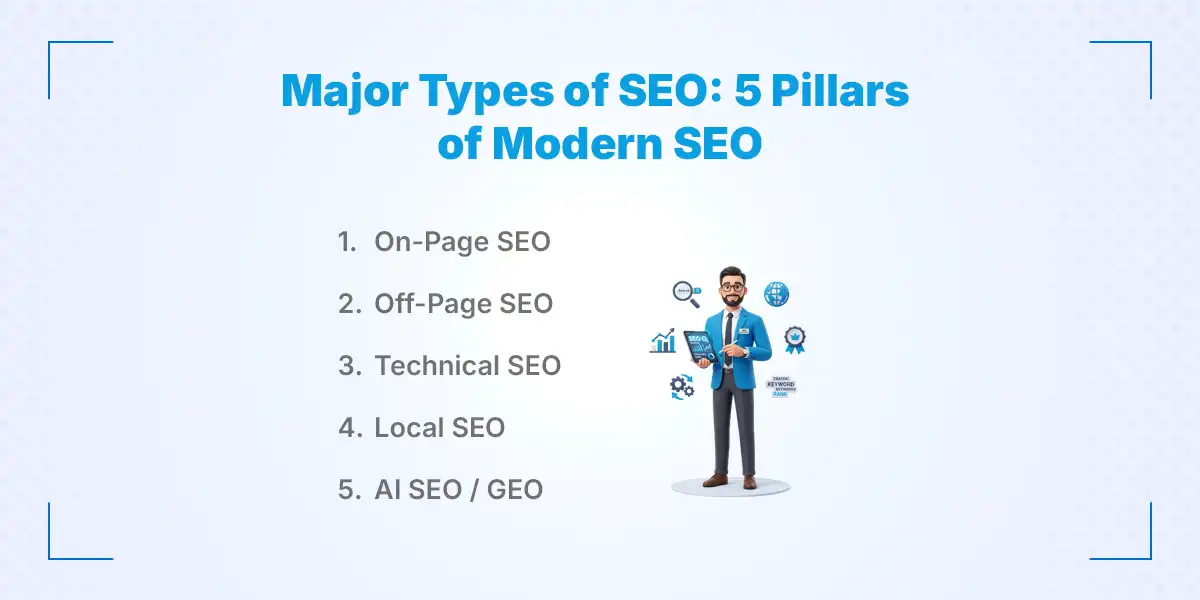
Major Types of SEO: The 5 Pillars of Modern SEO
Modern SEO is built on five major pillars: On-Page, Off-Page, Technical, Local, and AI SEO. Think of these as the primary foundation for any successful website strategy. Each type handles a different piece of the puzzle, working together to drive organic traffic and boost rankings. Let's explore how each pillar works so you can build a strong foundation.
1. On-Page SEO
On-page SEO optimizes the content directly on your web pages so search engines and readers understand it clearly. Its main goal is to rank your pages higher for targeted search terms. To do this, you place relevant keywords in titles, subheadings, and main text. For example, when writing a Pokhara trekking guide, you use clear headings (H1, H2, H3…) and link to related gear pages on your site.
2. Off-Page SEO
Off-page SEO focuses on actions outside your website to build its overall trust, authority, and web reputation. Its main goal is to show Google that your site is reliable and recommended by others. You do this by getting quality backlinks from respected websites and earning brand mentions. For example, when a top travel magazine links to your trekking guide, Google treats that link as a vote of confidence.
3. Technical SEO
Technical SEO fixes the backend structure of your website so search engine crawlers can easily index and load your pages. Its main goal is to make your site fast, secure, and mobile-friendly for both users and search bots. To achieve this, you speed up page loads, fix broken links, and secure pages with HTTPS certificates. For example, you compress heavy images so your page loads in under two seconds on smartphones.
4. Local SEO
Local SEO helps physical businesses rank higher in local search results for nearby customers. Its main goal is to bring local foot traffic and service calls directly to your doorstep. You do this by optimizing your Google Business Profile, gathering customer reviews, and adding your local address to online directories and review platforms like Search Commercia and Yellow Pages. For example, when someone in Kathmandu searches "dentist near me," local SEO helps your dental clinic appear in the Google Map Pack.
5. AI SEO / GEO (Generative Engine Optimization)
AI SEO, or Generative Engine Optimization, formats your content so AI tools like ChatGPT, Gemini, and Perplexity can cite your site in direct answers. Its main goal is to make your brand a trusted source in AI-generated summaries. To do this, you write short, clear answers and add structured schema code. For example, when someone asks ChatGPT for Kathmandu day-hike items, AI SEO ensures the tool pulls data directly from your blog.
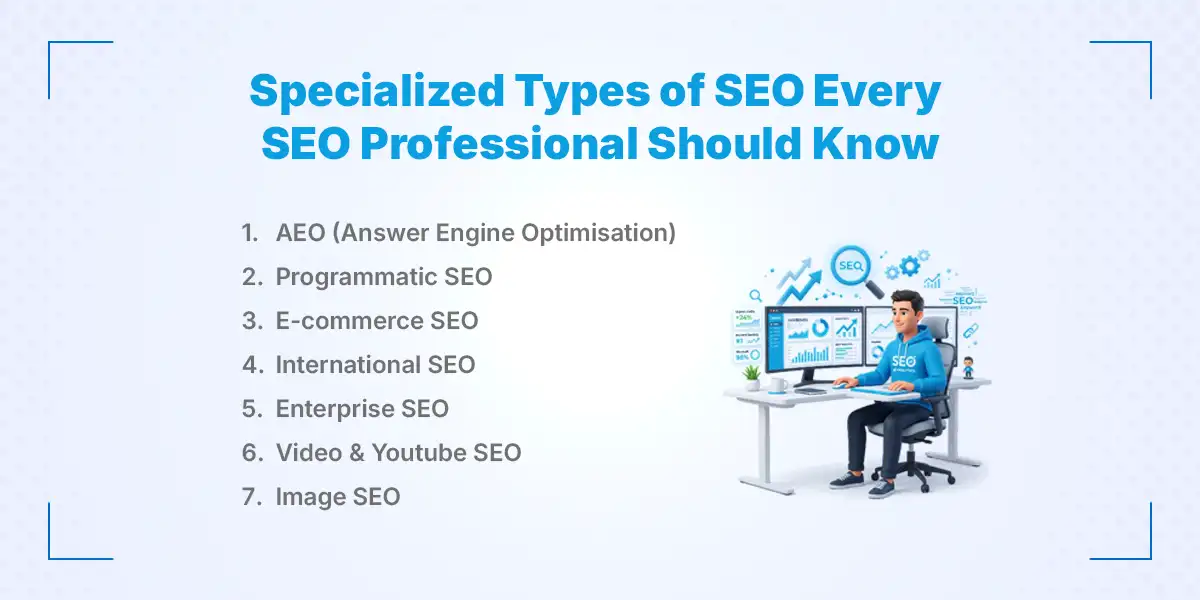
Specialized Types of SEO Every SEO Professional Should Know
Beyond the core pillars, specialized strategies like E-commerce, Programmatic, AEO, International, and Enterprise SEO handle unique search needs. These advanced methods adapt optimization for specific business models, massive websites, and non-text formats like video or images. Let's break down these specialized areas so you can see how they expand your optimization skills.
1. AEO (Answer Engine Optimization)
Answer Engine Optimization formats your content to directly answer quick questions for featured snippets and voice search. Its main goal is to deliver instant facts to users using voice assistants like Siri or Alexa. To achieve this, you place clear, two-sentence answers right at the top of your articles. For example, you might answer "What are the best months for trekking in Nepal?" in a single highlighted text box.
2. Programmatic SEO
Programmatic SEO uses code and structured database templates to automatically build hundreds or thousands of useful web pages. Its main goal is to help large sites target thousands of long-tail search terms without writing each page manually. To do this, you connect landing page templates to a central database. For example, travel sites like TripAdvisor automatically generate unique pages for "cheap hotels in Kathmandu," "cheap hotels in Pokhara," and thousands of other cities worldwide.
3. E-commerce SEO
E-commerce SEO optimizes online store product pages and category collections so shoppers can easily find them in search results. Its main goal is to turn searchers into buying customers. To do this, you write detailed product descriptions, optimize category menus, and add price tags in schema code. For example, if you sell handmade boots online, e-commerce SEO helps your "leather hiking boots" page show up when shoppers search Google.
4. International SEO
International SEO optimizes your website for visitors from different countries or speakers of different languages. Its main goal is to automatically show the right language and currency based on where the visitor lives. To do this, you use special hreflang language tags and localized domain structures. For example, an export business in Nepal uses international SEO to display an English page for US visitors and a Nepali page for local readers.
5. Enterprise SEO
Enterprise SEO manages search visibility for massive websites containing tens or hundreds of thousands of pages. Its main goal is to maintain site health, fix crawling errors, and coordinate SEO strategy across large corporate teams. To do this, you run regular technical site audits and fix crawl issues at scale. For example, an enterprise SEO specialist coordinates with developers to clean up broken links across 50,000 published news articles.
6. Video & YouTube SEO
Video SEO optimizes your video content to rank higher on YouTube search and Google's main video results. Its main goal is to gain more views, subscribers, and engagement for your visual content. To do this, you write keyword-rich titles, design clear thumbnails, and upload complete video transcripts. For example, when posting a tutorial on "How to Learn SEO in Nepal," adding descriptive timestamps helps Google feature your video directly in search results.
7. Image SEO
Image SEO optimizes image files so your website loads quickly and ranks in Google Images. Its main goal is to improve page load speed while driving extra organic traffic through visual searches. To do this, you shrink file sizes, write descriptive file names, and add clear alt text to every picture. For example, instead of naming the cover photo of this blog ‘IMG_102.jpg,’ I have renamed it ‘types-of-seo’. A descriptive alt text is also important for search crawlers to understand the context of the image.
Why Digital Agencies Prefer Versatile Candidates
If you are looking for SEO jobs in Nepal or pitching remote clients abroad, versatility is your biggest asset. Agencies rarely hire someone who can only write metadata. They prefer candidates who can write engaging content, understand basic technical audits, and adapt to modern AI search developments. Having a versatile skill set makes you far more valuable to prospective employers and clients.
Which Types of SEO Should a Good SEO Course Teach?
If you are looking for an SEO course in Nepal, you must ensure the curriculum covers real-world skills rather than outdated theories. A solid training program should give you practical hands-on experience across the core pillars.
Use this simple checklist when evaluating training programs:
- Keyword Research
- Content Optimization & SEO Writing
- Technical SEO Fundamentals
- Link Building & Off-Page SEO
- Google Analytics 4 (GA4)
- Google Search Console (GSC)
- AI Tools for SEO
- Schema Markup
- Local SEO
- E-commerce SEO
- Website SEO Audits
- Live Projects & Practical Training
Working on real websites during your learning phase is essential. Theory helps you understand concepts, but fixing actual errors on live websites builds real confidence.
Where to Learn SEO in Nepal: Choosing the Best SEO Course
If you're looking for a structured way to learn SEO, Kumari Job's Advanced SEO Course is a strong option, offering practical training in modern SEO, AI SEO, technical SEO, analytics, and live projects. However, it's not the only way to learn.
If you prefer guided learning, SEO training institutes provide a structured curriculum, mentorship, hands-on practice, and networking opportunities that can help you become job-ready faster.
If you're self-motivated, you can also learn SEO through free resources, official Google documentation, blogs, YouTube, and by practicing on your own website. The best approach depends on your learning style, budget, and career goals, but whichever path you choose, consistent practice on real websites is essential to becoming a skilled SEO professional.
Conclusion
SEO is no longer a single isolated skill. Today's successful digital professionals combine content creation, technical knowledge, analytics, AI tools, and strategic thinking to build online visibility.
For students and career starters, learning the different types of seo is not just about memorizing terminology. It is about identifying which areas fit your strengths and career goals. Start by building a strong foundation in core on-page, off-page, and technical SEO. Practice on real sites, test out AI search tools, and gradually expand into specialized areas over time.
As digital adoption expands across Nepal and global remote work continues to grow, becoming a versatile SEO specialist in Nepal offers immense opportunities. Build your foundation step by step, keep learning, and stay curious!
Frequently Asked Questions
Submit your comments

Get Our App On



What is the Public Relations Officer Salary in Nepal
VIEW DETAILS
What Is the Salary of a Ticketing Officer in Nepal?
VIEW DETAILS
What Is the Salary of a Travel Consultant in Nepal?
VIEW DETAILS
How to Become an Auditor in Nepal
VIEW DETAILS


Loading Comments...