




The Government of Nepal has announced a new salary scale for government employees, increasing overall monthly remuneration by around 21%, to be effective from Shrawan 1, 2083 (July 17, 2026). The revision was unveiled by Finance Minister Dr. Swarnim Wagle while presenting the FY 2083/84 national budget, marking the first major salary revision in four years.
But what does the 21% increase actually mean? Who will benefit from it? And how much will civil servants, teachers, health workers, Nepal Police, APF personnel, and Nepal Army personnel receive under the revised pay structure?
In this article, we'll break down the new government salary scale, explain how the increase has been calculated, and share the latest position-wise salary tables for different government services in Nepal.
In this blog
Government Announces Around 21% Salary Increase for Government Employees
The Nepal Government has officially announced a new salary scale for civil servants through the FY 2083/84 national budget. This is the first salary revision in four years, making it one of the biggest highlights of this year's budget.
Many government employees had been waiting for a salary increase as the cost of living and daily expenses continued to rise. With the new fiscal year beginning on Shrawan 1, 2083, the revised salary structure will come into effect from the same date.
Instead of increasing only the basic salary, the government has introduced a combination of higher basic pay, a monthly incentive, and existing allowances. Together, these changes increase the overall monthly income of civil servants while keeping the salary structure balanced.
Why Is Everyone Calling It a 21% Salary Increase?
The 21% salary increase refers to the overall monthly remuneration, not just the basic salary. While the basic salary has increased by 10%, additional incentives and allowances raise the total monthly earnings by around 21%. Here's a breakdown of how the revised salary structure works.
1. How the New Salary Structure Works
The revised monthly remuneration includes the following components:
- 10% increase in basic salary
- 10% monthly incentive calculated on the revised basic salary
- Rs. 5,000 monthly dearness allowance
- Grade amount based on the employee's position and service
Together, these components determine the total monthly remuneration under the new salary structure.
2. 10% Basic Salary + 10% Incentive Explained
The government has introduced three major changes to increase the monthly earnings of civil servants.
The basic salary has increased by 10% for all eligible government employees. This revised basic salary also becomes the basis for calculating other benefits.
Employees will receive a 10% monthly incentive, calculated on the revised basic salary. This additional incentive further increases the overall monthly remuneration.
The existing Rs. 5,000 dearness allowance will continue without any change. Employees will also receive grade amounts based on their designation and years of service.
When these revisions are combined, the total monthly remuneration increases by around 21%, although the exact amount varies depending on an employee's position, grade, and service level.
New Government Employee Salary Scale 2083/84 (Civil Service)
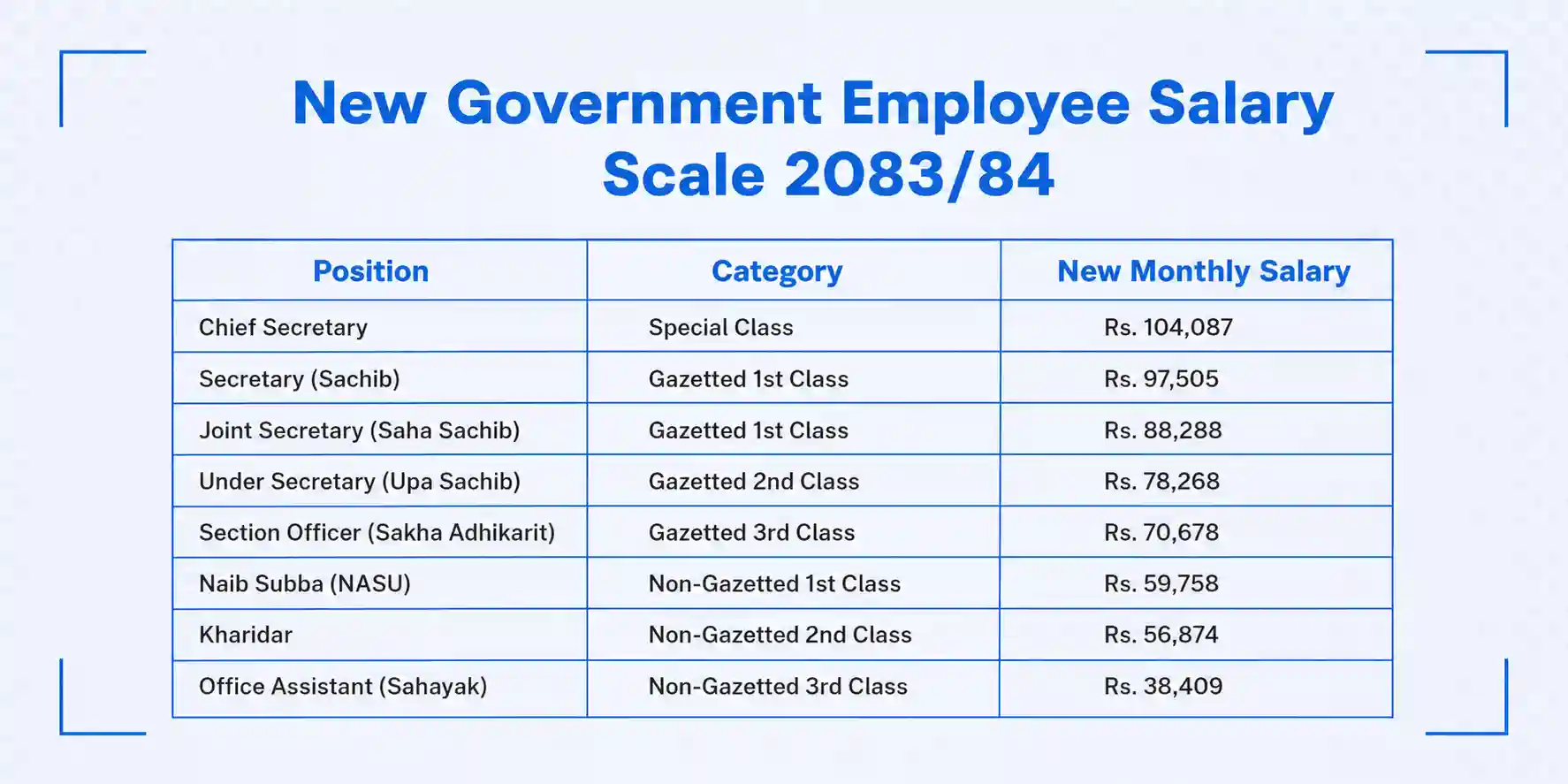
The Nepal Government has officially published the new salary scale for civil servants, effective from Shrawan 1, 2083. The revised pay structure includes a 10% increase in basic salary, a 10% monthly incentive, a Rs. 5,000 dearness allowance, and grade amounts based on position. The table below shows the updated monthly salary for major government positions.
Increased Government Salary Structure 2083/84 for Civil Servants
| Position | Previous Salary | Basic Salary Increase | 10% Incentive | Dearness Allowance | Grade Amount | Total Monthly Salary |
|---|---|---|---|---|---|---|
| Gazetted Positions | ||||||
| Chief Secretary | Rs. 77,211 | Rs. 7,721 | Rs. 8,493 | Rs. 5,000 | Rs. 5,662 | Rs. 104,087 |
| Secretary | Rs. 72,082 | Rs. 7,208 | Rs. 7,929 | Rs. 5,000 | Rs. 5,286 | Rs. 97,505 |
| Joint Secretary | Rs. 56,786 | Rs. 5,678 | Rs. 6,246 | Rs. 5,000 | Rs. 14,557 | Rs. 88,288 |
| Under Secretary | Rs. 48,737 | Rs. 4,873 | Rs. 5,361 | Rs. 5,000 | Rs. 14,296 | Rs. 78,268 |
| Section Officer (Officer) | Rs. 43,688 | Rs. 4,368 | Rs. 4,805 | Rs. 5,000 | Rs. 12,815 | Rs. 70,678 |
| Non-Gazetted Positions | ||||||
| Naib Subba (NASU) | Rs. 34,730 | Rs. 3,473 | Rs. 3,802 | Rs. 5,000 | Rs. 12,734 | Rs. 59,758 |
| Kharidar | Rs. 32,901 | Rs. 3,290 | Rs. 3,619 | Rs. 5,000 | Rs. 12,064 | Rs. 56,874 |
The table above shows how the new monthly salary is calculated for major government positions. It includes the previous salary, basic salary increase, 10% monthly incentive, dearness allowance, grade amount, and the final monthly salary under the revised pay structure.
Note: The new salary scale comes into effect from Shrawan 1, 2083. The final monthly salary includes the revised basic salary, 10% monthly incentive, dearness allowance, and applicable grade amount.
New Government Salary 2083/84 for Civil Servants
Revised Teacher Salary Scale in Nepal 2083/84
Community school teachers will also receive higher salaries under the FY 2083/84 pay revision. Since teachers follow the government salary structure, the revised pay reflects the latest changes announced through the national budget.
The table below shows the previous starting basic salary and the estimated revised monthly salary for different teaching levels.
| Teacher Level | FY 2082/83 Starting Basic Salary | FY 2083/84 Estimated Gross Salary |
|---|---|---|
| Secondary Level (First) | Rs. 56,787 | Around Rs. 73,712 |
| Secondary Level (Second) | Rs. 48,737 | Around Rs. 63,972 |
| Secondary Level (Third) | Rs. 43,689 | Around Rs. 57,864 |
| Lower Secondary (First) | Rs. 43,689 | Around Rs. 57,864 |
| Lower Secondary (Second) | Rs. 40,389 | Around Rs. 53,871 |
| Primary (First) | Rs. 40,389 | Around Rs. 53,871 |
Note: Actual take-home salary may vary based on grade, deductions, appointment category, and applicable education service rules.
New Salary for Government Health Workers 2083/84
Government health workers are also covered by the revised salary structure introduced for FY 2083/84. The updated pay scale increases monthly earnings across different service levels, while additional duty and risk allowances continue to apply where eligible.
| Health Service Level | FY 2082/83 Starting Basic Salary | FY 2083/84 Estimated Gross Salary |
|---|---|---|
| Twelfth Level | Rs. 72,082 | Around Rs. 92,219 |
| Eleventh Level | Rs. 56,787 | Around Rs. 73,712 |
| Eighth/Seventh Level | Rs. 43,689 | Around Rs. 57,864 |
| Fifth Level | Rs. 34,730 | Around Rs. 47,023 |
Note: Posting, duty type, risk exposure, and other service-related facilities are not included in the figures above.
Nepal Police Salary Scale 2083/84: Rank-Wise Pay Revision
Police personnel across all ranks will receive revised salaries under the new government pay structure. Besides the revised Nepal police salary, eligible personnel may also receive additional benefits based on their posting and service conditions.
Note: Ration allowance, uniform allowance, risk allowance, grade amount, and other service-related benefits are not included.
Updated APF Salary Scale for FY 2083/84
Personnel serving in the Armed Police Force (APF) will also receive revised salaries under the FY 2083/84 budget. The following table shows the estimated monthly salary across different ranks.
| APF Rank | FY 2082/83 Starting Basic Salary | FY 2083/84 Estimated Gross Salary |
|---|---|---|
| APF Inspector General | Rs. 72,082 | Around Rs. 92,219 |
| APF Additional Inspector General | Rs. 72,082 | Around Rs. 92,219 |
| APF Deputy Inspector General | Rs. 56,787 | Around Rs. 73,712 |
| APF Senior Superintendent | Rs. 52,603 | Around Rs. 68,650 |
| APF Superintendent | Rs. 48,737 | Around Rs. 63,972 |
| APF Deputy Superintendent | Rs. 43,689 | Around Rs. 57,864 |
| APF Inspector | Rs. 40,389 | Around Rs. 53,871 |
| APF Sub-Inspector | Rs. 34,730 | Around Rs. 47,023 |
| APF Assistant Sub-Inspector | Rs. 32,902 | Around Rs. 44,811 |
| APF Senior Havaldar | Rs. 28,570 | Around Rs. 39,570 |
| APF Havaldar | Rs. 27,612 | Around Rs. 38,411 |
| APF Assistant Havaldar | Rs. 26,677 | Around Rs. 37,279 |
| APF Constable | Rs. 26,082 | Around Rs. 36,559 |
| APF Attendant/Follower | Rs. 26,082 | Around Rs. 36,559 |
Note: Deployment, ration, uniform, and other service-specific allowances are paid separately where applicable.
Nepal Army Pay Scale Revised Under FY 2083/84 Budget
The salary revision also covers Nepal Army personnel, from Sipahi to General. While the figures below show the estimated revised monthly salary, actual take-home pay may be higher depending on deployment, grade, and other service-related benefits.
| Nepal Army Rank | FY 2082/83 Starting Basic Salary | FY 2083/84 Estimated Gross Salary |
|---|---|---|
| General | Rs. 77,211 | Around Rs. 98,425 |
| Lieutenant General | Rs. 72,082 | Around Rs. 92,219 |
| Major General | Rs. 56,787 | Around Rs. 73,712 |
| Brigadier General | Rs. 52,603 | Around Rs. 68,650 |
| Colonel | Rs. 48,737 | Around Rs. 63,972 |
| Lieutenant Colonel | Rs. 43,689 | Around Rs. 57,864 |
| Major | Rs. 40,389 | Around Rs. 53,871 |
| Captain | Rs. 37,547 | Around Rs. 50,432 |
| Lieutenant | Rs. 34,730 | Around Rs. 47,023 |
| Second Lieutenant | Rs. 32,902 | Around Rs. 44,811 |
| Subedar Major | Rs. 32,902 | Around Rs. 44,811 |
| Subedar | Rs. 30,200 | Around Rs. 41,542 |
| Jamadar | Rs. 28,570 | Around Rs. 39,570 |
| Hudda | Rs. 27,612 | Around Rs. 38,411 |
| Amaldar | Rs. 26,677 | Around Rs. 37,279 |
| Pyuth | Rs. 26,411 | Around Rs. 36,957 |
| Sipahi | Rs. 26,082 | Around Rs. 36,559 |
| Follower | Rs. 26,082 | Around Rs. 36,559 |
Note: The figures above do not include ration, peacekeeping, deployment, grade, or other service-specific allowances.
Why Nepal Government Revised Civil Servant Salaries After Four Years
The government revised civil servant salaries after four years without a pay increase, even as the cost of living continued to rise. During this time, expenses for housing, food, transportation, education, and healthcare increased steadily, putting added pressure on employees.
The new salary structure is expected to provide financial relief while making public service careers more attractive.
1. Rising Living Costs and Employee Concerns
Inflation has been one of the biggest reasons behind the salary revision. As the prices of everyday essentials increased, many civil servants felt their salaries no longer matched their living expenses.
Employee unions and organizations had also been calling for a salary revision, saying the existing pay structure no longer reflected the country's economic reality.
2. Government's Goal to Improve Employee Motivation
Beyond easing financial pressure, the government hopes the revised salary structure will strengthen the public service workforce by:
- Improving employee morale and motivation
- Retaining experienced civil servants
- Making government jobs more financially attractive
- Narrowing the gap between salaries and living costs
- Supporting better public service delivery
Although salary is only one aspect of government employment, the revision is expected to make public service careers more rewarding for both current employees and future Lok Sewa aspirants.
Who Will Benefit from the New Government Salary Scale?
The revised salary structure primarily applies to civil servants working under the Government of Nepal's pay scale. Employees serving in ministries, departments, constitutional bodies, and other government offices that follow the government salary structure will receive the revised remuneration from Shrawan 1, 2083.
The exact amount an employee receives will vary depending on their:
- Position and service level
- Grade and years of service
- Applicable allowances
- Other benefits approved under the government pay structure
If an organization follows a separate salary system, its employees may not automatically fall under this revision.
What Does the New Salary Increase Mean for Pensioners?
While serving employees will receive an overall increase of around 21%, the arrangement for pensioners is different.
According to the budget announcement, pension benefits will increase by 10%. Unlike serving employees, pensioners will not receive the additional monthly incentive that forms part of the revised salary package.
This means the overall increase for retired government employees is lower than that of employees currently in service.
What the New Salary Scale Means for Lok Sewa Aspirants
For thousands of Lok Sewa aspirants, the revised salary structure is more than just a pay increase, it makes government jobs even more attractive.
A government job has always offered stability, career growth, pension benefits, and social recognition. With higher monthly earnings, it also provides better financial security from the very beginning of a career.
As a result, the latest salary revision is likely to encourage even more candidates to prepare for competitive examinations in the coming years.
However, it is also worth remembering that higher rewards often bring tougher competition. Every year, thousands of candidates compete for a limited number of vacancies. Strong preparation, consistent practice, and staying updated with official notices remain the keys to success.
Planning to apply for Lok Sewa? While the new salary scale is encouraging, it's also important to stay informed about recent recruitment updates. Read our article on the government's decision to halt Lok Sewa recruitment to understand what it means for upcoming vacancies and aspiring candidates.
Conclusion
The new Nepal Government Salary Scale for FY 2083/84 marks the first major salary revision for government employees in four years. With an overall increase of around 21%, the updated pay structure benefits civil servants, teachers, health workers, Nepal Police, APF personnel, and the Nepal Army. The revision combines a 10% increase in basic salary, a 10% monthly incentive, and the existing Rs. 5,000 dearness allowance to improve monthly earnings across different government services.
The revised salary structure came into effect from Shrawan 1, 2083 (July 17, 2026) and is now applicable to eligible government employees. Whether you're a serving employee, preparing for Lok Sewa, or simply looking for the latest government salary information, this updated pay scale gives you a clear picture of the current remuneration across Nepal's public sector.
As future budget announcements, gazette notices, or service-specific revisions are released, it's always a good idea to stay informed through official government sources.
Frequently Asked Questions
Submit your comments

Get Our App On



What is the Public Relations Officer Salary in Nepal
VIEW DETAILS
What Is the Salary of a Ticketing Officer in Nepal?
VIEW DETAILS
What Is the Salary of a Travel Consultant in Nepal?
VIEW DETAILS
How to Become an Auditor in Nepal
VIEW DETAILS


Loading Comments...