




Nepal Police has always captured the imagination of young Nepalese. The uniform, the discipline, the respect, and the chance to serve the nation make it a career many dream about. Every time a Nepal Police vacancy is announced, thousands of eyes turn to the news with hope, curiosity, and sometimes confusion. Which position fits me best? Am I eligible? How do I apply? These questions are natural for anyone aiming to join the force.
Being part of Nepal Police is not just about a job, it’s about stepping into a role that matters, contributing to the safety and order of the country. The excitement around openings, the variety of roles, and the honor of serving your community make these vacancies highly sought after.
This guide is here to support you. It simplifies the process, breaks down the steps, and helps you understand everything about Nepal Police salaries, vacancies and how to apply for a police job in Nepal. Whether you are curious about officer-level positions, technical roles, hospital or forensic posts, or the short-term Myadi Police openings, this guide is designed to give you clarity and confidence to apply.
In this blog
Overview of Nepal Police
Nepal Police is the main law‑enforcement organization in Nepal that works to keep people safe and maintain order. It offers many kinds of jobs, ranging from frontline police officers to technical and medical staff. Nepal Police jobs are open for people from different backgrounds to apply.
Nepal Police has a clear rank structure, starting from Constable and moving up to ASI, SI, Inspector, DSP, and higher ranks, with responsibilities growing at each level. The force is divided into multiple units, including civil, armed, technical, medical, forensic, and administrative, offering a wide variety of roles. Some jobs require physical strength, while others need technical, medical, or specialized skills like forensic investigation or cyber security.
Because of these different units and a wide range of jobs, Nepal Police frequently post vacancies. This allows people with different skills to try and join. Whether you are interested in regular police work, technical support, medical staff, or administrative roles, Nepal Police might be waiting for you.
Latest Nepal Police Vacancies 2083
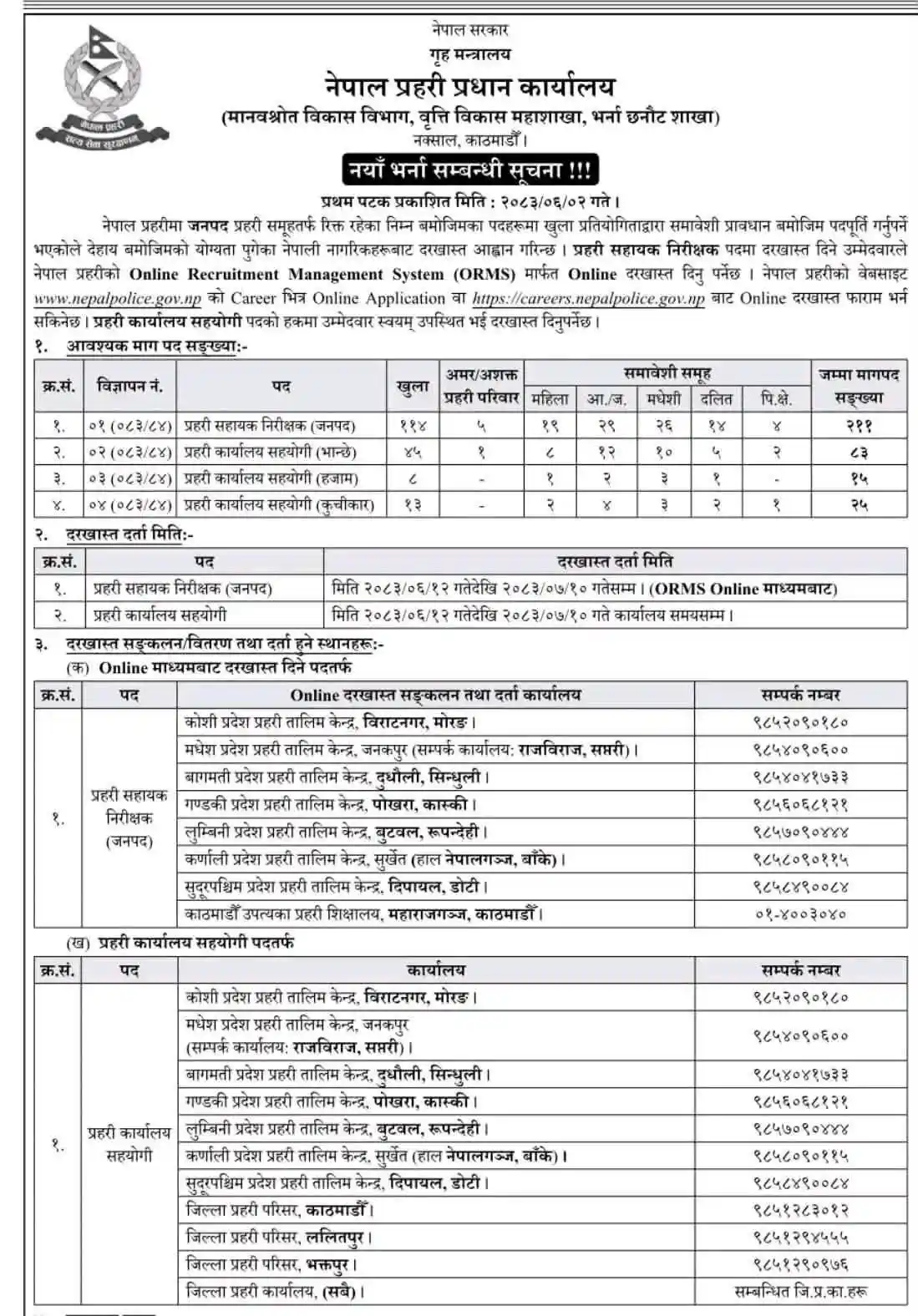
Nepal Police has announced 334 vacancies for the Janapad Police Group in 2nd of Asoj, 2083. The openings include Police Assistant Inspector (ASI) and three Police Office Assistant roles: Cook, Barber, and Sweeper. ASI applicants must apply online through the ORMS, while Office Assistant applicants need to submit their forms in person at the designated offices.
New Vacancy Information – Asoj 2083
| Post | Open | Inclusive/Other Quotas | Total |
|---|---|---|---|
| Police Assistant Inspector (ASI) | 114 | 97 | 211 |
| Police Office Assistant – Cook (भान्छे) | 45 | 38 | 83 |
| Police Office Assistant – Barber (हजाम) | 8 | 7 | 15 |
| Police Office Assistant – Sweeper (कुचिकार) | 13 | 12 | 25 |
| Total | 180 | 154 | 334 |
1. Police Assistant Inspector (प्रहरी सहायक निरीक्षक – जनपद)
Nepal Police has announced 214 vacancies for Police Assistant Inspector. There are 114 open seats. The remaining seats are for women, Adivasi/Janajati, Madhesi, Dalit, backward areas, and families of deceased or disabled police personnel. Applications must be submitted online through ORMS.
2. Police Office Assistant – Cook (प्रहरी कार्यालय सहयोगी – भान्छे)
There are 83 vacancies for Cook (भान्छे). 45 seats are open. Other seats are allocated for women, Adivasi/Janajati, Madhesi, Dalit, backward areas, and families of deceased or disabled police personnel. Applications must be submitted in person.
3. Police Office Assistant – Barber (प्रहरी कार्यालय सहयोगी – हजाम)
Nepal Police has announced 15 vacancies for Barber (हजाम). 8 seats are open. The remaining seats are allocated under inclusive categories, including women, Adivasi/Janajati, Madhesi, and Dalit. Applications must be submitted in person.
4. Police Office Assistant – Sweeper (प्रहरी कार्यालय सहयोगी – कुचिकार)
There are 25 vacancies for Sweeper (कुचिकार). 13 seats are open. The remaining seats are allocated for women, Adivasi/Janajati, Madhesi, Dalit, and backward areas. Applications must be submitted in person.
Other Details
- Total vacancies: 334
- Notice published: 2083/06/02
- Application period: 2083/06/23 to 2083/07/20
- ASI application: Online through ORMS
- Office Assistant application: In person
- Recruiting authority: Nepal Police, Human Resource Development Department, Recruitment Selection Branch
- Location: Naxal, Kathmandu
How and Where to Apply for Nepal Police Vacancy, Asoj 2083?
Candidates can apply for these Nepal Police vacancies from 2083/06/23 to 2083/07/20. The application process depends on the position.
- Police Assistant Inspector (ASI): Apply online through the Nepal Police ORMS. You can access it through the Career section of the Nepal Police website or the official recruitment portal, careers.nepalpolice.gov.np.
- Police Office Assistant: Submit the application in person at the designated Nepal Police offices. These include police training centres and selected district police offices listed in the vacancy notice.
- Application deadline: 2083/07/20
The detailed vacancy notice also lists the office locations and contact numbers for applicants.
How to Apply for a Police Job in Nepal?
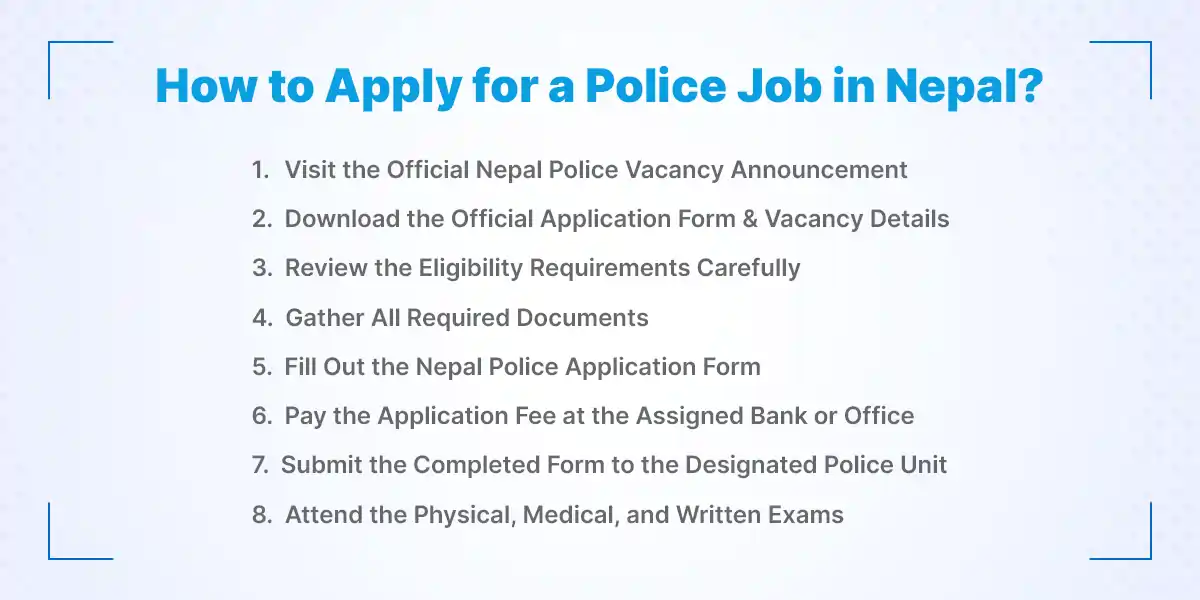
To apply for a police job in Nepal, you need to check the official vacancy announcement, complete the application form, submit it with required documents, and then appear for the selection tests. Shortlisted candidates will then attend physical, medical, and written exams to complete the selection process. Here’s a clear, step-by-step guide to help you understand the process and stay organized.
1. Visit the Official Nepal Police Vacancy Announcement
The first step is to check for official vacancy announcements. These are posted on the Nepal Police website and at the Nepal Police Headquarters notice board. Some specialized or technical roles may also be announced by PSC (Lok Sewa). Make sure you always rely on official sources to avoid fake notices.
2. Download the Official Application Form & Vacancy Details
Once you find a vacancy that fits your skills and interest, download the official application form. Along with the form, read the vacancy details carefully. Check the number of posts, required qualifications, age limit, physical standards, and any special requirements for the role you are applying for.
3. Review the Eligibility Requirements Carefully
Before you start filling out the form, double-check your eligibility. Look at age, education, height, chest measurement, eyesight, and any other specific requirements. If you’re applying for technical or hospital positions, ensure you meet the required educational or professional certifications.
4. Gather All Required Documents
Prepare all documents needed for the application. This typically includes:
- Nepali citizenship certificate (original + copy)
- Academic certificates and transcripts
- Passport-size photos
- Character certificate
- Medical or eye test reports (if available)
- Experience letters or technical certificates (if required)
Having everything ready before filling the form will save time and prevent mistakes.
5. Fill Out the Nepal Police Application Form
Complete the form carefully. If it’s online, create an account in Nepal Police’s official career page by registering your email and phone number. Upload scanned copies of your documents and double-check that your details are correct. If it’s a paper form, write clearly in black or blue ink, attach the required documents, and sign where needed. Accuracy is very important, mistakes can lead to rejection.
6. Pay the Application Fee at the Assigned Bank or Office
Some positions require a small application fee. Check the notice for the payment method, usually at a designated bank or office. Keep the receipt safe, as you may need it during document verification.
7. Submit the Completed Form to the Designated Police Unit
Once your form is ready and the fee is paid, submit it before the deadline. For online submissions, make sure to save the confirmation or application number. For offline forms, get an acknowledgement slip or stamped copy from the office. Missing the deadline can disqualify you automatically.
8. Attend the Physical, Medical, and Written Exams
After submission, shortlisted candidates will be called for tests. This usually includes:
- Physical fitness test: Running, push-ups, long jump, and other endurance tests.
- Medical examination: A full health check to ensure you are fit for duty.
- Written/practical exam: Tests general knowledge, language skills, and technical abilities for specialized roles.
Passing these stages successfully brings you closer to joining the Nepal Police. Always check official instructions for the schedule, venue, and required documents for each stage.
How Much is Nepal Police Salary?
The salary of Nepal police depends on the rank. Entry-level roles like junior constable at Nepal Police earns around NPR 26,082–33,034 per month. A senior officer in higher rank may earn upward of NPR 70,000–76,000 per month. On top of that, officers receive allowances of about NPR 6,000–24,000 (depending on posting), and additional allowances such as house‑rent, medical, transport, etc. The exact pay depends on your rank and role, but all positions provide a secure and respected career path.
1. Salary for Constable, ASI, and Mid-Level Roles
Entry-level roles like Constable and Assistant Sub-Inspector (ASI) earn a monthly salary of around NPR 30,000–40,000. Mid-level positions, like Sub-Inspector (SI), earn slightly higher, ranging from NPR 45,000–60,000, reflecting their added responsibilities and skills.
2. Salary for Inspector and Officer-Level Roles
Officer-level positions, including Inspector, DSP, and SSP, offer higher salaries ranging from NPR 70,000 to over 120,000 per month, depending on rank, experience, and responsibility. Leadership and specialized senior roles often come with additional incentives.
3. Allowances, Insurance & Other Benefits
On top of the base salary, Nepal Police employees receive allowances for housing, travel, and risk-related duties. Health insurance, medical coverage, and retirement benefits are also provided. For those posted in remote or challenging locations, extra incentives may apply. These perks make a career in Nepal Police not only secure but also rewarding.
What are the Requirements to Join Nepal Police?
To join Nepal Police, candidates must meet certain age requirements, physical fitness, medical standards, and educational qualifications. Checking your eligibility before applying is very important to avoid wasting time.
1. Age Limit for Inspector and Other Roles
The minimum and maximum age depends on the position. For entry-level posts like Constable, candidates are usually between 18 and 25 years. For mid-level roles like ASI or SI, the range is generally 21–28 years, while officer-level positions like Inspector allow applicants up to 30–32 years, sometimes with age relaxations for experienced or specialized candidates. Always check the official notice for exact limits.
2. Physical & Medical Requirements
Physical fitness is an essential part of Nepal Police selection. The physical‑fitness test includes events like 300 m run, long jump, high jump, sit‑ups, push‑ups, pull‑ups/ chin‑ups, and a 3.2 km (2‑mile) run. Candidates must pass each event to proceed. Requirements typically include:
Minimum height (approx 5’2” for men and approx 5’0” for women)
Chest measurement for certain positions (31–33” for men and usually not required for women)
Clear vision and hearing
Minimum weight requirement (50 kg for male and 42 kg for females)
Ability to pass running, push-ups, and endurance tests
A health certificate from an authorized doctor (approved by Police Headquarters)
A full medical check-up ensures candidates are healthy enough for police duties, especially for physically demanding or field-based roles.
3. Educational & Training Requirements
Education requirements depend on the post. For general police roles, a minimum of SEE or +2 may be required. Technical roles often need diplomas or degrees in IT, engineering, medicine, or forensics. Officer-level positions like Inspector usually require a bachelor’s degree.
After selection, candidates undergo training at the police academy, where they learn both practical and theoretical aspects of the job. This training ensures they are fully prepared for field and office work.
Popular Nepal Police Positions That Open Frequently
The most frequently open positions in Nepal Police include Police Constable (Jawan), Assistant Sub-Inspector (ASI), and technical or Supporting roles such as computer operators and drivers. Nepal Police offers a variety of positions, and some roles are open more often than others. These positions attract a lot of applicants because they provide good career growth, stability, and a chance to serve the country.
1. Nepal Police Inspector Vacancy (Officer-Level Openings)
Inspector positions are officer-level roles with leadership responsibilities. Inspectors supervise teams, manage police stations, and coordinate operations in their units. These positions often require a bachelor’s degree, physical fitness, and training at the police academy.
2. Nepal Police Technical Vacancy (IT, Engineering, Communications)
Technical roles focus on IT, engineering, and communications within the police force. These posts are important for cyber security, managing communication systems, and supporting investigations with technical expertise. Candidates usually need diplomas or degrees in relevant fields. These roles appear regularly as Nepal Police modernizes its technology.
3. Nepal Police Hospital Vacancy (Health & Medical Posts)
Nepal Police also hires medical staff, including doctors, nurses, and lab technicians, for police hospitals. These positions are vital for officers and public health. Applicants need medical degrees or certifications, and the vacancies are advertised whenever there is a need for hospital staff.
4. Nepal Police Forensic Lab Vacancy (Scientific & Analytical Roles)
Forensic lab roles focus on crime scene analysis, lab testing, and scientific investigations. Candidates with degrees in forensic science, chemistry, or biology can apply. These positions are important for criminal investigations and open whenever new forensic projects or units expand.
5. Nepal Sashastra Police Vacancy (Armed Force Roles)
The Sashastra Police deals with security, armed operations, and national safety tasks. Roles here require physical strength, discipline, and sometimes tactical training. These positions are in demand and often appear in recruitment cycles due to unit expansion or promotions.
6. Other New Vacancy in Nepal Police Categories
Other posts open from time to time in administrative, clerical, or support roles. These are suitable for candidates with organizational, technical, or office-based skills. Searching for job vacancy in Nepal Police or Nepal Police force vacancy helps applicants stay updated about these opportunities.
7. About Myadi Police Vacancy for Elections in Nepal
Myadi Police positions are announced specifically for short-term duty during elections. Candidates are recruited to help maintain law and order, assist in polling centers, and support security operations. These roles are crucial to ensure smooth election processes across the country.
Eligibility & Short-Term Contract Nature
Candidates applying for Myadi Police must meet basic age, physical, and educational requirements, similar to regular police roles. The contract is short-term, usually lasting only for the duration of the event or election. Despite being temporary, this opportunity offers hands-on exposure to police operations and can be a stepping stone for future permanent positions.
Steps to Apply for Myadi Police Vacancy During Election
Applying for Myadi Police is straightforward:
- Check the official Nepal Police website or notice boards for announcements.
- Download and carefully read the application form and vacancy details.
- Ensure you meet all eligibility criteria before applying.
- Submit the completed form along with required documents before the deadline.
- Attend the physical, medical, and written exams, if required.
Keeping an eye on official updates ensures you don’t miss the chance to apply for these short-term roles.
Understanding Nepal Police Recruitment and Vacancy Trends
Nepal Police recruitment offers opportunities across different ranks, units, and support roles. Each recruitment drive may have different requirements, vacancies, and application processes.
Why Nepal Police Vacancies Open Frequently
Nepal Police opens vacancies regularly for several reasons. One of the main factors is retirement. When officers retire, their positions become vacant, creating opportunities for new candidates. Similarly, promotions within the force lead to openings, as officers move into higher ranks and their previous roles need to be filled.
The expansion of specialized units also plays a key role. For example, forensic labs, hospital units, and cyber security divisions often require additional staff. These positions are essential for keeping the organization modern and efficient. In addition, during national elections or other major events, the police sometimes hire Myadi staff on short-term contracts to support increased security needs.
Growing Interest in Police Jobs Across Nepal
Police jobs in Nepal are increasingly popular among young people. Many are drawn to the stability and benefits these roles offer, such as healthcare, allowances, and opportunities for career growth.
Certain positions, like Inspector, Technical, or Sashastra Police roles, consistently grab youths’ interest because they offer both responsibility and skill-based work. These roles appeal to candidates who want a meaningful career while contributing to public safety.
Where to Find Reliable Nepal Police Vacancy Updates
The best way to stay updated on Nepal Police vacancies is through official channels. The Nepal Police website and headquarters notice boards provide verified information. For some technical or specialized positions, announcements may also appear on PSC (Lok Sewa).
For convenience, trusted portals like Kumari Job provide verified Nepal Police vacancy news and updates. This helps candidates avoid misinformation or fake notices. Always double-check sources before submitting your application to ensure accuracy.
Interested in working for Nepal's civil service? Explore the latest government jobs in Nepal!
Conclusion
Nepal Police offers a wide range of opportunities for those who want a career in public service. From entry-level Constables to officer-level Inspectors, and from technical to medical and forensic roles, there is something for many types of candidates.
Vacancies open regularly due to retirement, promotions, unit expansion, and short-term Myadi requirements. These roles are not only stable but also provide benefits, career growth, and a chance to serve the country.
Staying updated through official channels like the Nepal Police website, headquarters notice boards, PSC (Lok Sewa), and trusted portals like Kumari Job is essential. Understanding the eligibility criteria, application steps, and selection process will increase your chances of joining the force successfully. Whether you’re aiming for a long-term career or a short-term Myadi position, preparation and timely application are key.
Frequently Asked Questions
Submit your comments

Get Our App On



What is the Public Relations Officer Salary in Nepal
VIEW DETAILS
What Is the Salary of a Ticketing Officer in Nepal?
VIEW DETAILS
What Is the Salary of a Travel Consultant in Nepal?
VIEW DETAILS
How to Become an Auditor in Nepal
VIEW DETAILS


Loading Comments...