



Many Nepali people want a job in Loksewa Aayog, but most have trouble before they begin. Confusing rules about who can apply, tight deadlines, and a complicated application process make it hard for them. Many spend months preparing but end up making small mistakes that ruin their chances, feeling lost and confused without clear guidance.
The good news is that success doesn’t have to feel impossible. By knowing exactly what steps to take, what documents to prepare, and how to tackle each stage of the application and exam, you can approach the process with clarity and confidence.
In this guide, we break down everything about the Loksewa vacancy, from eligibility and application steps to exam preparation, so you can apply efficiently and maximize your chances of success.
In this blog
What is Lok Sewa Aayog?
Lok Sewa Aayog, also known as the Public Service Commission of Nepal, is the government body responsible for recruiting and managing human resources for various public service positions. Its main role is to ensure a transparent, fair, and merit-based selection process for candidates aspiring to work in government organizations. For many Nepalis, securing a position through Lok Sewa Aayog is considered a prestigious and stable career choice due to the job security, benefits, and professional growth it offers.
The commission plays a crucial role in maintaining efficient governance and quality public services by selecting qualified candidates for administrative, technical, and specialized roles across the country.
Key Functions of Lok Sewa Aayog:
- Conducting competitive examinations for different government positions
- Recruiting candidates based on merit, qualifications, and performance
- Evaluating applicants through written exams, interviews, and practical tests
- Advising the government on human resource policies and reforms
- Ensuring fairness, transparency, and accountability in public service recruitment
Working with Lok Sewa Aayog not only offers job security and government benefits but also provides an opportunity to contribute meaningfully to public service and national development. Over the years, the commission has become a trusted authority for ensuring that Nepal’s public sector is staffed with competent and skilled professionals.
Understanding the role and responsibilities of Lok Sewa Aayog is the first step for aspirants who want to prepare effectively and succeed in its highly competitive selection process.
Types of Loksewa Aayog Vacancy
Loksewa Aayog Vacancy opportunities are diverse, reflecting the wide range of roles needed to support public service delivery across Nepal. Understanding the different categories helps aspirants identify the right openings, prepare appropriately, and choose positions that fit their qualifications and career goals. Vacancies are typically classified by service type, level, and class, competition type, and jurisdiction.
1. Based on Service or Nature of Work
Vacancies under this category are grouped according to the skills and functions required:
- Non‑Technical Services: These include administrative roles such as Administrative Officer, Foreign Affairs Officers, Judicial positions, and Audit services. These jobs focus on policy, regulation, coordination, and governance functions.
- Technical Services: These require specialized expertise in fields like Civil or Mechanical Engineering, Agriculture, Forestry, Health (Doctors, Nurses), and Education. Technical roles usually demand professional degrees and certifications.
- Miscellaneous Services: This category covers specialized support or assistant roles that do not fall strictly under technical or non‑technical classifications.
2. Based on Level and Class
Loksewa positions are also ranked by class, reflecting seniority, responsibility, and pay scale:
- Gazetted Positions: Higher-level roles such as First Class (e.g., Joint Secretary or equivalent) and Second Class (e.g., Section Officer or similar). These positions often involve leadership and decision‑making responsibilities.
- Non‑Gazetted Positions: These include First Class roles like Nayab Subba and Second Class roles such as Kharidar. In technical services, levels may be specified numerically (for example, 9th or 11th level for health officials).
3. Based on Competition Type
Vacancies differ by who is eligible to compete:
- Open Competition: Available to all eligible Nepali citizens.
- Internal Competition: Only for existing permanent government staff seeking promotion.
- Inclusive Competition: Reserved for specific groups, including Women, Madhesi, Dalit, Persons with Disabilities, and candidates from backward regions.
4. Based on Jurisdiction
Vacancies are offered at different administrative levels:
- Federal/Central Loksewa: Positions in central ministries and departments.
- Provincial/Pradesh Loksewa: Vacancies within a specific province.
Understanding these categories enables aspirants to target their preparation and applications strategically, increasing their chances of success in the highly competitive Loksewa Aayog recruitment process.
How to Apply for Loksewa Vacancy: Step-By-Step
To apply for a Loksewa Aayog Vacancy, visit the official portal, register, complete your profile, select the right advertisement, upload documents, pay the fee, and submit your application. By following each stage carefully, you ensure your application is complete, accurate, and accepted without delays. Below is a detailed step-by-step guide to help you apply efficiently.
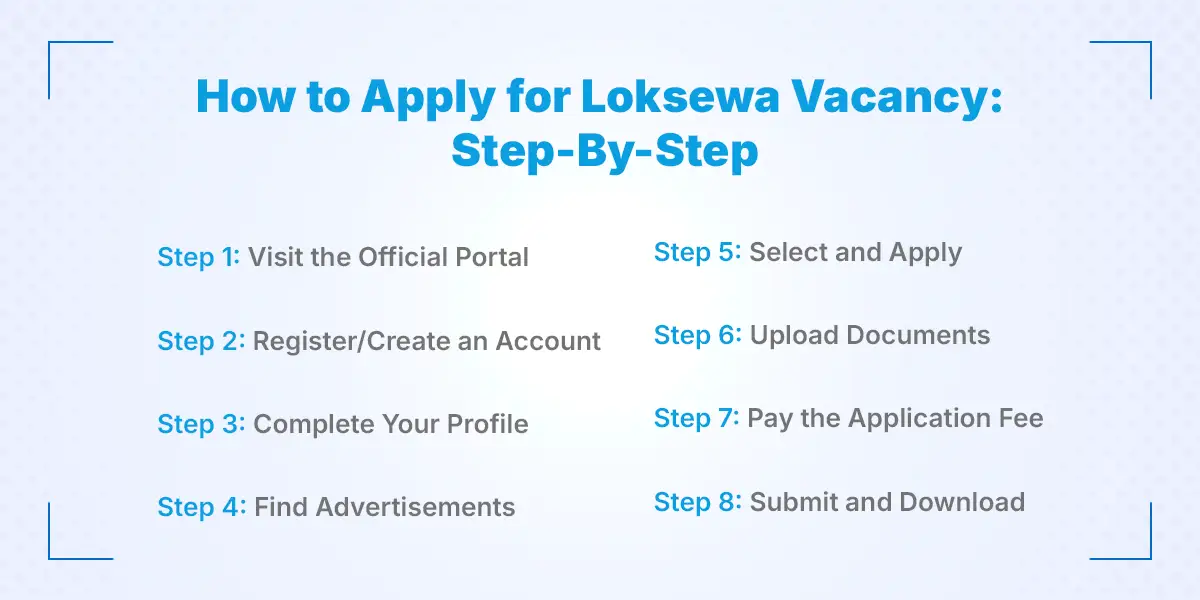
1. Visit the Official Portal
Start by going to the official Loksewa Aayog website. This is the only legitimate source for vacancy announcements and online applications. Make sure to check the latest notices regularly so you don’t miss deadlines.
2. Register/Create an Account
New applicants must create an account using a valid email and mobile number. This account will store your personal details and allow you to track applications. Keep your login credentials safe for future use.
3. Complete Your Profile
Fill out your personal, educational, and professional information accurately. Incomplete profiles may prevent you from applying for certain positions. Double-check all details before moving on to the application stage.
4. Find Advertisements
Browse the latest Loksewa Aayog vacancy notices to find positions that match your qualifications. Each advertisement contains important details like eligibility criteria, exam type, and deadlines.
5. Select and Apply
Choose the vacancy you want to apply for and click “Apply.” Ensure you meet all eligibility requirements and follow the instructions provided in the advertisement.
6. Upload Documents
Upload scanned copies of required documents such as certificates, ID, and photographs. Make sure file formats and sizes match the portal requirements to avoid rejection.
7. Pay the Application Fee
Pay the prescribed fee online or through approved banks. Keep the receipt or confirmation as proof of payment; it may be required later for verification.
8. Submit and Download
After reviewing your application, submit it officially. Download and save a copy for your records; it serves as confirmation and reference for future stages of the recruitment process.
Eligibility Criteria for Loksewa Aayog Vacancy
Before you apply for any Loksewa Aayog vacancy, it’s essential to understand the eligibility requirements set by the Public Service Commission. These criteria ensure that only qualified and suitable candidates enter the competitive selection process. Eligibility is not just about having a degree; it also includes age limits, citizenship status, professional registration for technical posts, and specific service experience for internal promotions. Knowing these rules ahead of time prevents application rejection and helps you select the right vacancy that matches your profile.
1. Citizenship and Basic Legal Requirements
To be eligible for a Loksewa Aayog Vacancy, you must be a Nepali citizen and possess a valid citizenship certificate. Applicants should not be legally disqualified under prevailing civil service laws, and they should be physically and mentally fit to perform job duties. Foreign nationals generally cannot apply unless the vacancy notice explicitly allows dual citizenship or similar exceptions.
2. Educational Qualifications
Each vacancy has minimum educational requirements that differ by service group and level. For basic posts like Nayab Subba or Kharidar, completion of SLC/SEE (with required GPA) or equivalent may be sufficient. Higher-level and technical positions usually require a relevant bachelor’s or master’s degree from a recognized institution. Technical roles in engineering, health, or agriculture may also require professional council registration or certifications.
3. Age Limit Rules
Candidates must meet the age criteria specified in the vacancy notice. For many posts, the minimum is 18 or 21 years, with an upper limit that varies by position (often up to 35 or 45 years for higher or health service roles). Relaxations are typically provided for women, persons with disabilities, and other inclusive groups. Permanent government employees may have different age rules for internal competitions.
4. Internal Promotion and Service Experience
For internal competitive exams or promotions, candidates must be existing permanent civil servants with a required minimum service period at a lower class or level. Performance records, disciplinary status, and service duration are evaluated according to civil service regulations. Inclusive category applicants may qualify with reduced service years as per the rules.
5. Professional Registration and Fitness
Technical and specialized posts often mandate valid registration with relevant professional bodies (like the Medical Council or the Engineering Council) and evidence of practical training or experience. All applicants must also be in sound physical and mental health to meet job requirements.
Loksewa Aayog Examination Pattern and Syllabus
The Loksewa Aayog exams in Nepal, including Kharidar, Nayab Subba, and Section Officer, usually follow a three-stage system. First, there’s a Preliminary exam with multiple-choice questions. Next comes the Main exam with descriptive questions. Finally, candidates face a Computer Skill Test and an Interview. The syllabus focuses on General Knowledge, Aptitude, Public Administration, Constitution, and job-specific subjects. Knowing this pattern makes your preparation easier and helps you focus on the right topics for each stage.
1. Stage I - Preliminary Exam
The first stage is a screening test with objective multiple-choice questions (MCQs). Subjects include General Knowledge, Mental Ability/Aptitude, and the English language. This exam usually carries 100 marks, and each wrong answer may deduct 20% of the mark. Only candidates who pass this stage can move to the next stage. It is designed to check your basic knowledge and reasoning ability.
2. Stage II - Main Examination
The Main exam is subjective, with descriptive questions to test in-depth understanding. The subjects depend on the post you apply for, like Administration, Law, Engineering, or Health. Each paper is usually 3 hours long, and answers are written in detail. This stage checks how well you understand the work-related topics and prepares you for practical job responsibilities.
3. Stage III - Final Stage
After written exams, most posts have a Computer Skill Test and an interview. The computer test checks basic office or technical skills, and the interview assesses your communication, confidence, and understanding of public service. Marks from this stage are added to your written score to decide the final result.
Syllabus Overview
General Knowledge & Aptitude:
- Geography, History, Culture, and Society of Nepal
- Economy, Policies, Science & Technology, Current Affairs
- Logic and reasoning tests
Subject-Specific Syllabus:
- Governance & Administration: Public administration, Constitution, Acts, Regulations
- Language: Nepali and English written tests
- Technical Subjects: Based on service, e.g., Medical Science for Health, Data Structures for Computer Officers
Key Points:
- Passing marks are usually 40-45%
- The exam can be in Nepali, English, or both
- Regular mock tests and focus on current affairs help a lot
Tips for Filling the Loksewa Aayog Application Form
Filling the Loksewa Aayog application form can be tricky if you are not careful. Many candidates make small mistakes that lead to rejection or delay. By following simple tips, you can complete your form correctly and increase your chance of getting accepted. This guide explains step by step how to fill out the application without stress.
1. Read the Instructions Carefully
Before starting, read the entire vacancy notice and instructions on the portal. Each post may have different requirements for education, age, and documents. Make sure you understand which documents are needed and the format for uploading. Following instructions helps avoid mistakes that could disqualify your application.
2. Fill Personal Details Accurately
Enter your name, date of birth, citizenship, and contact details exactly as they appear on your official documents. Double-check spellings and numbers. Mistakes in personal information can cause problems later during verification or at the exam hall.
3. Complete Educational and Professional Information
Write your educational qualifications carefully, including the correct name of the institution, year of passing, and grade or marks. If applying for technical or specialized posts, include relevant certifications or licenses. Ensure everything is accurate and matches your documents.
4. Upload Required Documents Correctly
Scan your certificates, citizenship, and photo according to the portal’s instructions. Check that the file size and format meet the requirements. Wrong uploads may lead to rejection, so take your time and double-check each document.
5. Pay the Application Fee Properly
Pay the required fee using the method specified in the advertisement. Keep the payment receipt or screenshot as proof. This is important because your application will not be processed without confirming payment.
6. Review and Submit Carefully
Before submitting, review the entire form one more time. Make sure all fields are filled correctly and documents are attached. Once you submit, download and save a copy of your application for reference.
Province-Wise Loksewa Aayog Vacancy in Nepal
Loksewa Aayog opens jobs not just at the central level but also in all seven provinces of Nepal. Each province has its own offices and departments, so the number and type of vacancies can differ. Checking province-wise openings helps candidates apply for jobs closer to home and plan their preparation better. Here’s a simple guide to the current vacancies in all seven provinces.
1. Koshi Province Loksewa Aayog Vacancy
Koshi Province Loksewa Aayog Vacancy includes jobs in administrative, technical, and support roles. There are openings in education, health, local administration, and other provincial offices. Some positions are reserved for women and disadvantaged groups. Candidates should carefully check eligibility before applying. All applications are submitted online, so proper scanning of documents is important. Staying updated with the official portal helps avoid missing new notices. Preparing for general knowledge, reasoning, and job-related subjects is recommended.
2. Madhesh Province Loksewa Aayog Vacancy
Madhesh Province Loksewa Aayog Vacancy focuses on roles in health, administration, and technical departments. Posts are available in local offices and provincial organizations. Reserved quotas are given for women, Madhesi, and other backward groups. Candidates should read the vacancy notice carefully to meet all requirements. Online application submission is mandatory with proper document uploads. Preparing for general knowledge and job-specific topics improves success. Tracking deadlines is important to avoid late submissions.
3. Bagmati Province Loksewa Aayog Vacancy
Bagmati Province Loksewa Aayog Vacancy is one of the busiest because it includes the capital region. Vacancies are available in finance, administration, technical, and support services. Some jobs are reserved for women and marginalized communities. Candidates should ensure documents are uploaded correctly when applying online. Preparing for written exams and computer skill tests is useful. Monitoring the portal regularly helps stay updated on new openings. Knowing the exam pattern and subjects is essential.
4. Gandaki Province Loksewa Aayog Vacancy
Gandaki Province Loksewa Aayog Vacancy offers positions in education, agriculture, forestry, health, and local administration. Both technical and non-technical roles are available. Reserved quotas exist for women and backward communities. Candidates should check eligibility and required documents before applying. Applications are submitted online, so scanning and uploading documents correctly is important. Studying the syllabus and general knowledge topics helps prepare well. Regularly checking the portal ensures you don’t miss updates.
5. Lumbini Province Loksewa Aayog Vacancy
Lumbini Province Loksewa Aayog Vacancy has openings in health, education, administration, and technical sectors. Jobs are available at provincial offices and local government offices. Some posts are reserved for women and disadvantaged groups. Candidates must carefully read the notice and eligibility criteria before applying. Applications are online, so document uploads must meet requirements. Preparing for general knowledge, reasoning, and post-related subjects increases chances of success. Checking updates on the official portal is recommended.
6. Karnali Province Loksewa Aayog Vacancy
Karnali Province Loksewa Aayog Vacancy focuses on technical, administrative, and health roles in provincial offices. Posts are also available in the education and local governance sectors. Reserved quotas apply to backward and marginalized groups. Candidates should fill tout he online forms carefully with proper documents. Studying general knowledge and province-specific topics helps in exams. Monitoring deadlines ensures applications are submitted on time. Preparing for computer tests and interviews is also important.
7. Sudurpashchim Province Loksewa Aayog Vacancy
Sudurpashchim Province Loksewa Aayog Vacancy mainly includes administrative, service-group, technical, and support roles. Local development offices and provincial administration are the main employers. Some posts are reserved for women and backward areas. Candidates must upload scanned documents correctly when applying online. Preparing for written exams, computer tests, and interviews is essential. Checking the official portal often helps in staying updated. Knowing the syllabus and practicing regularly increases chances of success.
How to Prepare for Loksewa Aayog Examination?
To prepare for Loksewa Aayog exams, focus on understanding the exam pattern, practicing general knowledge and aptitude, studying post-specific subjects, and taking regular mock tests. Below are simple steps and tips to guide your preparation effectively.
1. Understand the Exam Pattern
The first step is to know how the exam is structured. Most posts have three stages: Preliminary (MCQs), Main (subjective), and Final (Computer Skill Test/Interview). Check the syllabus and marks distribution for your specific post, like Nayab Subba, Kharidar, or Section Officer. Understanding the pattern helps you plan which subjects to study and how much time to spend on each. It also reduces surprises on exam day and helps you feel confident.
2. Focus on General Knowledge and Current Affairs
General Knowledge is a major part of the exam. Study Nepal’s geography, history, culture, society, economy, and current events. Read newspapers, online portals, and yearbooks regularly. Make short notes to revise easily. Practicing previous years’ questions can help you see which topics are asked more often. This improves speed and accuracy in the preliminary stage.
3. Improve Mental Ability and Aptitude
The preliminary exam also tests reasoning, logic, and mental ability. Practice numerical problems, puzzles, and logical reasoning questions every day. Time yourself while solving these questions to improve speed. Regular practice helps you avoid mistakes and manage time during the exam.
4. Study Post-Specific Subjects
The main exam focuses on your post-specific subjects. For administrative posts, study Public Administration, Constitution, and Governance. For technical posts, review engineering, health, or agriculture subjects. Use standard textbooks and previous question papers. Understand concepts rather than memorizing, so you can answer both objective and descriptive questions.
5. Practice Mock Tests and Previous Papers
Take mock tests for both preliminary and main exams. Solving past years’ papers gives an idea of question types and difficulty level. Check your answers, learn from mistakes, and improve weak areas. Regular testing also builds confidence and reduces exam anxiety.
6. Prepare for the Interview and Computer Skill Test
After written exams, most posts require a computer skills test and an interview. Practice basic computer operations like Word, Excel, and typing. For the interview, focus on communication skills, confidence, and knowledge about public service. Mock interviews with friends or mentors help you perform better on the final day.
Where to Find Loksewa Aayog Vacancy?
You can find Loksewa Aayog vacancies on the official portal, online job sites, Facebook groups, and newspapers. Finding the latest Loksewa Aayog vacancies can be confusing because they are published in many places. By knowing the main sources, you can avoid missing deadlines and apply on time. Here’s a simple guide on where to look for these job openings.
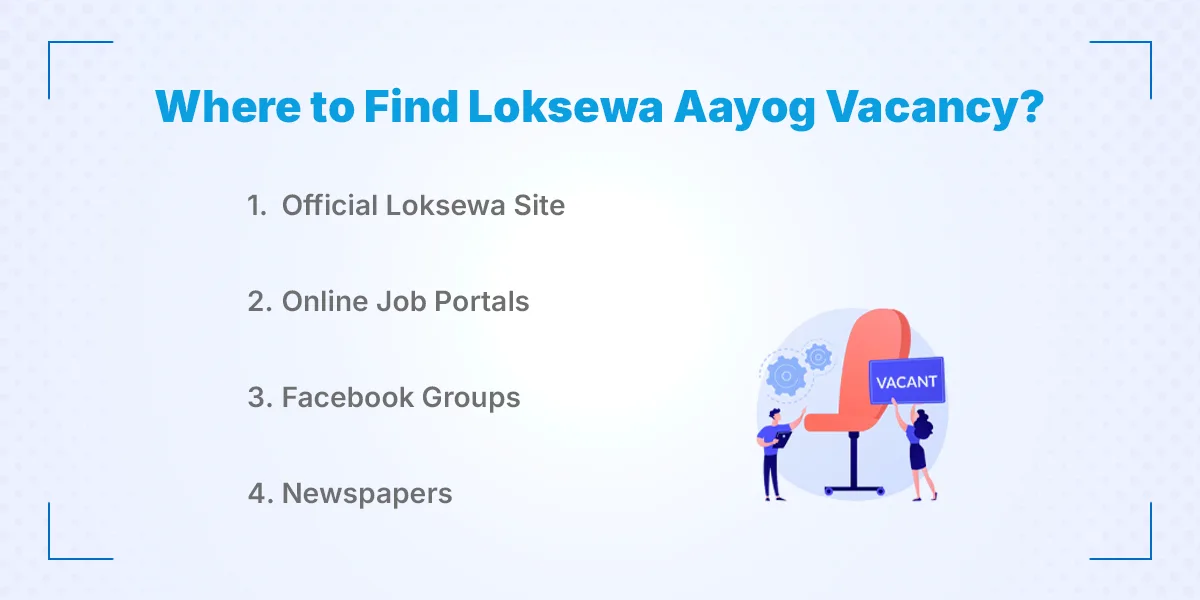
1. Official Loksewa Site
The official Loksewa Aayog website is the most reliable source for vacancy notices. All government jobs, including federal and provincial posts, are first published here. You can find detailed information about eligibility, the application process, deadlines, and required documents. The site also provides exam notifications, syllabus, and result updates. Checking this portal regularly ensures you don’t miss new job announcements. Online applications for most posts are submitted through this site. It’s also the safest source to avoid fake job postings.
2. Online Job Portals
Many online job portals list Loksewa Aayog vacancies for easy access. Sites like Kumari Job provide updates about current openings. These portals summarize vacancy notices, making it easier to find relevant posts. Some even provide alerts or newsletters so you get notifications for new openings. However, it’s important to cross-check details with the official site to ensure accuracy. Portals also sometimes provide application tips and preparation guidance, which can be helpful. They save time by letting you see multiple posts in one place.
3. Facebook Groups
Several Facebook groups share updates about Loksewa vacancies regularly. Members post links to official announcements, exam tips, and experiences from past candidates. Following these groups can help you stay updated instantly. You can also ask questions and get guidance from senior candidates. Make sure to verify each post with the official portal before applying. These groups are helpful for reminders about deadlines and discussions about preparation strategies. Engaging in groups can also give motivation and peer support during preparation.
4. Newspapers
Government and private newspapers also publish Loksewa Aayog job announcements. Local dailies like Kantipur, Gorkhapatra, and The Himalayan Times often include vacancy notices. Newspapers are especially useful if you prefer offline updates or want printed information. They provide details like post names, number of vacancies, and application deadlines. Checking newspapers regularly can help you catch announcements that might be missed online. Candidates often combine this with online sources for a complete update.
Conclusion
Successfully applying for a Loksewa Aayog vacancy requires careful planning, attention to detail, and consistent preparation. From checking official and province-wise announcements to understanding the exam pattern and syllabus, every step matters. Candidates should focus on filling out applications accurately, uploading correct documents, and paying fees on time to avoid rejection.
Preparing for general knowledge, aptitude, and post-specific subjects, along with mock tests and interview practice, significantly improves success chances. By following these steps, aspirants can confidently navigate the selection process and maximize opportunities across federal and provincial posts. With discipline, timely action, and strategic preparation, anyone can turn their ambition of joining Loksewa Aayog into a reality.
Frequently Asked Questions
Submit your comments

Get Our App On



What is the Public Relations Officer Salary in Nepal
VIEW DETAILS
What Is the Salary of a Ticketing Officer in Nepal?
VIEW DETAILS
What Is the Salary of a Travel Consultant in Nepal?
VIEW DETAILS
How to Become an Auditor in Nepal
VIEW DETAILS


Loading Comments...