




Recruiting dozens or even hundreds of employees within a short deadline can overwhelm any company in Nepal. During expansion, seasonal demand, or new project launches, internal HR teams often face the same pressure points: too many applications to process, limited time for screening, interview bottlenecks, and rising recruitment costs.
This challenge becomes bigger in a market where youth job-seeking is high. For example, Nepal’s youth unemployment rate (ages 15–24) was about 20.6% in 2024 (World Bank data as published via FRED). And national survey reporting has also shown youth joblessness around 22.7% in 2022–23, highlighting how competitive the applicant pool can be, especially when companies announce multiple openings at once.
In this blog, you will learn what bulk hiring services are, how they work in Nepal, which industries use them, their benefits and cost structure, and how to choose a reliable recruitment partner. This guide will help you understand how bulk recruitment can save time, reduce hiring risks, and improve workforce planning efficiency.
In this blog
What are Bulk Hiring Services?
Bulk hiring services are recruitment solutions designed to help companies hire a large number of employees within a short period through structured sourcing, screening, and onboarding processes. Unlike traditional recruitment, which fills one or a few positions over time, bulk hiring focuses on recruiting dozens or even hundreds of employees at once. This approach is ideal when companies open new branches, start new projects, expand operations, or scale quickly within a short period.
In Nepal, industries such as manufacturing, banking, IT, BPO, hospitality, retail, and outsourcing regularly depend on bulk recruitment to meet sudden workforce demands. When growth happens fast, businesses cannot afford slow hiring processes. Many companies choose recruitment agencies for bulk hiring because managing large volumes of applications internally can overwhelm HR teams. Reviewing hundreds of resumes, conducting multiple interviews, and coordinating onboarding requires significant time and resources.
Professional agencies simplify this process. They maintain large candidate databases, use structured screening systems, and assign dedicated recruitment teams to handle high-volume hiring efficiently. This helps:
- Reduce time-to-hire
- Maintain consistent candidate quality.
- Minimize administrative burden
- Allow management to focus on core business activities.
With the right system in place, bulk hiring becomes faster, more organized, and strategically aligned with business growth.
Why Companies in Nepal Need Bulk Hiring Services
Companies in Nepal need bulk hiring services to quickly fill large numbers of positions during expansion, seasonal demand, or project-based growth while reducing recruitment time and operational pressure.
When businesses grow rapidly or launch new branches, internal HR teams often cannot handle the sudden increase in hiring needs. Bulk hiring services provide structured processes, faster screening, and organized onboarding support. This helps companies avoid delays, maintain productivity, and ensure they hire the right candidates within tight deadlines. It also improves workforce planning and reduces hiring mistakes that can increase long-term costs.
1. Rapid Business Expansion
When a company opens a new branch or factory, it needs many employees at once. Hiring one by one can slow down operations and affect productivity. Bulk hiring services help fill multiple roles in a short time. This ensures the company starts operations smoothly. Fast recruitment supports business growth without delays.
2. Seasonal or Project-Based Hiring Needs
Some industries like hospitality, retail, and manufacturing face seasonal demand. During peak seasons, they need extra staff for a short period. Bulk hiring agencies can quickly source temporary or contract employees. This helps companies manage workload without long-term commitments. After the season ends, the workforce size can be adjusted easily.
3. Reducing Recruitment Time
Traditional hiring methods take weeks or even months. Screening hundreds of applications manually is time-consuming. Bulk hiring services use structured systems and experienced recruiters to speed up the process. They conduct mass screenings and group interviews efficiently. This reduces time-to-hire and prevents business disruption.
4. Managing High Applicant Volume Efficiently
When companies announce multiple vacancies, they receive a large number of applications. Managing these applications can overwhelm internal HR teams. Recruitment agencies use databases, filtering tools, and screening methods to shortlist suitable candidates quickly. This improves hiring quality and reduces errors. It also ensures no strong candidate is missed during the process.
5. Cost-Effective Workforce Planning
Bulk hiring may seem expensive at first, but it reduces overall recruitment costs. Agencies streamline sourcing, screening, and onboarding, which saves time and internal resources. Companies avoid repeated advertising and administrative expenses. Efficient hiring reduces employee turnover and training costs. In the long run, bulk hiring services support better workforce planning and budget control.
How Bulk Hiring Services Work in Nepal
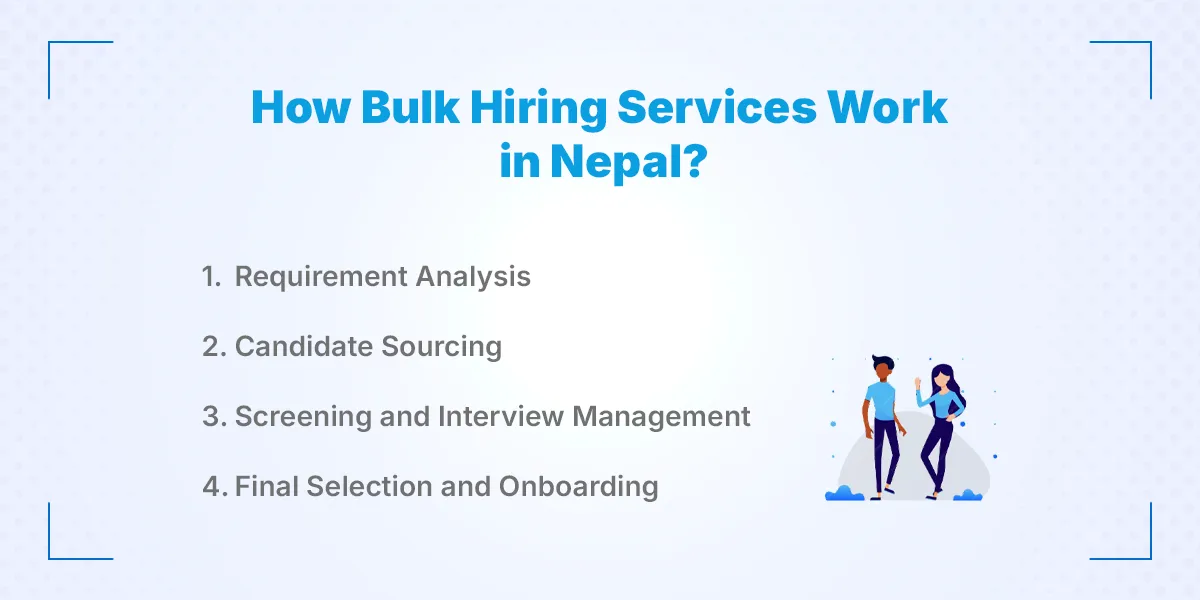
Bulk hiring services in Nepal follow a structured process that includes requirement analysis, candidate sourcing, screening management, and final onboarding to efficiently recruit large numbers of employees within a fixed timeline. Recruitment agencies use a step-by-step system to ensure speed, accuracy, and quality control. This structured approach reduces hiring delays and helps companies manage high-volume recruitment without overwhelming their internal HR teams.
1. Requirement Analysis
The first step in bulk hiring is understanding the company’s exact manpower needs. Recruitment agencies meet with the employer to clarify job roles, required skills, number of positions, salary range, and hiring timeline. They also analyze whether the roles are permanent, contract-based, or seasonal. Clear job descriptions are created to avoid confusion during sourcing. Proper requirement analysis ensures the hiring process starts with a well-defined strategy.
2. Candidate Sourcing
Once requirements are finalized, agencies begin sourcing candidates from multiple channels. This includes searching their internal database, posting jobs on portals, social media outreach, and mass advertising. Recruitment teams may also conduct walk-in drives or campus hiring if needed. The goal is to attract a large pool of suitable applicants quickly. Effective sourcing ensures enough qualified candidates are available for screening.
3. Screening and Interview Management
After sourcing, agencies filter resumes based on skills, experience, and job criteria. They may conduct phone screenings, group interviews, or skill assessments depending on the role. For technical or specialized positions, written or practical tests may be included. Shortlisted candidates are then scheduled for final interviews with the employer. This structured screening process improves candidate quality and reduces hiring risks.
4. Final Selection and Onboarding
In the final stage, selected candidates receive offer letters and employment terms. Agencies assist with document verification, background checks, and compliance requirements. They coordinate joining dates and ensure smooth communication between the employer and candidates. Some agencies also support onboarding formalities and initial training coordination. This step ensures the new workforce integrates quickly and begins contributing to company operations.
Industries That Use Bulk Hiring Services in Nepal
Industries in Nepal, such as manufacturing, banking, IT, hospitality, retail, and FMCG, frequently use bulk hiring services to recruit large teams quickly and efficiently during expansion or peak demand periods.
These sectors often require dozens or even hundreds of employees at once, making traditional recruitment methods slow and inefficient. Bulk hiring agencies help streamline the process, reduce delays, and ensure companies get the right workforce within a short timeline.
1. Manufacturing and Factories
Manufacturing companies often need large numbers of workers for production lines, packaging, and operations. When factories expand or start new production units, they require immediate workforce deployment. Bulk hiring helps fill roles such as machine operators, supervisors, and support staff quickly. Agencies manage mass screening and skill-based shortlisting for technical roles. This ensures production does not face delays due to manpower shortages.
2. Banking and Finance Sector
Banks and financial institutions use bulk hiring when opening new branches or launching financial products. They may need relationship officers, loan officers, customer service staff, and back-office employees. Managing large applicant volumes internally can slow operations. Recruitment agencies help conduct structured assessments and interviews efficiently. This allows financial institutions to maintain service quality while scaling operations.
3. IT and BPO Companies
IT and BPO companies often scale rapidly based on project requirements or outsourcing contracts. They may need developers, support staff, customer service agents, or data entry operators in large numbers. Bulk hiring agencies help source technical and non-technical candidates through databases and digital platforms. Quick recruitment is essential to meet client deadlines and service-level agreements. This ensures smooth project execution and operational efficiency.
4. Hospitality and Tourism
Hotels, resorts, airlines, and travel companies frequently require seasonal or event-based hiring. Peak tourist seasons increase the demand for front desk staff, housekeeping, chefs, and customer service representatives. Bulk hiring allows hospitality businesses to prepare in advance for high demand. Agencies also help with screening candidates for communication and service skills. This improves customer satisfaction during busy periods.
5. Retail and FMCG Companies
Retail stores and FMCG companies often need large sales teams, promoters, warehouse staff, and delivery personnel. During festivals or product launches, workforce demand increases significantly. Bulk recruitment helps quickly deploy sales representatives and operational staff. Agencies manage walk-in interviews and mass selection drives for these roles. Efficient hiring ensures smooth sales operations and inventory management.
Benefits of Using Bulk Hiring Services
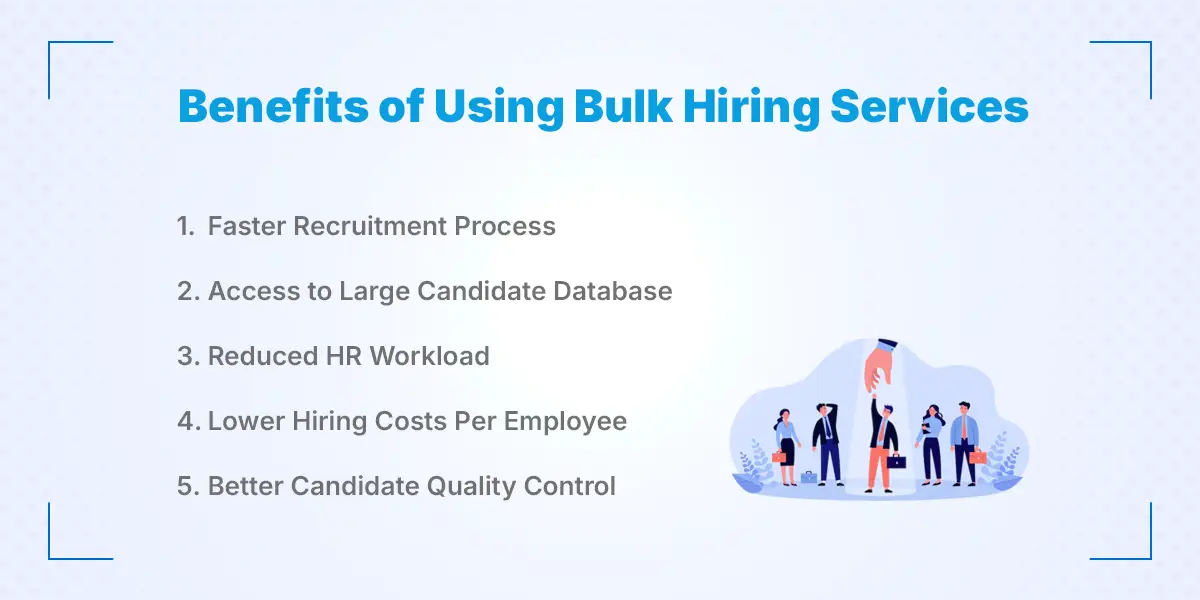
Bulk hiring services help companies recruit large numbers of employees quickly while improving efficiency, reducing internal workload, and maintaining quality control throughout the recruitment process. Organizations that rely on structured recruitment partners can scale operations faster and avoid delays caused by manual hiring processes. Bulk recruitment is especially useful when time, cost, and workforce quality are critical factors.
1. Faster Recruitment Process
Bulk hiring services significantly reduce time-to-hire. Agencies use structured systems, databases, and dedicated recruiters to manage large applicant volumes efficiently. Instead of reviewing hundreds of resumes manually, screening is done through organized filtering methods. Group interviews and mass assessments speed up selection. This allows companies to fill positions quickly without affecting business operations.
2. Access to Large Candidate Database
Recruitment agencies maintain extensive candidate databases across industries. This gives companies immediate access to pre-screened and job-ready applicants. Instead of starting from scratch, agencies can quickly shortlist suitable candidates. Databases often include active and passive job seekers. This improves hiring speed and increases the chances of finding the right talent.
3. Reduced HR Workload
Managing bulk recruitment internally can overwhelm HR teams. Agencies handle sourcing, screening, coordination, and documentation processes. This allows internal HR departments to focus on employee engagement and core business tasks. Reduced administrative burden improves productivity. It also minimizes hiring errors caused by rushed internal processes.
4. Lower Hiring Costs Per Employee
Although agencies charge service fees, bulk hiring often reduces the overall cost per hire. Structured recruitment reduces repeated advertising and administrative expenses. Faster hiring also lowers productivity loss caused by vacant positions. Efficient screening reduces employee turnover and rehiring costs. Over time, this makes bulk hiring financially practical for growing companies.
5. Better Candidate Quality Control
Agencies follow systematic screening and evaluation methods. Candidates are assessed based on skills, experience, and job fit before final interviews. This reduces the risk of hiring unsuitable employees. Quality control improves workforce performance and stability. As a result, companies benefit from stronger team productivity and long-term hiring success.
How to Choose the Right Bulk Hiring Agency in Nepal
To choose the right bulk hiring agency in Nepal, companies should evaluate credibility, recruitment capacity, pricing structure, client feedback, and compliance with labor regulations to ensure reliable and efficient hiring support.
Start by checking the agency’s experience in handling large-scale recruitment projects and the industries they specialize in. An experienced agency understands market trends, candidate availability, and hiring timelines. Next, assess their recruitment capacity, including database size, sourcing channels, and screening systems, to ensure they can manage high applicant volumes efficiently.
It is also important to compare service packages and pricing models to understand what is included, such as screening, testing, background verification, and onboarding support. Reviewing client testimonials and past recruitment projects provides insight into service quality and placement success rates. Finally, ensure the agency follows Nepal’s labor laws and ethical recruitment practices, as compliance protects your company from legal risks and ensures smooth workforce integration.
Which Is the Best Bulk Hiring Service Provider in Nepal?
When it comes to bulk recruitment in Nepal, Kumari Job is widely regarded as one of the most trusted and effective partners for large-scale hiring. With over 10 years of experience in HR Consulting services, recruitment, and talent acquisition, Kumari Job has built a strong reputation for helping businesses hire quickly and efficiently.
Kumari Job’s strength lies in its large talent database and structured hiring process, which makes it easier to source, screen, and place hundreds of candidates across industries such as manufacturing, IT, banking, hospitality, retail, and outsourcing. The platform connects employers with thousands of verified professionals and supports both permanent and contract hires, making it ideal for companies with high-volume staffing needs.
Here’s what sets Kumari Job apart:
- Proven Track Record: Operating since 2014, it has helped thousands of companies nationwide find qualified talent across different job levels.
- Wide Industry Coverage: Employers in sectors like IT, finance, hospitality, manufacturing, and BPO trust Kumari Job for quality candidate matches.
- Structured Screening & Matching: Its recruitment process includes targeted sourcing, skill-based shortlisting, and coordinated interviews, which reduces hiring risks and improves quality.
- Comprehensive HR Solutions: Beyond recruitment, Kumari Job provides HR consulting, outsourcing, and training services that help businesses improve HR systems and workforce performance.
Working with a certified HR consulting firm like Kumari Job ensures ethical recruitment practices, adherence to labor regulations, and consistent support throughout the hiring journey. Its integrated approach combining recruitment expertise with workforce planning tools makes building strong, high-performing teams easier and more efficient.
Bulk Hiring Cost in Nepal
Bulk hiring services in Nepal typically charge fees based on the number of hires, the urgency of recruitment, and the level of skill required, making it important for companies to understand cost structures before engaging a provider.
The typical fee structure for bulk hiring may be calculated as a percentage of the annual salary of each hired employee, a fixed cost per candidate placed, or a package rate for large hires. For example, many agencies charge 8%–15% of the first year’s salary per candidate when hiring for mid and senior roles, while high-volume packages may offer discounted flat rates when recruiting dozens of employees at once. These rates vary based on the scope of services, basic sourcing and shortlisting vs. full-cycle recruitment, including assessments and onboarding support.
Several factors affect the overall cost:
- Industry type: Specialized sectors such as IT and finance may involve higher fees due to skill testing and screening complexity.
- Skill level: Hiring for technical or managerial roles often costs more than recruiting entry-level positions.
- Urgency: Faster turnaround times usually incur premium fees due to priority processing and additional resources.
Compared to in-house recruitment, bulk hiring services can be more cost-effective when large teams are needed within short timelines. Internal hiring often involves repeated job postings, long screening hours, administrative overheads, and slower fill times, which can increase hidden costs. Agencies leverage databases and standardized systems to reduce time-to-hire and administrative burden. For customized plans or exact pricing tiers, especially for high-volume needs, companies can contact Kumari Job for expert consultation, detailed fee quotes, and scalable hiring packages tailored to industry and workforce size.
When Should a Company Consider Bulk Hiring?
A company should consider bulk hiring when it needs to recruit a large number of employees within a short period due to expansion, seasonal demand, or rapid business growth. Bulk recruitment becomes essential when internal HR teams cannot manage high hiring volumes efficiently. It helps avoid operational delays and ensures that manpower is available exactly when required. Companies that plan workforce expansion strategically can reduce risks and maintain productivity during growth phases.
1. Opening a New Branch or Factory
When a company opens a new branch, outlet, or manufacturing unit, it often requires dozens of employees at once. Roles may include operational staff, supervisors, sales teams, and administrative personnel. Hiring one by one can delay business operations. Bulk hiring ensures the workforce is ready before launch. This allows the company to start operations smoothly without manpower shortages.
2. Launching a New Product or Service
Introducing a new product or service often increases workload in sales, marketing, and customer support. Companies may need promotional staff, sales representatives, or support executives quickly. Bulk hiring helps deploy trained teams within tight deadlines. This ensures product launches are supported by adequate manpower. Proper staffing during launch improves market performance and customer experience.
3. Seasonal Hiring Demand
Industries such as hospitality, retail, and tourism face seasonal demand spikes. During festivals or peak tourist seasons, companies need temporary or contract staff. Bulk hiring allows businesses to manage this demand without long-term hiring commitments. Agencies can quickly source and deploy short-term workers. This keeps operations stable during high-demand periods.
4. Rapid Scaling Phase
Startups and growing businesses often experience rapid expansion. When scaling quickly, companies may need to hire large teams across departments. Bulk hiring helps maintain growth momentum without overwhelming internal HR teams. Structured recruitment ensures consistent candidate quality. This supports sustainable expansion and long-term business success.
Conclusion
Bulk hiring services help companies recruit large teams efficiently during expansion, seasonal demand, or rapid growth phases. They save time, reduce overall hiring costs, and improve workforce planning through structured sourcing and screening processes. Choosing a reliable recruitment partner ensures consistent candidate quality and long-term hiring success.
If your company is planning large-scale recruitment in Nepal, consider working with an experienced provider like Kumari Job to streamline the process and secure the right talent quickly. Along with customized bulk hiring solutions tailored to your industry and workforce needs, you can also benefit from professional HR training and workforce development programs that strengthen your internal HR capabilities and ensure long-term talent management success.
Frequently Asked Questions
Submit your comments

Get Our App On



What is the Public Relations Officer Salary in Nepal
VIEW DETAILS
What Is the Salary of a Ticketing Officer in Nepal?
VIEW DETAILS
What Is the Salary of a Travel Consultant in Nepal?
VIEW DETAILS
How to Become an Auditor in Nepal
VIEW DETAILS


Loading Comments...