



Are you curious about how much a Nijamati Karmachari earns in Nepal, but feel lost in all the complicated salary tables and government rules? You are not alone. Many people want a clear picture of civil servant pay, allowances, and benefits without getting stuck in confusing details.
In this blog, we will break it all down for you in the simplest way. From the basic salary to allowances like dearness and festival bonuses, and even the pension system, we’ll cover everything you need to know. By the end, you will understand the exact Nijamati Karmachari salary, so you can plan your career or future confidently.
In this blog
Who are Nijamati Karmachari/ Civil Servants?
Nijamati Karmachari, also called civil servants, are people who work for the government in Nepal. Their main job is to serve the public and help run government offices smoothly. If you have ever visited a government office, like the local municipality, ministries, or public departments, the staff you see there are mostly Nijamati Karmachari.
They are the backbone of the country’s administration. Without them, many government services like issuing documents, managing programs, and implementing laws would not work properly.
Here’s a simple way to understand what they do:
- Work in different government offices at local, provincial, and central levels
- Help citizens with services like ID cards, passports, and certificates
- Support policy-making and implement government plans
- Maintain records, manage resources, and handle public inquiries
- Ensure laws and rules are followed
Nijamati Karmachari are divided into gazetted and non-gazetted levels depending on their responsibilities and ranks. Gazetted officers usually handle decision-making roles, while non-gazetted staff work more on support and administrative jobs.
Becoming a Nijamati Karmachari is not only a respected job but also a stable career choice. They get regular salaries, allowances, and other benefits. Many people dream of this job because it offers security, growth, and a chance to serve the nation.
What is the Salary of Nijamati Karmachari in Nepal?
In 2083/84, gazetted Nijamati Karmachari generally earn about Rs. 60,000 to 90,000+ per month, and non‑gazetted staff usually earn around Rs. 34,000 to 50,000+ per month before allowances.
Nijamati Karmachari salaries in Nepal follow the official government pay scale set for the fiscal year 2083/84 B.S. The system is the same whether you work for the federal, provincial, or local government. Each post has a basic salary, and many also get grade increments based on experience and level.
For gazetted officers, like joint secretaries or section officers, the basic + grade figures tend to sit in the range mentioned above. These are higher‑level roles responsible for decision‑making and leading teams.
For non‑gazetted officers, such as office assistants or junior clerks, the salaries are lower but still stable because they follow the same structured scale.
It is important to note that these figures do not include monthly allowances such as the dearness allowance (Rs. 5,000) or other benefits like local, risk, or position allowances. When allowances are added, the total take‑home pay becomes noticeably higher.
Overall, the salary depends on your rank, grade count, and government level, but civil servants in Nepal enjoy a transparent and standardized pay system.
Salary Structure of Nijamati Karmachari by Level (Gazetted and Non-Gazetted)
The monthly salary of Nijamati Karmachari in 2083/84 B.S. follows the official government pay scale set by the Government of Nepal. These salaries include the basic pay plus grade increments, but do not include allowances such as dearness allowance, local or position allowances. The salary structure differs by role and rank, with gazetted officers earning higher than non-gazetted staff, contributing to a good salary in Nepal. This structured pay system helps ensure fairness and transparency in how civil servants are compensated.
1. Gazetted Officers (राजपत्राङ्कित पद)
| Position | Basic Salary (Rs.) | Grade No. | Grade Rate | Fixed Total |
|---|---|---|---|---|
| Chief Secretary (मुख्य सचिव) | 84,932 | 2 | 2,831 | 90,594 |
| Special Class Officer (रा.प. विशिष्ट) | 79,290 | 2 | 2,643 | 84,576 |
| Special Purpose Officer (अ.वि.वि. (विशेष प्रयोजन)) | 66,539 | – | – | 66,539 |
| Gazetted First Class Officer (रा.प. प्रथम) | 62,466 | 7 | 2,082 | 77,040 |
| Gazetted Second Class Officer (रा.प. द्वितीय) | 53,611 | 8 | 1,787 | 67,907 |
| Gazetted Third Class Officer (रा.प. तृतीय) | 48,058 | 8 | 1,602 | 60,874 |
2. Non-Gazetted Officers (राजपत्र अनङ्कित पद)
| Position | Basic Salary (Rs.) | Grade No. | Grade Rate | Fixed Total |
|---|---|---|---|---|
| Non-Gazetted First Class (Pension Purpose) (रा.प.अ. प्रथम अ.प्रा. पेन्सन प्रयोजन) | 41,517 | – | – | 41,517 |
| Non-Gazetted First Class Officer (रा.प.अ. प्रथम) | 38,203 | 10 | 1,273 | 50,933 |
| Non-Gazetted Second Class (Pension Purpose) (रा.प.अ. द्वितीय अ.प्रा. पेन्सन प्रयोजन) | 37,407 | – | – | 37,407 |
| Non-Gazetted Second Class Officer (रा.प.अ. द्वितीय) | 36,192 | 10 | 1,206 | 48,252 |
| Non-Gazetted Third Class Officer (रा.प.अ. तृतीय) | 30,373 | 7 | 1,012 | 37,457 |
| Non-Gazetted Fourth Class Officer (रा.प.अ. चतुर्थ) | 28,690 | 6 | 956 | 34,426 |
3. Other Relevant Government Staff
a. Heavy Vehicle Drivers / हेभी सवारी चालक
| Level | Basic Salary (Rs.) | Grade No. | Grade Rate | Fixed Total (Rs.) |
|---|---|---|---|---|
| Fifth Level (पाँचौं स्तर) | 45,517 | 4 | 1,524 | 51,813 |
| Fourth Level (चौथो स्तर) | 43,794 | 2 | 1,460 | 46,714 |
| Third Level (तृतीय स्तर) | 41,391 | 2 | 1,380 | 44,151 |
| Second Level (द्वितीय स्तर) | 36,673 | 2 | 1,222 | 39,117 |
| First Level (प्रथम स्तर) | 32,701 | 2 | 1,090 | 34,881 |
b. Light Vehicle Drivers / हलुका सवारी चालक
| Level | Basic Salary (Rs.) | Grade No. | Grade Rate | Fixed Total (Rs.) |
|---|---|---|---|---|
| Fifth Level (पाँचौं स्तर) | 43,794 | 4 | 1,460 | 49,634 |
| Fourth Level (चौथो स्तर) | 41,391 | 2 | 1,380 | 44,151 |
| Third Level (तृतीय स्तर) | 36,673 | 2 | 1,222 | 39,117 |
| Second Level (द्वितीय स्तर) | 32,701 | 2 | 1,090 | 34,881 |
| First Level (प्रथम स्तर) | 30,373 | 2 | 1,012 | 32,397 |
c. Messengers (Halkara) / हल्कारा
| Level | Basic Salary (Rs.) | Grade No. | Grade Rate | Maximum Salary (Rs.) |
|---|---|---|---|---|
| Fifth Level (पाँचौं स्तर) | 36,267 | 4 | 1,242 | 42,235 |
| Fourth Level (चौथो स्तर) | 33,789 | 2 | 1,126 | 36,041 |
| Third Level (तृतीय स्तर) | 31,891 | 2 | 1,063 | 34,017 |
| Second Level (द्वितीय स्तर) | 30,146 | 2 | 1,005 | 32,156 |
| First Level (प्रथम स्तर) | 28,690 | 2 | 956 | 30,602 |
d. Office Assistants / कार्यालय सहयोगी
| Level | Basic Salary (Rs.) | Grade No. | Grade Rate | Maximum Salary (Rs.) |
|---|---|---|---|---|
| Fifth Level (पाँचौं स्तर) | 36,142 | 4 | 1,205 | 40,962 |
| Fourth Level (चौथो स्तर) | 32,701 | 2 | 1,090 | 34,881 |
| Third Level (तृतीय स्तर) | 30,373 | 2 | 1,012 | 32,397 |
| Second Level (द्वितीय स्तर) | 28,980 | 2 | 956 | 30,602 |
| First Level (प्रथम स्तर) | 27,172 | 2 | 906 | 28,984 |
Allowances and Benefits for Nijamati Karmachari
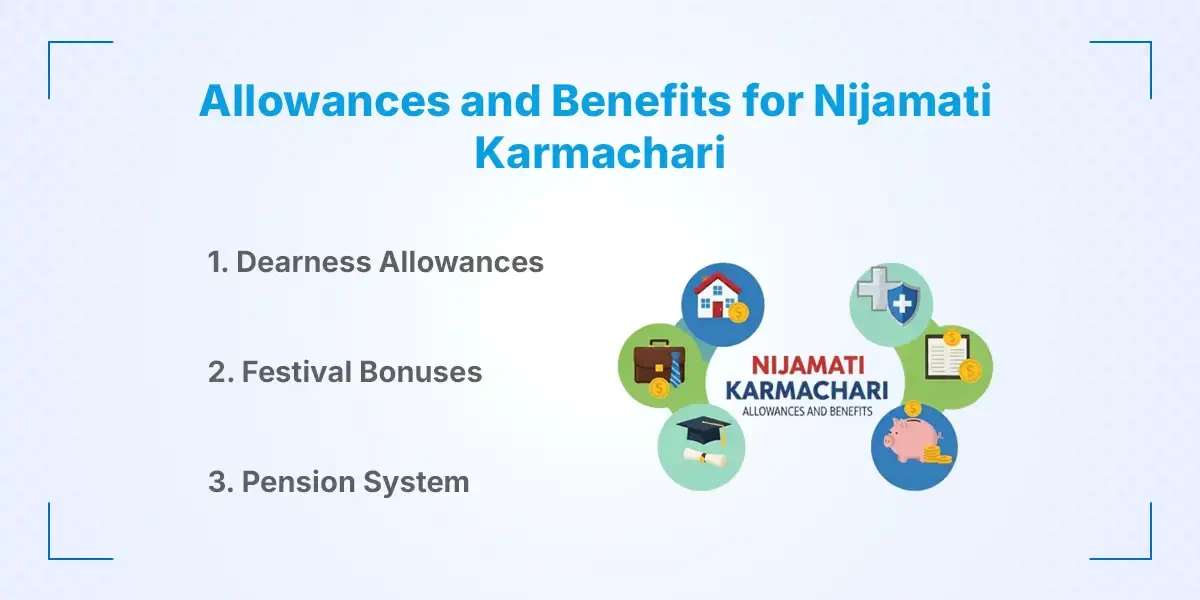
Civil servants in Nepal do not just earn a basic salary. The government also provides important allowances and benefits that help them manage daily expenses, celebrate festivals, and secure their future after retirement. These extras make government service more stable and rewarding than just the monthly pay. Here are the main ones every Nijamati Karmachari should know about.
1. Dearness Allowance
Dearness allowance is an additional amount that Nepal Government employees receive every month to help manage the rising cost of living and inflation. For FY 2083/84 B.S., the government has continued the monthly dearness allowance at Rs. 5,000 for eligible civil servants. Unlike the basic salary, this allowance is a fixed amount and is paid equally to employees regardless of their rank or position. It is added directly to the monthly salary and remains one of the key benefits for Nijamati Karmachari. The government may revise the dearness allowance in future budgets depending on inflation, economic conditions, and fiscal policy decisions.
2. Festival Bonuses
Government workers in Nepal receive a festival bonus, also called festival expenses or festival allowance, once every fiscal year. This bonus is equal to one month’s salary and is given so employees can celebrate major cultural, religious, and traditional festivals according to their beliefs. All permanent government employees are eligible for this benefit. Retired employees who receive a pension also get a festival amount equal to one month’s pension. Festival bonuses support families during big celebrations and cultural events.
3. Pension System
The pension system is a key benefit for Nijamati Karmachari after they retire from service. Once a civil servant completes the required years of service and retires, they become eligible for pension payments for life based on their last drawn salary and service period. Retired employees may also receive additional benefits like disability pension, family pension, educational allowance for children, and other long-term support as defined by government rules. These benefits ensure that civil servants have financial support even after finishing their careers.
Is Nijamati Karmachari Salary Enough for a Good Life in Nepal?
Yes, for many people, the salary of a Nijamati Karmachari is enough for a decent and stable life in Nepal. It may not make someone rich, but it helps cover daily needs without constant money stress. The biggest strength of this job is not just the salary, but the steady income and long-term security that comes with it.
A government salary is paid on time every month. Along with the basic pay, civil servants also get dearness allowance, festival bonus, and pension after retirement. These benefits reduce financial pressure, especially for families. Over time, grade increments and promotions slowly increase the income, which helps manage rising living costs.
Here is why many people feel the salary is enough:
- Monthly salary is fixed and reliable
- Dearness allowance helps with daily expenses
- Festival bonus supports family needs during major festivals
- Pension provides income after retirement
- Job security reduces fear of sudden income loss
However, lifestyle matters a lot. A single person or a small family can live comfortably on this salary, especially outside big cities. In places like Kathmandu, living costs are higher, so careful budgeting is important. Many civil servants also manage extra income through savings, side work, or family support.
Overall, the Nijamati Karmachari salary offers a balanced life. It supports basic needs, family responsibilities, and future security. For people who value stability, respect, and long-term peace of mind, this salary is more than acceptable for a good life in Nepal.
Why People Choose Nijamati Karmachari as a Career in Nepal
Many people in Nepal choose the Nijamati Karmachari career not just for money, but for long-term safety and peace of mind. This job offers stability in a time when private jobs can be uncertain. It also brings social respect and a structured career path. For these reasons, thousands of people prepare every year to enter civil service.
1. Job Security
Job security is one of the biggest reasons people choose Nijamati service. Once appointed, the risk of losing the job is very low. Even during economic problems, government jobs remain safe. Employees do not face sudden layoffs like in private companies. This security helps people plan their lives with confidence. They can take loans, buy homes, and support families without fear. For many, this sense of safety is more important than a high salary.
2. Respect in Society
Nijamati Karmachari receive strong respect in society. People often see them as responsible and trustworthy. Their opinions are valued in families and communities. Working in a government office brings a sense of pride. Many parents encourage their children to choose this career for this reason. Social respect remains even after retirement.
3. Steady Income
The salary of a Nijamati Karmachari is fixed and paid on time every month. There is no worry about delayed payments. Along with salary, they receive allowances and festival bonuses. Grade increments slowly increase income over time. This steady flow of money helps manage daily life. It brings mental peace and financial balance.
4. Pension
The pension system is a major benefit of government service. After retirement, employees receive regular pension payments. This ensures income even when they stop working. Pension helps cover daily needs in old age. Family pension also supports dependents if needed. This long-term support gives a strong sense of security.
5. Work-Life Balance
Nijamati jobs usually have fixed working hours. Employees get public holidays and regular leave. This allows time for family, health, and rest. Work pressure is often more balanced compared to private jobs. People can plan personal life better. This balance makes the job more comfortable in the long run.
Conclusion
Choosing a Nijamati Karmachari career in Nepal in 2083/2084 offers a stable and dependable life rather than quick wealth. The salary, when combined with allowances, festival bonus, and pension, is enough for a comfortable and secure living for many people. While it may not match high-paying private jobs, it gives something more important, peace of mind.
Regular income, strong job security, social respect, and a balanced work life make this career attractive. Over time, salary increases through grades and promotions further improve financial stability. For those who value safety, steady growth, and long-term support, the Nijamati Karmachari salary is truly enough for a good life in Nepal.
Frequently Asked Questions
Submit your comments

Get Our App On



What is the Public Relations Officer Salary in Nepal
VIEW DETAILS
What Is the Salary of a Ticketing Officer in Nepal?
VIEW DETAILS
What Is the Salary of a Travel Consultant in Nepal?
VIEW DETAILS
How to Become an Auditor in Nepal
VIEW DETAILS


Loading Comments...