



Have you ever wondered how much the Prime Minister of Nepal earns? It’s more than just a number. It shows how the country values its top leader. Knowing the salary, perks, and allowances of the Prime Minister helps citizens stay informed and understand government transparency. Beyond the paycheck, the Prime Minister enjoys various benefits that support the role, from official residences to security and medical care.
In this guide, we will break down the monthly and yearly salary, compare it with other ministers, and explain the allowances in a way that’s easy to understand. By the end, you’ll have a clear picture of the Prime Minister’s total compensation and why it matters.
In this blog
What are the Key Responsibilities of the Prime Minister?
The Prime Minister of Nepal is responsible for leading the government, making policies, representing the country internationally, and handling national crises. The Prime Minister is the most important political leader in Nepal. Their decisions affect the entire country. Understanding their responsibilities helps citizens know how the government works and why their role is so crucial.
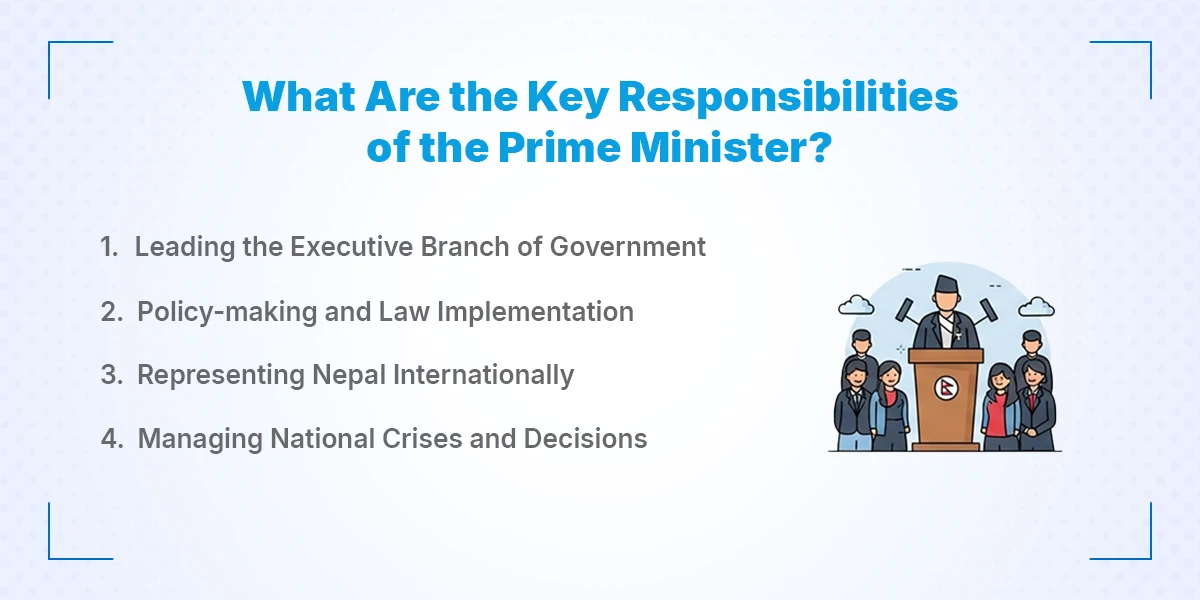
1. Leading the Executive Branch of Government
The Prime Minister is the head of the executive branch and leads the entire government. They make sure that all ministries and departments work together smoothly. Without their guidance, different parts of the government may struggle to coordinate. The Prime Minister sets priorities and ensures that government plans are executed efficiently. They also monitor the performance of ministers and officials to achieve national goals. In short, their leadership keeps the government organized and effective for the benefit of the citizens.
2. Policy-making and Law Implementation
The Prime Minister is responsible for shaping policies and making sure laws are followed. This includes planning economic development, education, health, and other key areas.
- Proposing new policies for national growth
- Ensuring laws are applied correctly across the country
- Coordinating with ministers to achieve government goals
3. Representing Nepal Internationally
Nepal’s Prime Minister represents the country in global forums. They build relationships with other nations and participate in international agreements.
- Attending diplomatic meetings and summits
- Promoting Nepal’s trade, tourism, and cultural relations
- Signing treaties or agreements on behalf of Nepal
4. Managing National Crises and Decisions
In emergencies, the Prime Minister takes charge to maintain stability. They coordinate responses to disasters, political issues, or economic challenges.
- Making quick, important decisions during crises
- Guiding government agencies to respond effectively
- Communicating with the public to provide updates and assurance
What is the Current Salary of the Nepal Prime Minister?
The current monthly salary of the Prime Minister of Nepal is approximately NPR 94,280, which includes a basic salary of NPR 77,280, dearness allowance of NPR 2,000, communication allowance of NPR 5,000, and a hospitality allowance of NPR 10,000.
The stated salary figure includes the base pay plus allowances such as communication and hospitality. While this gives a solid number for the monthly and annual pay, it doesn’t fully reflect the total compensation when you factor in fuel, staff support, travel, and other perks. Understanding these numbers helps give transparency around what the top leader in Nepal is officially earning.
Monthly and Annual Salary Breakdown
According to the most recent official directive (the Eighth Edition of the Work Operations Directive, 2077 BS), the breakdown for the Prime Minister is as follows:
1. Base monthly salary: NPR 77,280.
2. Additional monthly allowances:
- Dearness/inflation allowance: ~ NPR 2,000
- Communication allowance: ~ NPR 5,000
- Hospitality allowance: ~ NPR 10,000
3. When you add those together, the monthly figure comes to around NPR 94,280.
4. That monthly total multiplied by 12 gives an annual base/allowance salary of about NPR 11,31,360 (approximation), again, excluding extra benefits like fuel, staff, vehicle use, residence, etc.
Comparison With Past Prime Ministers
- Earlier figures for the Prime Minister’s salary were much lower. For example, under older laws, the monthly salary was sometimes quoted as around NPR 77,280 (base) before allowances.
- Some reports (unofficial/historical) show the Prime Minister’s monthly pay at around NPR 91,190 in a prior review.
- A recent legislative change now gives the Council of Ministers authority to set or revise the salary and benefits of the Prime Minister and ministers, rather than rigidly fixed figures.
- Because of these changes, future salaries may differ, meaning historical comparisons should be treated with some caution since the rules have changed.
Notes & Caveats
- The salary figures reported represent official salary + allowances, but do not include non‑monetary perks such as official residence, vehicles, fuel, staff services, travel allowances, etc., which add significant value.
- Although the directive gives a salary number (NPR 94,280/month), the new law now allows for salary changes via Cabinet decision and publication in the Nepal Gazette. So the number may change in the future.
- Public sources note that while the salary number gives transparency, many additional benefits are harder to quantify publicly (fuel, staff count, official vehicles, security, official residence), which means the “true compensation” is higher.
Allowances and Benefits of the Prime Minister
The Prime Minister of Nepal doesn’t just receive a salary; there are also significant allowances and benefits that come with the job. These perks support the heavy responsibilities of the role and help the leader carry out duties without personal cost for many essentials. In this section, we’ll look at three major categories: official residence, vehicles/staff, medical and security, and other perks.
1. Official Residence, Vehicles, and Staff
The Prime Minister is provided with a state‑maintained residence to live in while in office. They don’t have to pay rent or basic maintenance for that home. They also get an official vehicle (or vehicles) with a driver so that travel for official business is smooth and secure. Along with that, a team of staff is available, including assistants, advisors, and office helpers, to support day‑to‑day duties and logistics. All of this means the PM can focus on governance rather than worry about personal accommodation, transport, or administrative support.
2. Medical benefits and security
In addition to housing and transport, the Prime Minister is covered by state‑provided medical benefits. This means treatment and care, often both inside Nepal and abroad when needed, are part of the official support. Security is another major part: because of the high‑risk nature and public visibility of the job, the PM gets full security protection, which includes bodyguards, secure transport, and facilities to ensure safety. This ensures the leader can perform duties without undue risk to personal well‑being.
3. Other perks
There are further benefits beyond residence, transport, and health. For example, allowances for travel when outside Kathmandu, fuel allocations for vehicles, communication allowances (phones, internet), and hospitality expenses. These extra perks help cover costs tied to the public role rather than private life. The idea is that while serving the country, the Prime Minister should not bear high out‑of‑pocket costs for official duties.
Prime Minister’s Salary Compared with Other Ministers
The Prime Minister earns more than cabinet ministers and MPs, but the gap isn’t huge. For example, the PM’s monthly salary is around NPR 94,280, while cabinet ministers get around NPR 79,230.
When you look at how much top leaders earn in Nepal, you’ll see a tiered structure. The role of the Prime Minister of Nepal sits at the top in terms of salary and perks. Cabinet ministers are next, followed by MPs and lower ministers. The differences reflect their responsibilities and rank.
Cabinet Ministers vs the Prime Minister
Under the current guideline, the Prime Minister’s monthly total is about NPR 94,280 (this includes base pay and allowances). For a cabinet minister, the monthly total is around NPR 79,230. So, while the PM earns more, ministers still have substantial pay. The extra for the PM corresponds to higher duty, more staff, and stronger allowances.
MPs’ salaries comparison
Members of Parliament get less than ministers. According to the Nepal government, the MPs earn around NPR 66,000 monthly. This reflects that MPs, though important, do not carry the same executive responsibilities as ministers or the Prime Minister.
Government pay scale overview
The pay scale shows a clear hierarchy: PM > ministers > MPs. But beyond base salaries, allowances, and perks complicate the picture. Also, recent law changes mean the cabinet now has the power to set or revise the salaries of these officials. Because of this, pay figures may change going forward.
Conclusion
The Prime Minister of Nepal has a significant role, and their salary reflects the responsibilities they carry. Beyond the base pay, allowances, and perks like official residence, vehicles, staff, medical care, and security, add to the total compensation. Compared to other ministers and MPs, the Prime Minister earns more, which matches the leadership duties of the position.
Understanding this salary and benefits package helps citizens see how public funds are used and ensures transparency in government. Staying informed about these figures is important because salaries and allowances can change with government updates. Knowing the details also helps people appreciate the work and responsibilities that come with leading the nation.
Frequently Asked Questions
Submit your comments

Get Our App On



What is the Public Relations Officer Salary in Nepal
VIEW DETAILS
What Is the Salary of a Ticketing Officer in Nepal?
VIEW DETAILS
What Is the Salary of a Travel Consultant in Nepal?
VIEW DETAILS
How to Become an Auditor in Nepal
VIEW DETAILS


Loading Comments...