



Ever wondered how much a Nepal Police officer actually earns? From the jawan on the street to the Inspector General who leads the entire force, their salaries are something that many are interested in. After all, they protect us day and night, and people naturally want to know how much they earn each month. Now, the pay of Nepal Police is not just about the basic salary. It also comes with allowances, benefits, and steady growth with rank. That’s why understanding the salary structure gives a clear picture of their career and lifestyle.
In this blog, we’ll break down the Nepal Police salary rank by rank, explain allowances, and show how their pay compares in 2026.
In this blog
What is the Salary of Nepal Police?
The salary of Nepal Police ranges from around NPR 27,172 per month for a recruit to NPR 84,576 per month for the Inspector General of Police (IGP). The salary of Nepal Police depends on rank. The jawan, the lowest rung of the force, is paid the least. The greater the rank, the higher the pay. The officers, like inspectors, DSPs, and SSPs, get more than the lower-ranked ones. But even at the junior level, police officers also get allowance for food, dress, and other small benefits. Their income, therefore, does not solely depend on the basic salary that they receive every month.
Second, also remember that the salary in the Nepal Police gets refreshed from time to time. When the government does a pay grade hike for public servants, the police pay also increases. It provides job security compared to most private jobs. And then there are added benefits in the form of pension, shelter allowance, and medical facilities. So, although the take-home basic salary-wise might seem relatively low, the total compensation package is decent.
It is also important to realize that being a police officer is not easy. They work long hours, take risks, and carry the heavy burden on their shoulders. Their salaries are based on their work and service years. The higher the rank, the more the responsibility, and hence the salary. As of 2026, the salary scale certainly reflects the fact that the police force earns more and gains respect as officers advance in rank.
Nepal Police Salary by Position/Rank (2083/84)
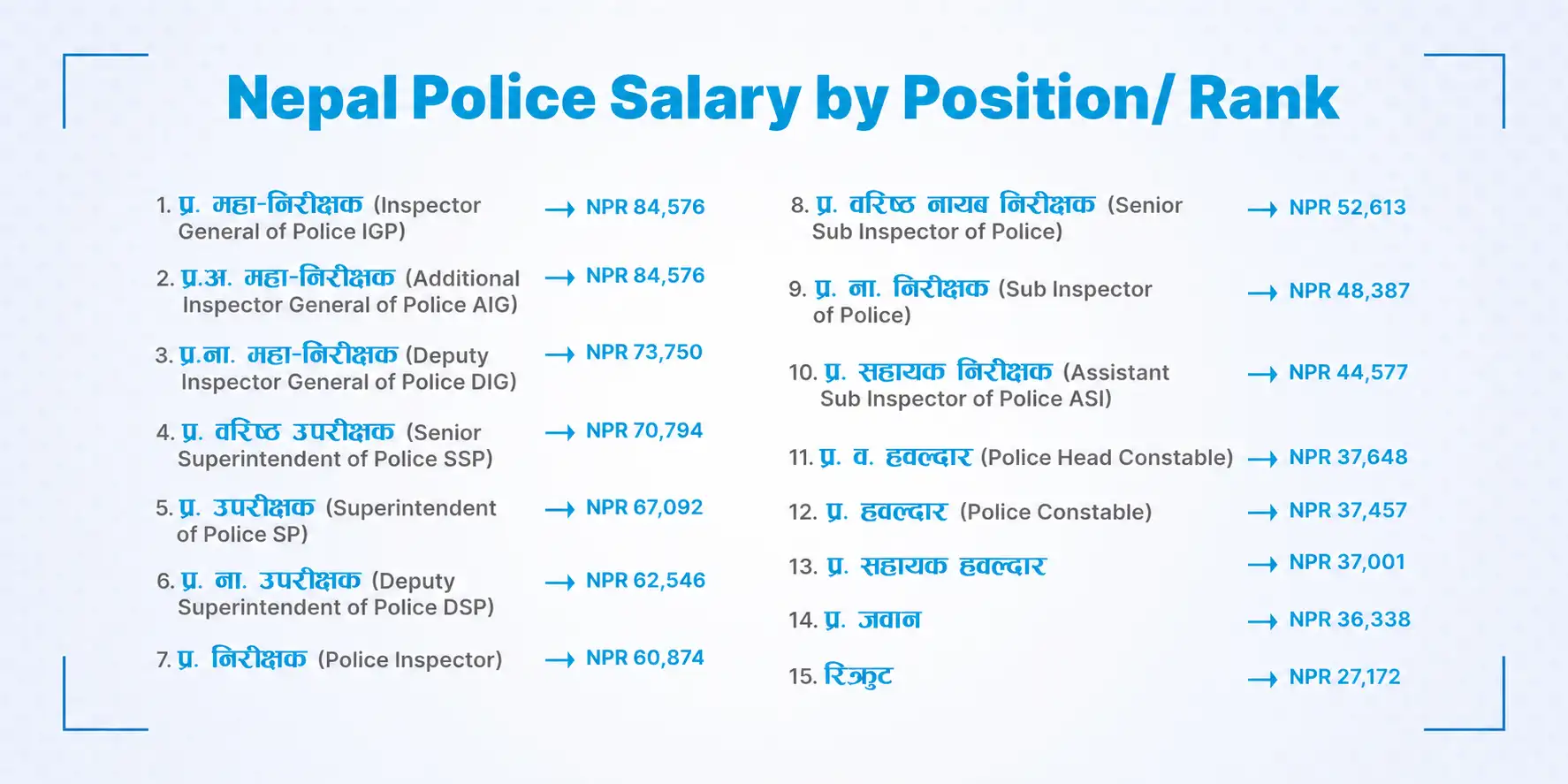
The salary of Nepal Police is different for every rank. A jawan earns the least while the Inspector General earns the most. As officers move up in position, their salary also increases. This is because higher ranks come with more responsibility, leadership, and pressure.
The salary also includes allowances, so the total amount is more than just the basic pay. For example, housing, ration, and travel support are common. These benefits make the overall package better for police staff.
To give you a clear picture, here is the salary of Nepal Police by position and rank. This table will help you understand how much each level earns in 2026.
| पद (Ranks of Nepal Police) | अन्तिम तलब (Final Salary) |
|---|---|
| प्र. महा-निरीक्षक (Inspector General of Police IGP) | NPR 84,576 |
| प्र. अ. महा-निरीक्षक (Additional Inspector General of Police AIG) | NPR 84,576 |
| प्र. ना. महा-निरीक्षक (Deputy Inspector General of Police DIG) | NPR 73,750 |
| प्र. वरिष्ठ उपरीक्षक (Senior Superintendent of Police SSP) | NPR 70,794 |
| प्र. उपरीक्षक (Superintendent of Police SP) | NPR 67,092 |
| प्र. ना. उपरीक्षक (Deputy Superintendent of Police DSP) | NPR 62,546 |
| प्र. निरीक्षक (Police Inspector) | NPR 60,874 |
| प्र. वरिष्ठ नायब निरीक्षक (Senior Sub Inspector of Police) | NPR 52,613 |
| प्र. ना. निरीक्षक (Sub Inspector of Police) | NPR 48,387 |
| प्र. सहायक निरीक्षक (Assistant Sub Inspector of Police ASI) | NPR 44,577 |
| प्र. व. हवल्दार (Police Head Constable) | NPR 37,648 |
| प्र. हवल्दार (Police Constable) | NPR 37,457 |
| प्र. सहायक हवल्दार | NPR 37,001 |
| प्र. जवान | NPR 36,338 |
| रिक्रुट (Recruit) | NPR 27,172 |
Allowances and Benefits in Nepal Police
Salary is only the earnings of the Nepal Police. Along with the basic salary in the Nepal Police, they are also eligible for different allowances and facilities. These benefits make their career more secure and stable than many private jobs. Ration to medical facilities, all the police staff get additional support that reduces their daily expenses to a great extent. Let us explore these benefits.
1. Ration Allowance, Uniform, and Equipment
Nepal Police staff members get a ration allowance on a monthly basis. That is, they receive money or food rations to fulfill daily meals, reducing family expenses. Other than this, the police force itself provides uniforms. Police officers do not need to purchase a duty uniform from their own salary. Other required items like boots, belts, and protection gear are also provided. These are small things, but they save a lot of money every year. Added to the minimum salary in Nepal Police, such support makes the package fairer and better.
2. Medical Facilities and Healthcare
Another critical benefit for Nepal Police is medical support. Police members and their families get medical care at police and government hospitals. Many treatments are free or highly discounted. It is a great relief as medical costs can be very high in Nepal. It is a reassurance and security for the family with this facility. It is also a signal that the government is concerned about the well-being of its security force. To some, it is even more precious than the monthly pay itself.
3. Housing and Travel Allowances
Police officers are usually posted to different parts of the country. To make it easier, they are given a housing allowance in case quarters cannot be arranged. In some cases, they get government houses at no or minimal cost. This saves rent, which is a major expense in the city. Travel allowances are also given, along with housing. These help to meet official travel, transfers, and normal movement. All these combined reduce the burden of expenditure and make police life more comfortable.
Nepal Police Pension and Retirement Benefits
Salary and allowances are important during service, but what comes after retirement matters equally. Nepal Police officers get a pension and other perks that help them stay financially stable even after retirement from active duty. Such post-retirement benefits are one of the main reasons the police force is viewed as a secure profession by many. Pension, gratuity, and family benefits provide officers and their families the ability to live with dignity after serving for decades. Let us see this in detail.
1. Pension Eligibility and Calculation
Police officers in Nepal become eligible for a pension after completing a specified number of years. Usually, this is after 20 years of uninterrupted service. The pension is based on the last drawn basic salary in Nepal and years of service. For example, an individual with a higher rank and more years of service will receive a bigger pension. This system encourages officers to work longer and receive promotions. Pension is paid every month, like a regular salary, which gives retired officers a regular income. It is one of the strongest reasons why a police career is considered secure compared to most private careers.
2. Family Benefits and Gratuity
Along with a pension, Nepal Police officers also get gratuity after retirement. Gratuity is a sum of money given based on the officer's salary and service period. It helps them start a small business, buy land, or fulfill family needs. In case of the death of a police officer while in service or after retirement, family benefits are provided. The spouse and children can still get a portion of the pension. This helps ensure that the family does not suffer from a sudden financial problem. Family benefits offer an added layer of security and make the Nepal Police salary and benefits package increasingly appealing.
How does Nepal Police Salary Compare with Nepal Army and Civil Service?
The salary of the Nepal Police is almost the same as the salary of the Nepal Army. They are both security divisions, and hence their salary structure is decided by the government equally. A police jawan gets a slightly higher amount than an entry-level soldier in the army gets. The same goes for officers of higher ranks. There is very minimal difference, and it mainly relies on allowances related to duty.
In comparison to civil service, Nepal Police salaries are generally a bit higher. Ministry and government office government officials get a lower basic salary at the initial level. However, they may be eligible for other types of office-based allowances. Police officials, however, get a ration, uniform, housing, and travel allowance, so their overall package is stronger.
Briefly, the Nepal Police salary is slightly greater than that of the civil service and the army. This reflects the fact that police duty is recognized as hard and risky, and thus the salary and allowances are designed to match the level of duty.
Why do Youth Choose Nepal Police as a career?
The majority of the youths prefer to serve in Nepal Police because it offers stable employment, fixed pay, good allowances, pension, and respect from society, and hence one of the most secure and satisfying jobs in Nepal. Police work also provides a feeling of service and pride. Compared to most private-sector jobs, police work provides stability in finances in the long term. That's why thousands of youths try to get into the police force each year.
1. Job Security and Regular Income
One of the major reasons for youth to become part of the Nepal Police is job security. Once selected, officers have a secure career for many years. Fixed monthly salary and allowances provide a guaranteed source of income to cover most expenses. With retirement plans like pension and gratuity, officers can secure their future without any hassle. Even at the lower grade, salaries are more than many private-sector jobs. The career of the police is not easily affected by economic changes. This stability can attract youth from all over Nepal who aspire for financial stability and an honorable profession.
2. Respect and Social Status
Another reason why teens choose Nepal Police is respect in society. The police are considered to be the protectors of the nation. Society looks up to them and respects their work. This social respect gives many young minds a motivation to join the police force. Higher ranks and promotion provide even more respect and added responsibility. Being part of an organized and disciplined system also gives individuals pride. Most young minds are proud to be in uniform and serve the country.
3. Growth and Training Opportunities
Nepal Police also provides training and growth opportunities. The officers have the ability to learn skills in leadership, management, and security operations. Advancement from a jawan to higher officer ranks is possible. All promotions come with better pay, benefits, and responsibilities. This is considered an opportunity for youth to have a career that can last a lifetime. Continuous learning and growth make work stimulating. This is the growth, income, and respect aspect that makes many young people want to join the Nepal Police.
Challenges of Police Life in Nepal
The life of Nepal police officer is not easy. Though the allowance and salary are good, police have to encounter many problems every day. The job is dangerous, intense, and time-consuming. They have to do it under poor conditions, sometimes staying away from their families. Understanding these challenges makes us respect the hard work.
1. Long Working Hours and Duty Pressure
Nepal Police staff have to work for extended hours, even 12 hours during the day sometimes. Weekends, holidays, and night shifts don't give them much relief. They need to be ready to respond at any moment. Such constant pressure may cause stress and leave them drained. The staff needs to stay alert, calm, and focused, even during emergency situations. Sometimes, workload can also hamper personal life and health. Despite these challenges, many officers continue to serve with dedication and commitment.
2. Risk and Safety Concerns
Police work is risky in Nepal. Police officers have to face criminals, protesters, accidents, and natural disasters. Their life can be threatened during duty. One small mistake can prove to be dangerous. Protective equipment and training can reduce the risk, but do not remove it. This makes the job quite different from the rest of the jobs. The risky nature of police life is one of the reasons why salary and benefits are set to match the risk.
3. Transfers and Family Disruption
The majority of police officers are assigned outside of their homes. Frequent transfers can keep them away from home for very long periods. It can hamper family life, education for the children, and personal comfort. Moving to different locations usually requires adapting to different living conditions. Housing allowances might reduce this discomfort, but it cannot fully replace being near loved ones. Officers must be flexible and accommodating to adapt to this issue. However, they proceed to serve since they know their role in society.
Conclusion
Nepal Police offers a respected job. As you move up in rank, your pay increases, and you get extra benefits. Officers receive a basic salary along with food, uniforms, housing, travel help, medical care, and a pension. These benefits help keep officers and their families safe. The job can be tough, with long hours, risks, and frequent travel. Still, many young people choose this path because it provides stability, growth, and respect. Compared to the Nepal Army and civil service, police pay is good, making it a smart choice for those looking for a steady and meaningful job. Overall, working for Nepal Police offers a good balance of pay, benefits, and pride in serving.
Looking for Nepal Police vacancies? Check out the latest openings, apply today, and start your journey toward a secure and respected career in the public sector.
Frequently Asked Questions
Submit your comments

Get Our App On



What is the Public Relations Officer Salary in Nepal
VIEW DETAILS
What Is the Salary of a Ticketing Officer in Nepal?
VIEW DETAILS
What Is the Salary of a Travel Consultant in Nepal?
VIEW DETAILS
How to Become an Auditor in Nepal
VIEW DETAILS


Loading Comments...