



Forensic science sounds like a great career choice. You imagine being employed in crime laboratories, investigating crimes, and assisting in bringing justice. However, there is one large question that many students in Nepal ask themselves: how much salary will I be earning? Many +2 graduates and even bachelor-level students feel confused. Some say the pay is low. Others say it grows fast. Without clear information, it becomes hard to plan your future.
If you are considering studying forensic science or are already pursuing it, knowing the real earning potential is very important. Salary matters for your family, your lifestyle, and your long-term goals.
In this guide, you will find it easy to know the forensic scientist salary in Nepal, both at the entry level and the senior level, government jobs, specialization, and future growth opportunities.
In this blog
Who are Forensic Scientists and What do they do?
Forensic scientists are professional scientists who apply the science to help in solving crimes. They gather, examine, and experiment with various pieces of evidence and give their results in court. Their primary objective is to establish facts scientifically to prove the truth in a legal matter.
Forensic scientists in Nepal usually have the opportunity to collaborate with the Nepal Police and government forensic laboratories. There are also those who work in private labs or assist law investigations as specialists. They do not work in one field only. It may be biology, chemistry, physics, or even computer science. Their day-to-day activities may be quite different depending on their area of specialization.
The following are the key activities of forensic scientists:
- Go to crime scenes to gather evidence such as blood, fingerprints, weapons, and fibers.
- Sample test and analyze in laboratories with scientific instruments.
- Examine DNA to determine suspects or victims.
- Investigate drugs, poisons, or other unknown chemicals.
- Restore lost information on phones and computers in cybercrime.
- Write elaborate reports of their findings.
- Give expert evidence in the court.
They have to be cautious, truthful, and detail-oriented since any little slip may have an impact on a case. Their contribution assists in making just judgments by the police, lawyers, and judges. Put simply, science is applied by forensic scientists to promote justice.
What is the Average Forensic Scientist Salary in Nepal?
The average salary of a forensic scientist usually ranges between NPR 40,000 and NPR 70,000 per month. This may vary depending on the organization, qualifications, and level of experience. Recent graduates usually begin in the lower bracket, particularly in government or low-level laboratory work. With some experience and better technical skills, the monthly income can gradually move toward the higher side of this salary range.
In larger cities and central government laboratories, the pay may be slightly higher compared to smaller districts. Those who work in specialized areas like digital forensics or DNA analysis may also earn more over time. While the starting salary may not seem very high, the forensic scientist's salary improves steadily with promotions, experience, and added certifications.
Forensic Scientist Salary by Experience Level
The forensic scientist's salary in Nepal mainly depends on experience. The more years you work, the higher your income becomes. Skills, confidence, and responsibility also increase with time. Let us understand salary growth step by step.
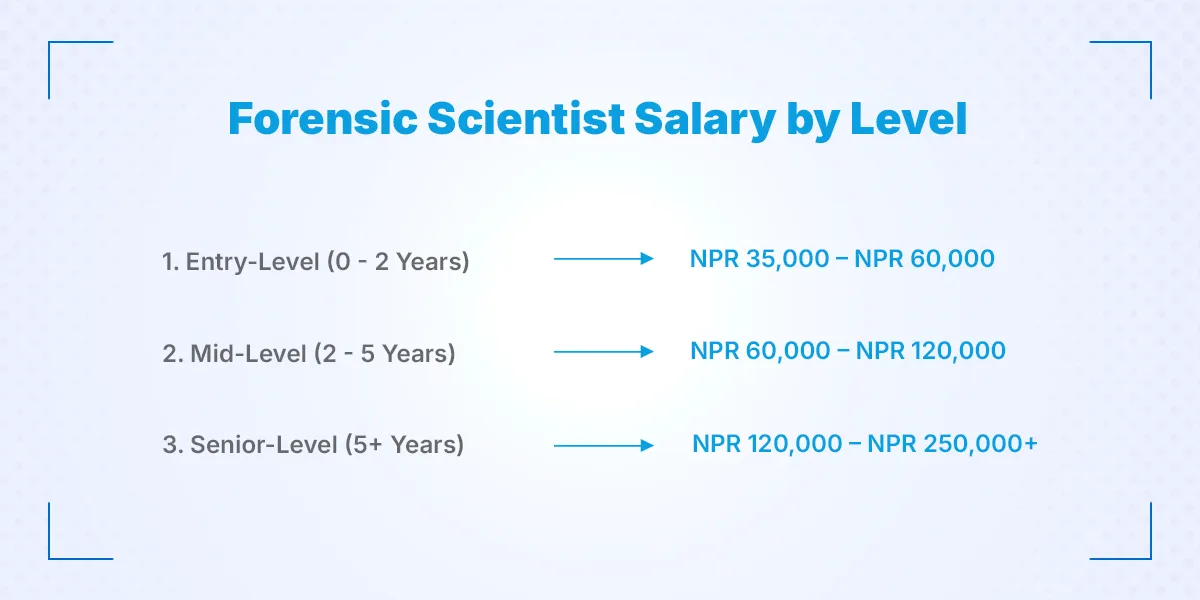
1. Entry-Level (0–2 years)
At the beginning of their career, most forensic scientists earn between NPR 35,000 and NPR 60,000 per month. This stage usually includes fresh graduates and trainees. They mostly work under senior staff and learn practical lab work. Their tasks include collecting samples, testing basic evidence, and preparing simple reports. Government jobs may start at a fixed pay scale. Private labs may offer slightly different amounts. At this level, the focus is more on learning than earning. With good performance, salary increases slowly over a few years.
2. Mid-Level (2–5 years)
After gaining two to five years of experience, the salary improves clearly. Most mid-level forensic scientists earn between NPR 60,000 and NPR 120,000 per month. At this stage, they handle cases more independently. They may lead small teams or manage specific lab sections. Their skills become stronger, and they make fewer mistakes. Some may choose special areas like digital forensics or DNA testing. Promotions and internal exams in government jobs can also increase income. Experience plays a very important role in this stage.
3. Senior-Level (5+ years)
Senior forensic scientists earn the highest salary in this field. Their monthly income can range from NPR 120,000 to NPR 250,000 or even more. They usually have more than five years of strong experience. Many of them manage full laboratory departments. They supervise junior staff and make final reports for court cases. Some work as expert witnesses in legal cases. Specialized experts in cyber forensics or advanced DNA analysis can earn higher amounts. At this level, respect, responsibility, and income all grow together.
Government Forensic Scientist Salary in Nepal
In Nepal, many government forensic scientists work at the National Forensic Science Laboratory. This is the main government forensic laboratory in Khumaltar, Lalitpur, under the Ministry of Education, Science, and Technology. The pay in this job is according to the government civil service scale and increases gradually with experience and promotion.
The average salary of forensic scientists ranges between NPR 45,000 and NPR 65,000 every month. The total income is increased by allowances such as housing and festival bonuses. Within several years of experience, most of the officers will be able to advance to high positions and earn a salary of between NPR 80,000 and NPR 100,000 per month.
In addition to salary, government jobs provide extra benefits like social security fund, paid leaves, Dashain allowance, pension after retirement, and more. These benefits make government forensic positions secure and attractive for those planning a long-term career in forensic science.
Highest Paying Forensic Science Specializations in Nepal
Forensic science has many different fields, and some pay more than others. Salary usually depends on the type of work, required skills, and demand. Choosing the right specialization can help you earn more and grow faster in your career. Let’s look at the highest-paying jobs for forensic scientistsin Nepal and what they do.
1. Medical Forensics
Medical forensics deals with the study of bodies and wounds to determine how one died or was injured. Forensic doctors and medical professionals operate in hospitals, morgues, or police labs. They study wounds, perform autopsies, and prepare reports for courts. This field needs medical knowledge and strong attention to detail. In Nepal, medical forensic experts often earn higher pay than in many other entry-level jobs. Experience and seniority can increase salary further.
2. Crime Scene Investigation
Crime scene investigators (CSIs) are employees who attend crime scenes to gather evidence such as fingerprints, blood, and weapons. They record the scene and sample it to be tested in the laboratory. CSIs should be extremely careful, as the errors can influence the entire case. They collaborate with laboratory scientists and police. In Nepal, government or specialized laboratory CSIs receive good salaries, particularly with experience.
3. Digital Forensics
Digital forensic experts investigate crimes involving computers, phones, and networks. They recover deleted files, check hacking cases, and find digital evidence for court. This field needs strong computer and technical IT skills. Digital forensics is growing fast in Nepal, so demand and pay are increasing. Experienced digital forensic specialists can earn one of the highest salaries in forensic science.
4. Forensic Toxicology
Forensic toxicologists study drugs, alcohol, and poisons in people or objects. They test blood, urine, or other samples to find harmful substances. Their reports help the police and courts understand the cause of death or poisoning. Toxicologists usually work in labs and hospitals. In Nepal, toxicology specialists are rare, so they earn higher salaries than general lab staff.
5. DNA and Biological Analysis
DNA analysts study blood, hair, and other biological samples to identify people. They help solve crimes and identify victims. This field requires lab skills and knowledge of genetics. In Nepal, DNA specialists work in government labs or private research centers. Because the work is highly technical, their pay is higher than that of many other forensic roles.
6. Ballistics and Firearms Examination
Ballistics experts study guns, bullets, and shooting cases. They check if a bullet came from a particular weapon. They also analyze gunshot injuries and prepare reports for courts. This specialization needs careful observation and technical knowledge. In Nepal, ballistics experts are in short supply, so salaries for these roles are generally higher.
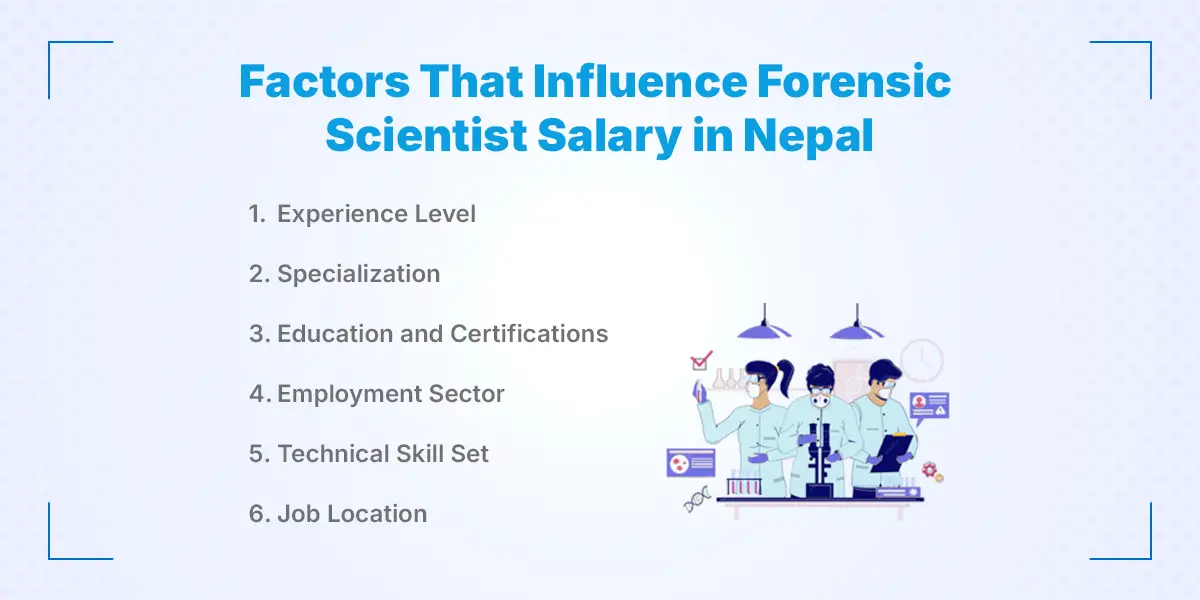
Factors That Influence Forensic Scientist Salary in Nepal
A forensic scientist's salary in Nepal varies widely. It relies upon a lot of factors such as experience, skills, and the workplace. Some are better paying due to the specialization or the kind of employer. Knowing these aspects can help you plan your career and make more money.
1. Experience Level
One of the primary considerations in salary is experience. Fresh graduates usually start with lower pay. As you work for 2–5 years, your salary grows. More than 5 years of experience can bring senior-level pay. Experienced scientists can handle complex cases and supervise others. Employers appreciate experience, and hence the increment in salary gradually increases as time goes by.
2. Specialization
The field you choose also affects your income. Digital forensics, DNA analysis, and medical forensics usually pay more. General lab work or entry-level roles may pay less. Specialized skills are rare, so employers offer higher salaries. Choosing a high-demand specialization can improve career growth and pay.
3. Education and Certifications
Higher education and extra certifications can increase salary. A master’s degree or special lab training is valued by employers. Certifications in digital forensics or DNA analysis make you more competitive. Those with better qualifications usually get promotions faster and higher pay.
4. Employment Sector
Where you work makes a difference. There are steady benefits and a regular salary in government jobs. The other option is that private labs or international organizations offer higher salaries, but with less job security. NGOs also have the tendency to remunerate in different ways depending on the project and financing. It is essential to select the appropriate sector to grow both in pay and career.
5. Technical Skill Set
Skills in lab techniques, software, or cyber investigations affect pay. A higher level of skills implies that you can cope with challenging cases. Employers usually pay more to professionals who are independent workers. Salary increases with constant learning and updating skills.
6. Job Location
Salary can be different according to the city or lab site. Labs in Kathmandu or big cities tend to pay more than those in small districts. Travel and cost of living also affect allowances. Working in central government labs usually gives better pay and extra benefits.
How to Become a Forensic Scientist in Nepal?
To become a forensic scientist in Nepal, complete a science or medical degree, gain specialized training, and get proper certification. Following these steps helps you start a career in forensic labs, crime investigation, or medical forensics. With the right education and experience, you can grow into higher-paying roles and specialist positions.
1. Academic Foundation (Undergraduate)
The first step is completing an undergraduate degree. There are two main paths:
- Medical Path (Forensic Medicine/Pathology): Have successfully completed an MBBS degree in an institution recognized by the Nepal Medical Council. It is the route to follow if working as medical forensic experts.
- Scientific Path (Forensic Laboratory): Pursue a BSc in Chemistry, Biology, or Forensic Science. This prepares you for lab work, crime scene investigation, and scientific analysis of evidence.
Both directions require a solid scientific background, and well-performing grades boost your postgraduate opportunities and employment with the government.
2. Specialized Training (Postgraduate)
After undergraduate studies, you can choose specialized training:
- MD Forensic Medicine: 3 years postgraduate program offered in the BP Koirala Institute of Health Sciences (BPKIHS), Kathmandu University (KUSMS), Maharajgunj Medical Campus, or Gandaki Medical College. This is the way of medical forensic doctors.
- MSc / Digital Forensics: Degrees in cybercrime and computer-related evidence are available at Different colleges. This is appropriate for lab scientists or digital forensics experts.
Expert education enhances expertise, technical expertise, and remuneration.
3. Licensing and Certification
Medical forensic doctors must register with the Nepal Medical Council to practice legally. In scientific careers, DNA analysis, toxicology, or digital forensics certifications can be used to become more employable and earn more.
4. Key Institutions & Requirements
- Entrance Exams: To be admitted to the PG medical programs, one must pass the Medical Education Commission entrance exam with a minimum score of 50 percent.
- Specializations: Training covers fields like Forensic Pathology, Toxicology, Anthropology, and Psychiatry.
By following the steps, you are set to have a successful forensic science career in Nepal, either in government labs, hospitals, or in a private organization.
Where to Find Forensic Scientist Jobs in Nepal?
You can find forensic scientist jobs in Nepal through government portals, online job websites like Kumari Job, newspapers, and recruitment agencies. With knowledge of where to search, it becomes easier to apply quickly and seize good opportunities. Most jobs are competitive, and it is therefore important to be up to date and apply on time.
1. Official Portals
Official portals usually advertise government positions of forensic scientists. As an example, vacancies are posted in the National Forensic Science Laboratory, Nepal Police. Forensic and scientific officer vacancies are also available with the Public Service Commission (Lok Sewa Aayog). These portals will offer the official job details, eligibility, and deadline of the application. Application via official portals guarantees that your application is authentic, and it will be taken into consideration by the authorities. It is these formal procedures that many government laboratories like their candidates to adhere to.
2. Online Job Portals
A number of Nepali job search websites have forensic science job postings. Government and private vacancies in the lab are advertised frequently on websites such as Kumari Job. To find a good position, you can use the keyword, location, or employer to search. Such portals usually enable online applications directly, thus simplifying and accelerating it. Visiting these sites regularly will help you to get updated on openings in time.
3. Newspapers
In Nepal, newspapers remain a common way of posting government jobs. Notices of vacancies are announced in daily newspapers such as Gorkhapatra and The Rising Nepal. They contain information on necessary requirements, age restrictions, and application procedures. By reading newspapers, you will be able to notice jobs that are not immediately posted on the internet. There are still a lot of candidates who use printed advertisements of official government laboratories.
4. Recruitment Agencies
Some recruitment agencies, such as Kumari Job, are private agencies that assist in the placement of forensic scientists in labs or NGOs. They tend to impose a minimal service fee or a percentage of salary in the private sector jobs. Agencies may advise you about appropriate vacancies and recruitment processes. They can be used when you need some private lab jobs or projects in other countries. Always ensure that the agency is credible before you give personal information or fees.
Is Forensic Science a Good Career in Nepal?
Yes, forensic science is an excellent career option in Nepal among students who enjoy science, investigation, and real-life problem-solving. The field is expanding because law enforcement and courts require additional trained workers to examine evidence, resolve cases, and promote justice. Labs are not the only thing in forensic science. It encompasses numerous varieties of work, such as crime scene investigation, digital evidence, toxicology, and DNA testing. Assuming that you are ready to work hard and acquire practical skills, it may result in a stable and respected career in Nepal.
Job stability is one of the strongest reasons why forensic science is a good career in Nepal. Government forensic science facilities, such as the National Forensic Science Laboratory, Khumaltar, and police forensic units, recruit trained scientists on a regular basis. These are jobs that have a fixed pay rate, benefits, and consistent growth if you perform well. There are also opportunities in private labs, NGOs, and international organizations, which are particularly relevant to experts in digital forensics and advanced laboratory work.
Here are some real benefits and realities of choosing forensic science:
- Growing demand: Police and legal systems are paying more attention to scientific evidence.
- Multiple fields to choose: You can work in crime scene investigation, digital forensics, toxicology, DNA lab, or ballistics.
- Good salary potential: With experience and specialization, monthly earnings can increase significantly.
- Job satisfaction: You help solve real cases and support justice for victims and their families.
However, it is also important to understand some challenges. Training can take time, and an entry‑level salary may feel modest at first. Competition for government posts is high, and exams can be tough. Practical skills and real lab experience are very important, not just degrees.
Overall, if you enjoy science and investigation, forensic science is a meaningful and rewarding career in Nepal with good future prospects.
Conclusion
Forensic science is a promising career in Nepal for anyone interested in crime investigation and scientific analysis. Forensic scientists play a vital role in solving cases, supporting the police, and helping the justice system. High-paying fields like digital forensics, DNA analysis, and medical forensics offer strong long-term earning potential. Success in this career depends on education, practical training, and continuous skill development.
With steady demand, clear promotion paths, and meaningful work, a forensic science career not only provides financial stability but also respect and satisfaction. For students who enjoy science and investigation, this is one of the best career choices in Nepal.
Frequently Asked Questions
Submit your comments

Get Our App On



What is the Public Relations Officer Salary in Nepal
VIEW DETAILS
What Is the Salary of a Ticketing Officer in Nepal?
VIEW DETAILS
What Is the Salary of a Travel Consultant in Nepal?
VIEW DETAILS
How to Become an Auditor in Nepal
VIEW DETAILS


Loading Comments...