


.webp)

A single outdated document can delay a project, create costly errors, and leave teams working with the wrong information. That is why Document Controllers play an important role in Nepal’s construction, hydropower, engineering, and other industries.
But how much does a Document Controller earn in Nepal?
This guide covers the Document Controller salary in Nepal by experience level, industry, and career stage. You’ll also learn about the qualifications, skills, responsibilities, and career path needed to grow in this field.
In this blog
What Is the Average Document Controller Salary in Nepal?
The average Document Controller salary in Nepal varies based on experience, industry, location, company size, and job responsibilities. Entry-level professionals generally earn less, while experienced Document Controllers and managers can earn significantly more.
| Experience Level | Estimated Monthly Salary |
|---|---|
| Entry-Level Document Controller | NPR 20,000–30,000 |
| Mid-Level Document Controller | NPR 30,000–45,000 |
| Senior Document Controller | NPR 45,000–65,000 |
| Document Control Manager | NPR 65,000–90,000+ |
These figures are estimates and may vary between employers. Allowances, bonuses, project size, and specialized software skills can also affect total compensation.
How Much Does a Document Controller Earn Per Month in Nepal?
A Document Controller in Nepal typically earns around NPR 20,000 to NPR 60,000 per month, depending on experience, skills, and industry. Freshers may earn NPR 15,000–25,000 monthly, while experienced professionals can earn NPR 40,000–60,000 or more. Senior Document Controllers with advanced software skills and leadership responsibilities may earn higher salaries.
Document Controller salaries can vary between Kathmandu and other cities based on company size and industry demand. In addition to basic salary, employees may receive overtime pay, travel allowances, bonuses, and other benefits. The gross salary includes total earnings before deductions, while the take-home salary is the amount received after taxes and other deductions
What Factors Affect the Document Controller Salary in Nepal?
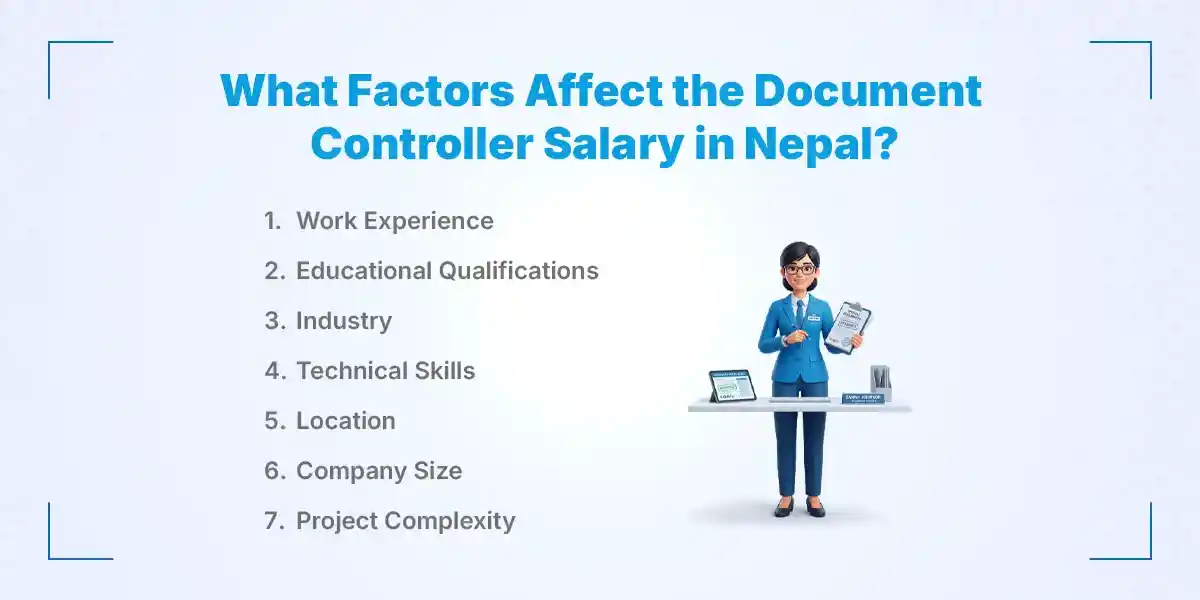
The Document Controller salary in Nepal depends on several factors, including work experience, educational qualifications, industry, technical skills, location, and company size. Professionals with advanced document management skills and experience in large-scale projects may have access to higher-paying job opportunities.
Work Experience
Experienced Document Controllers may earn higher salaries because they have better knowledge of document management processes and workplace responsibilities.
Educational Qualifications
A relevant degree, diploma, or professional certification can improve job opportunities and support career growth.
Industry
Document Controller salaries may vary across construction, hydropower, engineering, and multinational companies based on industry requirements and salary structures.
Technical Skills
Knowledge of document management software, Microsoft Office, and digital document control systems can improve earning potential.
Location
Document Controllers working in Kathmandu may earn different salaries from those working in other cities due to differences in job demand and living costs.
Company Size
Large companies and international organizations may offer different salary packages, benefits, and career growth opportunities.
Project Complexity
Professionals working on large-scale construction or engineering projects may earn higher salaries because these projects often require advanced document control skills.
Professionals working on large-scale construction or engineering projects may earn higher salaries because these projects often require advanced document control skills.
What Does a Document Controller Do in Nepal?
A Document Controller in Nepal is responsible for organizing, tracking, and maintaining every official document that moves through a company or project, ensuring nothing gets lost, duplicated, or used in an outdated version. This role sits at the intersection of administration and quality control, since accurate documentation directly affects project timelines and compliance. Their day-to-day work typically includes:
- Organizing and maintaining company documents
- Managing document numbering and filing systems
- Tracking document revisions and updates
- Maintaining accurate records of incoming and outgoing documents
- Ensuring documents are accessible to authorized employees
- Coordinating document submissions between departments
- Maintaining digital and physical document archives
- Supporting compliance with company documentation procedures
- Preparing document status reports
What Qualifications Are Required to Become a Document Controller in Nepal?
Most employers in Nepal require a bachelor's degree along with solid computer skills and, ideally, some prior exposure to document control procedures. Formal training is helpful but not always mandatory, especially for entry-level roles where employers are willing to train the right candidate. What matters most is a combination of relevant education, computer proficiency, and demonstrated attention to detail.
1. Educational Background
Most employers prefer candidates with a bachelor's degree in management, business administration, information management, engineering, or a closely related field. This academic background gives candidates a working understanding of organizational systems and business processes. Some companies also accept a relevant diploma or vocational training in place of a full degree, depending on the role's seniority. Ultimately, employers care more about demonstrated organizational ability than the specific degree title on a certificate.
2. Computer Knowledge
Strong computer literacy is non-negotiable for this role, starting with confident use of Microsoft Word and Excel for creating and tracking documents. Beyond the basics, familiarity with the wider Microsoft Office suite helps controllers manage reports, presentations, and communication efficiently. Comfort with digital file management systems, including folder structures and naming conventions, is equally important. Candidates who can navigate both physical and electronic filing systems tend to be more attractive to employers managing large document volumes.
3. Additional Qualifications
Formal training in document control or records management gives candidates a real edge over general administrative applicants. Understanding industry-specific documentation procedures, such as drawing registers in construction or contract logs in hydropower, is particularly valuable. Relevant work experience or internships, even short ones, demonstrate that a candidate can apply document control concepts in a live work environment. Employers often weigh this practical exposure more heavily than classroom training alone.
What Skills Are Needed to Become a Document Controller?
A successful Document Controller needs a mix of technical software skills and interpersonal soft skills to manage documents accurately while working across departments. Technical ability alone is not enough, since the role constantly involves coordinating with engineers, managers, and external stakeholders. The strongest candidates combine precision with clear communication.
1. Technical Skills
Document management and records organization form the technical backbone of this role, covering everything from filing systems to archive maintenance. Proficiency in Microsoft Excel and Word is essential for creating logs, tracking sheets, and formal correspondence. Document version control skills prevent teams from working off outdated drafts, which is one of the most common and costly mistakes in project environments. Beyond software, a working knowledge of document management systems and basic data entry and reporting rounds out the core technical skill set.
2. Soft Skills
Attention to detail separates a good Document Controller from a great one, since a single misfiled or mislabeled document can delay an entire project phase. Time management matters just as much, particularly when multiple departments are submitting documents with overlapping deadlines. Strong communication and organizational skills allow controllers to coordinate smoothly across teams without creating bottlenecks. Problem-solving ability, teamwork, and a reliable sense of confidentiality and accuracy complete the profile employers look for.
How to Become a Document Controller in Nepal?
Becoming a Document Controller in Nepal generally involves completing relevant education, building strong computer and document management skills, and gaining practical experience before applying for open roles. The path is accessible to fresh graduates willing to build technical skills early. Following these steps in order gives candidates the best chance of landing a role quickly.
1. Complete Relevant Education
Start by pursuing a relevant academic qualification or diploma in a field such as business administration, management, or engineering. This foundation gives candidates the organizational and analytical grounding the role demands. Employers use educational background as an initial screening filter, especially for entry-level applicants without work history. A relevant degree or diploma also makes it easier to transition into document control from adjacent administrative roles later on.
2. Develop Computer Skills
Learn Microsoft Office thoroughly, with particular focus on Word and Excel, since these tools are used daily in almost every document control role. Practice building spreadsheets for tracking document status, revisions, and submission dates. Digital file organization skills, including consistent naming conventions and folder hierarchies, are equally important and often overlooked by beginners. Strong computer skills at this stage make every later step of the career path easier.
3. Understand Document Control Procedures
Study how document numbering systems work, since most companies use structured codes to identify document type, revision, and origin. Learn the basics of version control so outdated drafts are never mistaken for current ones. Understand how document tracking logs function across the lifecycle of a project, from initial submission to final approval. This procedural knowledge is exactly what separates candidates who can start contributing immediately from those who need extensive onboarding.
4. Gain Practical Experience
Apply for internships, administrative positions, or entry-level documentation roles to build real-world experience. Even a few months of hands-on exposure to a live filing or tracking system carries significant weight with employers. Practical experience shows that a candidate can apply classroom knowledge under real deadlines and with real stakeholders. This step often becomes the deciding factor between two similarly qualified candidates.
5. Learn Document Management Software
Explore the specific software platforms used in construction, engineering, and general business documentation, since many mid-to-large employers use dedicated systems rather than plain spreadsheets. Familiarity with at least one such platform makes a candidate significantly more competitive. Employers value candidates who can adapt quickly to their existing systems rather than needing extensive retraining. Self-study through free tutorials or trial versions is a practical way to build this skill before starting a formal job.
6. Prepare a Professional CV
Highlight technical skills, attention to accuracy, and any relevant work experience clearly and near the top of the CV. Use specific examples where possible, such as the size of a document set managed or the software used, rather than vague statements. Keep the format clean and easy to scan, since hiring managers often review documentation-related CVs quickly given the volume of applicants. A well-organized CV also signals, indirectly, that the candidate understands the value of clear structure.
7. Apply for Document Controller Jobs
Search for suitable vacancies through online job portals such as KumariJob, where construction, engineering, and hydropower employers regularly post openings. Filter searches by industry and experience level to focus on realistic opportunities. Tailor each application to the specific employer's sector, since document control expectations differ between banking, construction, and IT. Consistent, targeted applications typically produce faster results than mass-applying to unrelated postings.
Which Industries Hire Document Controllers in Nepal?
Construction, hydropower, and engineering firms hire the largest share of Document Controllers in Nepal, though the role also exists in manufacturing, banking, IT, and international organizations. Each industry has slightly different documentation priorities, from technical drawings to compliance paperwork. Candidates who understand these differences can target their applications more effectively.
| Industry | Common Document Control Responsibilities |
|---|---|
| Construction | Drawings, contracts, and project records |
| Hydropower | Engineering documents and reports |
| Manufacturing | Production and quality records |
| Banking | Administrative and compliance records |
| IT | Digital documentation and internal records |
Beyond these core sectors, Document Controllers also work in infrastructure development, consulting firms, and international organizations, supporting everything from large-scale project records to internal administrative documentation.
What Is the Career Growth of a Document Controller in Nepal?
A Document Controller in Nepal can progress from an entry-level documentation assistant to a senior document control manager over the course of a career, provided they continue building technical and leadership skills. Career growth is driven less by tenure alone and more by expanding responsibility and software expertise. The typical progression looks like this:
- Entry-Level: Documentation Assistant or Junior Document Controller
- Mid-Level: Document Controller or Document Control Officer
- Senior-Level: Senior Document Controller or Lead Document Controller
- Management-Level: Document Control Manager or Records Management Manager
Professionals can accelerate this progression by developing advanced document management skills, gaining industry-specific experience, building project management knowledge, strengthening leadership and coordination abilities, earning professional certifications, and gaining hands-on experience with enterprise-level document management systems.
What Are the Benefits of Working as a Document Controller?
Working as a Document Controller provides opportunities for career growth, industry flexibility, and skill development. Key benefits include:
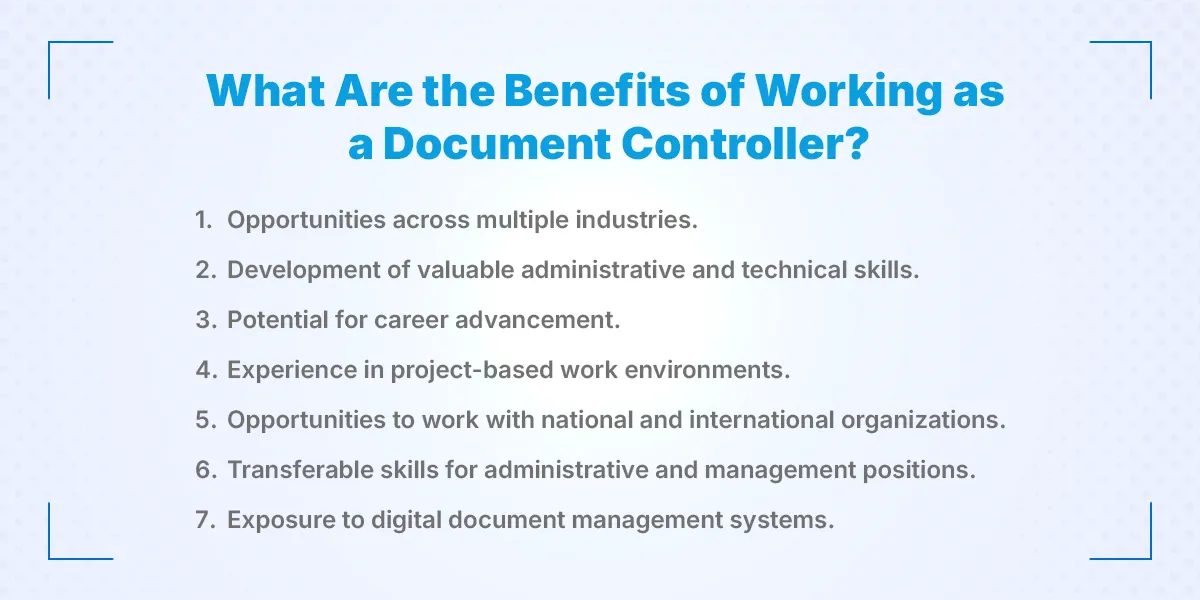
1.Opportunities Across Multiple Industries
Document Controllers can work in construction, engineering, healthcare, IT, manufacturing, and other industries.
2.Career Growth Opportunities
With experience, Document Controllers can advance to senior administrative, project coordination, or document management positions.
3.Development of Technical and Administrative Skills
This role helps professionals develop organizational, communication, record-keeping, and digital document management skills.
4.Experience in Project-Based Work
Document Controllers gain practical experience managing project documents, reports, and records in professional work environments.
5.Opportunities with National and International Organizations
Professionals may find opportunities to work with local companies, multinational organizations, and international development projects.
6.Transferable Skills for Management Roles
The skills gained in document control can support career growth in administration, project management, and operations.
Exposure to Digital Document Management Systems
Document Controllers gain experience using digital tools and document management software to organize, track, and maintain important records.
What Are the Challenges of Working as a Document Controller?
The biggest challenge Document Controllers face in Nepal is managing large volumes of documents accurately while working under tight project deadlines. Coordinating between departments that submit documents inconsistently adds another layer of difficulty. Most of these challenges are manageable with the right systems and habits.
- Managing large volumes of documents
- Maintaining accuracy under deadlines
- Tracking multiple document revisions
- Coordinating with different departments
- Ensuring data confidentiality
- Adapting to new software and documentation systems
- Handling urgent document submissions
Strong organizational habits, ongoing technical training, and consistent attention to detail help professionals manage these pressures without sacrificing accuracy.
Where Can You Find Document Controller Jobs in Nepal?
The easiest way to find Document Controller jobs in Nepal is through online job portals, company career pages, and industry-specific recruitment announcements. KumariJob helps job seekers discover relevant vacancies and apply for suitable positions.
- Search for Document Controller vacancies on KumariJob to find relevant job openings in Nepal.
- Explore construction and engineering company career pages directly.
- Check hydropower project recruitment announcements regularly.
- Use professional networking platforms to find job opportunities and referrals.
- Connect with recruitment agencies specializing in engineering or administrative roles.
- Prepare a job-ready CV and cover letter before applying.
- Review job descriptions carefully to ensure you meet the requirements.
Conclusion
Document Controller salaries in Nepal depend on experience, industry, skills, and company size. Developing computer skills, learning document management software, and gaining practical experience can help you grow your career and earn a better salary. With the right skills and experience, you can advance from an entry-level position to senior roles in construction, hydropower, banking, and other industries.
If you are looking for Document Controller jobs in Nepal, check the latest vacancies on KumariJob and apply for positions that match your skills and experience.
Frequently Asked Questions
Submit your comments

Get Our App On



How to Become a Public Health Officer in Nepal?
VIEW DETAILS
What is the Public Relations Officer Salary in Nepal
VIEW DETAILS
What Is the Salary of a Ticketing Officer in Nepal?
VIEW DETAILS
What Is the Salary of a Travel Consultant in Nepal?
VIEW DETAILS


Loading Comments...