




Interest in stars often collides with uncertainty about income prospects. Students attracted to space science face doubts related to limited institutions, research funding gaps, and unclear pay structures in Nepal. Career planners struggle due to missing local salary benchmarks and inconsistent guidance across academic sources. Such uncertainty delays decision-making for science-focused career paths.
In this blog, Astrophysicist Salary in Nepal receives a focused explanation through verified career data and practical context. Coverage includes astrophysicist roles, daily responsibilities, income ranges within Nepal, salary influencing elements, required qualifications, and future career direction toward 2026. Content aims to support informed academic and professional planning.
In this blog
Who is an Astrophysicist? What do they do?
Astrophysicist is a scientist who studies the physical behavior of stars, planets, galaxies, black holes, and cosmic matter. Professional focus stays on understanding the origin, structure, motion, and future of celestial objects. This career combines physics, mathematics, and computer analysis to explain space-related phenomena. Research-driven work supports academic institutions, observatories, and space research programs. Many professionals also teach physics or astronomy at the university level.
What astrophysicists do:
- Analyze data collected from telescopes and space observatories
- Study star formation, planetary systems, and galaxy evolution
- Use mathematical models to explain cosmic events
- Write research papers for scientific journals
- Collaborate with international research teams
- Teach astronomy or physics at colleges and universities
- Develop simulations using programming tools
What is the Average Astrophysicist’s Salary in Nepal?
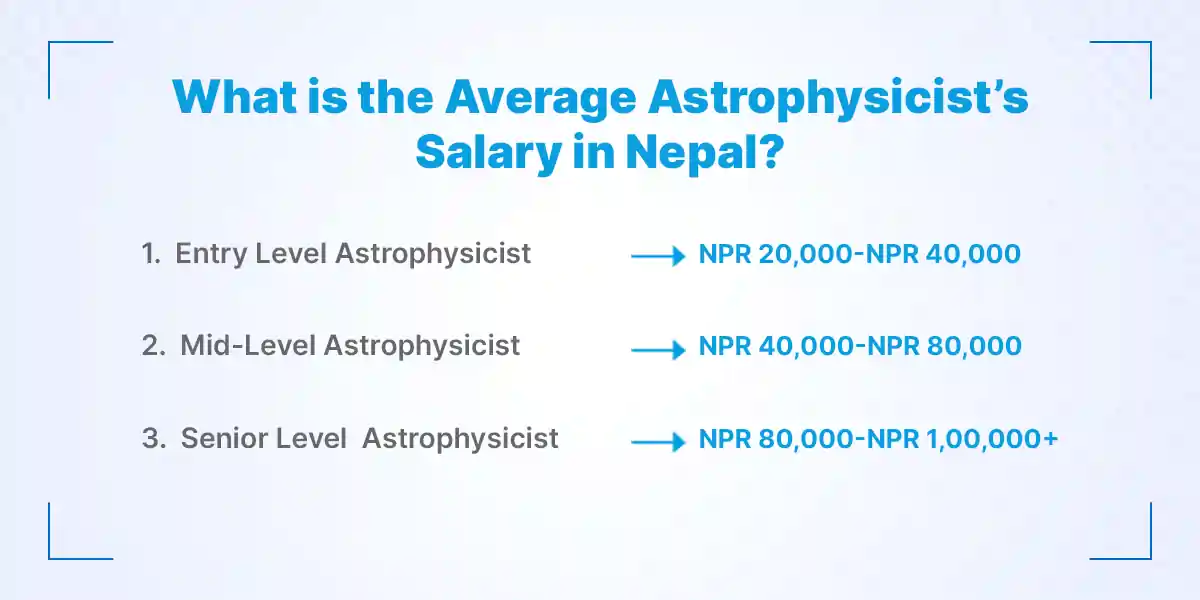
The average astrophysicist's salary in Nepal ranges from NPR 20,000 to NPR 1,00,000+ per month, depending on experience, employer, and research involvement. The average salary in Nepal for mid and senior-level scientists is higher, reflecting their expertise and responsibilities. Entry-level professionals earn modest pay due to limited research institutions. Location, specialized skills, and participation in international projects also influence overall earnings, and salaries remain competitive compared to other science and academic careers.
Entry Level Astrophysicist
Entry-level astrophysicists in Nepal, typically fresh graduates with a bachelor’s or master’s degree in physics or astrophysics, earn between NPR 20,000 and NPR 40,000 per month. Their work mostly involves assisting senior researchers, collecting observational data, performing basic simulations, and maintaining telescopes or other instruments. Participating in entry-level job roles such as small research projects or internships can slightly improve salary prospects. At this stage, professionals focus on gaining practical experience and building foundational skills required for higher roles.
Mid-Level Astrophysicist
Mid-level astrophysicists usually have 3-7 years of research or teaching experience. Salaries in this range reflect the growing responsibility of designing experiments, analyzing complex data, mentoring junior researchers, and publishing research papers. Professionals often take on mid-level job roles in national or international research teams, and project-based incentives or additional stipends can supplement monthly earnings. This stage emphasizes skill development in advanced observational techniques, programming, and mathematical modeling.
Senior Level Astrophysicist
Senior astrophysicists with more than 7-10 years of experience earn between NPR 80,000 and NPR 1,00,000 or more, depending on employer and research contributions. They lead major research projects, manage teams, secure funding through grant proposals, and publish significant studies in scientific journals. Many also take on senior-level job roles by teaching at universities or representing Nepal in international conferences. Participation in global collaborations and high-impact projects can further increase income. At this level, salary reflects expertise, reputation, and the strategic importance of their research work.
Factors That Influence an Astrophysicist's Salary in Nepal
Several factors determine an astrophysicist's salary in Nepal. Education level and specialized qualifications directly impact entry and mid-level pay. Experience and research output increase earning potential over time. Employer type, including government, university, or private research institutes, affects compensation packages. Location and local demand for space research professionals also influence salary variations. Understanding these elements helps professionals plan career growth and maximize earnings.
Education and Qualifications
Education and qualifications play a key role in determining an astrophysicist’s salary. Candidates with a master’s degree or PhD in astrophysics, astronomy, or related fields typically earn higher pay compared to those with only a bachelor’s degree. Specialized training in programming, data analysis, or telescope operations can enhance skills and improve compensation. Academic achievements, participation in research projects, and recognition during education often result in higher starting salaries. Continuous learning and certifications in advanced areas further increase eligibility for better-paying roles.
Experience and Research Publications
Experience and research output significantly affect earning potential. Professionals with several years of hands-on experience in observations, simulations, or teaching tend to earn more than newcomers. Publishing research papers in reputable journals strengthens credibility and can directly influence salary negotiations. Leading projects or mentoring junior researchers also adds to compensation prospects. Long-term experience combined with a strong research portfolio often positions professionals for senior-level roles with higher pay.
Employer Type: Government, University, Private Research Institutes
The type of employer directly impacts salaries and benefits. Government research institutions usually offer structured pay scales with limited flexibility, but long-term stability and benefits such as pensions and allowances. Universities provide salaries that may include teaching allowances, research grants, and performance incentives. Private research institutes often offer higher pay for specialized projects but typically rely on short-term contracts or performance-based incentives. Professionals must consider employer type when planning career growth, as it affects both salary progression and work environment.
Location and Demand for Space Research Professionals
Location and demand influence earnings considerably. Major cities such as Kathmandu, where research institutes and universities are concentrated, usually offer higher salaries due to better resources and higher living costs. Remote or less developed areas may provide lower pay but can offer hands-on experience with unique observational projects. Additionally, demand for space research professionals in Nepal is limited, making collaboration with international projects or institutes a key factor in increasing salary. Professionals positioned in jobs by city with access to research opportunities generally earn more.
Qualifications Required to Become an Astrophysicist in Nepal
Becoming an astrophysicist in Nepal requires a strong academic foundation in physics and astronomy. Formal education from undergraduate to doctoral level plays a major role in shaping career prospects. Specialized training, research experience, and practical exposure through projects or internships further enhance skills. Employers often consider both academic qualifications and hands-on experience when determining eligibility and salary.

1. BSc in Physics
A Bachelor’s degree in Physics provides the essential foundation for a career in astrophysics. Students learn core concepts such as mechanics, thermodynamics, electromagnetism, and quantum physics. This degree equips them with problem-solving skills, mathematical reasoning, and laboratory experience, which are crucial for advanced studies. Graduates often begin by assisting in research labs or observational projects, building practical knowledge that prepares them for specialized postgraduate education. Strong performance at this level also increases the chances of securing scholarships or research opportunities for higher studies.
2. MSc in Astrophysics/Astronomy
A Master’s degree in Astrophysics or Astronomy allows students to specialize in areas such as cosmology, stellar evolution, planetary science, or computational astrophysics. Coursework focuses on advanced theories, research methodologies, and data analysis techniques. During this stage, students engage in independent research, simulations, and observational studies. Completing an MSc increases employability in universities, research institutes, or international collaborations, and provides higher starting salaries compared to a general physics background. Advanced projects during this stage also help in building a strong professional portfolio for career growth.
3. PhD for Research Positions
A PhD is typically required for senior research roles, university teaching positions, or leading major projects. Doctoral programs focus on original research, publication in peer-reviewed journals, and contributing new knowledge to the field. Candidates develop advanced skills in scientific writing, programming, statistical modeling, and experimental design. Completing a PhD significantly improves career prospects, provides access to international collaborations, and positions professionals for higher-level salaries in Nepal and abroad. Doctoral research also enhances recognition in the scientific community, opening doors to global opportunities.
4. Importance of Internships and Research Projects
Internships and research projects provide practical experience that complements academic qualifications. Students gain hands-on exposure to telescopes, simulations, and observational techniques while working with experienced researchers. Participating in projects enhances problem-solving, data analysis, and collaboration skills. Internships also improve networking opportunities and can lead to job offers or funding for advanced studies. Employers often value practical experience equally with formal education, making it a critical factor in career advancement. Additionally, strong project experience can differentiate candidates in competitive job markets.
Future in Astrophysics in Nepal
Astrophysics in Nepal is gradually gaining recognition, though opportunities remain limited compared to global standards. Career prospects depend on education, experience, and networking within national and international research communities. Growth potential exists in research, teaching, and collaborations with space agencies. Understanding current trends helps aspiring professionals plan realistic career paths and prepare for future opportunities in this field.
1. Career Growth Opportunities: Research, Teaching, and Space Agencies
Career growth in astrophysics in Nepal spans research, teaching, and positions within emerging space agencies. Research roles include observational and theoretical work in universities, research institutes, or collaborative projects with international organizations. Teaching positions at universities allow astrophysicists to train the next generation of scientists while conducting personal research. Space agencies and government programs, though limited, offer specialized roles in satellite monitoring, astronomical data analysis, and space technology projects. Professionals with advanced degrees and strong research experience can advance to senior roles, leading projects and mentoring junior researchers.
2. Emerging Opportunities in Global Collaborations
Global collaborations are becoming a significant avenue for Nepali astrophysicists to gain exposure and improve career prospects. Partnerships with international research institutions, space observatories, and universities provide access to advanced facilities, funding, and high-impact projects. These collaborations allow professionals to contribute to global studies, co-author publications, and participate in conferences, enhancing their reputation and employability. Working on joint research projects also increases the chances of securing scholarships or fellowships abroad.
3. Challenges and Prospects in the Nepali Context
The primary challenges in Nepal include limited funding, few research institutions, and scarce advanced observational equipment. Lack of structured space programs restricts long-term career opportunities. Despite these challenges, prospects are improving with increasing interest in STEM education and international collaborations. Professionals who focus on skill development, networking, and practical research experience can overcome constraints and find rewarding opportunities in research, teaching, and global projects. Emerging technologies and partnerships offer hope for a more robust astrophysics community in Nepal.
Conclusion
Astrophysics in Nepal offers a promising yet challenging career path. Salaries vary widely based on experience, education, employer type, and research contributions, with entry-level positions starting around NPR 20,000 and senior roles exceeding NPR 1,00,000 per month. Success depends on strong academic qualifications, practical experience, and involvement in research projects or internships. Opportunities exist in universities, research institutes, and emerging space agencies, while global collaborations provide additional avenues for career growth and recognition.
Aspiring astrophysicists should focus on building a solid educational foundation, gaining hands-on experience, and developing specialized skills. Despite limited local resources, dedication and networking can lead to rewarding research roles, teaching positions, and international opportunities. With careful planning, professionals can achieve both scientific impact and financial stability in Nepal’s astrophysics sector.
Looking for the latest astrophysics or engineering jobs in Nepal? Discover verified openings, apply quickly, and take the next step toward a rewarding career today
Frequently Asked Questions
Submit your comments

Get Our App On



What is the Public Relations Officer Salary in Nepal
VIEW DETAILS
What Is the Salary of a Ticketing Officer in Nepal?
VIEW DETAILS
What Is the Salary of a Travel Consultant in Nepal?
VIEW DETAILS
How to Become an Auditor in Nepal
VIEW DETAILS


Loading Comments...