




Many students and job seekers in Nepal feel confused about AI careers. You hear people say AI engineers earn a lot, but no one clearly tells you how much they actually make in Nepal. Some blogs show foreign salaries, others give random numbers. This creates doubt, stress, and wrong career choices. You might be asking yourself, Is AI really worth my time, money, and effort?
That confusion is normal, and you are not alone. AI is new, fast-growing, and often explained in a hard way that feels distant from real Nepali jobs.
But don’t worry. In this guide, you will get clear, simple, and honest answers. You will learn about the AI engineer salary in Nepal, required skills, career growth, and what to expect at each stage.
In this blog
What is the Average AI Engineer Salary in Nepal?
The average AI engineer salary in Nepal usually ranges from NPR 40,000 to NPR 80,000 per month, depending on the company and job role. AI engineers earn above the average salaries in Nepal because AI engineering is a growing field, and the demand is also rising steadily. Most companies hiring AI engineers are IT firms, software companies, startups, and outsourcing companies working with foreign clients. Because of this, the salary of an AI engineer in Nepal is generally higher than many other entry to mid-level IT roles. However, it is still lower than salaries offered in countries like India, the US, or Europe.
The AI engineer salary in Nepal also varies widely from one company to another. Some local companies offer salaries closer to the lower end, while companies working on international projects may pay more. Freelance and remote work opportunities can also push earnings higher than the average range. Overall, AI engineering offers a strong earning potential in Nepal, especially compared to traditional tech roles, making it an attractive career option for long-term growth.
AI Engineer Salary in Nepal by Experience Level
An AI engineer's salary in Nepal mainly depends on work experience. As experience increases, responsibility and pay also increase. Beginners earn less because they are still learning. Experienced professionals earn more due to trust and results.
1. Freshers and Junior AI Engineers
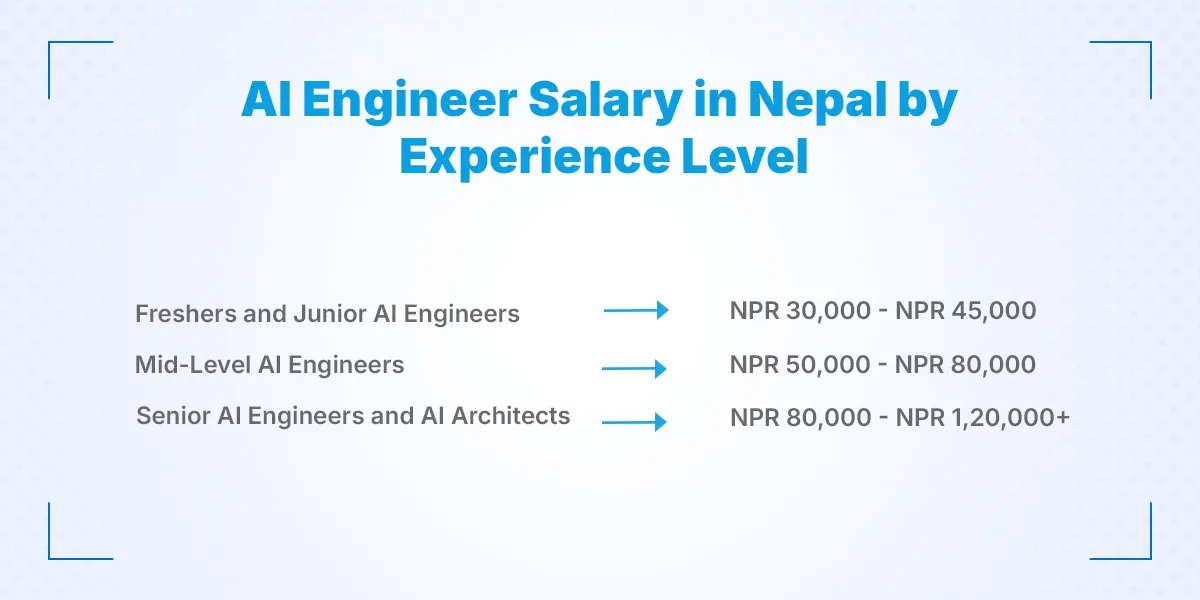
The salary for freshers and junior AI engineers usually ranges from NPR 30,000 to NPR 45,000 per month, which is a good salary in Nepal for junior-level roles compared to other fields. At this stage, most people are learning how real projects work. Companies focus more on training than pressure. Freshers often help senior engineers with simple tasks. They work with data, testing, or small model updates. Mistakes are part of learning at this level. Growth depends on practice and effort. It’s also a time to explore different AI tools and techniques. This experience helps build a strong foundation for better roles later.
2. Mid-Level AI Engineers
Mid-level AI engineers usually earn between NPR 50,000 and NPR 80,000 per month in Nepal. They have real project experience. They can handle tasks with less guidance. Companies trust them with deadlines and problem-solving. This level brings more responsibility and better pay. Many professionals stay here for several years. Some also take remote or freelance work. At this stage, engineers start leading small projects. They also begin to specialize in areas like machine learning, NLP, or computer vision.
3. Senior AI Engineers and AI Architects
Senior AI engineers and AI architects often earn NPR 80,000 to NPR 1,20,000 or more per month. They lead projects and guide teams. Companies depend on their planning and decisions. Their role goes beyond coding and models. They design full AI systems. Very few people reach this level quickly. Many seniors work with international clients or global teams. They also mentor juniors and help shape company AI strategies. At this level, professionals can influence how AI is applied across products and services.
Factors Affecting an AI Engineer's Salary in Nepal
An AI engineer's salary in Nepal is not the same for everyone. Different factors can make a big difference in how much you earn. Skills, education, company type, and work location all matter. Understanding these can help you plan your career better and earn more.
1. Skills and Technical Expertise
The most important factor is your skills and knowledge. AI engineers with strong machine learning, deep learning, or NLP skills usually earn more. Knowing programming languages like Python and tools like TensorFlow or PyTorch also helps. People who can handle real data and build models are in high demand. The more advanced your skills, the higher the salary you can expect. Companies reward people who solve problems efficiently. Practicing projects and building a portfolio can increase your value. Continuous learning is key in AI because the technology changes fast.
2. Education and Academic Background
Education also affects your salary. Engineers with a degree in computer science or AI often get better starting pay. Specialized courses, certifications, or a master’s degree can give an advantage. Employers trust candidates with verified academic knowledge. Sometimes, experience matters more than degrees, but a good educational background opens doors faster. Some companies may offer higher salaries to graduates from top universities. Learning from recognized institutions also shows dedication. Education combined with skills can push you into higher salary brackets quickly.
3. Industry and Company Type
The type of company you work for changes your salary. IT firms, startups, and outsourcing companies may pay differently. Companies working with international clients often pay more. Some industries like fintech, health tech, or research may have higher budgets for AI engineers. Startups might offer lower pay but include other benefits like equity. Big IT companies may have structured salary and growth plans. Freelance work for global clients can also increase income. Choosing the right company can make a big difference in your career earnings.
4. Location and Work Model
Where you work in Nepal also affects your salary. AI engineers working in Kathmandu often earn more than in smaller cities. Companies in major cities have better budgets and more projects. Remote work for international clients can also increase pay. Some engineers work part-time or freelance to earn extra. Living costs in different areas also impact salary expectations. Being flexible with location or remote work can open more opportunities. The work model, whether in-office or online, can change how much you take home.
How to Increase Your Salary as an AI Engineer?
To increase your salary as an AI engineer, focus on improving your skills, gaining more experience, earning relevant certifications, and choosing the right company or projects. Salary growth is possible if you improve your skills, gain experience, and make smart career choices. The good news is that small changes can have a big impact on your pay. In this section, we will explain practical ways to increase your salary step by step.
1. Upgrade Your Skills
Learning new IT skills is the fastest way to earn more. Companies pay more to engineers who can handle advanced AI tasks. Focus on areas like machine learning, deep learning, NLP, or computer vision. Practice building real projects to show your ability. Knowing AI tools like TensorFlow or PyTorch can increase your value. Skills in cloud computing and data handling also help. The more you can do, the higher your salary.
2. Gain More Experience
Experience is very important in salary growth. The longer you work on real projects, the more companies trust you. Handle bigger responsibilities and show results consistently. Working on international projects or remote clients can also increase pay. Experience allows you to negotiate better salaries. It also helps you move into mid-level or senior roles faster.
3. Get Certifications and Education
Certifications in AI, machine learning, or cloud computing can make a difference. They show companies that you are serious and skilled. Completing online courses or advanced degrees can also increase your credibility. Some employers pay higher to certified or well-educated professionals. It also helps you stand out from other candidates.
4. Choose the Right Company or Job
The company you work for affects your pay. Some IT firms and startups pay less, while companies with international clients pay more. Switching to a better company can boost your salary quickly. Look for roles with more responsibility or growth opportunities. Working remotely for foreign clients can also increase your income.
5. Continuous Learning and Networking
AI changes fast, so keep learning new tools and techniques. Attend workshops, meetups, or online communities. Networking can help you find higher-paying opportunities. Companies prefer engineers who stay updated and connected in the AI field.
Skills Needed to Become an AI Engineer in Nepal
Becoming an AI engineer in Nepal is not only about getting a degree. You need a mix of technical skills, knowledge of AI concepts, and soft skills. These skills help you work on real projects and earn a good salary. In this section, we will explain the key skills you need in a very simple way.
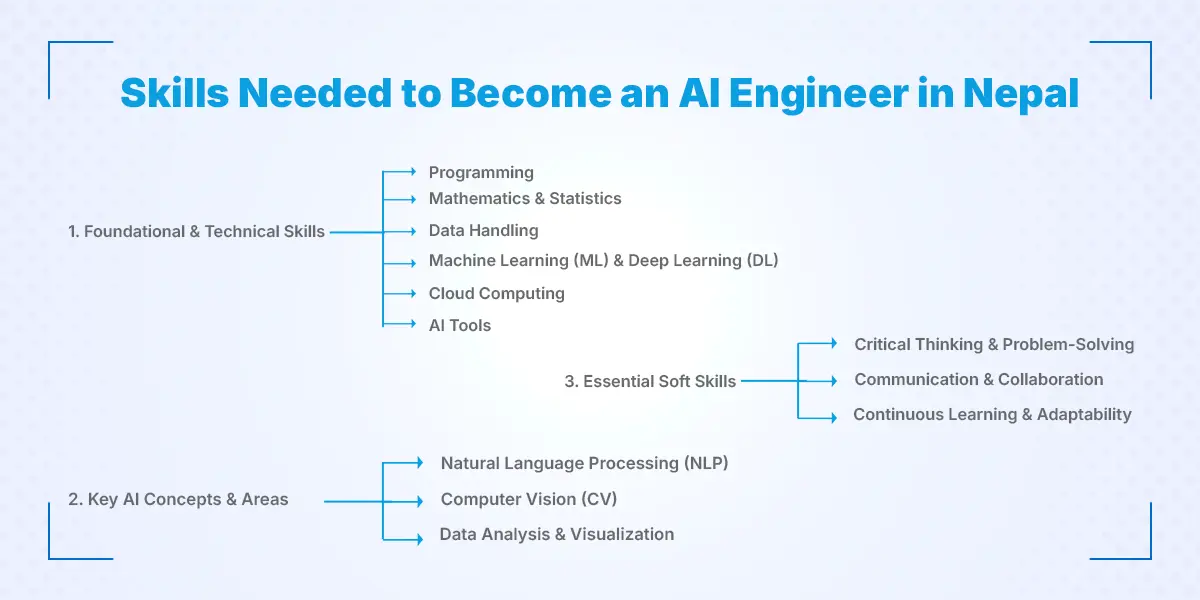
1. Foundational & Technical Skills
These are the basic skills every AI engineer must have. They form the foundation to learn advanced AI tools and techniques.
- Programming: Programming is essential to building AI models. Languages like Python are mostly used because they are simple and powerful.
- Mathematics & Statistics: Math and statistics help you understand how AI models work. Without them, it is hard to interpret data or algorithms.
- Data Handling: Data handling is about collecting, cleaning, and managing data. Good data handling makes AI models more accurate.
- Machine Learning (ML) & Deep Learning (DL): ML and DL are core parts of AI. They allow computers to learn from data and make decisions automatically.
- Cloud Computing: Cloud computing helps run AI models without needing expensive computers. Platforms like AWS or Google Cloud are commonly used.
- AI Tools: AI engineers use tools like TensorFlow, PyTorch, or Keras. These tools make building and testing AI models faster and easier.
2. Key AI Concepts & Areas
After technical skills, understanding AI concepts is very important. These areas are the main applications of AI in real life.
- Natural Language Processing (NLP): NLP helps machines understand human language. It is used in chatbots, translation apps, and voice assistants.
- Computer Vision (CV): CV helps machines see and understand images or videos. It is used in face recognition, object detection, and self-driving cars.
- Data Analysis & Visualization: Data analysis helps you find patterns in data. Visualization shows these patterns in charts or graphs, making it easy to understand.
3. Essential Soft Skills
Soft skills are equally important as technical knowledge. They help you work well in teams and solve problems effectively.
- Critical Thinking & Problem-Solving: AI engineers must think clearly and solve complex problems. This skill helps in fixing errors and improving AI models.
- Communication & Collaboration: Good communication helps explain ideas to team members or clients. Collaboration ensures smooth project completion.
- Continuous Learning & Adaptability: AI technology changes fast, so learning continuously is necessary. Being adaptable helps you stay relevant in the industry.
Career Growth and Future Scope of AI Engineers in Nepal
AI is growing fast in Nepal, and AI engineers are becoming more important. Companies are starting to use AI for business, healthcare, finance, and many other areas. This means more jobs, better salaries, and exciting opportunities. If you are planning a career as an AI engineer, it can be very rewarding in the long term.
As you gain experience, your career can grow step by step. Freshers start with basic tasks and small projects. Mid-level engineers handle bigger projects and sometimes lead small teams. Senior AI engineers and AI architects lead projects, make important decisions, and guide juniors. The higher your experience and skills, the higher your salary and responsibility.
There are also many directions you can grow in AI. Some of the popular paths include:
- AI Specialist or Expert – Focus deeply on one area, like NLP or computer vision.
- Data Scientist – Work with data, analysis, and AI models for better business decisions.
- AI Project Manager or Lead – Lead teams and manage AI projects.
- Researcher – Explore new AI methods and work on innovation.
- Freelance or Remote Work – Work for international companies from Nepal, which can pay more.
The future for AI engineers in Nepal looks bright. AI is still new in many companies, so skilled engineers are highly valued. Global companies are also looking for remote AI talent, which opens more opportunities. Learning continuously, improving skills, and gaining real project experience will help you grow faster. With dedication, you can move from a beginner to a senior expert and earn top salaries.
In short, AI engineering in Nepal is not just a job—it’s a growing career with long-term potential, higher pay, and many exciting paths.
How to Become an AI Engineer in Nepal: Step-by-Step
Becoming an AI engineer in Nepal may sound hard, but it is possible with the right steps. You don’t need to know everything at once. Start small, learn consistently, and practice as much as you can. Here is a step-by-step guide to help you start your AI career.
1. Get a Basic Education
Start with a bachelor’s degree in computer science, IT, or related fields. This gives you a foundation in programming, math, and data. You don’t need a perfect score, but understanding the basics is important.
2. Learn Programming and Math
Python is the most common language in AI. Learn it well, along with the basics of math and statistics. Linear algebra, probability, and calculus help you understand AI models better. Start with small coding projects to practice.
3. Study AI and Machine Learning
Begin with basic AI concepts and machine learning algorithms. Take online courses or join training programs in Nepal. Try to build simple projects like predicting numbers or classifying images. This makes learning practical.
4. Learn Data Handling
AI works with data. Learn how to collect, clean, and manage data properly. Try small datasets to understand how AI models use data. The better you handle data, the stronger your models will be.
5. Practice Projects and Build Portfolio
Make small AI projects and show them in a portfolio. Projects can include chatbots, image recognition, or data analysis. A portfolio helps employers see your skills clearly. It also increases your chances of getting hired.
6. Gain Experience through Internships
Apply for internships in IT companies, startups, or research labs. Even short internships give valuable hands-on experience. Learn from senior engineers and understand real work environments.
7. Keep Learning and Stay Updated
AI is changing fast. Learn new tools, techniques, and frameworks regularly. Join online communities, attend webinars, and read articles. Continuous learning keeps you relevant and makes your skills stronger.
8. Apply for Jobs and Negotiate
Start applying for AI engineer positions in Nepal. Prepare well for interviews and showcase your portfolio. Don’t be afraid to negotiate a salary based on your skills and projects.
Conclusion
Becoming an AI engineer in Nepal is a smart choice if you want a growing career with good pay. The salary can start from around NPR 30,000 for freshers and go above NPR 1,20,000 for senior engineers. Your pay depends on skills, experience, education, company, and location. By learning AI tools, working on real projects, and improving continuously, you can increase your salary faster. There are many opportunities in machine learning, NLP, computer vision, and data analysis.
With dedication and practice, you can grow from a beginner to an expert, lead projects, or even work with international clients. In short, AI engineering in Nepal offers both career growth and a strong income potential.
Frequently Asked Questions
Submit your comments

Get Our App On



What is the Public Relations Officer Salary in Nepal
VIEW DETAILS
What Is the Salary of a Ticketing Officer in Nepal?
VIEW DETAILS
What Is the Salary of a Travel Consultant in Nepal?
VIEW DETAILS
How to Become an Auditor in Nepal
VIEW DETAILS


Loading Comments...