




Starting a business in Nepal is exciting, but the company registration process can feel confusing for first-time entrepreneurs due to legal steps, required documents, and government procedures. Many people struggle with where to start and how to avoid delays caused by missing or incorrect paperwork.
The good news is that company registration becomes simple when you follow a clear step-by-step process. This guide explains how to register a company in Nepal, including requirements, documents, costs, timelines, and the key steps to build and grow your business legally and confidently.
In this blog
What Is Company Registration in Nepal?
Company registration in Nepal is the legal process of establishing a business entity under the laws of Nepal through the Office of the Company Registrar (OCR).
A registered company receives legal recognition and can conduct business activities, enter contracts, own assets, and hire employees. Registration also helps businesses comply with tax regulations and build trust with customers, investors, and financial institutions.
- Establishes a separate legal identity for the business
- Provides legal protection to shareholders and directors
- Enables business banking and financing
- Supports regulatory and tax compliance
- Creates opportunities for growth and expansion
Why Should You Register a Company in Nepal?
You should register a company in Nepal to operate your business legally, protect your business interests, build credibility with customers and investors, and access opportunities such as business banking, financing, government contracts, and employee hiring. A registered company also helps ensure compliance with tax and regulatory requirements while supporting long-term business growth.
- Legal protection for shareholders and business owners
- Increased trust among clients and customers
- Eligibility for loans and investment opportunities
- Ability to hire employees legally
- Easier tax registration and compliance
- Access to government tenders and contracts
- Improved long-term business sustainability
What Types of Companies Can Be Registered in Nepal?
Nepal allows entrepreneurs, investors, and organizations to register different types of companies based on their business objectives, ownership structure, and operational requirements. Choosing the right company type is important because it affects legal responsibilities, fundraising options, taxation, compliance obligations, and future business growth.
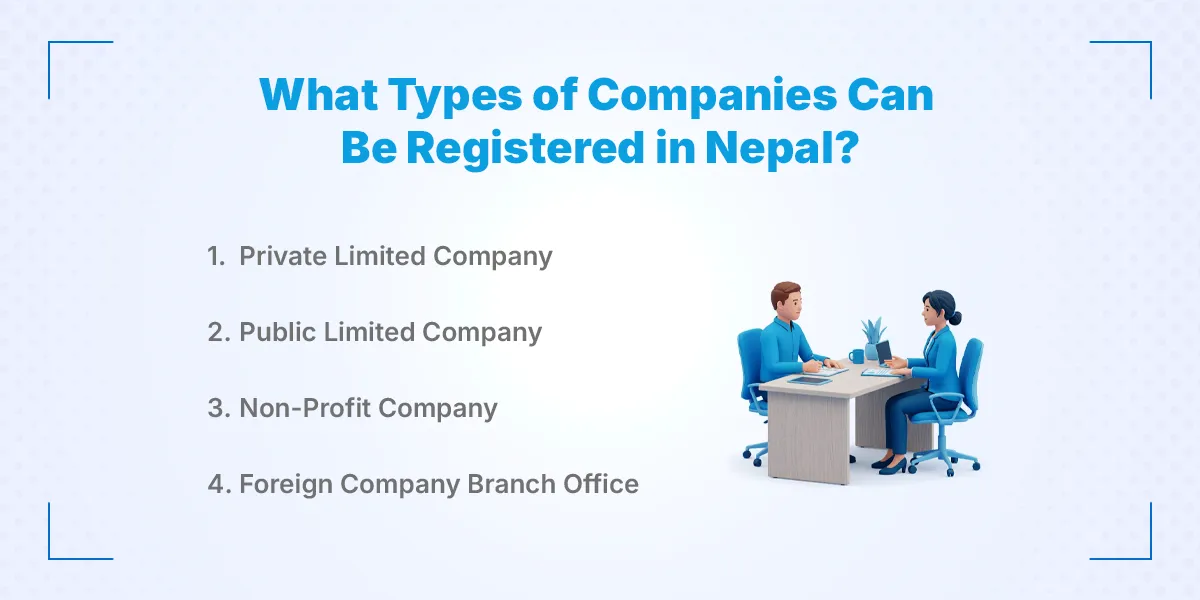
1. Private Limited Company
A Private Limited Company is the most common business structure in Nepal for startups and small businesses. It offers limited liability protection to shareholders while allowing flexible business operations. The company can have a limited number of shareholders and cannot publicly trade its shares. Most entrepreneurs choose this structure because it balances legal protection with operational simplicity.
2. Public Limited Company
A Public Limited Company is designed for larger businesses that intend to raise capital from the public. This structure requires compliance with additional regulatory requirements and corporate governance standards. Public companies may issue shares to the public through approved mechanisms. Businesses planning significant expansion often consider this option.
3. Non-Profit Company
A Non-Profit Company is established to pursue social, educational, charitable, or public welfare objectives. The organization does not distribute profits among members or founders. Any surplus income is generally used to further organizational goals. This structure is suitable for organizations focused on community development and public benefit.
4. Foreign Company Branch Office
Foreign companies can establish branch offices in Nepal after obtaining required approvals from relevant authorities. The branch office may conduct approved business activities within Nepal. Additional documentation from the parent company is typically required. Regulatory compliance and foreign investment laws must be carefully followed.
What Are the Requirements for Company Registration in Nepal?
The requirements for company registration depend on the type of business structure being established.
Businesses must satisfy legal, administrative, and documentation requirements before approval is granted. Preparing these requirements in advance can significantly speed up the registration process.
- Minimum required shareholders based on company type
- Appointment of directors
- Approved company name
- Registered office address
- Defined share capital structure
- Compliance with applicable laws and regulations
- Required identification and supporting documents
- Properly prepared incorporation documents
Documents Required for Company Registration in Nepal
Several documents must be submitted during the company registration process. Incomplete or inaccurate documentation is one of the most common reasons for registration delays. Ensuring all documents are properly prepared helps improve approval efficiency.
- Citizenship certificates of promoters and shareholders
- Passport-sized photographs
- Memorandum of Association (MOA)
- Articles of Association (AOA)
- Registered office address information
- Shareholder details
- Director consent documents
- Company registration application forms
- Additional supporting documents when required
How to Register a Company in Nepal?
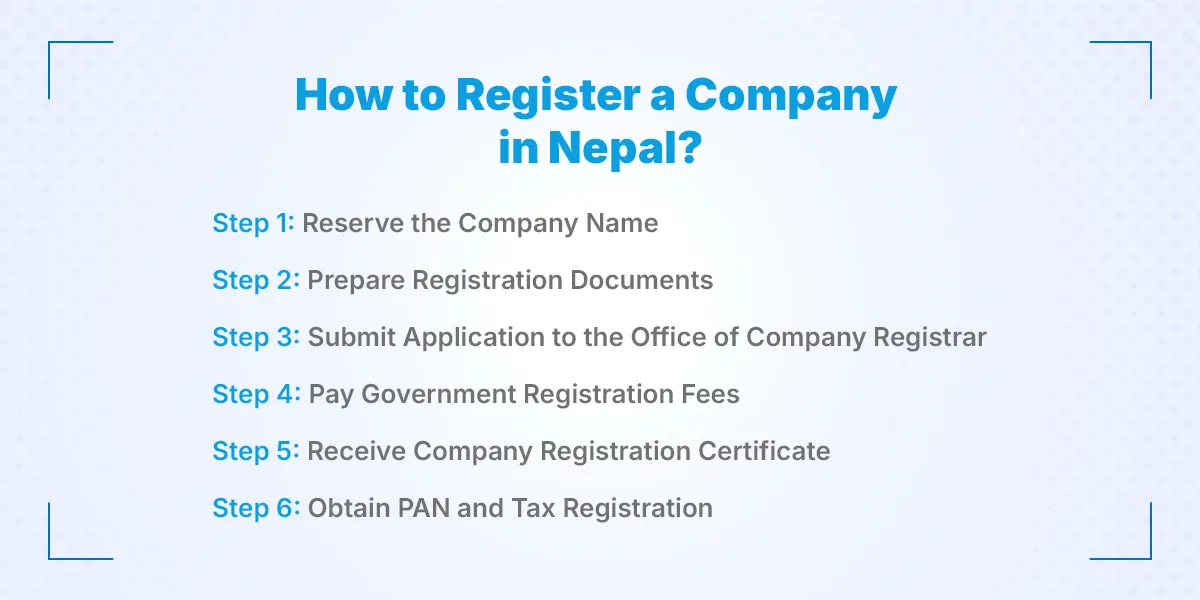
To register a company in Nepal, reserve a company name, prepare the required documents, submit an application to the Office of the Company Registrar, pay the registration fee, obtain the company registration certificate, and complete PAN and tax registration. Most businesses can begin the registration process online through the official company registration system.
1. Reserve the Company Name
The first step is selecting and reserving an available company name through the Office of the Company Registrar. The proposed name must be unique and should not conflict with existing registered entities. Authorities review the application to determine whether the requested name meets legal requirements. Once approved, the name becomes available for company registration.
2. Prepare Registration Documents
The next step involves preparing all required incorporation documents and supporting materials. Key documents include the Memorandum of Association and Articles of Association. Shareholder information, director details, and registered office information must be verified carefully. Accurate documentation helps prevent application rejection or processing delays.
3. Submit Application to the Office of the Registrar of Companies
Applicants must submit the registration application along with supporting documents through the prescribed process. The Office of the Company Registrar reviews the application for completeness and compliance. Additional clarification may be requested if information is missing or inconsistent. Properly prepared applications generally move through the review process more efficiently.
4. Pay Government Registration Fees
Registration fees vary depending on the company's authorized capital and business structure. Payment must be completed according to government guidelines before final approval is issued. Applicants should retain payment records for future reference. Timely payment helps avoid unnecessary delays during processing.
5. Receive Company Registration Certificate
After successful review and approval, the company receives its registration certificate. This certificate serves as official proof of the company's legal existence. Businesses can begin undertaking authorized activities once registration is completed. The certificate should be securely maintained for compliance and administrative purposes.
6. Obtain PAN and Tax Registration
Following company registration, businesses must complete tax registration requirements. A Permanent Account Number (PAN) is necessary for taxation and financial transactions. Additional tax obligations may apply depending on business activities and revenue levels. Compliance with tax requirements is essential for lawful business operations.
How Much Does Company Registration Cost in Nepal?
The cost of company registration in Nepal typically ranges from NPR 1,000 to NPR 43,000+ in government registration fees for a private limited company, depending on the company's authorized capital. In addition to government fees, entrepreneurs should budget for legal assistance, document preparation, local business registration, company seal creation, and post-registration compliance costs.
For most startups and small businesses, the total practical cost of company registration usually falls between NPR 15,000 and NPR 50,000, depending on whether the founders complete the process themselves or hire a lawyer, consultant, or registration agency.
Government Registration Fees for Private Limited Companies
The Office of the Company Registrar (OCR) charges registration fees based on the company's authorized capital. The higher the authorized capital, the higher the registration fee.
| Authorized Capital | Registration Fee (NPR) |
|---|---|
| Up to 100,000 | 1,000 |
| 100,001 – 500,000 | 4,500 |
| 500,001 – 2,500,000 | 9,500 |
| 2,500,001 – 10,000,000 | 16,000 |
| 10,000,001 – 20,000,000 | 19,000 |
| 20,000,001 – 30,000,000 | 22,000 |
| 30,000,001 – 40,000,000 | 25,000 |
| 40,000,001 – 50,000,000 | 28,000 |
| 50,000,001 – 60,000,000 | 31,000 |
| 60,000,001 – 70,000,000 | 34,000 |
| 70,000,001 – 80,000,000 | 37,000 |
| 80,000,001 – 90,000,000 | 40,000 |
| 90,000,001 – 100,000,000 | 43,000 |
Additional Costs to Consider
Besides the OCR registration fee, businesses may incur several additional expenses during and after registration.
| Expense | Estimated Cost (NPR) |
|---|---|
| Legal or Consultant Fees | 10,000 – 50,000 |
| Document Drafting | 2,000 – 10,000 |
| Notarization Charges | 500 – 2,000 |
| Company Stamp/Seal | 500 – 2,000 |
| Digital Signature (if required) | 1,500 – 2,000 |
| Printing & Documentation | 500 – 1,500 |
| Local Ward Registration | Varies by Municipality |
| Office Rental Agreement | Depends on Location |
Example Cost for a Small Startup
A startup registering a private limited company with an authorized capital of NPR 500,000 may spend:
- OCR Registration Fee: NPR 4,500
- Legal Assistance: NPR 10,000–15,000
- Company Seal and Documentation: NPR 1,000–3,000
- Local Registration and Miscellaneous Costs: NPR 3,000–10,000
Estimated Total Cost: NPR 18,500–32,500 depending on the municipality and professional services used.
How Long Does It Take to Register a Company in Nepal?
Company registration in Nepal typically takes 3 to 15 working days if all required documents are submitted correctly and the proposed company name is approved without issues. The actual timeline may vary depending on the complexity of the application and the workload of the Office of the Company Registrar.
The registration timeline mainly depends on:
- Accuracy of submitted documents
- Availability and approval of the company name
- Government processing workload
- Additional verification requirements
- Timely payment of registration fees
- Compliance with registration guidelines
Entrepreneurs can speed up the process by preparing all documents in advance and ensuring that the application is complete and accurate before submission.
Common Mistakes to Avoid During Company Registration
Many registration delays occur because applicants make avoidable errors during the process.
Understanding these common mistakes can help entrepreneurs complete registration more efficiently and reduce the likelihood of rejection.
- Selecting a company name without checking availability
- Submitting incomplete documents
- Providing inaccurate shareholder information
- Drafting incorrect MOA and AOA documents
- Missing registration deadlines
- Ignoring tax registration requirements
- Failing to maintain supporting records
- Overlooking legal compliance obligations
What Happens After Company Registration?
After registration, businesses must complete several operational and compliance-related activities before scaling operations.
These steps help establish a strong foundation for future growth while ensuring compliance with applicable regulations.
- Complete PAN registration
- Open a corporate bank account
- Establish accounting and bookkeeping systems
- Implement tax compliance procedures
- Maintain statutory records
- Understand labor and employment obligations
- Develop internal business policies
- Prepare for future audits and reporting requirements
How to Hire Employees After Registering Your Company?
To hire employees after registering your company in Nepal, define your job requirements, create clear job descriptions, follow labor laws, and recruit candidates through job portals, networks, or recruitment agencies such as Kumari Job to quickly connect with qualified talent.
This helps businesses streamline hiring and build a skilled workforce efficiently while staying compliant with employment regulations.
- Identify workforce requirements
- Create detailed job descriptions
- Develop salary and benefits structures
- Understand labor regulations
- Build a recruitment workflow
- Establish onboarding procedures
1. Where Can You Hire Qualified Employees in Nepal?
Businesses can recruit employees through online job portals, professional networks, educational institutions, and recruitment agencies. Each recruitment channel offers different advantages depending on hiring requirements. Online platforms often provide faster access to a larger candidate pool. Combining multiple recruitment channels can improve hiring outcomes.
2. Why Use Kumari Job for Recruitment?
Kumari Job provides employers with access to a large network of qualified candidates across various industries. The platform helps streamline recruitment by connecting businesses with suitable talent efficiently. Employers can promote vacancies, strengthen employer branding, and reduce hiring time. Startups and established businesses alike can benefit from structured recruitment support.
Company Registration in Nepal: Key Legal and Tax Compliance Requirements
Businesses must continue meeting legal and tax obligations after registration to maintain good standing.
Failure to comply with regulations can result in penalties, administrative issues, and operational disruptions.
- Annual company filings
- Tax return submission
- Company renewal obligations
- Record-keeping requirements
- Financial reporting responsibilities
- Employee-related compliance requirements
- Regulatory updates and notifications
- Penalties for non-compliance
Conclusion
The most important step in building a successful business in Nepal is establishing a strong legal foundation from the beginning. Proper company registration not only protects your business interests but also creates opportunities for growth, financing, partnerships, and talent acquisition.
Once your company is registered, focus on building the right team and maintaining compliance as you scale. If you are ready to recruit qualified employees and grow your workforce efficiently, Kumari Job can help connect your company with skilled candidates across Nepal.
Frequently Asked Questions
Submit your comments

Get Our App On



What is the Public Relations Officer Salary in Nepal
VIEW DETAILS
What Is the Salary of a Ticketing Officer in Nepal?
VIEW DETAILS
What Is the Salary of a Travel Consultant in Nepal?
VIEW DETAILS
How to Become an Auditor in Nepal
VIEW DETAILS


Loading Comments...