




Nepal's Social Security Fund (SSF) pays out real medical and maternity benefits to contributors, but most people never claim them because the process isn't clearly explained anywhere. This guide breaks down exactly how the SSF Medical, Health and Maternity Protection Scheme works, who qualifies, what documents you need, and how to file a claim step by step so you can actually use the benefit you're already paying into.
In this blog
What Is the SSF Medical and Maternity Scheme?
The SSF Medical, Health and Maternity Protection Scheme is one of four bundled protection programs under Nepal's Contribution-Based Social Security Act, 2074 (2017), covering outpatient treatment, hospitalization, and paid maternity leave for registered contributors. It's funded through a combined 31% monthly contribution on basic salary 20% from the employer and 11% from the employee, collected and managed by the Social Security Fund under the Ministry of Labour, Employment and Social Security.
- Coverage includes outpatient (OPD) treatment, hospitalization, and paid maternity leave.
- A 20% co-payment generally applies to medical claims — SSF does not cover 100% of treatment costs.
- Treatment must generally be sought at an SSF-empanelled hospital to qualify for direct settlement, though a reimbursement route exists for other cases.
Who Is Eligible, and When Does Coverage Start?
Eligibility depends on how long you've been contributing, not just whether you're registered with SSF. Medical benefits (OPD and hospitalization) generally become available after 3 consecutive months of contribution, while maternity benefits require a longer contribution history before they can be claimed.
- Medical benefits: eligible after 3 consecutive months of contribution, per multiple SSF guides.
- Maternity benefits: most commonly cited as requiring 12 months of contribution within an 18-month period, though some sources cite a shorter 6-month threshold confirm your exact window on the SSF Contributor Portal before assuming you qualify.
- Portability: your SSID (Social Security Identification number) stays with you across employers, so your contribution history and eligibility carry over when you change jobs.
What Medical Benefits Can You Claim?
SSF covers outpatient treatment, hospitalization costs, and extended sick leave pay for contributors who meet the minimum contribution period. Each benefit has its own cap and co-payment rule, so what you can actually recover depends on the type of treatment and how long you've been contributing.
- Outpatient (OPD) treatment reimbursement, subject to an annual ceiling.
- Hospitalization costs, including medicine, surgery, and diagnostics, also subject to an annual ceiling.
- Extended sick leave benefit if medical leave runs beyond 12 days (up to a maximum of 13 weeks), the contributor receives 60% of basic salary for the qualifying period.
Note on the annual claim ceiling: current guides disagree on the exact hospitalization/OPD cap some cite NPR 1,00,000 per year, others cite up to NPR 700,000 per year. The correct figure likely depends on your specific claim category and the current SSF procedure revision, so confirm it directly with SSF (sosys.ssf.gov.np or your nearest SSF office) before relying on either number.
What Maternity Benefits Can You Claim?
SSF provides up to 98 days of maternity leave pay, combining full salary for part of the leave and a reduced rate for the remainder, plus separate paternity leave and coverage for pregnancy-related medical costs. The exact structure is fixed by SSF's operating procedure rather than negotiated with your employer.
- Paid maternity leave: 60 days of full-pay leave, plus up to an additional 38 days at 60% of basic salary, for a combined maximum of 98 days.
- Paternity leave: commonly cited as 15 days, separate from the mother's leave entitlement.
- Pregnancy-related medical costs: tests, delivery, and related hospitalization are covered under the same medical scheme, subject to the standard co-payment.
- Newborn support: some guides cite an additional lump-sum payment (reported around one month's minimum wage) per newborn, though this isn't uniformly reported and should be confirmed at claim time.
What Documents Do You Need to Claim SSF Medical or Maternity Benefits?
You'll need proof of your SSF registration, proof of treatment, and the official claim form missing any one of these is the single biggest reason claims get delayed. Gather these before you start the claim, not after treatment is already underway.
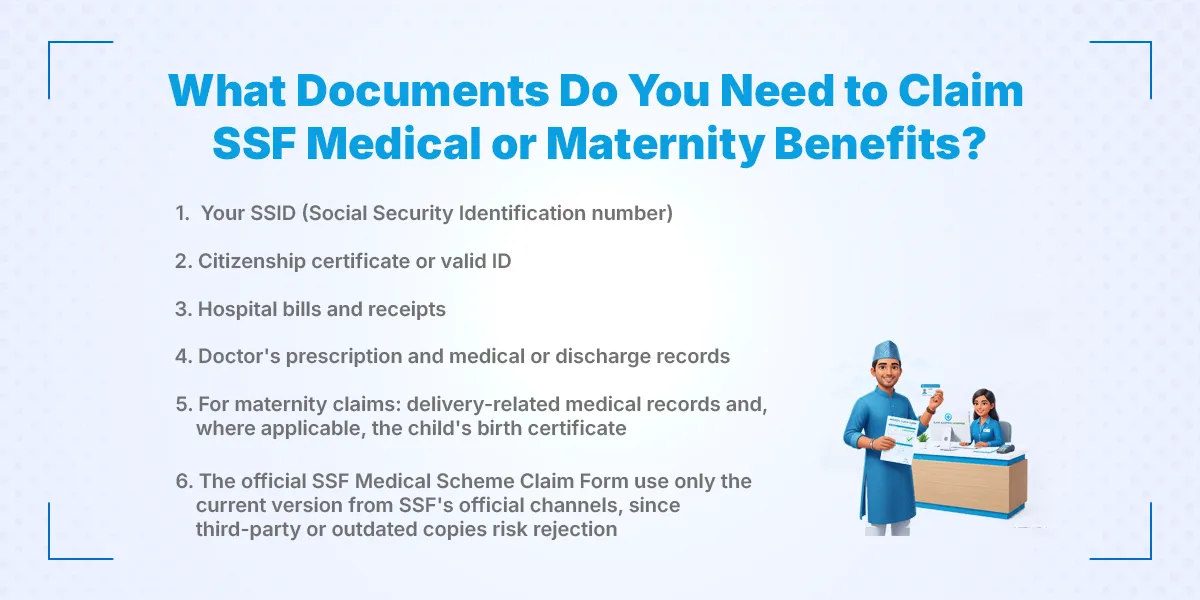
- Your SSID (Social Security Identification number)
- Citizenship certificate or valid ID
- Hospital bills and receipts
- Doctor's prescription and medical or discharge records
- For maternity claims: delivery-related medical records and, where applicable, the child's birth certificate
- The official SSF Medical Scheme Claim Form use only the current version from SSF's official channels, since third-party or outdated copies risk rejection
How Do You Claim SSF Medical and Maternity Benefits Step by Step?
There are two ways to settle an SSF medical or maternity claim: direct settlement at an empanelled hospital, or reimbursement after you've paid out of pocket. Which one you use depends on where you're treated and whether that facility has a direct-settlement agreement with SSF.
Direct Settlement (at an SSF-empanelled hospital)
- Choose a hospital or health institution empanelled with SSF — SSF lists 35+ empanelled institutions across Nepal.
- Confirm with the hospital that they support direct settlement before treatment begins.
- SSF settles the eligible portion directly with the hospital; you're responsible for the standard co-payment.
- Keep all bills and the discharge summary for your own records, even though the hospital handles the main settlement.
Reimbursement (if you paid out of pocket)
- Pay for treatment upfront at the time of care.
- Log in to the SSF Contributor Portal at sosys.ssf.gov.np.
- Select the relevant claim type Medical Claim or Maternity Claim.
- Upload the required documents: medical bills, doctor's prescription, hospital/discharge records, and the completed claim form.
- Submit the claim and note your reference or tracking number.
- SSF verifies the documents and processes eligible claims commonly cited processing time is around 15 working days for medical claims, though some guides cite up to 30 days depending on the scheme and verification required.
Why Do SSF Claims Get Delayed or Rejected?
Most rejected claims fail for procedural reasons, not because the contributor was actually ineligible a document mismatch or an unnoticed contribution gap is usually the real cause. Checking these before you submit will save you weeks of back-and-forth.
- Treatment taken at a hospital not empanelled with SSF, without prior confirmation of reimbursement eligibility
- Missing or mismatched documents; claim form details not matching hospital bills
- Contribution gaps: a salary deduction alone doesn't guarantee your employer actually deposited it with SSF, so always check your Contribution Statement on the portal, not just your payslip
- Submitting a claim before meeting the minimum contribution period for that specific benefit
- Using outdated or third-party claim forms instead of the current official version
What If Your Employer Hasn't Deposited Your Contributions?
If your SSF Contributor Portal shows missing months despite salary deductions on your payslip, your employer likely hasn't remitted those contributions, and you should raise it before filing any claim that depends on that period. Unresolved gaps can be escalated beyond the employer directly to SSF.
- Log in to the SSF Contributor Portal or app and check your monthly deposit record against your salary slips.
- If you find a gap, raise it in writing with your employer first.
- If unresolved, request reconciliation directly from SSF through its official support channel, or escalate through Nepal's labour dispute channels.
Conclusion
SSF's medical and maternity benefits are a real, usable part of your compensation, not just a payroll deduction, but claiming them correctly depends on knowing your eligibility window, keeping the right documents, and using the correct claim route. Check your contribution history now, before you actually need to file a claim.
you're currently job-hunting and want to make sure your next role comes with proper SSF registration and real benefits, not just a promise of them, browse verified job listings and employer benefit details on Kumari Job to find opportunities backed by genuine social security coverage.
Frequently Asked Questions
Submit your comments

Get Our App On



What is the Public Relations Officer Salary in Nepal
VIEW DETAILS
What Is the Salary of a Ticketing Officer in Nepal?
VIEW DETAILS
What Is the Salary of a Travel Consultant in Nepal?
VIEW DETAILS
How to Become an Auditor in Nepal
VIEW DETAILS


Loading Comments...