




Are you a microbiology graduate wondering how to start your career in Nepal’s growing healthcare and science sector? With increasing demand in hospitals, diagnostic laboratories, pharmaceuticals, food industries, and research institutions, microbiology offers promising career opportunities, but only if you know the right approach. Many graduates struggle not because of a lack of jobs, but due to limited guidance on career pathways.
In this blog, we focus on a job for microbiologist in Nepal and explain everything you need to know to enter the field successfully. You will learn about career options, required skills, eligibility, where to find microbiology jobs, and step-by-step guidance to improve your chances of getting hired in Nepal’s competitive job market. This guide is designed to help both fresh graduates and early-career professionals find their footing in health, pharma and biotech jobs in Nepal.
In this blog
What is a Microbiologist's job in Nepal?
A microbiologist’s job in Nepal involves studying microorganisms such as bacteria, viruses, fungi, and parasites to support healthcare, research, and industrial processes. Microbiologists work in hospitals, diagnostic laboratories, pharmaceutical companies, food industries, research institutions, and public health organisations. Their role is essential in disease diagnosis, infection control, quality testing, and laboratory research.
In Nepal, microbiologists play a critical role in public health and industrial development. They support accurate medical testing, help prevent the spread of infectious diseases, ensure food and water safety, and contribute to pharmaceutical and vaccine-related research. With rising health awareness and expanding laboratory services, the demand for skilled microbiologists continues to grow across both public and private sectors.
Why are microbiology careers gaining importance in Nepal?
- Increasing demand for diagnostic testing in hospitals and private laboratories
- Growing focus on public health, disease prevention, and outbreak control
- Expansion of the pharmaceutical, biotechnology, and food processing industries
- Rising need for quality control and laboratory compliance standards
- Greater investment in research, surveillance, and healthcare infrastructure
- Increased awareness of microbiology’s role in food safety and environmental health
Types of Jobs for Microbiologists in Nepal
There are various career paths available for professionals seeking a job for microbiologist in Nepal, depending on their specialisation and interests. Microbiologists are employed across healthcare, industry, research, and government sectors. Each sector offers different responsibilities, work environments, and growth opportunities, including various entry-level job roles for recent graduates. Understanding these options helps candidates choose the right career direction and prepare accordingly.
1. Hospital and Diagnostic Laboratory Jobs
Microbiologists working in hospitals and diagnostic laboratories are responsible for testing clinical samples and identifying infectious agents. They perform culture tests, antimicrobial sensitivity testing, and routine laboratory analyses. These professionals support doctors by providing accurate diagnostic reports for patient treatment. Strict adherence to laboratory safety and quality standards is a key part of this role. Hospitals and private labs are among the largest employers of microbiologists in Nepal.
2. Pharmaceutical and Biotechnology Companies
In pharmaceutical and biotechnology companies, microbiologists work in research, production, and quality control units. Their tasks include testing raw materials, monitoring sterile environments, and ensuring compliance with regulatory standards. They may also support drug development and vaccine research activities. These roles require strong technical knowledge and attention to detail. The growing pharmaceutical sector in Nepal is creating new opportunities for microbiology graduates.
3. Food, Dairy, and Beverage Industries
Microbiologists in the food, dairy, and beverage industries focus on food safety, hygiene, and quality assurance. They test products for microbial contamination and ensure compliance with food safety regulations. Their work helps prevent foodborne illnesses and maintain product standards. These roles are common in manufacturing plants and processing units. With increasing food safety awareness, this sector continues to expand.
4. Research Institutions and Universities
Research institutions and universities offer microbiologists opportunities to work in academic research and teaching roles. Professionals conduct laboratory experiments, publish research papers, and assist in academic projects. They may also teach microbiology-related subjects at colleges and universities. These positions are ideal for those interested in research and higher education. Advanced degrees often improve prospects in this field.
5. Government and Public Health Sector Jobs
Microbiologists in the government and public health sector work on disease surveillance, public health programs, and laboratory services. They support national health initiatives, outbreak investigations, and environmental monitoring. These roles often involve collaboration with public hospitals and health departments for those looking to get health and medical jobs in Nepal. Government jobs provide stability and opportunities to contribute to national health development. Public health laboratories are key employers in this sector.
Educational Qualifications Required
To secure a job for microbiologist in Nepal, candidates must meet specific educational and training requirements. Employers look for strong academic foundations combined with practical laboratory exposure. The level of qualification often determines the type of role, responsibilities, and career growth opportunities. Higher education and specialised training can significantly improve employability in competitive sectors.
1. Bachelor’s Degree in Microbiology
A bachelor’s degree in microbiology or a related life science is the minimum requirement for most entry-level microbiologist jobs in Nepal. This degree provides fundamental knowledge of microorganisms, laboratory techniques, and biosafety practices. Graduates can apply for junior roles in diagnostic labs, hospitals, and industries. Practical lab sessions during the course play an important role in skill development. This qualification is suitable for fresh graduates starting their careers.
2. Master’s Degree and Specialisations
A master’s degree allows microbiologists to access senior roles, research positions, and specialised fields. It enhances technical expertise, analytical skills, and career advancement opportunities. Many employers prefer candidates with postgraduate qualifications for leadership or research-focused roles. Below are common specialisations:
Medical Microbiology: Medical microbiology focuses on disease-causing microorganisms and clinical diagnostics. Professionals work closely with healthcare providers to identify infections and support treatment decisions. This specialisation is highly valued in hospitals and diagnostic laboratories.
Industrial Microbiology: Industrial microbiology involves the use of microorganisms in manufacturing processes such as pharmaceuticals, fermentation, and biotechnology. Microbiologists in this field support production, quality control, and regulatory compliance. It offers strong career prospects in industrial sectors.
Environmental Microbiology: Environmental microbiology focuses on microorganisms in soil, water, and environmental systems. Professionals work in environmental monitoring, waste management, and public health projects. This specialisation supports sustainability and environmental protection initiatives in Nepal.
3. Required Certifications and Laboratory Training
Certifications and laboratory training enhance practical skills and employability. Training in biosafety, quality control, laboratory techniques, and equipment handling is highly beneficial. Short-term lab courses and workshops help bridge the gap between theory and practice. Employers value candidates with hands-on experience and certified technical skills.
How to Get a Job for Microbiologist in Nepal? Step by Step
To get a job for microbiologist in Nepal, candidates must combine the right educational background with practical laboratory skills and a strategic job search approach. Employers look for applicants who not only understand microbiology concepts but can also apply them in real laboratory settings. Following a step-by-step process helps candidates stay focused and competitive in Nepal’s growing healthcare and science sectors. Below are the key steps to improve your chances of securing a microbiologist job.
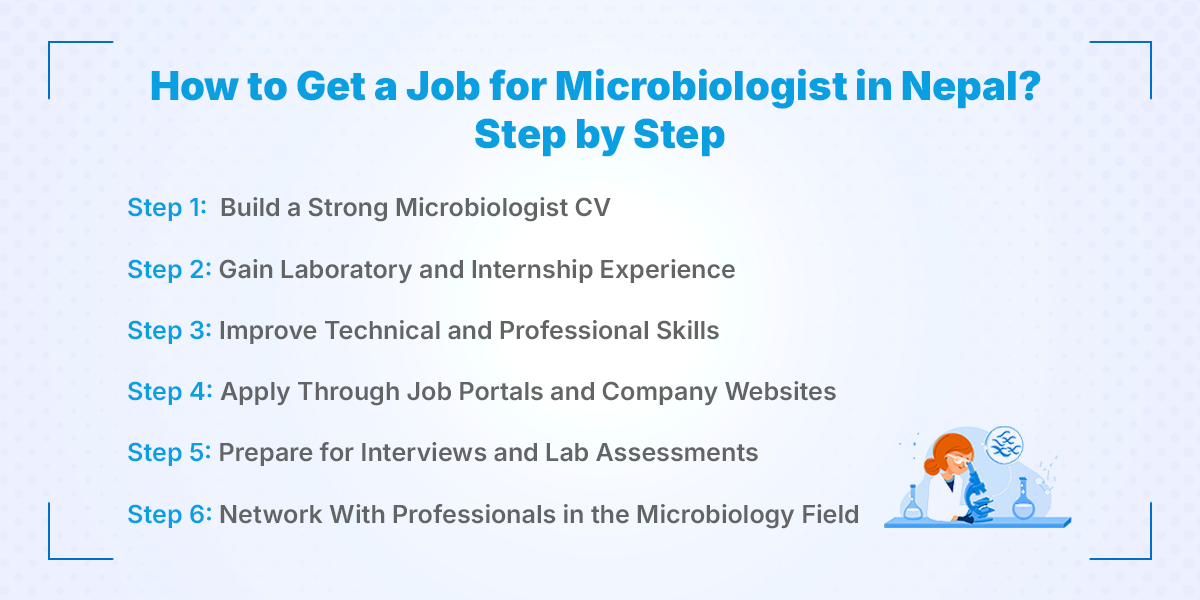
Step 1: Build a Strong CV
A strong CV is the foundation of a successful job application. Highlight your academic qualifications, laboratory skills, internships, and research projects clearly. Include technical skills such as microbial culturing, microscopy, and laboratory safety practices. Make CV concise, well-structured, and tailored to microbiology roles. Using relevant keywords increases visibility during screening.
Step 2: Gain Laboratory and Internship Experience
Laboratory and internship experience is highly valued for microbiologist jobs in Nepal. If you are a student or a recent graduate, securing an internship in Nepal within hospitals, diagnostic labs, pharmaceutical companies, or food industries can provide essential hands-on exposure. Practical experience helps you understand real testing procedures, equipment handling, and quality standards. Even short-term lab experience can significantly strengthen your profile. Employers often prefer candidates with proven lab experience.
Step 3: Improve Technical and Professional Skills
In addition to academic knowledge, microbiologists need strong technical and professional skills. Focus on improving laboratory techniques, data analysis, report writing, and documentation skills. Learning to operate modern lab equipment is a major advantage. Communication and teamwork skills are also important in lab environments. Continuous skill development improves long-term career growth.
Step 4: Apply Through Job Portals and Company Websites
Regularly applying through trusted job portals and company websites increases your chances of finding suitable opportunities. Many hospitals, laboratories, and pharmaceutical companies post vacancies online. Customise your application for each role instead of sending generic CVs. Applying early and consistently helps you stay ahead of the competition. Monitoring new job postings is essential.
Step 5: Prepare for Interviews and Lab Assessments
Interview preparation is crucial to secure a microbiologist job. Review core microbiology subjects, lab safety rules, and testing procedures. Some employers conduct practical lab assessments to evaluate technical skills. Practising common interview questions builds confidence. Being well-prepared improves your performance and selection chances.
Step 6: Network With Professionals in the Microbiology Field
Networking helps uncover job opportunities that may not be publicly advertised. Connect with professors, lab supervisors, and professionals working in microbiology-related fields. Attending seminars, workshops, and training programs builds professional relationships. Networking also provides valuable career guidance. Strong connections can lead to referrals and recommendations.
Skills Required to Get a Job for Microbiologist in Nepal
To secure a job for microbiologist in Nepal, candidates must possess a balanced mix of technical, analytical, and professional skills. Employers look beyond academic qualifications and focus on practical laboratory abilities and workplace readiness. Strong skills improve job performance, increase employability, and support long-term career growth. Developing these competencies is essential for success in healthcare, research, and industrial settings.
1. Laboratory and Technical Skills
Laboratory and technical skills are the core requirements for any microbiologist role. These include microbial culturing, staining techniques, microscopy, and sample handling. Familiarity with laboratory equipment and testing procedures is highly valued. Microbiologists must follow standard operating procedures accurately. Strong technical skills ensure reliable test results and laboratory efficiency.
2. Research and Analytical Skills
Research and analytical skills help microbiologists interpret data and draw accurate conclusions. These skills are important for identifying microorganisms, analysing test results, and supporting research projects. Microbiologists must think critically and solve problems during laboratory work. Data interpretation plays a key role in diagnostics and quality control. Strong analytical skills improve decision-making accuracy.
3. Documentation and Report Writing
Proper documentation and report writing are essential in microbiology jobs. Microbiologists must record test results, procedures, and observations clearly and accurately. Well-written reports support clinical decisions and regulatory compliance. Attention to detail is crucial to avoid errors. Good documentation skills also reflect professionalism and reliability.
4. Quality Control and Safety Knowledge
Knowledge of quality control and laboratory safety standards is critical. Microbiologists must follow biosafety guidelines and maintain contamination-free environments. Understanding quality assurance procedures ensures accurate and consistent results. Safety knowledge protects both laboratory staff and the public. Employers prioritise candidates who follow strict safety protocols.
5. Communication and Teamwork Skills
Microbiologists often work as part of a multidisciplinary team. Clear communication helps in sharing findings with doctors, researchers, and colleagues. Teamwork ensures smooth laboratory operations and efficient workflow. Good interpersonal skills improve collaboration and problem-solving. Strong communication skills enhance overall workplace effectiveness.
Where to Look for Job Vacancies for Microbiologists in Nepal?
You can look for a job for microbiologist in Nepal on job portals like Kumari Job and directly through hospitals, laboratories, and diagnostic centres. These platforms regularly publish updated microbiology job vacancies across Nepal. In addition, pharmaceutical companies, government notices, and professional networks also provide reliable job opportunities. Actively checking multiple sources increases your chances of finding the right role.
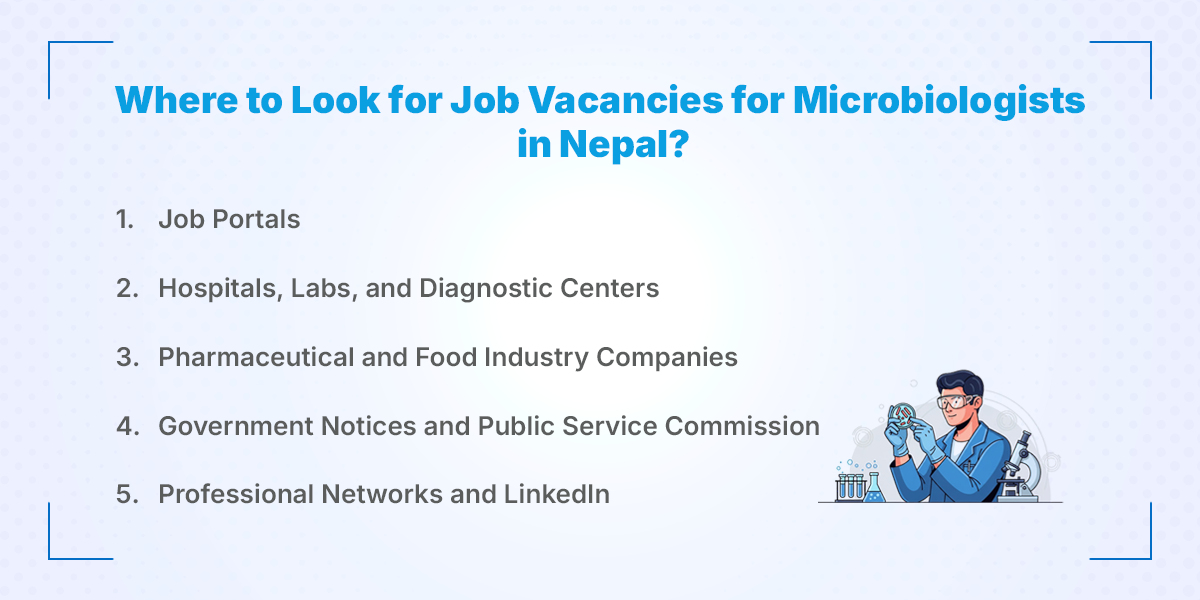
1. Job Portals
Job portals such as Kumari Job are one of the most effective ways to find microbiologist vacancies in Nepal. These platforms list opportunities from hospitals, labs, research centres, and industries. Candidates can filter jobs by qualification, experience, and location. Regularly updating your profile improves visibility to employers. Job portals also provide application alerts for new postings.
2. Hospitals, Labs, and Diagnostic Centres
Hospitals and diagnostic laboratories are major employers of microbiologists in Nepal. Many institutions publish vacancies on their official websites or notice boards. Visiting hospital websites and contacting labs directly can uncover opportunities. Private diagnostic centres frequently hire microbiologists for routine testing and analysis. Consistent follow-up increases your chances of selection.
3. Pharmaceutical and Food Industry Companies
Pharmaceutical and food industry companies require microbiologists for quality control, production, and safety testing. These companies often post vacancies on their websites or through job portals. Microbiologists play a key role in maintaining hygiene and regulatory compliance. Applying directly to companies can be effective. This sector offers strong career growth potential.
4. Government Notices and Public Service Commission
Government microbiologist jobs are announced through official notices and the Public Service Commission. These roles are available in public health labs, research centres, and regulatory bodies. Government jobs offer job security and structured career paths. Candidates must meet eligibility criteria and pass competitive exams. Staying updated with notices is essential.
5. Professional Networks and LinkedIn
Professional networks and LinkedIn help microbiologists connect with employers and industry professionals. Networking can lead to referrals and job leads not publicly advertised. Following hospitals, labs, and companies on LinkedIn keeps you informed. Engaging with professionals increases visibility. Strong networks support long-term career growth.
Salary Range and Career Growth for Microbiologists in Nepal
The salary range for a job for a microbiologist in Nepal depends on education level, experience, specialisation, and the sector of employment. Entry-level salaries are modest but increase steadily with skills, certifications, and work experience. Microbiologists working in diagnostics, pharmaceuticals, research, and public health often see better pay growth compared to the average salary in Nepal for general science graduates. Long-term career progression is strong, especially for those with postgraduate qualifications.
1. Entry-Level Microbiologist Salary in Nepal
At the entry level, microbiologists in Nepal typically earn between NPR 15,000-NPR 30,000 per month. These roles include laboratory technician, junior microbiologist, or quality control analyst positions. Salaries vary based on the type of organisation, location, and workload. Private diagnostic labs and hospitals usually offer starting packages within this range. Entry-level roles focus on building practical experience.
2. Salary After Experience and Specialisation
With experience and specialisation, microbiologists can earn NPR 40,000 to NPR 60,000 or more per month. Professionals with a master’s degree, certifications, or expertise in diagnostics, pharma, or public health are better compensated. NGOs, INGOs, and research organisations often offer higher salaries. Average monthly earnings across sectors are around NPR 37,000. Specialised roles show faster salary growth.
3. Long-Term Career Growth and Promotion Opportunities
Microbiologists have strong long-term career growth opportunities in Nepal. With experience, professionals can move into senior microbiologist, lab manager, quality assurance, or research leadership roles. Promotions often come with increased responsibilities and higher pay. High-end laboratories and international organisations offer significant growth. Some microbiologists also explore opportunities abroad for advanced careers.
Career Options After Gaining Experience as a Microbiologist
After gaining professional experience, a job as a microbiologist in Nepal can lead to several advanced and specialised career paths. Experienced microbiologists have opportunities to move into leadership, research, regulatory, and international roles. Career options expand significantly with higher education, certifications, and strong technical expertise. These paths offer better salaries, responsibilities, and long-term stability.
1. Senior Laboratory Scientist Roles
Senior laboratory scientist roles involve overseeing laboratory operations, supervising staff, and ensuring quality standards. Professionals manage advanced testing, equipment, and reporting processes. These roles require strong technical knowledge and leadership skills. Senior scientists play a key role in maintaining laboratory accuracy and efficiency. Experience and specialisation are essential for promotion to this level.
2. Research and Academic Careers
Microbiologists can pursue research and academic careers in universities and research institutions. These roles include conducting studies, publishing research papers, and teaching microbiology-related subjects. Advanced degrees are often required for academic positions. Research careers allow professionals to contribute to scientific advancement. This path suits those interested in innovation and education.
3. Quality Assurance and Regulatory Roles
Quality assurance and regulatory roles focus on maintaining compliance with national and international standards. Microbiologists ensure proper documentation, audits, and safety protocols in laboratories and industries. These roles are common in the pharmaceutical, food, and biotechnology sectors. Strong knowledge of regulations is essential. Quality roles offer stable career growth and responsibility.
4. International Job and Study Opportunities
Experienced microbiologists can explore international job and study opportunities. Global organisations, research institutes, and universities value skilled professionals. Higher studies abroad can further enhance expertise and career prospects. International exposure offers competitive salaries and advanced research facilities. This path is suitable for those seeking global career growth.
Tips to Get Selected for a Job as a Microbiologist in Nepal
Getting selected for a job for microbiologist in Nepal requires more than just academic qualifications. Employers prefer candidates who demonstrate practical skills, updated knowledge, and professional readiness. A focused approach to applications and career development can greatly improve your selection chances. Below are key tips to help you stand out in a competitive job market.
1. Tailoring Your CV for Microbiology Roles
Tailoring your CV specifically for microbiology roles increases your chances of shortlisting. Highlight relevant laboratory skills, research work, and internships clearly. Use microbiology-related keywords that employers look for. Keep the CV concise and well-organised. A targeted CV reflects professionalism and job readiness.
2. Importance of Hands-On Lab Experience
Hands-on laboratory experience is critical for microbiologist jobs in Nepal. Practical exposure helps you understand real testing procedures and safety protocols. Employers value candidates who can work independently in lab settings. Internships and lab training strengthen your technical confidence. Practical skills often outweigh theoretical knowledge.
3. Staying Updated With Microbiology Trends
Staying updated with microbiology trends helps you remain competitive. Follow developments in diagnostics, biotechnology, and public health. Reading research articles and attending seminars improves subject knowledge. Updated knowledge reflects enthusiasm for the field. Employers appreciate candidates who keep learning.
4. Networking and Professional Development
Networking plays an important role in career growth. Connect with professors, lab professionals, and industry experts. Attend workshops, conferences, and training programs to expand your network. Professional connections often lead to job referrals. Continuous development supports long-term success.
Conclusion
Finding a job for a microbiologist in Nepal requires the right mix of education, practical laboratory experience, and strategic job searching. From choosing the correct academic path to developing technical skills and applying through trusted platforms, each step plays a vital role in building a successful microbiology career. Understanding different job sectors and salary expectations helps candidates make informed career decisions.
With consistent effort, skill enhancement, and professional networking, microbiologists can access stable and rewarding career opportunities in Nepal. Whether you aim to work in diagnostics, research, industry, or public health, early preparation and continuous learning will set you apart. Stay focused, stay updated, and apply strategically to achieve long-term career growth.
Frequently Asked Questions
Submit your comments

Get Our App On



What is the Public Relations Officer Salary in Nepal
VIEW DETAILS
What Is the Salary of a Ticketing Officer in Nepal?
VIEW DETAILS
What Is the Salary of a Travel Consultant in Nepal?
VIEW DETAILS
How to Become an Auditor in Nepal
VIEW DETAILS


Loading Comments...