



Are you tired of looking for work and not finding any good leads? Many people in Nepal love cars and bikes, but don't know how to turn that passion into a real job. You might feel stuck working in a small local garage for very little money, or maybe you just finished school and have no idea where to apply.
The truth is, the car business in Nepal is growing fast, especially with all the new electric vehicles (EVs) hitting the streets. There are plenty of openings if you know where to look. In this post, I will show you exactly how to get hired. I’ll explain the training you need, where to find the best automobiles jobs in Nepal, and how to talk to big companies. Follow these steps, and you can start a solid career in no time.
In this blog
Types of Automobiles Jobs in Nepal
If you love cars and bikes, there are many ways to make a living in Nepal. The streets are full of new vehicles, and every one of them needs someone to sell it or fix it. You don't always need a big university degree to start working in this field. Whether you like working with tools or talking to customers, there is a spot for you in the Nepali auto market.
1. Mechanic Jobs
Mechanics are the people who keep Nepal moving by fixing engines and parts. Most mechanics start by helping out at a local workshop or garage to learn the basics. In these jobs, you will spend your day changing oil, fixing brakes, and making sure engines run smoothly. If you get good at your job, you can apply to work for big brands like Suzuki or Hyundai. These big companies pay better and give you a clean place to work. It is a physical job, so you should be ready to get your hands a bit dirty. Many mechanics eventually open their own small shops after learning the trade for a few years. It is a very stable job because there are always cars that need repairs.
2. Automobile Engineer Jobs
This is a more technical role that usually requires a diploma or a degree in engineering. In Nepal, automobile engineers don't usually design new cars from scratch, but they manage the technical side of things. You might work at an assembly plant where bikes like Bajaj or TVS are put together. Your job is to make sure every vehicle follows the safety rules and works perfectly. You will also help the mechanics solve very difficult problems that they can’t fix on their own. Engineers often work in offices but spend a lot of time on the shop floor checking the machines. It is a great career if you are good at math and like solving puzzles.
3. Auto Electrician and Technician Roles
Modern cars in Nepal are now full of computers, sensors, and wires. Auto electricians are the specialists who fix the lights, the music system, and the digital dashboard. Since electric vehicles (EVs) are becoming very popular in Kathmandu, these technicians are in high demand right now. You will use special scanner tools to find out why a warning light is blinking on the dashboard. It is less about heavy lifting and more about understanding how electricity and software work together. If you know how to fix a battery or a sensor, you will never be out of work. This is one of the fastest-growing jobs in the whole country.
4. Automobile Sales and Showroom Jobs
Not everyone in the auto industry works with a wrench; some work in beautiful, air-conditioned showrooms. As a sales consultant, your main job is to talk to people and help them choose the right car or bike. You need to know every detail about the vehicle, like the mileage, the price, and the engine power. You will also help customers with bank loans and insurance paperwork to make the buying process easy. Good communication skills are the most important part of this job. If you are friendly and honest, you can earn a lot of extra money through sales commissions. It is a perfect role for someone who likes meeting new people every day.
4. Workshop Manager and Supervisor Jobs
Once you have plenty of experience, you can move up to become a supervisor or a manager. These people are the bosses of the service center who make sure everything runs on time. You will talk to the customers when they bring their cars in and give them an estimate of the cost. You also give tasks to the mechanics and check their work to make sure it is perfect. Managers have to handle the money, order spare parts, and keep the customers happy. It is a job with a lot of responsibility, but it pays very well. You need to be good at leading a team and staying organized under pressure.
Qualifications Required for Automobiles Jobs in Nepal
Getting a job in the automobile world in Nepal is easier if you have the right papers and skills. While some small shops might hire you just for your interest, big companies and modern showrooms look for specific qualifications. You need a mix of school education and hands-on training to really stand out. Having these credentials proves you know what you are doing and helps you earn a better salary.
1. For Mechanics: Vocational Training (CTEVT)
If you want to be a professional mechanic, a CTEVT certificate is the gold standard in Nepal. You can start with a short-term course of about 3 months or go for a longer Pre-Diploma (TSLC), which takes about 18 months. These courses teach you the basics of engines, brakes, and gears through lots of practice. Big workshops for brands like Tata or Mahindra specifically ask for these certificates during hiring. It shows them that you have been trained by experts and follow safety rules. This is much better than just learning as a helper in a local garage because you get a formal degree at the end.
2. For Engineers: Diploma or Bachelor’s Degree
To work as an Automobile Engineer, you need to complete a Diploma (3 years) or a Bachelor’s degree (4 years) in Automobile or Mechanical Engineering. Most people study at places like Tribhuvan University (TU), Kathmandu University (KU), or CTEVT-affiliated colleges. During these years, you learn how vehicles are designed and how complex machines work together. This qualification is necessary if you want to work in vehicle assembly plants or management roles. It also opens doors for you to work in government offices as a technical officer. Without a formal engineering degree, it is very hard to get these high-level technical positions.
3. For EV Technicians: Special Electrical Certifications
Since electric vehicles (EVs) are the future of Nepal, being an EV Technician is a smart move. You usually need a basic background in electronics or a diploma in electrical engineering first. Then, you can take special short-term courses on EV batteries, motors, and charging systems from training centers like Abhiyantriki Karmashala. These courses focus on how to handle high-voltage batteries safely and how to use software to fix cars. Brands like BYD, MG, and Tesla (importers) are always looking for people with these specific skills. It is a very new field, so having a certificate now gives you a huge advantage over others.
4. For Sales and Showroom Jobs: Management Education
If you want to work in a showroom, you generally need to have finished +2 (Intermediate) or a Bachelor’s degree in Management (BBS or BBA). While you don't need to know how to fix an engine, you must understand how a car works so you can explain it to buyers. Companies look for people who can speak well in both Nepali and English and have a friendly personality. They often provide their own training on the specific car models they sell once you are hired. Having a clean appearance and a valid driving license is often just as important as your degree. This role is perfect if you are good at math for calculating prices and loans.
5. Mandatory for All: A Valid Driving License
No matter what job you do in the automobile sector, having a Nepali Driving License is almost always a requirement. For bike mechanics and sales, you need a Category A (Motorcycle) license, and for cars, you need a Category B (Car/Jeep). Companies need to know that you can legally test-drive a customer's vehicle or move cars around the showroom. If you apply for a job without a license, your chances of getting hired are very low, even if you have a great degree. It is the first thing many employers check during the interview. Make sure your license is updated and that you are a confident driver.
How to Get Automobiles Jobs in Nepal: Step by Step
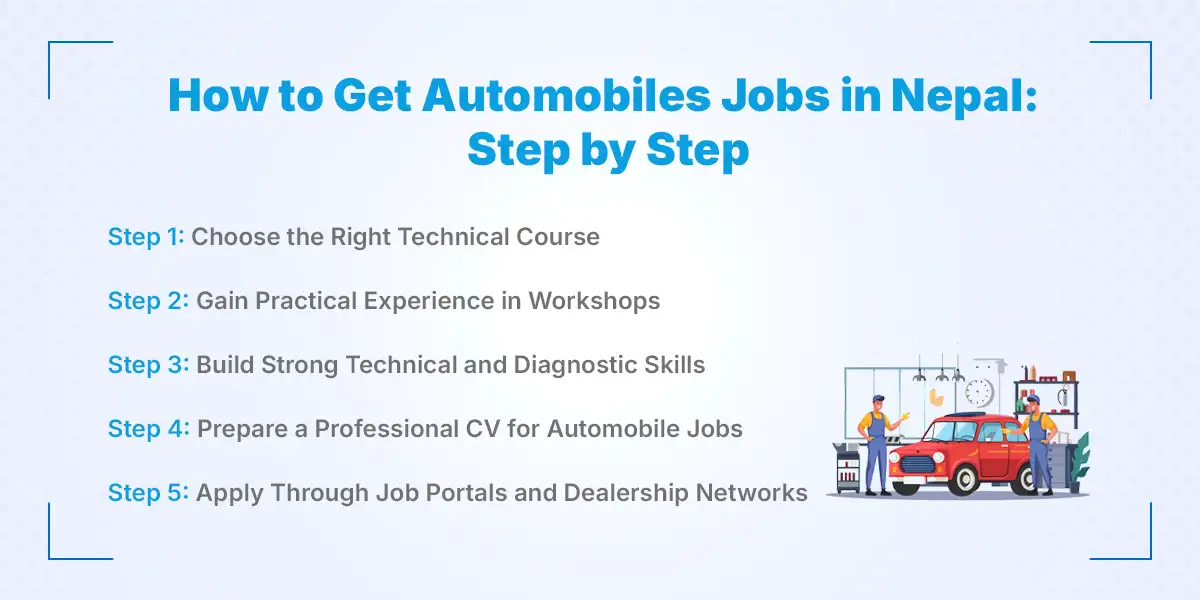
To get an automobile job in Nepal, you need to finish a technical course, get hands-on practice in a garage, and apply to big companies with a simple CV. This path helps you move from being a beginner to a professional who can handle modern cars and bikes. By following these steps, you can build a career that stays steady as the vehicle market grows.
Step 1: Choose the Right Technical Course
The first move is to get a certificate that proves you have the basic knowledge. In Nepal, the CTEVT offers the best courses, ranging from short 3-month sessions to 3-year diplomas in Automobile Engineering. These classes teach you how engines work and how to handle tools safely. You can find these courses in many technical schools across Kathmandu, Butwal, and Pokhara. Having a certificate makes big companies like Tata or Suzuki trust you more when you apply. It is the best way to start your journey with a solid foundation.
Step 2: Gain Practical Experience in Workshops
Learning from books is good, but you really learn about cars by getting your hands dirty. Try to find an apprenticeship or a helper role at a local workshop or an authorized service center. Many people start by working for free or for a small khaja expense just to see how real repairs are done. This is where you learn how to change oil, fix flat tires, and listen to engine sounds. Big dealerships often hire people who have spent at least 6 months to a year working in a real garage. Experience is the most valuable thing you can show an employer in this field.
Step 3: Build Strong Technical and Diagnostic Skills
Vehicles today are very smart, so you need to learn more than just how to use a wrench. You should learn how to use digital scanners and software to find out what is wrong with a car's computer. Since many new cars in Nepal are now Electric Vehicles (EVs), learning about batteries and motors is a huge plus. Practice finding faults quickly and accurately so you don't waste time or parts. Good diagnostic skills make you a specialist rather than just a regular mechanic. The more technical problems you can solve, the higher your salary will be.
Step 4: Prepare a Professional CV for Automobile Jobs
Your CV is the paper that introduces you to the boss before they even meet you. Keep it very simple and list your technical skills, the courses you finished, and the workshops where you worked. Make sure to mention if you have a Driving License, as this is very important for most auto jobs. Use bullet points to list things you are good at, like Engine Overhauling or EV Battery Testing. You don't need a long or fancy design; just make sure your contact number is correct. A clean and honest CV helps you get called for an interview much faster.
Step 5: Apply Through Job Portals and Dealership Networks
To actually land a job, you need to look where the big companies post their ads and use your connections. In Nepal, websites like Kumari Job have special sections just for Automobiles. You should also check the Career pages of famous companies like Sipradi Trading (Tata), MAW Enterprises (Yamaha/Skoda), or Agni Group (Mahindra). Sometimes, the best way is to go directly to a showroom with your CV and ask if they are hiring. Many jobs in local workshops are also found through friends or by talking to people already working in the industry. Don't just wait at home; be active online and offline to find the best openings.
Skills Needed to Succeed in Automobiles Jobs in Nepal
To do well in the automobile world in Nepal, you need more than just a degree or a certificate. Bosses look for people who can actually handle tools and understand how new cars work. Since vehicles are changing fast, your skills need to keep up with the new technology. Having a mix of hands-on ability and a good attitude will help you get promoted quickly.
1. Mechanical and Technical Skills
You need to be very comfortable working with your hands and using different tools like wrenches and pliers. It is important to know how to take apart an engine and put it back together without losing any screws. You should also understand how different parts like the brakes, gears, and suspension work together. Being steady and careful with your hands is the most basic skill for any mechanic or engineer.
2. Problem-Solving Ability
When a customer brings in a car that won't start, you have to act like a detective to find the reason. You need to listen to strange noises and check different parts until you find the exact fault. Good problem-solving means you don't just guess what is wrong and waste the customer's money on parts they don't need. Fixing a difficult issue quickly will make you a favorite among both your boss and the car owners.
3. Knowledge of Modern Vehicle Systems
Most new cars in Nepal today are not just mechanical; they are full of sensors and computer chips. You need to know how to use digital tablets or scanners to read the "error codes" that appear on the dashboard. Understanding things like power steering, anti-lock brakes (ABS), and fuel injection is now a basic requirement. If you only know how to fix old engines, you will struggle to work on the newer models hitting the streets.
4. Electric Vehicle (EV) Technology Knowledge
Electric cars and scooters are everywhere in cities like Kathmandu now, so you must learn how they work. This means understanding how big lithium batteries store power and how electric motors drive the wheels. You need to learn special safety rules because the electricity in these cars can be very dangerous if you touch the wrong wire. If you can fix an EV battery or a motor, you will be one of the most wanted workers in Nepal right now.
5. Communication Skills for Showroom Jobs
If you work in a showroom, the way you talk to people is just as important as what you know about cars. You need to explain technical things in simple words so that a regular buyer can understand why a car is good for them. Being polite, smiling, and answering questions patiently will help you close more sales and earn more commission. Good communication helps build trust, which is the most important thing when someone is spending a lot of money on a new vehicle.
Where to Find Automobiles Job Vacancies in Nepal?
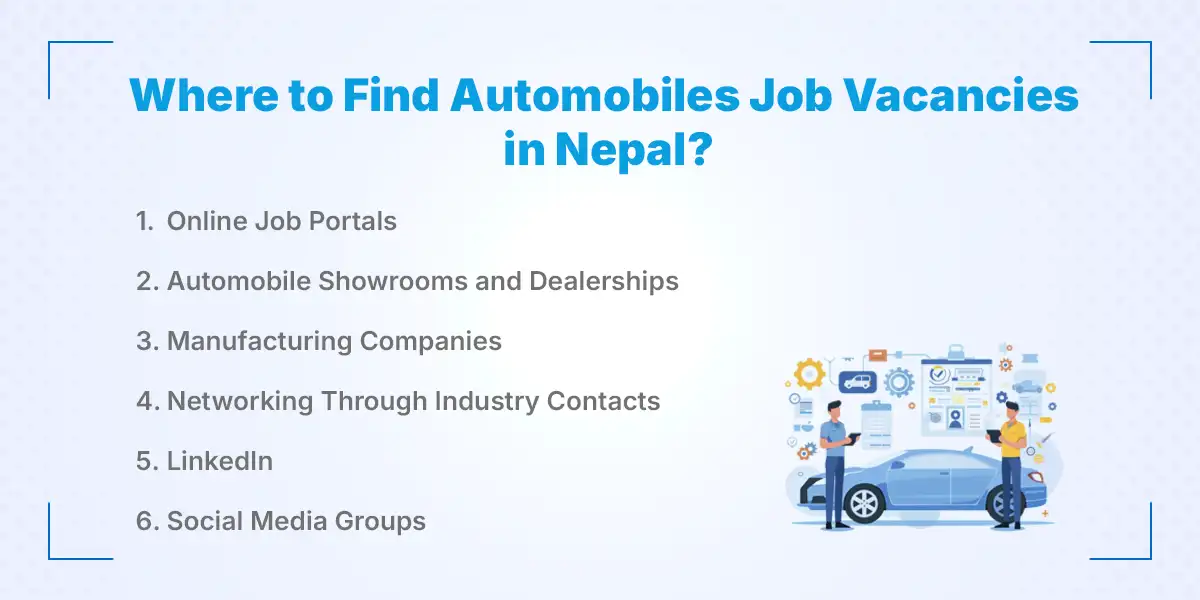
You can find automobile jobs in Nepal on the top job websites like Kumari Job, local showrooms, manufacturing companies, LinkedIn, and social media groups. Using online platforms along with physical visits gives you the best chance to see every available vacancy. By spreading your search across different places, you won't miss out on the perfect role for your skills.
1. Online Job Portals
Websites like Kumari Job are the best places to start your search online. Most big companies in Nepal post their latest openings here under the "Automotive" or "Mechanical" categories. You can create a free profile, upload your CV, and set up alerts so you get an email whenever a new job is posted. These sites often list details like the salary, location, and what experience you need. It is a quick and easy way to apply for multiple jobs from your phone or computer.
2. Automobile Showrooms and Dealerships
Many of the biggest jobs are found at the authorized showrooms of brands like Tata (Sipradi), Hyundai (Laxmi Intercontinental), and Yamaha (MAW). You should check the "Career" or "Vacancy" pages on their official websites regularly to find professional roles. If you live near a major auto hub like Teku or Thapathali in Kathmandu, you can even visit the showrooms in person with your CV. Sometimes showrooms need staff immediately and haven't posted the ad online yet. Talking directly to the manager can show them that you are hardworking and eager to start.
3. Manufacturing Companies
Nepal now has several plants that assemble bikes and cars, such as the Bajaj and TVS factories in the Terai region. These companies often need a large number of technicians, assembly line workers, and quality checkers. You can look for these roles by following the parent companies, like Golchha Group or Jagdamba Motors. These jobs are great if you want to work with heavy machinery and see how vehicles are built from scratch. They usually offer stable work and good training for beginners who want to learn the industrial side of the business.
4. Networking Through Industry Contacts
In Nepal, "who you know" can be just as important as "what you know." Many workshop owners and showroom managers prefer to hire people recommended by their own trusted workers. You should talk to friends, family, or former teachers who are already working in the car or bike business. Let them know you are looking for work and show them your skills. Often, a small recommendation can help you skip the long waiting line and get an interview immediately.
5. LinkedIn
LinkedIn is a professional social network that is becoming very popular for hiring in Nepal. You should make a profile that lists your technical skills, any certificates you have, and your work history. Follow the HR managers and official pages of major Nepali automobile groups to see their updates. You can also send polite messages to people working in companies you like to ask for advice or job leads. It is a great way to build a professional image and find high-level jobs in management or engineering.
6. Social Media Groups
Facebook is still a huge tool for finding work in Nepal through various "Job Vacancy" groups. Many smaller workshops and reconditioned car houses post their ads directly on Facebook because it is fast and reaches many people. You can join groups like "Jobs in Nepal" or "Automobile Engineers Nepal" to stay updated on daily openings. Be careful to check if the post is real before sharing your personal info, as some ads might be fake. If you see a post from a real garage or showroom, you can often comment or send a message to apply instantly.
Why Choose a Career in Automobiles Jobs in Nepal?
Choosing a career in the automobile sector in Nepal is a smart move because the industry is growing fast and always needs new workers. Even as other businesses face ups and downs, people still need cars and bikes to get to work and transport goods. This field offers a mix of steady pay, new technology, and the chance to one day run your own business.
- Growing Vehicle Imports and Sales: Nepal imports thousands of new cars and bikes every year to keep up with the growing number of buyers. This constant growth means showrooms and service centers are always hiring new staff to handle sales and repairs.
- Rise of Electric Vehicles: Electric cars and scooters are taking over the streets of Kathmandu and other cities very quickly. Because this technology is new, there is a huge demand for workers who understand how to fix EV batteries and motors.
- Long-Term Career Stability: As long as people are driving, they will always need a skilled person to fix their vehicles when they break down. This is a "hands-on" job that cannot be replaced by a computer, giving you a very secure future.
- Entrepreneurship Opportunities in Auto Workshops: After learning the trade for a few years, you can easily open your own local garage or spare parts shop. Since every neighborhood needs a reliable mechanic, running your own business can be a great way to earn a good living.
Conclusion
Getting a job in Nepal’s automobile sector is all about matching your technical passion with the right training and a proactive search. Whether you want to fix high-tech electric cars or lead a sales team in a busy showroom, the opportunities are there if you are ready to learn. By getting a CTEVT certificate, gaining hands-on experience in a workshop, and staying updated on new EV technology, you can build a career that is both stable and well-paying.
Don't wait for the perfect job to find you; instead, visit showrooms in person, check portals like Kumari Job daily, and talk to people already in the industry. The future of transport in Nepal is changing fast, and there is a huge demand for skilled people who can keep the country moving. If you start today by building your skills and a simple CV, you can turn your love for vehicles into a successful lifelong career.
Frequently Asked Questions
Submit your comments

Get Our App On



What is the Public Relations Officer Salary in Nepal
VIEW DETAILS
What Is the Salary of a Ticketing Officer in Nepal?
VIEW DETAILS
What Is the Salary of a Travel Consultant in Nepal?
VIEW DETAILS
How to Become an Auditor in Nepal
VIEW DETAILS


Loading Comments...