



Artificial Intelligence is already shaping the way businesses work, from smarter healthcare diagnostics to automated customer service and data-driven decision making. Around the world, and increasingly in Nepal, organizations are using AI to work faster, solve complex problems, and stay competitive.
Naturally, this shift has sparked a big question among students, tech enthusiasts, and professionals: What is the real scope of artificial intelligence as a career? Many people are curious about the opportunities, but they are unsure where to start or what the future actually looks like.
Understanding where AI is being used, what is the scope of artificial intelligence in Nepal, and what opportunities exist can help you prepare for the future. Let’s start with the basics and show you the roadmap to land your first AI job in Nepal.
In this blog
What is Artificial Intelligence (AI)?
Artificial Intelligence, or AI, refers to machines or software systems designed to perform tasks that usually require human intelligence. In simple terms, it allows computers to learn from data, recognize patterns, and make decisions. Instead of following only fixed instructions, AI systems can improve their performance as they process more information.
Several core technologies make this possible. Machine Learning allows systems to learn from data and make predictions. Deep Learning, a branch of machine learning, uses advanced neural networks to solve more complex problems. Natural Language Processing (NLP) helps machines understand and respond to human language, while Computer Vision allows systems to interpret images and videos. Robotics then brings AI into the physical world by enabling machines to perform tasks automatically.
Because of these technologies, AI is now being used across a wide range of industries. From healthcare and finance to marketing and transportation, organizations are using AI to work faster, reduce errors, and make smarter decisions.
What is the Future Scope and Career Growth in AI?
Artificial Intelligence is quickly becoming a core technology for modern businesses. Companies now rely on AI to analyze data, automate tasks, and improve decision-making. As a result, many industries, from healthcare and banking to retail and education are investing heavily in intelligent systems.
Because of this rapid shift, the demand for skilled professionals is growing fast, making AI one of the most promising and well-paid roles in the technology sector. Roles such as AI engineers, data scientists, and machine learning specialists are becoming more common in the global job market. At the same time, new AI startups and innovation hubs are emerging, creating even more opportunities for people with the right skills.
Another major advantage of the AI industry is the rise of remote work. Many AI professionals can now work with international companies while living in their home country. With this rapid growth, AI careers are becoming some of the most promising and well-paid roles in the technology sector.
Scope of Artificial Intelligence in Different Industries in Nepal
Artificial Intelligence is being used across many real‑world areas like health, banking, business, transport, and education. Around the world, most companies now use some form of AI in their work. In fact, about 78 % of global businesses report using AI in at least one part of their operations, and over 90 % are either using it or exploring it. This shows the real scope of artificial intelligence worldwide and explains why it’s becoming so important in Nepal too, especially in sectors such as finance, education, and healthcare.
1. Healthcare
In healthcare, AI helps doctors and hospitals make faster and more accurate decisions. Tools powered by AI can analyse medical scans, spot patterns in patient data, and even help predict which patients might get sick before symptoms appear. In many countries, AI adoption in health tech is growing quickly, and even in Nepal, telemedicine platforms and AI tools are starting to assist remote consultations and diagnostics where traditional services are harder to access.
2. Finance and Banking
Banks and financial firms are among the biggest users of AI. AI systems can check transactions in real time to detect and prevent fraud, analyse customer data to score credit risk more accurately, and boost security for online banking. In Nepal too, banks and digital wallets like eSewa and FonePay use machine learning models to spot unusual activity and secure customer accounts. As digital financial services grow in Nepal, professionals who understand AI and data analysis are becoming valuable in helping these systems work smoothly and safely.
3. Business and Marketing
Businesses everywhere are using AI to understand their customers better and make smarter decisions. AI tools can study how people behave online, suggest what products a customer might like, and automate parts of marketing work like sending messages or creating ads. For instance, Daraz, the popular e-commerce platform in Nepal uses AI to recommend products and improve user experience. This shows that even local businesses are tapping into these technologies. As a result, professionals with skills in AI analytics, marketing automation, and customer data are in higher demand.
4. Transportation
AI is changing how goods and people move around the world. Systems powered by AI can plan the best routes for delivery trucks, reduce traffic congestion with smart signals, and are even the foundation of self‑driving vehicles in advanced markets. While Nepal’s transport infrastructure is still developing, ride‑sharing and logistics companies are adopting AI‑powered tools to optimise routes and save time and fuel, especially in cities. These improvements help logistics firms deliver faster and at lower cost, opening up roles for AI and tech professionals to support smart transport solutions.
5. Education
In education, AI is helping personalise learning for each student. Platforms can adjust lessons based on how well a student is doing, and AI tutors or grading systems can support teachers by handling routine tasks. In Nepal, schools and colleges are starting to use online and AI‑assisted tools that tailor learning experiences and track student progress more closely. This means educators and technologists who understand AI can help shape the learning systems of tomorrow, making education more engaging and effective for students.
As AI adoption increases across industries, the demand for skilled professionals is also growing significantly. In many sectors, AI is not just a technology trend but a crucial part of everyday operations, which means more opportunities for people who can build, manage, or work with intelligent systems.
What are the Career Opportunities in Artificial Intelligence in Nepal?
AI offers a variety of exciting careers for tech professionals. Roles like machine learning engineers, data scientists, and AI researchers are in high demand across industries. Each position allows you to use AI skills to solve real-world problems and drive innovation. With AI becoming a core part of business and technology, these careers also come with strong growth and salary potential.
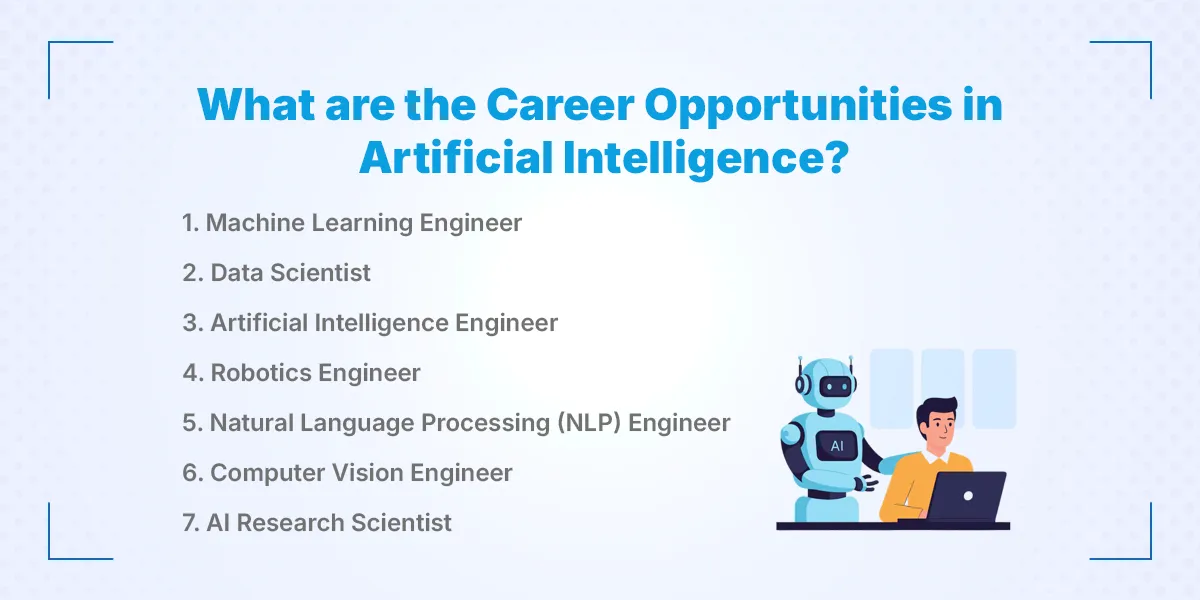
1. Machine Learning Engineer
Machine Learning Engineers develop algorithms that allow computers to learn from data without being explicitly programmed. They design models for predictive analytics, recommendation engines, and automation systems. These engineers must have strong skills in programming languages like Python, data handling, and statistical analysis. Their work directly impacts areas like fraud detection, personalized marketing, and intelligent decision-making, making businesses more efficient and responsive.
2. Data Scientist
Data Scientists collect, clean, and analyze large amounts of data to extract meaningful insights. They combine statistics, programming, and machine learning to uncover patterns and trends that guide business strategies. Data scientists are key contributors in sectors like healthcare, finance, and e-commerce, helping organizations make data-driven decisions. Their analyses often drive innovation, reduce costs, and improve customer experiences by predicting future trends accurately.
3. Artificial Intelligence Engineer
AI Engineers design and deploy AI systems that solve practical problems in business and technology. They integrate machine learning, deep learning, and other AI methods into applications, products, and services. Their expertise allows organizations to automate tasks, improve operational efficiency, and create intelligent software solutions. By translating complex AI models into usable systems, AI Engineers play a central role in digital transformation initiatives.
4. Robotics Engineer
Robotics Engineers combine AI, electronics, and mechanical systems to create autonomous machines. They design robots that can perform tasks in manufacturing, logistics, healthcare, and even agriculture. Their work requires knowledge of AI algorithms, sensors, and control systems to ensure machines operate safely and efficiently. Robotics Engineers contribute by reducing human error, speeding up processes, and tackling tasks that are dangerous or repetitive for people.
5. Natural Language Processing (NLP) Engineer
NLP Engineers specialize in teaching machines to understand and interact with human language. They work on chatbots, voice assistants, translation systems, and sentiment analysis tools. Strong skills in linguistics, machine learning, and programming are essential for their role. Their contributions help businesses communicate better with customers, automate support services, and extract insights from large volumes of text or speech.
6. Computer Vision Engineer
Computer Vision Engineers enable machines to “see” and interpret visual data from images or videos. They work on applications like facial recognition, autonomous vehicles, medical imaging, and security systems. Their role requires knowledge of AI models, image processing, and deep learning. By converting visual information into actionable data, they help industries improve safety, diagnostics, and operational efficiency.
7. AI Research Scientist
AI Research Scientists explore advanced algorithms and innovative AI methods to solve complex problems. They often work in labs, universities, or R&D teams, pushing the boundaries of what AI can achieve. Their work includes creating new models, publishing research, and improving existing AI technologies. By driving innovation, AI Research Scientists contribute not only to businesses but also to the global advancement of artificial intelligence knowledge.
These roles also come with competitive salary prospects, depending on expertise, experience, and the sector. Skilled AI professionals are highly sought after, both locally in Nepal and globally, reflecting the growing importance of AI in almost every industry.
Salary Trends for Artificial Intelligence Professionals in Nepal
AI professionals are among the highest‑paid tech workers, both globally and in Nepal. Globally, entry-level AI roles often start at $60,000–$80,000 per year, with mid-level engineers earning $100,000–$150,000, and senior specialists sometimes exceeding $200,000 annually. In Nepal, salaries are lower than international figures but still attractive compared to typical IT roles, reflecting the growing demand for AI skills. Factors like experience, skill specialization, industry, company size, and whether you work locally or remotely for an international company all influence earnings.
1. Salary for Entry‑Level AI Professionals in Nepal
In Nepal, entry-level AI professionals, including junior AI engineers or data analysts, typically earn NPR 40,000–80,000 per month, according to Kumari Job listings. These junior roles focus on learning real-world AI applications, assisting senior engineers, and contributing to data analysis or machine learning tasks. Entry-level AI work often involves both coding and problem-solving, building a strong foundation for more advanced positions. Even at this stage, professionals can gain valuable hands-on experience and develop portfolios that significantly improve future earning potential.
2. Mid‑Level AI Engineers
With 2–5 years of experience, Mid-level AI engineers earn around NPR 100,000–180,000 per month, depending on the company and projects handled. At this level, professionals design and deploy AI models, optimize algorithms, and may lead small teams or projects. Many mid-level engineers in Nepal also work remotely for international companies, which can boost salaries closer to global standards. Strong knowledge of Python, TensorFlow, machine learning frameworks, and cloud platforms is essential to stand out at this stage.
3. Senior AI Specialists and Researchers
Senior AI specialists and research scientists, usually with 5+ years of experience, can earn NPR 200,000–350,000 per month in Nepal, particularly if they lead teams, manage AI strategies, or work on international projects. Their work often involves advanced AI modeling, algorithm research, and innovative applications across industries like healthcare, finance, or robotics.
Globally, senior AI professionals can earn significantly more, and Nepali experts with strong portfolios or remote opportunities can tap into that potential. This makes AI one of the most lucrative and rewarding career paths for tech professionals in Nepal and beyond.
How to Start a Career in Artificial Intelligence in Nepal?
To start an AI career in Nepal, build strong foundations, gain practical experience, and showcase your skills in a well-curated CV or portfolio. In 2026, AI jobs in Nepal are rising. So, landing your dream AI job could be competitive, but not impossible. Here’s a step-by-step guide to help you get started:
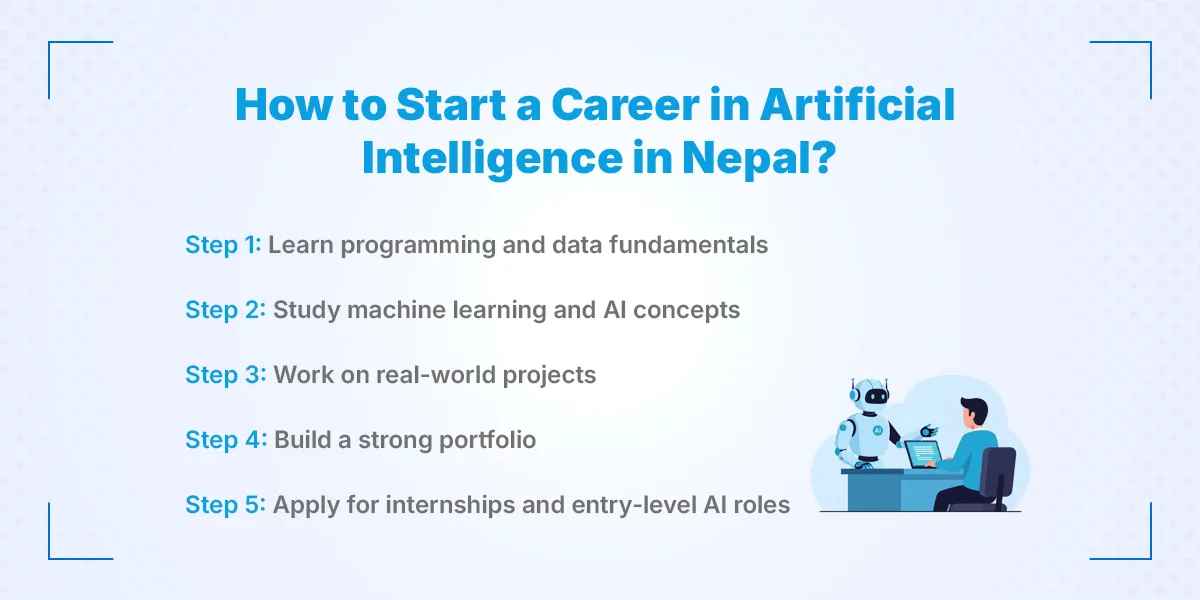
Step 1 – Learn Programming and Data Fundamentals
Programming is the backbone of AI. Start with languages like Python, which is widely used in machine learning and AI projects. Along with programming, develop a solid understanding of data fundamentals, including data cleaning, manipulation, and basic statistics. These skills will prepare you to handle real datasets and form the base for advanced AI concepts.
Step 2 – Study Machine Learning and AI Concepts
Once you are comfortable with coding and data, dive into machine learning and AI concepts. Learn about supervised and unsupervised learning, neural networks, deep learning, and AI algorithms. Online courses, tutorials, and books can help, but make sure to apply what you learn through small projects, so the theory sticks.
Step 3 – Work on Real-World Projects
Practical experience is crucial. Start with small AI projects such as predicting trends from datasets, building simple chatbots, or analyzing images. Contributing to open-source projects or collaborating with peers on real problems gives you hands-on skills that employers value. This step also helps you understand the workflow of AI projects and problem-solving in real situations.
Step 4 – Build a Strong Portfolio
A portfolio showcases your skills to employers. Include your projects, GitHub repositories, and any certifications you earn. Highlight the problems you solved, the tools you used, and the impact of your work. A strong portfolio makes it easier to stand out in Nepal’s growing AI job market and can even attract remote opportunities.
Step 5 – Apply for Internships and Entry-Level AI Roles
Once your skills and portfolio are ready, start applying for internships or entry-level AI positions. Internships are an excellent way to gain experience, learn from experts, and get your first foot in the AI industry. Look for opportunities on local job portals, company websites, and platforms like Kumari Job, which frequently lists AI and tech vacancies in Nepal.
Starting a career in AI is a journey of learning, experimenting, and demonstrating your abilities. By following these steps, you can gradually build expertise, gain practical experience, and position yourself for rewarding AI roles in Nepal and beyond.
Top Companies Hiring AI Professionals in Nepal
Nepal’s AI job market may still be emerging, but there are growing opportunities in both local firms and startups that are actively hiring AI and machine learning talent. These companies span from homegrown tech innovators to international R&D teams with operations in Nepal or remote roles open to Nepali professionals. Here are some notable organizations making space for AI careers:
1. Fusemachines Nepal
Fusemachines is one of the most prominent AI companies with a strong presence in Nepal. Originally founded to make AI technology accessible globally, Fusemachines trains and employs local engineers and builds AI solutions for international clients. They work on machine learning, deep learning, natural language processing, and enterprise AI services, and also run fellowship programs that help Nepalis gain high‑value AI skills and job experience.
2. DevDash Labs
DevDash Labs is a fast‑growing AI startup working on applied AI products and services, including automation systems and client‑facing solutions. They regularly hire AI engineers and full‑stack AI professionals in Nepal, offering roles where you can work on real product development, from frontend integration to backend AI workflows. Their career listings often include positions that support Nepalese talent building world‑class AI systems.
3. Cloud Pro AI
Cloud Pro AI is another local tech startup in Kathmandu focusing on machine learning and AI engineering roles. They hire mid‑to‑senior level professionals passionate about solving real‑world problems and building impactful AI products. These roles often involve work with data pipelines, model training, and modern machine learning tools.
4. Other Local and Top AI Employers in Nepal
There are several other Nepal‑based AI or tech companies that either employ AI talent or are prime places for future opportunities, such as:
- Leapfrog Technology, a software development company with AI initiatives where seasoned AI engineers can find roles in product development
- Paaila Technology, known for robotics and AI innovations developed locally, including speech and vision systems.
- AI Automation Nepal Pvt. Ltd., which is focused on practical AI automation for businesses, building tools like chatbots and workflow intelligence.
In addition, many international and remote opportunities are open to Nepali AI professionals through platforms and global tech firms that hire talent from around the world. As the AI ecosystem in Nepal keeps growing rapidly, these companies and roles offer a variety of ways to enter and advance in the field.
5. Remote Opportunities for Nepali AI Professionals
Nepalese AI professionals are increasingly finding remote roles with international companies, allowing them to work on cutting-edge AI projects without leaving the country. Many global tech firms and startups hire machine learning engineers, data scientists, and AI developers from Nepal due to strong English proficiency, technical skills, and lower operational costs.
Remote work opportunities often offer higher salaries than local companies, sometimes matching international standards, while providing flexibility and exposure to global AI trends. Platforms like Kumari Job, LinkedIn, and Upwork frequently list remote AI openings, making it easier for Nepali talent to connect with worldwide employers.
How to Find Artificial Intelligence Jobs in Nepal?
Finding AI jobs in Nepal requires a mix of smart searching, networking, and demonstrating your skills. While the market is growing, knowing where to look and how to stand out is essential. Here are the most practical ways to discover AI opportunities:
1. Check Technology Job Portals
Job portals are the first stop for most professionals. Platforms like Kumari Job and LinkedIn regularly list openings for AI engineers, data scientists, and machine learning specialists. Keeping your profile updated and setting alerts for AI-related roles ensures you don’t miss new opportunities. These portals often include both local and remote positions, helping candidates explore multiple options.
2. Follow Tech Companies and Startups
Many startups and IT companies in Nepal are adopting AI technologies and frequently hire skilled developers. Following company websites, social media, and career pages can give you early access to job announcements. Companies like Fusemachines, DevDash Labs, and Cloud Pro AI are actively seeking talent, so staying connected with them is key. Even smaller SMEs adopting AI may have hidden openings, so networking is important.
3. Use Professional Networking Platforms
Networking is crucial in Nepal’s AI job market. Platforms like LinkedIn, GitHub, and local tech communities help you connect with employers, showcase your work, and get referrals. Joining AI groups, attending webinars, and participating in hackathons increases visibility and can lead to job offers that aren’t advertised publicly. Personal connections often play a big role in landing AI roles locally.
4. Build Projects and Showcase Skills
A strong portfolio of AI projects makes a huge difference. Work on personal or collaborative projects, contribute to open-source AI tools, or solve real-world problems with machine learning. Showcasing your work on GitHub or a personal website demonstrates your skills and practical knowledge to employers. Companies in Nepal and abroad look for candidates who can apply AI concepts, not just know the theory.
Conclusion
AI skills are becoming core to nearly every modern technology career. Businesses, from small startups to large corporations in Nepal and abroad, are seeking professionals who can make data-driven decisions and build intelligent systems.
Upskilling in AI not only opens doors to high-demand roles but also helps you stay competitive in a fast-changing job market. By learning AI, you position yourself to work on innovative projects, contribute to smarter business solutions, and even access global remote opportunities while based in Nepal.
Ready to take your first step into the world of Artificial Intelligence? Start building your skills today, work on real projects, and explore exciting job opportunities, both in Nepal and globally. Don’t wait, your future in AI starts now!
Frequently Asked Questions
Submit your comments

Get Our App On



What is the Public Relations Officer Salary in Nepal
VIEW DETAILS
What Is the Salary of a Ticketing Officer in Nepal?
VIEW DETAILS
What Is the Salary of a Travel Consultant in Nepal?
VIEW DETAILS
How to Become an Auditor in Nepal
VIEW DETAILS


Loading Comments...