




Which IT career will still be relevant, high-paying, and secure in the next 5-10 years? With rapid advancements in artificial intelligence, automation, and cloud technologies, choosing the best IT jobs for future growth has become more important than ever. Many traditional roles are evolving, while new opportunities are emerging across global and remote markets.
In this blog, the best IT jobs for the future are explored in detail, covering the most promising career paths, required skills, and salary potential. We will highlight high-demand roles like AI engineer, data scientist, cybersecurity specialist, cloud computing expert, and more. Additionally, the blog explains how to choose the right career path by analyzing global trends and the emerging market for IT jobs in Nepal based on your interests and growth opportunities.
In this blog
Why IT Careers Are Growing Rapidly in the Future?
IT careers are expected to grow rapidly in the future, driven by the accelerating adoption of technology across industries, which creates a high demand for skilled professionals. Businesses are embracing automation, cloud solutions, data analytics, and AI, making IT roles more critical than ever. Global digital transformation, remote work trends, and the need for cybersecurity further drive growth in IT careers. Choosing the right IT job now ensures long-term stability, competitive salaries, and future-proof skills.
Key factors driving IT career growth:
- Rapid adoption of artificial intelligence and machine learning across sectors.
- Increased reliance on cloud computing for business operations and storage.
- Rising cybersecurity threats and the need for data protection.
- Expansion of remote work is creating global job opportunities.
- Growing demand for data analysis and business intelligence roles.
- Continuous digital transformation in healthcare, finance, and e-commerce.
- Automation of routine tasks is increasing the need for skilled IT professionals in advanced roles.
Best IT Jobs for Future Growth and Stability
The best IT jobs for future growth and stability are those that align with emerging technologies, global demand, and high-value skill sets. Roles in AI, data, cybersecurity, cloud, and software development offer long-term career security, competitive salaries, and opportunities for remote and global work. Choosing a future-ready IT career ensures adaptability, continuous learning, and access to industries that are evolving rapidly, making these positions highly sought after in 2026 and beyond.
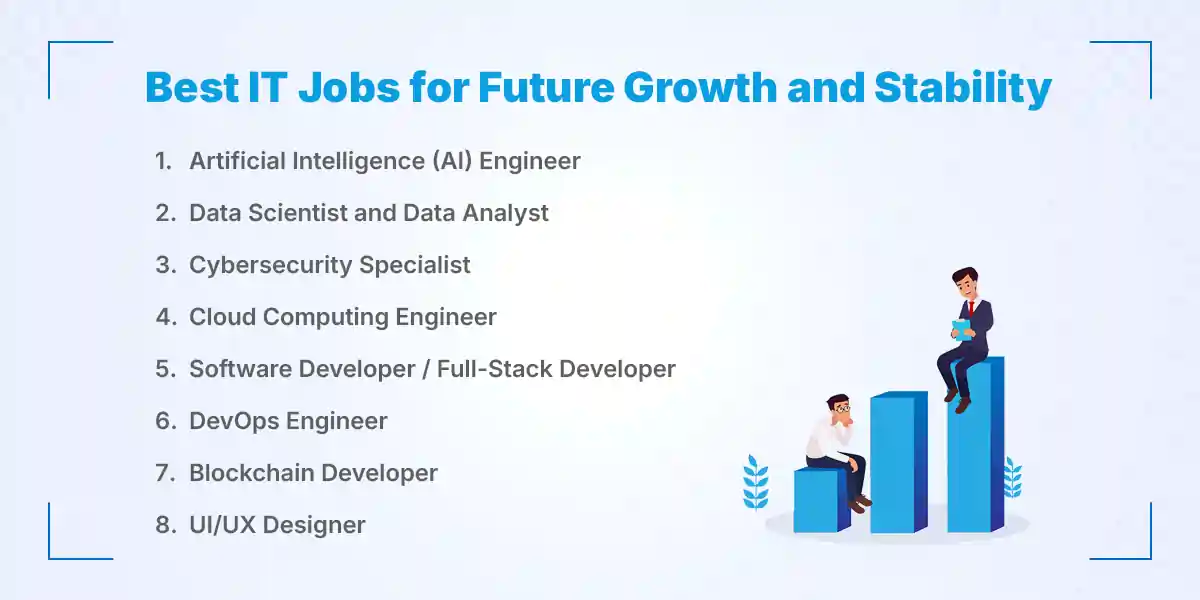
1. Artificial Intelligence (AI) Engineer
AI Engineers design and develop intelligent systems that can learn, adapt, and make decisions. They work with machine learning algorithms, neural networks, natural language processing (NLP), and computer vision to create solutions for industries like healthcare, finance, and autonomous vehicles. These professionals also optimize AI models for efficiency and accuracy, often requiring mastery of Python, R, TensorFlow, or PyTorch. As companies locally and globally invest in automation, the AI engineer salary in Nepal has become increasingly competitive, reflecting the high level of technical expertise required. With AI adoption accelerating, these engineers remain among the top IT jobs in demand for the future, offering high salaries and global opportunities.
2. Data Scientist and Data Analyst
Data Scientists analyze complex datasets to uncover insights, predict trends, and support decision-making. They use statistical analysis, machine learning, and data visualization tools like Python, R, SQL, and Tableau. Data Analysts focus on interpreting and presenting data for business operations, and both roles are crucial for companies to leverage big data for strategic decisions. Given the rising demand for data-driven strategies in the local market, the data scientist salary in Nepal now reflects the high value these professionals bring to modern businesses. Demand for these positions continues to rise across sectors like healthcare, finance, e-commerce, and marketing, making them some of the best IT jobs for future growth.
3. Cybersecurity Specialist
Cybersecurity Specialists protect networks, systems, and sensitive data from cyber threats and attacks. They implement security protocols, conduct vulnerability assessments, monitor threats, and respond to incidents. Knowledge of ethical hacking, firewalls, encryption, and compliance standards is essential. With increasing cybercrime and stricter data privacy regulations, cybersecurity roles are highly stable, globally in demand, and essential for all businesses, positioning them as one of the top IT jobs in demand for the future.
4. Cloud Computing Engineer
Cloud Computing Engineers design, implement, and manage cloud-based solutions on platforms like AWS, Azure, and Google Cloud. They work on serverless architecture, cloud migration, storage optimization, and scalability. Companies are moving critical infrastructure to the cloud to reduce costs and improve flexibility, making cloud engineers extremely valuable. Skills in DevOps, networking, and cloud security further enhance career prospects. This role remains among the best IT jobs for future growth, offering flexibility and high-paying opportunities globally.
5. Software Developer / Full-Stack Developer
Software Developers and Full-Stack Developers create, test, and maintain web, mobile, and enterprise applications. Full-stack developers handle both front-end and back-end development, working with languages like JavaScript, Python, Java, and frameworks like React or Node.js. Their work powers essential business applications, SaaS platforms, and mobile apps. Demand for these roles is steady, adaptable, and global, making them one of the best IT jobs for future stability and growth.
6. DevOps Engineer
DevOps Engineers bridge software development and IT operations to ensure continuous integration, delivery, and deployment. They automate workflows, manage cloud infrastructure, monitor performance, and maintain system reliability. Knowledge of CI/CD tools, Kubernetes, Docker, and cloud platforms is critical. DevOps improves productivity and reduces downtime, making it essential in modern IT organizations. As companies focus on agile and automated development, DevOps remains one of the top IT jobs in demand for the future.
7. Blockchain Developer
Blockchain Developers create decentralized applications (dApps), smart contracts, and blockchain solutions for industries like finance, supply chain, and healthcare. They work with platforms like Ethereum, Hyperledger, and Solidity. Beyond cryptocurrency, blockchain technology is being adopted for secure transactions, digital identity, and data integrity. With increasing enterprise adoption, blockchain developers are highly sought-after, making this a promising IT career for the future with high growth potential and competitive pay.
8. UI/UX Designer
UI/UX Designers focus on creating intuitive, engaging, and user-friendly digital experiences. They conduct user research, develop wireframes, and design interactive interfaces for web and mobile apps. Tools like Figma, Adobe XD, and Sketch are commonly used. With the rise of SaaS products, mobile-first platforms, and digital services, designers who can enhance usability and customer satisfaction are in high demand. This role combines creativity and tech skills, making it one of the best IT jobs for future stability and growth.
Top IT Jobs in Demand for the Future by Industry
The top IT jobs in demand for the future by industry are shaped by digital transformation, automation, and the growing reliance on technology across sectors. Different industries prioritize specific IT skills, making certain roles more valuable depending on market needs. Understanding these industry-specific trends helps candidates focus on future-ready IT careers, ensuring higher employability, career growth, and global opportunities.
1. IT Jobs in Healthcare and Biotech
Healthcare and biotech sectors increasingly rely on IT professionals to manage electronic health records, telemedicine platforms, and medical data analytics. Roles like healthcare data scientist, AI engineer, and cloud computing specialist are in high demand to improve patient care, predict disease trends, and optimize clinical operations. Bioinformatics and digital health startups also create opportunities for IT experts to innovate treatments and manage large-scale health data securely. Professionals in this sector often collaborate with doctors, researchers, and regulatory teams, making cross-functional skills highly valuable.
2. IT Jobs in Finance and FinTech
The finance and FinTech industry demands IT professionals to develop secure, efficient, and scalable digital banking and payment solutions. Positions like cybersecurity specialist, blockchain developer, and data analyst are crucial for fraud detection, risk management, and digital transactions. As FinTech adoption grows globally, exploring IT jobs in banks and financial institutions has become a top priority for graduates seeking career stability and exposure to cutting-edge financial technologies. Additionally, knowledge of regulatory compliance and financial data standards can give candidates a competitive edge in this rapidly evolving sector.
3. IT Jobs in E-commerce and Digital Marketing
E-commerce and digital marketing companies need IT talent to optimize platforms, enhance user experiences, and analyze customer data. Roles such as full-stack developer, UI/UX designer, and data scientist are vital for website/app performance, marketing analytics, and personalization. With online shopping and digital advertising booming, IT professionals in this sector are among the top IT jobs in demand for the future, offering remote work and global exposure. Experience with SEO tools, analytics software, and customer engagement platforms is increasingly preferred.
4. IT Jobs in Government and Smart Cities
Government agencies and smart city projects require IT professionals to manage infrastructure, cybersecurity, and digital public services. Positions like cloud engineer, cybersecurity specialist, and AI developer are used to implement smart grids, e-governance solutions, and urban data analytics. These roles combine stability with long-term career growth and provide opportunities to work on high-impact projects that shape cities and public services for the future. Familiarity with public policy, IoT integration, and large-scale project management further enhances job prospects.
How to Choose the Best IT Job for Your Future?
To choose the best IT jobs for the future, you can start by evaluating your personal interests, strengths, and long-term career goals. The right choice combines passion with market demand, skill compatibility, and future growth potential. Considering factors like the highest paid IT jobs, industry demand, learning requirements, and career flexibility ensures you invest your time in roles that remain relevant in the evolving IT landscape. Making informed decisions now can set the foundation for a stable, rewarding, and future-proof IT career.
1. Assess Interests and Strengths
Understanding your core interests and technical strengths is the first step. Are you drawn to data, programming, design, or security? Your natural aptitude for problem-solving, creativity, or analytical thinking can guide the selection of roles such as AI engineer, data scientist, or UI/UX designer. Aligning a career with your passion increases job satisfaction and motivation, making it easier to adapt and grow in rapidly evolving IT fields. Also, matching your personality traits with job demands helps reduce burnout and increases long-term engagement.
2. Compare Salary, Demand, and Growth
Salary potential, industry demand, and career growth are critical in choosing a future-ready IT job. Research the compensation trends for roles like cloud engineers, cybersecurity specialists, or full-stack developers. Consider global and remote opportunities, as these often offer higher pay. Evaluating demand ensures you enter fields with long-term job security, while assessing growth opportunities helps identify roles where promotions, advanced responsibilities, and leadership paths are realistic. Additionally, comparing salary growth trajectories across industries can help prioritize high-return career paths.
3. Learning Curve and Entry Barriers
Each IT role has its own learning curve and prerequisites. Some positions, like AI or blockchain development, require advanced knowledge, certifications, and programming expertise. Others, like UI/UX design, may rely on creativity and design tools. Understanding entry barriers allows you to plan education, certifications, and skill development efficiently. A realistic assessment prevents frustration and accelerates career progression while keeping you competitive in the job market. Assessing your willingness to invest time and effort in overcoming these barriers ensures sustainable career growth.
4. Long-Term Career Flexibility
Future-proof IT jobs offer versatility, allowing professionals to pivot into new technologies or industries. Skills in data analysis, cloud computing, or cybersecurity can be applied across healthcare, finance, e-commerce, and government sectors. Flexible careers also accommodate remote work, freelancing, and consulting opportunities. Choosing roles with adaptability ensures sustained relevance, global mobility, and continuous growth, making it easier to navigate the evolving tech landscape. Considering transferable skills also allows smoother transitions into emerging IT domains as technology evolves.
Skills Required for the Best IT Jobs for the Future
The skills required for IT jobs for the future combine technical expertise, analytical abilities, and strong interpersonal skills. Future-ready IT professionals must stay updated with emerging technologies, adapt quickly to changing environments, and continuously upgrade their knowledge. Mastering both hard skills like programming and cloud computing, along with soft skills such as communication and problem-solving, ensures success in highly competitive and evolving IT roles.
1. Programming Languages (Python, JavaScript, Java)
Programming forms the backbone of most IT careers. Knowledge of languages like Python, JavaScript, and Java allows professionals to build applications, automate processes, and develop software solutions. Python is crucial for AI, machine learning, and data analysis, while JavaScript dominates web and full-stack development. Java remains widely used in enterprise systems. Proficiency in multiple languages increases employability and allows seamless adaptation to diverse projects across industries.
2. Data and Cloud Fundamentals
Understanding data management, analytics, and cloud computing is essential for roles in AI, DevOps, and cloud engineering. Knowledge of databases, SQL, data visualization, and cloud platforms like AWS, Azure, or Google Cloud helps professionals manage, store, and analyze large datasets efficiently. Cloud fundamentals also support scalable applications and infrastructure. Grasping these concepts prepares candidates for future IT trends and emerging technologies across industries.
3. Cybersecurity Awareness
Cybersecurity knowledge is increasingly critical as digital threats rise globally. Awareness of encryption, firewalls, ethical hacking, and compliance standards ensures IT systems remain secure. Cybersecurity skills are relevant not only for specialists but also for developers, data analysts, and cloud engineers to prevent vulnerabilities. A strong understanding of cybersecurity principles enhances employability and reduces business risks in any IT role.
4. Soft Skills and Problem-Solving
Technical expertise alone is not enough; soft skills such as communication, collaboration, critical thinking, and problem-solving are equally important. IT professionals often work in cross-functional teams, interact with stakeholders, and address complex challenges. Effective communication helps translate technical solutions into actionable business insights. Strong problem-solving skills combined with technical proficiency create versatile professionals ready for future IT leadership roles.
Salary Expectations for Future IT Jobs
Salary expectations for future IT jobs vary depending on experience, industry, and location. Roles in AI, cloud computing, cybersecurity, and data science often offer highly competitive pay due to global demand and skill scarcity. Entry-level professionals can start with decent salaries, while experienced specialists and those in leadership positions command premium packages. Understanding salary trends helps candidates plan career growth, negotiate effectively, and target high-return IT careers in both local and international markets.
1. Entry-Level vs Experienced Salary Trends
Entry-level IT professionals typically earn a starting salary that reflects foundational skills and limited work experience. For example, junior developers or analysts may start at moderate pay, while roles like AI engineers or cybersecurity analysts start slightly higher. Experienced IT professionals with 5-10 years of expertise, advanced certifications, or leadership responsibilities often earn significantly more. Salary growth is faster in high-demand technologies, making continuous skill development crucial for maximizing income.
2. Global vs Local IT Salary Comparison
IT salaries vary widely between local and global markets. Professionals working in Nepal may earn less than their counterparts in the US, Europe, or other developed countries, even for similar roles. Remote opportunities allow access to international pay scales while working locally. Global IT jobs in AI, cloud, and cybersecurity are especially lucrative. Considering both local and remote options helps professionals optimize earning potential while gaining international experience.
3. Freelancing and Remote Income Potential
Freelancing and remote IT work offer flexible income opportunities, often exceeding traditional local salaries. Platforms like Upwork, Toptal, and Freelancer allow skilled IT professionals to work on projects globally. Freelancers can charge premium rates for specialized skills in AI, full-stack development, or cybersecurity. Remote work also provides exposure to diverse projects, enhances experience, and allows multiple income streams for long-term career stability.
Certifications That Boost Future IT Careers
Certifications play a key role in strengthening resumes, validating skills, and increasing employability for future IT jobs. With rapidly evolving technologies, employers value certified expertise in cloud, cybersecurity, data, and AI. Holding recognized certifications can accelerate career growth, increase salary potential, and open doors to international opportunities. Investing in certifications ensures you remain competitive, credible, and prepared for emerging IT roles in 2026 and beyond.
1. Cloud Certifications
Cloud certifications like AWS Certified Solutions Architect, Microsoft Azure, and Google Cloud Professional validate expertise in designing, deploying, and managing cloud infrastructure. These credentials demonstrate knowledge of cloud services, scalability, and security practices. Cloud-certified professionals are in high demand across industries, including healthcare, finance, and e-commerce. Gaining cloud certifications enhances credibility, improves job prospects, and prepares candidates for leadership roles in cloud computing projects.
2. Cybersecurity Certifications
Cybersecurity certifications such as Certified Ethical Hacker (CEH), CISSP, and CompTIA Security+ prove expertise in protecting systems and data from threats. Professionals with these certifications are equipped to perform vulnerability assessments, penetration testing, and incident response. Cybersecurity skills are critical for both specialist roles and general IT positions, and as businesses prioritize data protection, the demand for cybersecurity jobs in Nepal continues to grow. These certifications significantly increase employability, salary potential, and relevance in a threat-driven digital landscape.
3. Data and AI Certifications
Certifications in data science, machine learning, and AI, like Microsoft Certified: Azure AI Engineer, TensorFlow Developer, or IBM Data Science Professional, demonstrate proficiency in managing, analyzing, and extracting insights from data. AI certifications validate skills in building intelligent systems and automating processes. Acquiring these certifications boosts credibility, opens doors to high-paying roles, and ensures adaptability to future technology trends.
Common Mistakes to Avoid When Choosing an IT Career
Choosing the right IT career requires careful planning and self-awareness. Many professionals make mistakes that can slow growth, limit opportunities, or lead to dissatisfaction. Avoiding these common pitfalls ensures that your career remains future-proof, fulfilling, and aligned with industry demand. Being mindful of interests, foundational skills, and practical experience is essential for long-term success in the fast-evolving IT landscape.
1. Following Trends Without Interest
Many candidates chase trending IT roles like AI, blockchain, or cloud computing without considering personal interest or aptitude. While high-demand skills can boost salaries, lacking passion may result in burnout or frustration. Choosing a career aligned with both demand and personal motivation ensures long-term engagement and growth. Assess your curiosity, strengths, and willingness to learn before committing to any trend-driven IT path.
2. Ignoring Foundational Skills
Jumping directly into advanced technologies without mastering basics such as programming, networking, or database management can hinder growth. Foundational skills are critical for understanding complex systems and solving problems efficiently. Ignoring them may create knowledge gaps, reduce adaptability, and limit the ability to excel in specialized roles.
3. Skipping Practical Experience
Relying solely on certifications or theoretical knowledge without hands-on experience limits your effectiveness in real-world scenarios. Internships, projects, and freelance work are crucial for applying concepts, building a portfolio, and demonstrating capability to employers. Skipping practical experience reduces confidence, slows career progression, and may affect employability in competitive IT markets.
Where to Find the Best IT Jobs for the Future?
You can find the best IT jobs for the future in online job portals like Kumari Job and top IT companies that actively recruit skilled professionals. These sources provide updated listings, detailed job descriptions, and application instructions, making it easier for candidates to identify opportunities that match their skills. Staying active on these platforms ensures you don’t miss high-demand positions and emerging IT roles.
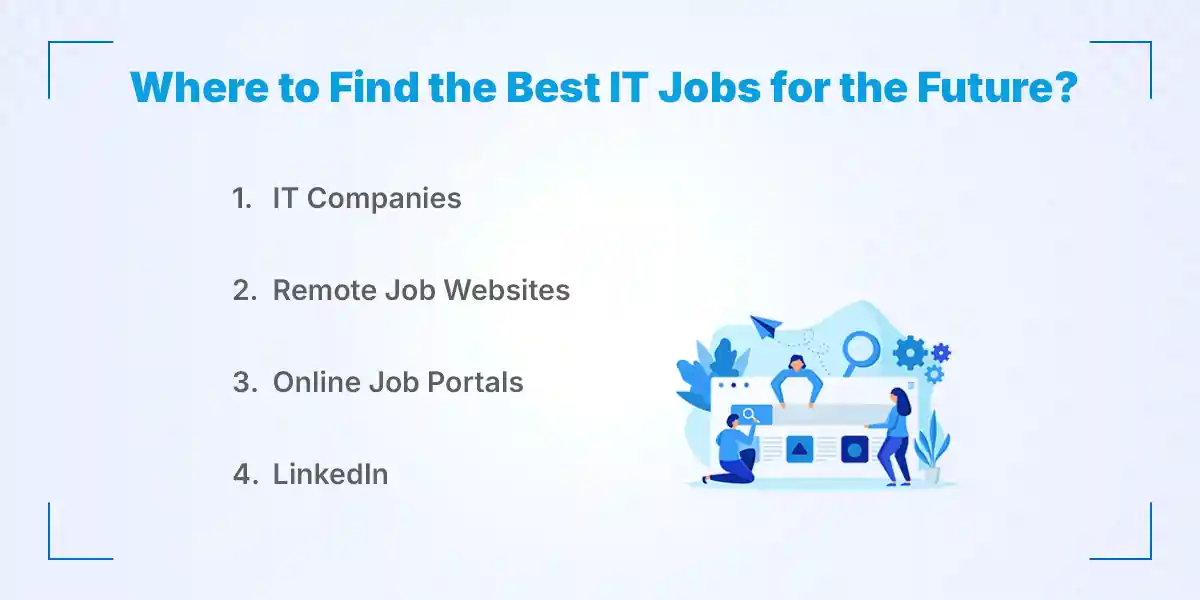
1. IT Companies
Top IT companies in Nepal and abroad frequently hire for roles in AI, cloud computing, cybersecurity, and software development. Direct applications through company career pages give candidates a higher chance of selection and exposure to structured training programs. Many IT companies also provide internships and graduate trainee programs to build future talent pipelines.
2. Remote Job Websites
Remote work opportunities allow professionals to work globally while staying local. IT jobs like software development, data analysis, and cybersecurity often offer remote roles that pay competitively. Applying for remote positions through company career pages or verified remote job platforms can increase global exposure and access to diverse projects. Remote work also helps develop time management, cross-cultural collaboration, and adaptability skills crucial for future IT careers.
3. Online Job Portals
Online job portals like Kumari Job list regular IT openings, including entry-level, mid-level, and specialized positions. These portals allow filtering by skills, experience, and location, making it easier to find relevant roles. Regularly checking portals ensures candidates are updated with deadlines, eligibility, and emerging opportunities in the IT sector.
4. LinkedIn
LinkedIn is a professional networking platform where companies post vacancies and recruiters actively search for candidates. Following IT companies, joining groups, and engaging with relevant content increases visibility and connections. LinkedIn also allows applying directly to some roles, building a strong professional profile, and showcasing skills to potential employers.
Conclusion
Choosing the best IT jobs for the future requires a careful balance between personal interests, skills, and industry demand. With technology advancing rapidly, roles in AI, data science, cybersecurity, cloud computing, and software development offer high growth potential, stability, and global opportunities. Focusing on relevant skills, certifications, and practical experience ensures you stay competitive in this evolving landscape.
Planning your career strategically also means evaluating salary trends, learning curves, and long-term flexibility. By leveraging the right resources, understanding industry-specific demands, and continuously upskilling, professionals can secure rewarding, future-proof IT careers that remain relevant for years to come.
Frequently Asked Questions
Submit your comments

Get Our App On



What is the Public Relations Officer Salary in Nepal
VIEW DETAILS
What Is the Salary of a Ticketing Officer in Nepal?
VIEW DETAILS
What Is the Salary of a Travel Consultant in Nepal?
VIEW DETAILS
How to Become an Auditor in Nepal
VIEW DETAILS


Loading Comments...